
With a changing work schedule, a running routine of “the same time every Tuesday” sometimes exists only on paper. You start early in one part of the week, finish late in another, and the next rota arrives later too. Instead of repeating weekdays, a planning method based on genuinely known time windows can help. Coordination itself can become the consistent part of the system.
This guide concerns organising a calendar and everyday logistics. It does not give health or loading prescriptions for shift work. Sleep, health and an individual training programme need to be addressed according to your situation. An empty calendar slot alone does not prove running then is appropriate for you.
Distinguish confirmed times from hoped-for ones
When reviewing the week, mark three types of slot: definitely committed, uncertain and genuinely available for choice now. An unannounced shift is not the same as a free afternoon. If you treat everything as empty until the rota arrives, the running plan repeatedly looks like a forced change. Marking uncertainty is a more accurate starting point.
Include travel and agreed tasks at home among fixed commitments, not only work. Between the end of a shift and free time at home, there may be a long journey, shopping or family duties. Omitting them creates an overly optimistic calendar. Find real windows within the whole day.
The NIDDK advice on starting physical activity also recommends noting barriers and solutions in advance. With variable work, the barrier is often not general lack of time but missing specific information: Thursday’s rota is not known yet, or the journey home after the shift is uncertain. Naming this can make the next decision more precise too.
Choose your own planning time
Give updating the calendar a repeatable place even if running days change. For example, review the next known period after the new rota arrives. You do not have to choose Sunday evening if the necessary information is not available then. Link the planning ritual to how your work schedule actually operates.
During planning, examine fixed commitments first, then possible running occasions. Coordinate selected times with those affected. Next prepare the associated logistics: location, clothes, approach and getting home. This avoids leaving hidden tasks behind a calendar entry.
The CDC guide to overcoming barriers also discusses observing schedules and identifying time available for movement. With a changing rota, this is not something to do for one eternal week. Reviewing the known period again reveals genuine opportunities on those particular days.
Think in outing types rather than days
You might have a nearby default route you can shorten, a social outing requiring more organisation and a programme linked with travel. In this article these are different logistical formats, not different training doses. Your own programme helps determine which movement suits each day. Recognising organisational difficulty is worthwhile separately.
An easily reached default helps when little information is certain beforehand. It does not require distant travel or coordinating several people. A social outing offers different value but may need more related commitments. Distinguishing the two deliberately protects against filling every apparently free evening with a complicated programme.
Make a short preparation sequence for each type. For example, the local loop needs clothes and keys; a distant location needs journey planning and longer total absence; a shared run needs a confirmed meeting. Give these prerequisites a place in the calendar too. Departure should not be the moment to solve every open question simultaneously.
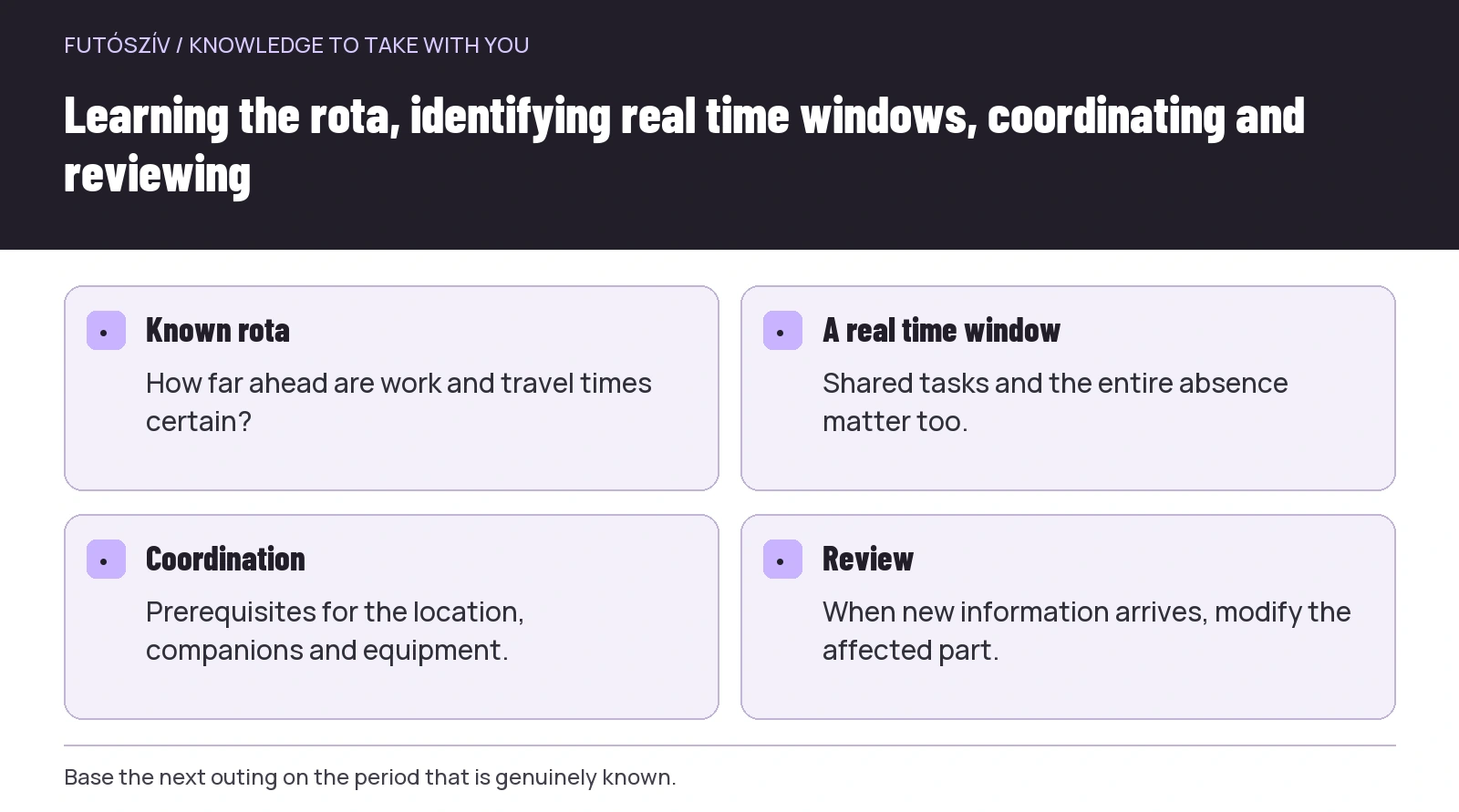 Enlarge diagram
Text version of the diagram
- Known rota
- How far ahead are work and travel times certain?
- A real time window
- Shared tasks and the entire absence matter too.
- Coordination
- Prerequisites for the location, companions and equipment.
- Review
- When new information arrives, modify the affected part.
Four fields in a rolling plan
| Field | What does it record? | What is it useful for? |
|---|---|---|
| Known period | How far ahead is the work rota certain? | Avoiding distant assumptions |
| Chosen outing | When, where and with what personal programme would you set off? | Providing a specific next step |
| Prerequisites | What still needs arranging or preparing? | Making logistics visible |
| Review | When will you check the plan again? | Following new information |
The “known period” may be shorter or longer than a week. The method need not force a Monday-to-Sunday format if work follows another rhythm. Coordination with your training programme may be a separate task, particularly when working with a professional. Share the actual time available accurately with them.
A backup time should be a real option
You can designate a backup alongside a primary time, but only one that is genuinely feasible. “After the shift sometime” is not precise enough if travel is regularly long and another commitment awaits. Describe the location and full time window. A backup is usable when you know how it would happen.
A backup is not automatically an extra outing. If the primary plan happened, the second slot does not become compulsory running. Name its role beforehand. Otherwise, a calendar intended to be flexible can fill unnoticed with new commitments. Marking a backup does not override your own programme’s boundaries.
If both options fall through, replan the next known period. You do not need to fill every empty slot retrospectively by the weekend. Working with the rota includes treating change as real information. A past calendar cannot be rewritten into an outing that happened.
Three kinds of change need separate responses
A shift swap known beforehand. Once the information is certain, review the affected programme and arrangements. For a social run, notify people in good time. Managing change is then mostly a planning task: which time remains free, and which preparation needs moving?
Work runs late on the day. There may now be less room to decide. Consider the real next commitment and conditions for getting home. You do not need to fit the full original programme unchanged into less time. Appropriate modification depends on your own situation and programme, but rushing is not itself an organisational solution.
A lasting change in work pattern. Instead of repeatedly patching the old weekly template, look for a new default. Another time of day, location or coordination rhythm may become useful. Losing the former system does not prove personal failure. The conditions on which it rested have changed.
An illustrative example with a two-week rota
A runner receives two weeks of work shifts at once. First, they enter work and travel in both directions, then coordinate fixed programmes in the shared household. They assign appropriate outings from their own running programme to the first few definitely usable windows. They do not automatically call more distant uncertain slots free.
They prepare equipment for the nearby loop and ask for separate confirmation of the social programme. Their next planning time is tied to the arrival of the new rota. If a shift swap occurs meanwhile, they review only the affected part, rather than reassessing their entire running history. The system keeps the next decision in view.
This is not a training plan and does not recommend frequency. It demonstrates handling work-schedule information. A personal programme may require other considerations alongside time windows. Calendar opportunity and appropriate loading deliberately remain separate.
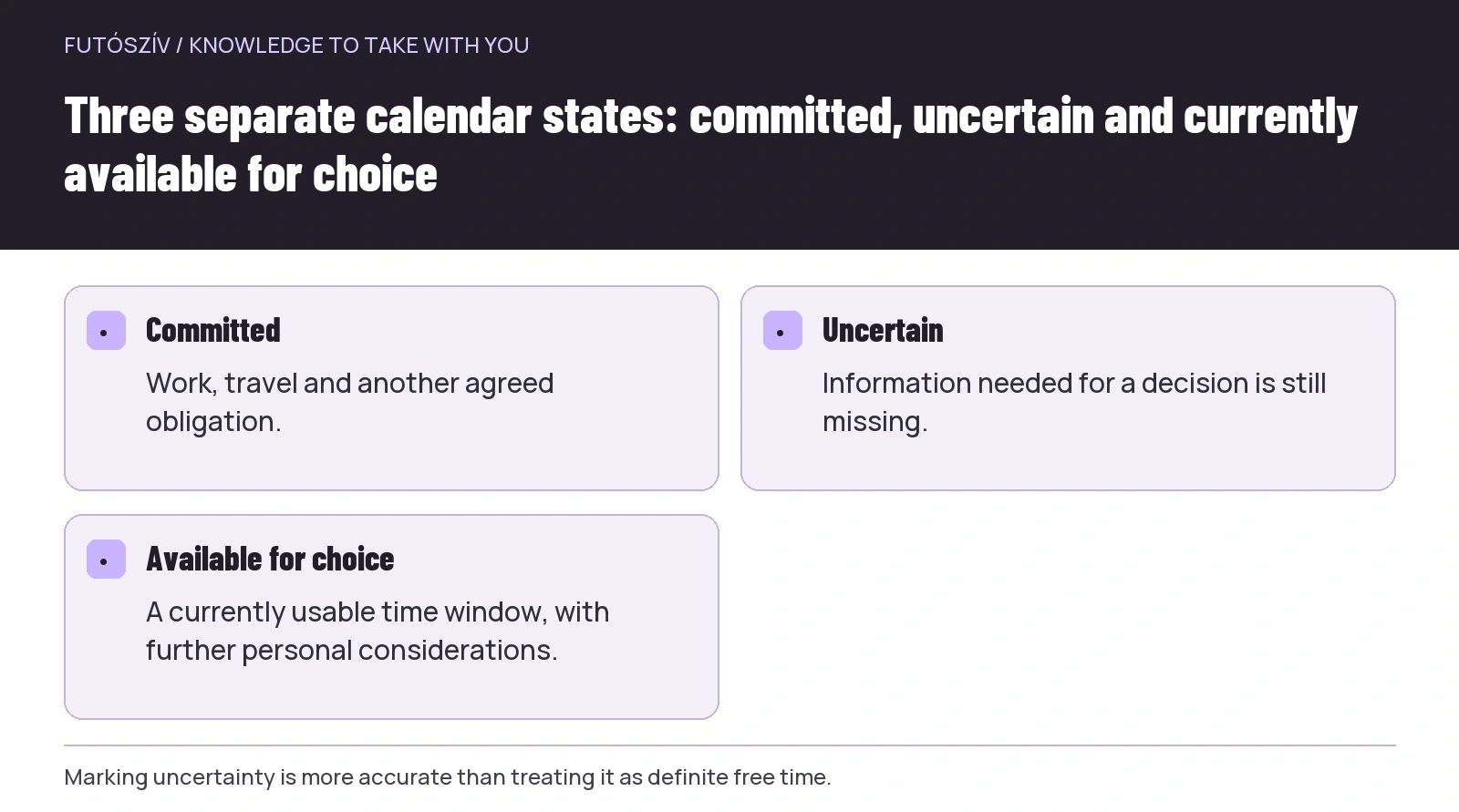 Enlarge diagram
Text version of the diagram
- Committed
- Work, travel and another agreed obligation.
- Uncertain
- Information needed for a decision is still missing.
- Available for choice
- A currently usable time window, with further personal considerations.
Agree on communication with running companions
Explain how far ahead you can be certain. “I receive next Tuesday’s rota on Friday; I will let you know then.” This is more precise than an uncertain yes followed by cancellation. The other person can plan their own time when the response deadline is clear.
If joining a club, ask about booking and cancellation procedures. Several available sessions may help with changing work, but check current conditions with the particular community. Knowing the rules beforehand helps decide which format fits. The label “flexible” alone is not a specific way of operating.
For a shared run, distinguish a confirmed meeting from interest. “I might come” in a group message should not automatically promise that others will wait. Make it clear if they should start without you. Reliable communication is possible even when your attendance frequency varies.
Simplify equipment logistics
With changing days, a ready, usable basic setup can be particularly valuable. This does not mean taking the same things in every condition, but knowing which clothes are clean and where necessary small items are. Start there when choosing the next outing, then adapt to the actual environment.
If moving between several locations, track precisely where shoes, belt or spare clothes stayed. “Somewhere at work” is insufficient when you leave from another site that day. A short location list or consistent repacking routine can remove much last-minute searching. A backup has value only if accessible.
Coordinate washing and drying with expected use too. A changing rota affects household-task time as well as departure. If clothing care regularly falls at the intended running time, arrange the two tasks separately. Do not call the problem a lack of motivation when usable equipment is actually missing.
Rest and other commitments are real calendar time too
An apparently empty slot is not necessarily spare capacity. It may contain needed rest, family time or a task not previously entered. Account for these according to your own circumstances too. Organising running is not filling every white space in the day.
A coloured calendar does not resolve health symptoms, persistent exhaustion or individual difficulties related to work patterns. Appropriate professional consultation may also be needed. An organisational system can honestly reveal actual time and remaining uncertainty. This can support asking for help more precisely.
If planning with a coach, communicate schedule changes promptly. Knowing real work patterns helps more than an ideal week you later try to fit. Report actual sessions and reasons for missed ones accurately too. The personal programme can then connect to real circumstances.
At the next rota, keep only what worked
During review, consider three things: which window was genuinely usable, which preparation helped and where a hidden obstacle remained. If the same time of day repeatedly falls through, do not try to retain it only through another promise. Another default or shorter overall logistics may fit the working day better.
Consistency does not necessarily mean the same Tuesday evening. It can mean reviewing real opportunities when the new rota arrives, coordinating and preparing the next manageable outing. A flexible system can have a clear order too. Running can then remain a planned part of life even when workdays do not repeat in exactly the same form.
How Futószív articles are prepared: our editorial guidelines.