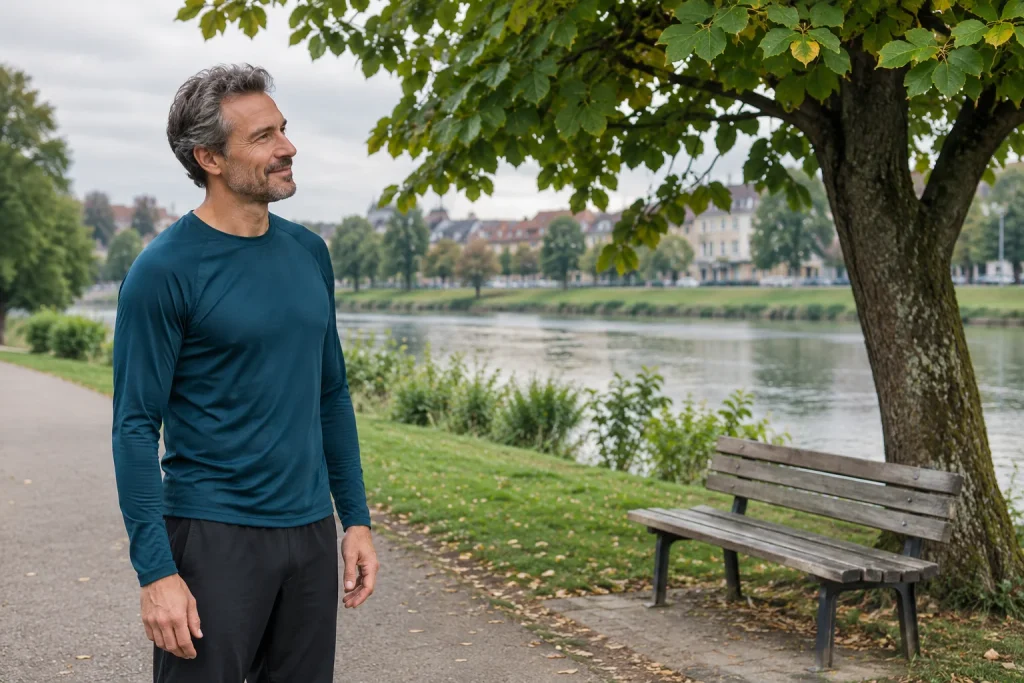
One day, a riverside is the setting for an effortless run; another, every metre recalls a difficult day. The trees, benches and surface have barely changed. You do not have to decide that one experience was true and the other mistaken. Experiencing a route is more than inventorying visible surroundings: it includes memories you bring, what happened beforehand and what you want from the occasion.
Environmental-psychology thinking about running should therefore ask about the person too. What matters is not only how green a route is, but what the place means to you. This article starts with research on favourite places and recalled experiences. The aim is not a mood-regulation recipe or personality test, but more precise language for why a running route can remain variable even among the same streets and parks.
A route is a physical place and a personal history
On a map, a running loop is a line, a distance and some turns. In memory, it may be where you first returned after a long break, regularly meet a friend or once had to hurry home. These do not appear on the map, but they shape how you imagine setting off again. The same stretch can carry different meanings for two people.
Personal history does not make real circumstances irrelevant. A junction with poor sightlines or an unpleasantly crowded pavement remains practical. A good memory does not remove actual difficulty, and a bad day does not prove the route physically changed. Separating these levels can prevent blaming yourself for a real obstacle or permanently condemning a place after one occasion.
Try saying: I like this park, but it was too noisy today. Or: the route is easy to use, yet it brought back an unpleasant memory. These are more nuanced than simply calling a place good or bad. They leave room for your relationship with the environment to change while retaining concrete usability considerations.
What did recalling favourite places investigate?
In Ratcliffe and Korpela’s 2016 online study, 234 adults living in Finland imagined a favourite place and rated associated memories, attachment and perceived restorative qualities. Autobiographical and positive emotional memory characteristics, together with place attachment, were associated with perceived restorative potential. This was a relationship based on recollection and self-report; it did not establish that changing a memory causes a later running experience to improve.
A distinctive feature is that participants did not all rate the same assigned park. Recalling their own favourite place foregrounded personal meaning. It reminds us that evaluating an environment cannot always be traced to one external property of the location. But rating an imagined place differs from being there in real time, and even more from measuring experience during a workout.
The online method does not become instructions on remembering ‘correctly’. The study did not ask runners to imagine a bad route as good or validate a mental reframing technique for every situation. It makes the role of personal history in environmental judgements an interesting question. Practical conclusions must remain more restrained than a universal technique.
 Enlarge image
Time and your sense of self can attach to a place too
Another paper by the authors also used descriptions of favourite places and positive memories from 234 adults in Finland. Published online in 2017 and in a 2018 journal issue, it analysed relationships among self- and time-related memories, place identity and perceived restoration. Do not read it as a new independent running experiment: it develops the questionnaire-based interpretation of favourite places.
In an everyday running example, a track may represent a former home, a circle of friends or a period of life. If much around you changes, returning can feel different. This possible meaning does not require psychological labels for every loop. It is enough to recognise that a route can be more than a surface suitable for sport; it may be where part of your life happened.
Recalling memories can be pleasant, neutral or difficult, and analysing them during training is not compulsory. If you would rather avoid a place, you can choose another without proving perseverance. If you enjoy returning, that needs no elaborate explanation either. Understanding your relationship with places can offer more freedom of choice, rather than another task alongside running.
Today’s mood is not a final verdict on the neighbourhood
Different details may stand out after a busy day than on a quiet morning. A seemingly endless red light, loud group or sudden diversion may occupy more of the experience. Another time, you notice light between buildings or enjoy familiar neighbourhood life. These examples illustrate changing experience; they are not compulsory emotional mechanisms derived from the studies.
Time-specific wording may help describe a day’s experience. ‘Being here felt tiring today’ leaves more possibilities than ‘this route always ruins my mood’. Equally, recurring discomfort need not be dismissed as temporary mood. If a loop is regularly difficult to use, repeated experience may reasonably support seeking another option.
The aim is not to explain every bad feeling through attitude. Environments have real properties, and staying away from a situation may be sensible. Considering mood helps when it supplements realistic assessment. It becomes a harmful simplification when used to brush aside safety or a specific difficulty.
Why do runners not all like the same places?
The life of an urban promenade gives one person social closeness and another too much stimulation. One feels free in an open field while another misses familiar landmarks. Different judgements do not mean one perceives incorrectly. They may seek different things and arrive with different histories. Specific features therefore say more in a route recommendation than unconditional enthusiasm.
When recommending a place to a friend, explain what you like: easy access, varied scenery, familiar people or quiet stretches. The other person can compare these with their needs. Instead of promising they will definitely enjoy it, preserve choice. A personal recommendation can remain warm and enthusiastic without claiming universal validity.
Difference in a shared run is not necessarily a problem to solve. You can alternate locations or accept spending some occasions separately. Not every session must take place in everyone’s favourite environment. Respecting different needs makes location discussions less about proving who is a real nature lover or committed runner.
A bad memory need not become a compulsory challenge
An unpleasant event may be attached to a place. A route can then evoke a feeling you do not want alongside movement, rather than simply becoming boring. An internet article does not justify forcing yourself to return. Research on memories and places does not authorise a general self-directed therapeutic experiment or make avoiding the park a personal failure.
If a place-related difficulty persistently narrows everyday life or creates a strong recurring psychological burden, consider discussing it with an appropriate professional. The experience and its effects can themselves be the reason for seeking help; you do not first have to prove you tried to resolve it through running alone. Movement can remain part of life while difficult memories receive separate support.
An everyday decision may be small and temporary: another loop today, going with a friend or resting. These do not replace care, but neither must each be interpreted as a treatment step. Respecting your boundaries can coexist with curiosity about your relationship with surroundings. Curiosity is not the same as deliberately provoking unpleasant experiences.
 Enlarge image
How can you recall the outing without a distorting ranking?
To understand why today’s run felt different, choose one or two specific details. What occupied you? Which section do you recall fondly, and where was being present harder? You do not need to list every experience, particularly if analysis itself becomes burdensome. The aim is to nuance a vague overall impression, not dismantle the outing psychologically.
Consider when you recall it too. Immediately afterwards, a difficult moment may dominate; later, conversation or arrival may remain most memorable. Neither account is necessarily false; they select memorable details from different perspectives. A brief occasion-specific sentence may be more useful than a definitive location score. Personal notes are not a scientific instrument.
Comparison stays fair when it does not demand the same experience from different days. A weekend group loop and a solo run after a rushed working day differ in many ways. A different mood alone cannot reveal how much the location mattered. You can accept this uncertainty without abandoning your preferences.
A favourite route is allowed to remain variable
A favourite park is not a contract for constant cheerfulness. Neutral or difficult occasions can happen there while it remains important. What you seek may also change: perhaps you once liked its social life and now want a short quiet loop. Changing needs do not betray old running experiences; they are part of your circumstances developing.
It may help not to require one route to serve every role. One place may suit shared runs, another easy access and another occasional visits. This is not compulsory route collecting: a few manageable options may suffice. What matters is that choice relates to actual needs rather than an expectation of permanently perfect movement.
Careful thinking about mood and surroundings can thus offer more room to choose. The place matters, personal history may matter and no day repeats exactly. You need not solve every difference’s cause to choose meaningfully. Take real circumstances and your experience seriously together, without turning either into a rule for everyone.
Primary sources
Ratcliffe and Korpela: Memory and place attachment as predictors of imagined restorative perceptions of favourite places, 2016. The authors’ institutional record describes the online study’s method and associations.
Ratcliffe and Korpela: Time- and Self-Related Memories Predict Restorative Perceptions of Favorite Places Via Place Identity, online 2017, journal issue 2018. A questionnaire analysis of favourite places and memories, not a running or therapeutic intervention. Running situations are original editorial examples; this article is not the result of documented medical review.
How Futószív articles are prepared: our editorial guidelines.