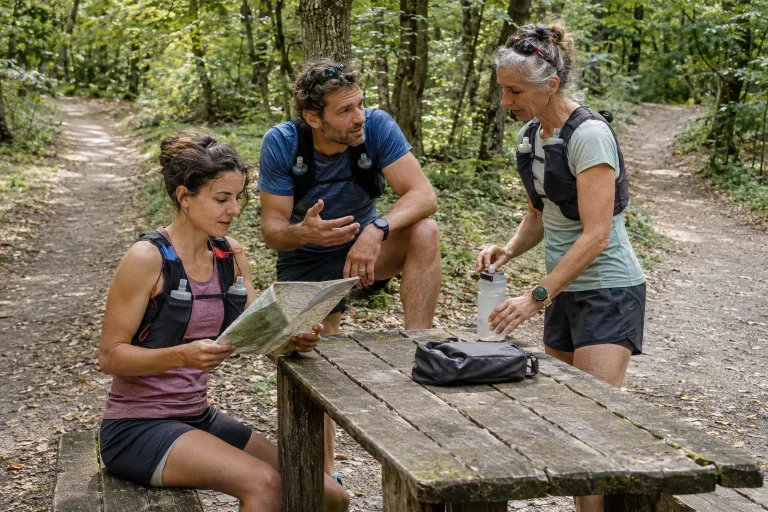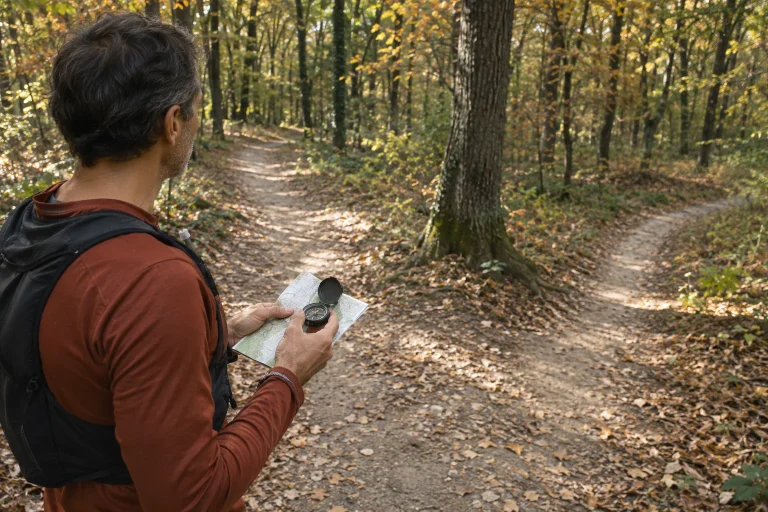
A good post about a run does not necessarily showcase the biggest achievement. It can feature unusual light, a shared idea that worked, a new place or an organisational lesson useful to someone else. When sharing centres on the experience, you do not need to turn every outing into a record or perfect story. Content can follow what actually happened rather than making the run fit the next post.
The system below offers a framework for personal running reports and smaller community posts. It does not promise reach, follower growth or a guaranteed algorithm trick. Those depend on the platform and period too. Instead, it helps you have something to say, connect pictures and text, and give attention to participants, sources and readability while sharing.
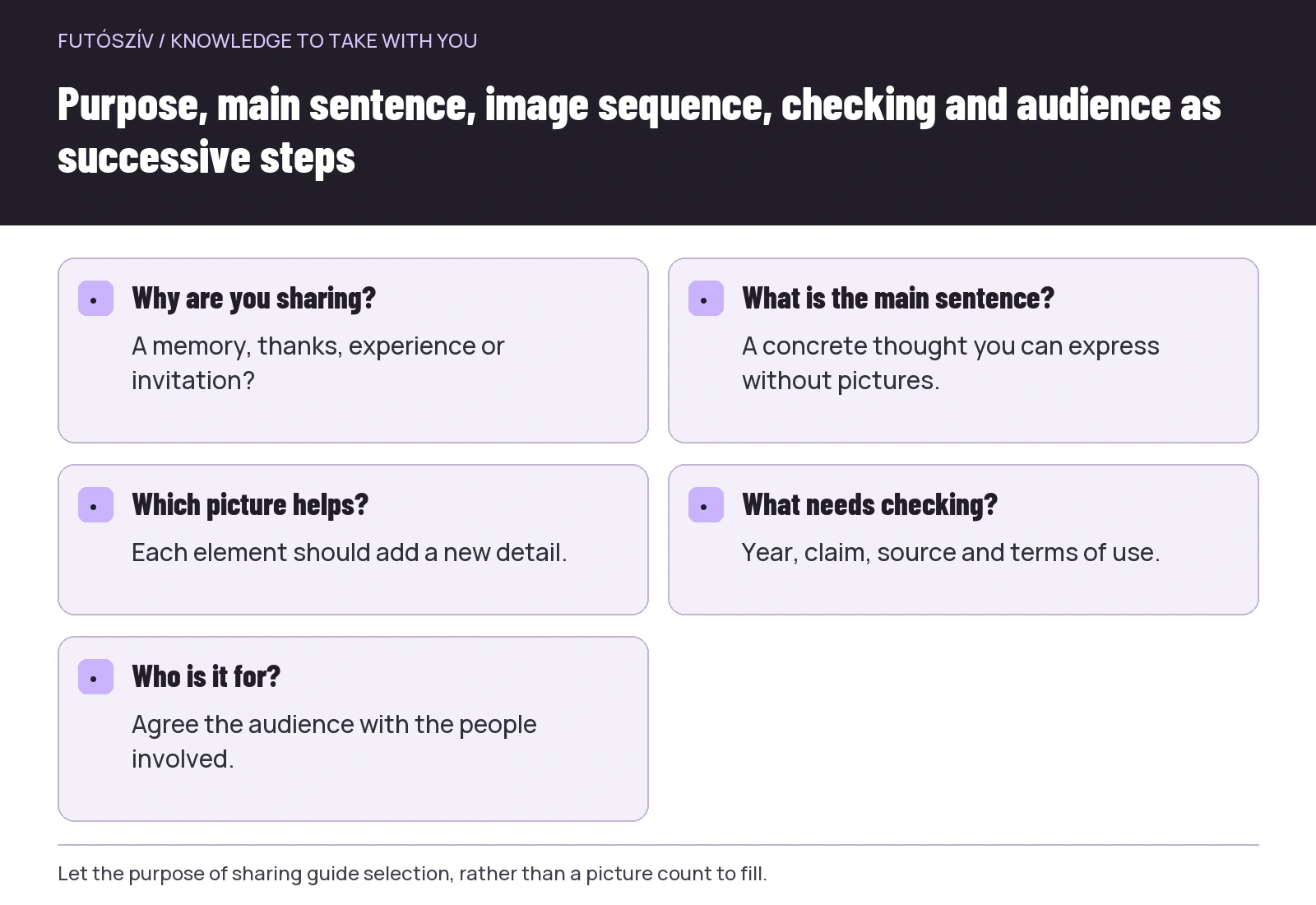
Start with why you want to share
The purpose might be preserving a memory, giving thanks, showing a shared activity, passing on practical experience or inviting people to the next session. These call for different posts. A personal memory does not need every organisational detail; an invitation, however, needs clear participation information alongside atmosphere. Clarifying the purpose first helps decide what to leave out.
Choose one main sentence you could say even if you could not attach a single picture. For example: our mixed-pace group run worked well because we agreed beforehand where to meet again. That is already a substantive statement. Pictures can show it rather than leaving you to fill the text with impressive adjectives in their place.
If the main sentence is only ‘it was really good’, find what specifically was good. The place, company, course, your own decision or a small unexpected moment? You do not need to include them all. One concrete detail often says more than every possible positive expression together.
Do not replace the experience with constant content production
Decide beforehand whether you want to take a few pictures or use existing material afterwards instead. Recording during a run is not a compulsory part of the activity. If you take a picture, choose a place and time that do not disturb others or conflict with the organiser’s rules. A good background does not justify changing how the course operates.
For a shared activity, say if you would like photographs or a short video. Others should be able to participate without automatically becoming central to a public report. A group photograph agreed separately may be simpler than constant unannounced recording. Someone who came to run has not necessarily agreed to appear in a social-media series too.
A short note can be enough to help you remember later: what happened, what you noticed and precisely what you want to thank someone for. The story can be assembled afterwards. You do not need to post every moment immediately for it to remain authentic. Indeed, later selection can make it easier to notice which details matter and which only seemed important at the venue.
 Enlarge diagram
Text version of the diagram
- Why are you sharing?
- A memory, thanks, experience or invitation?
- What is the main sentence?
- A concrete thought you can express without pictures.
- Which picture helps?
- Each element should add a new detail.
- What needs checking?
- Year, claim, source and terms of use.
- Who is it for?
- Agree the audience with the people involved.
Choose a narrative focus
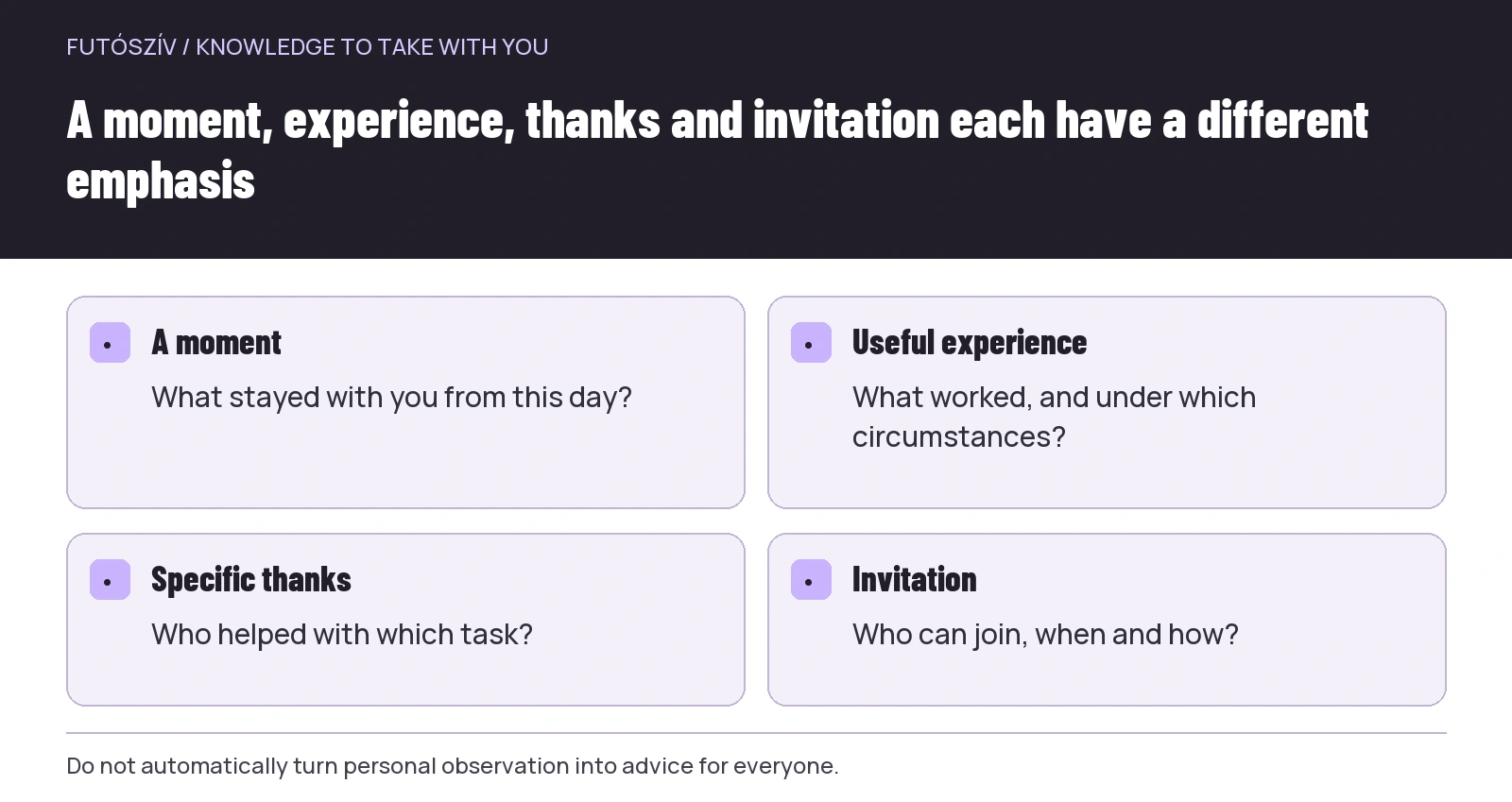
An atmospheric report needs a different structure from a practical experience post. The atmospheric version can start from a specific moment and explain its personal meaning. The practical version can describe a problem, the chosen solution and its limits. A thank-you can identify exactly what work someone helped complete.
| Narrative focus | Main question | What to avoid |
|---|---|---|
| The story of a moment | What stayed with you from the day? | Judging the entire event from a single image |
| Useful experience | What worked in your own situation? | Turning a personal experience into an instruction for everyone |
| Community thanks | Who helped with which specific task? | Blurring people’s roles and giving an empty list of names |
| Showing a place | What do your own photographs actually show? | Presenting old or uncertain information as current conditions |
| Invitation | Who can join, when and how? | Atmospheric text without essential details |
The structure is not a compulsory recipe. It helps prevent one post from trying to be a travel guide, results list, equipment recommendation and full community introduction at once. If you have several separate things to say, some can wait. A shorter, clear thought does not necessarily offer less value.
Separate personal observation from verifiable information
You can say that you found the meeting point easy to locate. That does not mean it was equally easy for every participant. Name the circumstances of your own experience: when you arrived, which entrance you used or what helped. You do not need to declare satisfaction or difficulty on other people’s behalf.
The event date, entry status and next edition’s programme are information that needs checking. When writing about them, link to the organiser’s current source. Last year’s promotional video or your own photograph does not establish that the same course and services will be available the following year. Identify the year of archived material, particularly when the post encourages future participation.
For numbers, clarify what is yours and what is official too. The distance shown by your watch, your own chip time and the organiser’s published result can be different data. An atmospheric report does not have to include every metric. If a number is part of your point, however, do not present it as though other possible interpretations did not exist.
Each picture in a sequence should add something new
In a multi-image post, the first picture should show what the whole post concerns. Later pictures can add details: surroundings, a shared moment, a solution or the story’s ending. Instead of three almost identical finish photographs, one such image and a detail of the venue may say more. The aim is to show your point, not fill a numerical quota.
A caption should do more than repeat what is already readable in the photograph. It can add context: which year it is from, why a particular object matters or how it relates to the story. If something is not visible, do not write as though the picture proves it. Clearly distinguishing visible content from the personal interpretation you add makes a report more credible.
Light and surroundings can remain natural when editing. A modest crop or brightening may help, but every picture does not need the same strong effect. If you use an explanatory illustration instead of a real photograph, label it as such. You do not need to add a scene that never happened to the story of your own run.
Make the image’s content understandable in text too
According to the W3C WAI guide to informative images, a text alternative should convey the image’s essential information in the context of its use. For a personal post too, keeping an important message from depending solely on the picture is a useful principle. If the platform offers image descriptions, use them deliberately; check the current help for the feature’s precise location.
A running-image description should focus on the relevant scene. For example: four runners at a marked meeting point wait for the other group. There is no need to list every clothing colour if the story concerns meeting again. In another picture, however, a distinctive object or sign may be important. Match the description to the image’s role rather than using an automatically repeated keyword list.
If you add text to an image, important information can appear in the post’s text too. A graphic crowded with tiny, pale lettering is hard to read on a phone. For video, understanding should not depend solely on sound: captions for essential speech or information can help. More accessible content is not a decorative extra; it is part of enabling more people to understand what you want to show.
 Enlarge diagram
Text version of the diagram
- A moment
- What stayed with you from this day?
- Useful experience
- What worked, and under which circumstances?
- Specific thanks
- Who helped with which task?
- Invitation
- Who can join, when and how?
Attribution does not replace terms of use
Do not automatically treat a fellow runner’s, organiser’s or official photographer’s picture as your own content. Check what use the creator or service permits. An image being publicly visible is not the same as permission to download, alter and republish it freely for any purpose. If the conditions are unclear, linking or contacting the creator may be more appropriate.
The official overview of Creative Commons licences presents several permissions with differing conditions. Seeing ‘CC’ alone is not enough: the specific licence and intended use matter. Some licences impose conditions beyond attribution. For your report, verify usability at the original source rather than inferring it from a label in an arbitrary image search.
Music and video may have separate conditions too. A soundtrack or sharing option available on one platform does not necessarily give identical rights for a downloaded version re-uploaded elsewhere. If you want to appear in several places, clarify the conditions for the chosen material and use separately. Technical copyability does not settle the question.
Make thanks precise and proportionate
A community report can identify what helped. Someone arranged the meeting beforehand, another person gave directions at an uncertain point and a third participant took the group photograph. A specific role is clearer than a general claim that everyone was a hero. Do not blur paid and volunteer work if you discuss them.
Quote other people accurately and in the proper context. If you cannot remember the exact words, explain in your own words what you discussed, or omit quotation marks and the supposed statement. You do not need to invent witty dialogue afterwards for the report. A simple, true sentence is worth more than a fictional scene.
A positive story can include a limitation. If a meeting worked well but you would handle a transport detail differently, you can say so. A useful report is not necessarily advertising. Equally, your own difficulty does not need to become a judgement on the entire event. Make the particular circumstance and your own conclusion clear.
A fictional example of a post centred on an experience
A group of friends chose two loops of different lengths on the same afternoon. The post’s main sentence is that a shared meeting point allowed everyone to choose their own activity while still ending the day together. The first picture shows the meeting point, the second a shared moment and the third a detail of the location. Participants agreed beforehand which pictures could be public.
The text briefly describes the organisational idea and the conditions in which it worked. It does not claim this is the best method for every group or turn the two loops into a competition. Exact private starting points, app screens and other people’s personal information are omitted. The focus stays on what they genuinely want to convey.
If they also invite people to the next group run, they do so separately with current participation information. They do not retrospectively turn the past report into an invitation whose new date is unclear. The personal memory and opportunity to join can then connect without becoming confused.
Keep content something you can stand behind after posting too
Before sharing, review names, years, sources, the audience for pictures and the text’s main claim. If someone later asks for clarification or says a detail about them is problematic, address it meaningfully. Incorrect information can be corrected, and the correction does not need to invent a new story about what originally happened. Make the current, accurate version clear.
The amount of feedback does not necessarily measure an experience’s value. A post for a smaller audience can still achieve its purpose if friends find the memory or someone takes away a useful organisational idea. There is no need to rewrite every quieter post afterwards with louder claims.
The next run does not need to outdo the previous post either. If you have a concrete sentence and a few pictures that genuinely fit, you already have something to share. If you do not want to publish at the moment, the experience remains just as valuable. Content can be a trace of running without becoming a condition for it.
How Futószív articles are prepared: our editorial guidelines.