Weekly meal planning can easily begin with a search for the perfect menu, then fall apart on the first working day that runs late. As a runner, it is more useful to see the daily routine first: when you are home, where you can eat, when you travel and where training fits. Food needs to be accessible within this real life. This article provides an organising method for preparing everyday meals for healthy adults, not a personalised diet or quantities calculated for a performance target. Individual needs, known conditions, allergies and particular life circumstances require coordination with an appropriate professional; the plan here makes eating opportunities visible.
Keep the outline of the week simple and realistic
Draw seven days, but do not immediately fill every minute. First mark events that are hard to move: starting work, travel, family plans and agreed training. Then add where you will be at your usual meal times. There is no need to prescribe the same number or timing of meals for everyone. Start with your own familiar rhythm and look for situations in which the opportunity to eat usually disappears. The first version of the daily schedule aims to reveal problem points, not make every line ideal.
Mark separately where place and time are still uncertain. An uncertain end to work is not the same as an evening definitely spent at home. If the planned run time may change, leave that flexible too. A prearranged menu works poorly when it disguises uncertainty as a fixed time. A good weekly outline instead shows where you need two workable options. This is an organisational backup, not strict control of eating. A spreadsheet does not authorise or prohibit hunger, appetite and individual needs.
A real opportunity rather than an eating window
Note whether a location has a fridge, reheating facilities, cutlery, drinking water and a calm place to eat. An apparently free half-hour is insufficient if you are travelling then or have no suitable food with you. Workplace facilities may differ from those at home, and the area around a track session may not offer the same things either. Make access concrete in planning: ready food at home, an appropriately transported meal, a known place to obtain food or another option suitable for you. What matters is that the plan can actually be carried out on site.
The NSW Institute of Sport sports nutrition Q&A specifically addresses training at a usual meal time and emphasises advance organisation. Your solution is not a single universal time or portion, but coordination between training and the day’s other meals. This article therefore does not copy an elite athlete’s schedule for every runner. The source reinforces the practical point that training should not quietly squeeze eating opportunities out of the day.
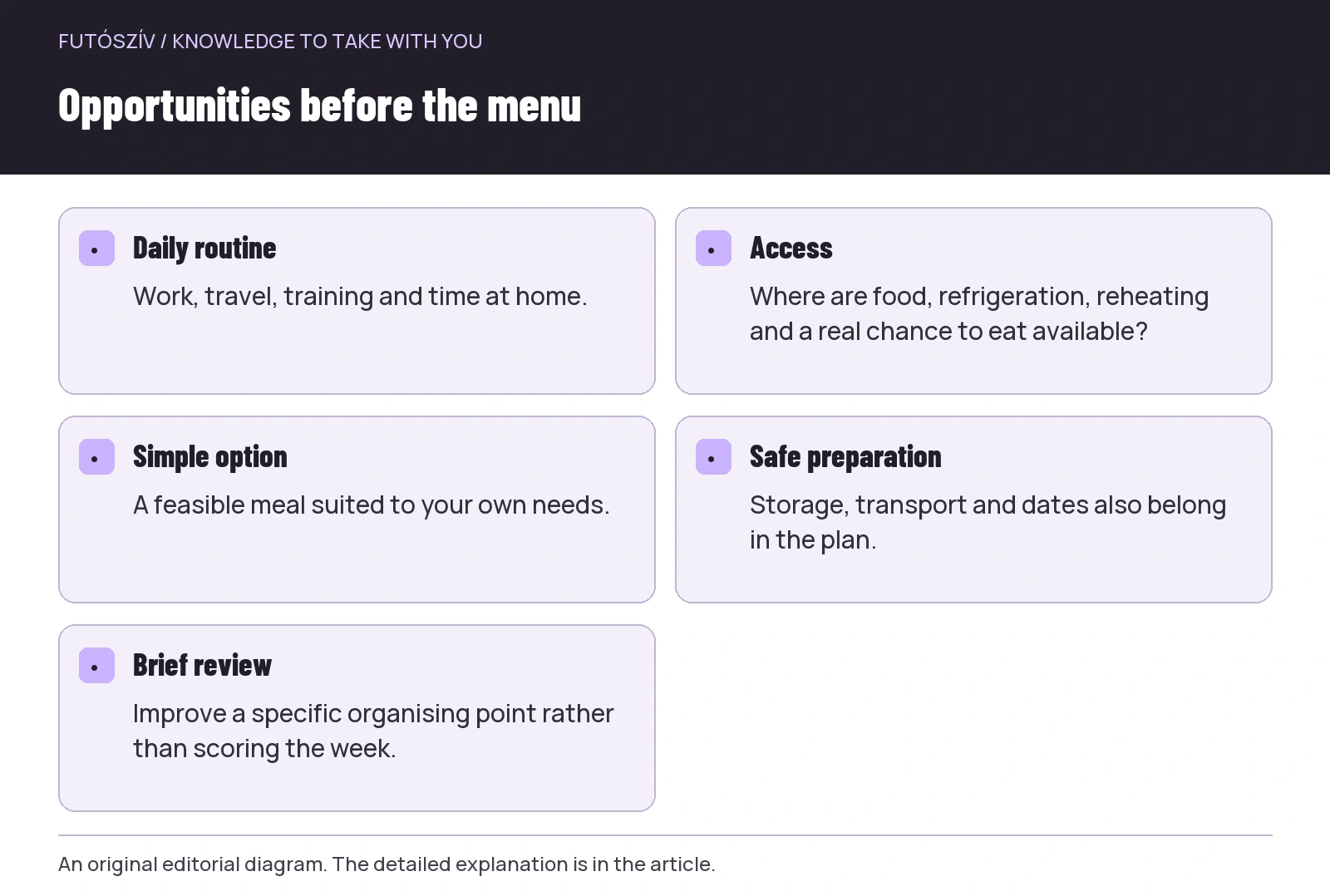 Enlarge diagram
Text version of the diagram
- Daily routine
- Work, travel, training and time at home.
- Access
- Where are food, refrigeration, reheating and a real chance to eat available?
- Simple option
- A feasible meal suited to your own needs.
- Safe preparation
- Storage, transport and dates also belong in the plan.
- Brief review
- Improve a specific organising point rather than scoring the week.
Choose the type of meal before the recipe
Initially, write simple meal solutions beside the daily routine rather than detailed recipes. For example, lunch prepared at home, a meal requiring refrigeration under appropriate conditions, or a simple dinner assembled where you are. Then choose foods matching your tastes, needs and known limitations. Beginning with seven complicated recipes can easily create more cooking tasks than you actually have time for. A good system supports achievable meals rather than adding another project alongside running.
The Hungarian Dietetic Association’s adult OKOSTÁNYÉR guide offers a starting point for the Hungarian basics of varied, balanced eating. This is a general framework, not a diet calculated for a particular runner’s workload. In weekly organisation, it can help you notice whether one easily accessible food is filling the entire week. Apply considerations of food groups and variety together with your own dietary needs, with professional help in particular life circumstances.
A training day is not automatically a separate diet day
Food needs are influenced by the whole day, workload and individual circumstances; seeing a run on the calendar is not enough. The Australian Institute of Sport nutrition education modules treat adequate energy intake and planning as important elements of athletes’ nutrition. This does not imply an identical quantity or compulsory product for everyone. In your own weekly outline, check whether suitable food is available and whether eating is missed merely for organisational reasons. A detailed sports nutrition plan is a different task from arranging access in a calendar.
Do not make running a condition for deserving food. The plan is not about deciding which meal to remove because of a missed workout, and it is not a weight-loss prescription. If you are uncertain because of your needs, persistent symptoms, recovery or a body-weight-related goal, a sports dietitian can offer individual help. The organising method remains useful: it shows the professional when and where you can actually eat. A good plan supports adequate, appropriate eating that fits your routine rather than surrounding it with rigid restrictions.
Two options for uncertain days
Choose one or two days that regularly change and write options A and B beside them. A is the usual option; B is easier to carry out. The two versions are not labels of good and bad food. For example, if work ends later, a known place offering suitable food may replace a home-cooked meal. The point is that the backup should be more than “I will eat something”. Avoid having to make every basic decision again when tired, while keeping the choice flexible enough for your actual needs.
Storage conditions also limit the backup. Food needing refrigeration cannot be kept indefinitely in a bag so it is available whenever needed. If safe transport and storage are not arranged, choose another suitable food or way to obtain it. Packaging and the nature of the food matter together. A compartment in a sports bag does not automatically become refrigerated storage because the food is in a container. Clarify this during planning, because subsequent cooking and shopping depend on it.
| Routine situation | Planning question | Usable backup |
|---|---|---|
| Work finishing later | What will be available when the finishing time changes? | A known, suitable source of food or an option that can be stored. |
| Training at a usual meal time | Where will eating fit into the day? | An option arranged in advance to suit your needs. |
| Travel | Where and how can you actually eat? | A packed meal or stop matching transport conditions. |
| Arriving tired in the evening | How much preparation is still realistic? | Simple food that is safely available. |
| Changed family plans | How can a shared meal remain flexible? | Ingredients that can be combined in several ways. |
Make room for cooking and chilling too
Alongside preparation time, allow for safe storage arrangements and keeping the kitchen in order. There is no need to cook several days of meals on one day if you lack appropriate chilling and storage capacity. The Nébih guide to menu planning without leftovers also discusses preparation and handling leftovers, linking storability to suitable temperatures and timely chilling. A weekly plan is therefore not permission to keep any food in the fridge for an entire week. Follow food-safety guidance appropriate to the particular food and conditions.
Mark which meals will be made fresh, which parts can be prepared ahead and what can be frozen appropriately. Labelling date and contents helps with use. Also make clear who will eat it and when, so two separate plans do not count on the same portion. Free fridge space and appropriate containers are real conditions, not administrative details. If the food’s storage history is uncertain, do not count it as a definitely usable backup. Good intentions to avoid waste cannot replace food safety.
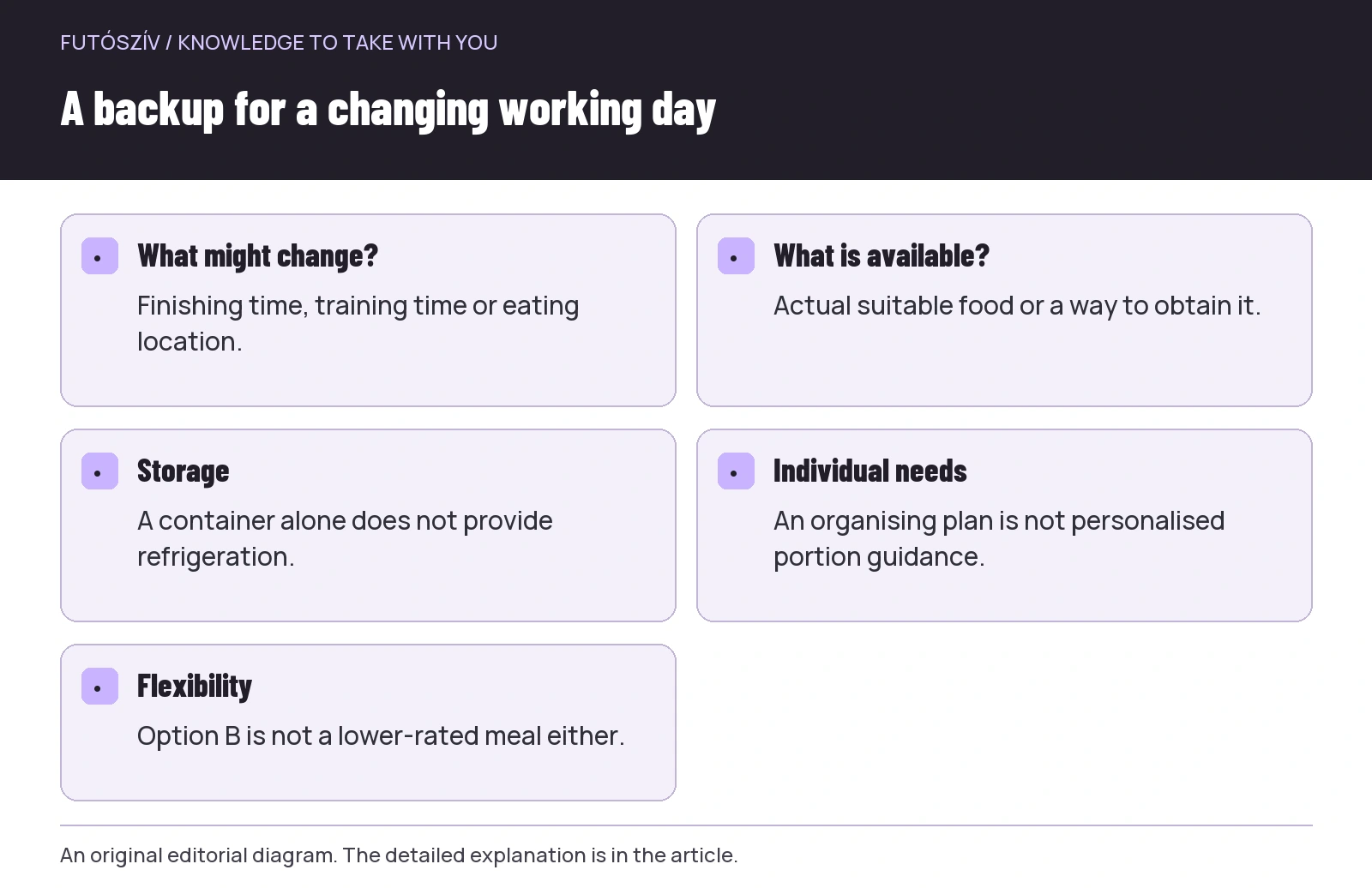 Enlarge diagram
Text version of the diagram
- What might change?
- Finishing time, training time or eating location.
- What is available?
- Actual suitable food or a way to obtain it.
- Storage
- A container alone does not provide refrigeration.
- Individual needs
- An organising plan is not personalised portion guidance.
- Flexibility
- Option B is not a lower-rated meal either.
Redrawing an illustrative working day
In an imaginary situation, someone goes straight from work to running training and arrives home only afterwards. The original plan lists dinner at home but does not consider when food will be available during the long period beforehand. The improvement is not necessarily a new recipe: first address the gap visible in the daily routine with an eating opportunity suited to personal needs and comfort. This might be an arrangement made at work, appropriately transported food or another available choice. Precise timing and quantity may be personal sports nutrition questions.
In another example, weekend cooking plans too many different dishes even though several weekdays are spent away from home. The quantity of leftover prepared food and its storage time then exceed what is needed. Mapping locations can reduce unnecessary preparation here. These are editorial examples, not diets prescribed to individuals. They illustrate the method: before the menu and shopping, see where eating actually happens and how it will be made possible. The plan can adapt to changes in the routine; there is no need to call a change a failure.
Let the shopping list follow the opportunities
Once you see the weekly outline and simple meal options, review supplies at home. List ingredients from this real plan rather than buying for every promising recipe at once. Mark products to use sooner and those chosen as longer-lasting backups. Known dietary limitations, allergen information and packaging instructions matter for simple dishes too. Organisation does not override them. If family members have differing needs, agreeing on ingredients and storage is easier while making the list than after the food is prepared.
Using ingredients in several ways can support variety and flexible cooking, but should not turn every meal into compulsory leftover use. Count on options that can be handled safely and are actually liked. If you do not usually eat something, do not buy a large quantity merely because its name sounds healthy. A good list relates to realistic appetite, routine and supplies. The need for a specialist sports nutrition product is a separate question, not resolved by running appearing on the calendar. Access to everyday food remains the first organisational foundation.
A brief weekly review without a score
At the end of the week, examine which meals were easy to make happen, where food or time was missing and what remained unnecessarily. There is no need to label the entire week as good or bad eating. One concrete organising observation is already useful: the workplace fridge made packing feasible, one dinner needed too much preparation, or the backup food source was unavailable. Improve these specifically in the next plan. Persistent anxiety about eating, health symptoms or restrictions that are difficult to manage require appropriate professional help.
The point of planning from the daily routine is to make real eating easier to achieve. There is no need to create a perfect menu, count every bite or make running a condition for eating. A weekly outline, access, simple meal options and safe preparation together form a flexible system. The result for the next week is more than a recipe list: it is a plan that helps you eat appropriately for yourself among work, travel, training and life at home.
Sources and further reading
- NSWIS: What should I do if I train during meal times?
- AIS: Performance Nutrition HQ Modules
- MDOSZ: The updated adult OKOSTÁNYÉR
- Nébih: Menu planning without leftovers
How Futószív articles are prepared: our editorial guidelines.