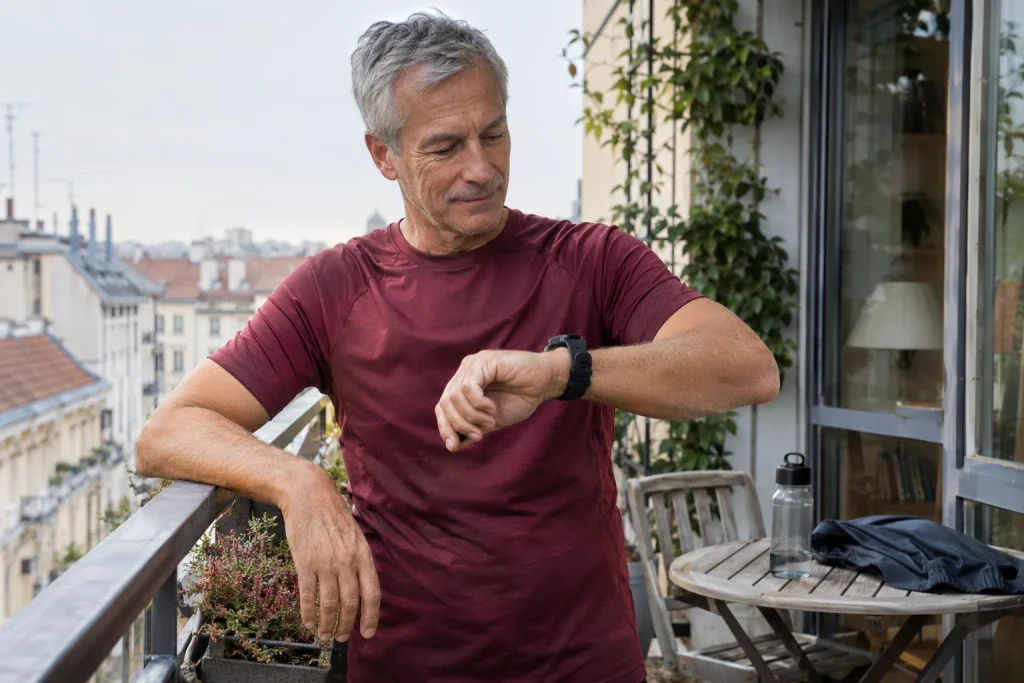
Running feels easier during the pre-race taper, and your watch shows a more favourable number too. That is welcome feedback, but what exactly has improved? Daily readiness, an estimate of fitness and a marathon time prediction are different questions. It is worth learning the order in which to read the screen so that the positive signal helps you prepare for the start rather than tempting you into a new last-minute test.
First name which display has improved
A sports watch can produce numbers for several different questions: how much load you have accumulated, how ready you appear for the next session, how the current run compares with your usual level and what race time the algorithm estimates. These are not different colours for the same thing. The exact feature name is the first step in interpretation; a screen turning green does not yet tell you which variable you are seeing.
Make a brief note of the display’s name, date and what preceded its appearance. Do not read a daily readiness score in the same way as an endurance estimate changing over several weeks. A similar name on another watch does not necessarily mean the same calculation either. Your own model’s manual is useful because it specifies the feature’s inputs and purpose more precisely than the app’s colour does.
The most important distinction in language is between measurement and estimation. The device records sensor signals and then calculates different outputs from these and your history. The displayed VO2max estimate is not a direct respiratory gas measurement, and a race prediction is not a future result. They can still be useful, but need their proper place in the decision: as information, rather than evidence overriding every other piece of data.
Improving readiness may accompany the planned taper
The official Training Readiness description for the Garmin epix series lists the previous night’s sleep score, recovery time, HRV status, acute load and recent sleep and stress history among the inputs. The score also updates during the day. This is a specific manufacturer example, not a definition applying to every watch or every similarly named app feature.
If training volume changes during the taper and your daily routine becomes more settled, these inputs can change too. A readiness score moving therefore does not by itself prove a new marathon capability built in a few days. It may describe a more favourable current situation according to the algorithm. Daily readiness and fitness developed over a longer period are connected, but need separate interpretation.
There is therefore no need to immediately verify a favourable signal with another hard test. First look at the task designated for the week in advance. If the aim is a more settled preparation for racing after earlier work, an improving daily signal can coexist with a shorter programme. Not every positive response needs to be converted into new exertion as though the score were a performance allowance to spend that day.
 Enlarge image
A plus sign during a run is a different comparison
The Garmin Performance Condition description describes a current assessment during running that uses pace, heart rate and heart rate variability in relation to your own average fitness level. It is not the same as the morning readiness indicator. The feature makes its own comparison, so a favourable reading cannot tell you directly how much faster your marathon has become.
Place a value appearing early in a run within that particular session. What route were you on, at what pace, in what weather and following what previous activity? The positive feeling of a shorter, easy run is an important personal experience, but it is a different task from sustaining performance through the final hour of a marathon. An encouraging card on the watch screen does not bridge that difference on its own.
For assessment, keep more than a screenshot of the best moment. The structure of the whole session and your own brief comment add more. For example, did the planned loop remain steady and comfortable throughout, or was the beginning good before the task changed later? Keeping the feature’s name attached makes the signal a useful discussion point rather than an abbreviated answer to another performance question.
Do not automatically call a changed race prediction a changed ability
An estimation model’s output can change because of new data even if the ability it is intended to represent has not changed by the same amount. A new run not previously seen may give the algorithm different information. An incorrect heart rate series or different recording may instead be a misleading input. Without the manufacturer’s detailed model, the exact cause cannot always be reconstructed, so avoid confident explanations invented afterwards.
The research estimating critical speed from raw training data illustrates the importance of this principle: the model was calculated from previously recorded fastest sections, and its relationship with marathon performance was examined. The diary’s contents determine which information is available for estimation. This is not identical to every commercial watch algorithm and does not prove the accuracy of a particular displayed time.
As our own example, imagine a watch displaying a 4:12 marathon on Tuesday and 4:06 on Friday. For now, the six-minute difference is the difference between the two displays. Changing your starting plan requires more than the new number being more favourable. Look at your previous race, the entire preparation and course conditions too. The example is fictional, not a measured error or expected change for a watch model.
Comparable runs involve more than the same number of kilometres
If you compare short loops during the taper, first set their circumstances side by side. The same flat route and the same activity task offer a more useful comparison than a hilly evening run and a cool morning loop on tarmac. This still does not turn the two days into a laboratory experiment. The aim is at least to keep large, known differences from remaining hidden behind pace and heart rate.
Note a change of shoes too if comparing two sessions is the question. There is no need to attribute every improvement automatically to the new shoes or record the difference as definite progress. A more precise statement is simpler: different equipment was involved in this session, so comparison with the previous run did not take place under entirely identical conditions. Naming uncertainty preserves the data’s value.
Check the recording as well. An unusual heart rate line that stays flat for a long time, or a jump in the mapped route, may need explanation before you calculate a performance change from it. Mark data that appears incorrect and keep the original. The taper is no exception to data quality: an approaching race does not make a sensor more accurate, though it may give the displayed number greater emotional weight.
What do repeated measurements during preparation show?
The marathon prediction study with repeated assessments during preparation tracked various physiological characteristics and changes in the estimate. Such work also raises the question of when measurements are made and how each measure develops during training. It did not draw every conclusion from a single watch number appearing the day before a race.
The large analysis of recreational marathon tapers instead compared patterns of volume in the pre-race weeks with results. Favourable associations appeared with more consistent tapering, but this observation does not automatically validate any watch-based readiness or target-time estimation feature. Taper research and evaluation of a particular algorithm are separate research questions.
The distinction between sources has practical significance. One follows laboratory characteristics, another follows volume patterns in training diaries, while the manufacturer’s page explains its own feature’s purpose. All three can help, but they are not interchangeable. You gain a useful picture by taking from each what it actually addresses, rather than assembling them into the appearance of a certain race time.
 Enlarge image
Do not let a good signal tempt you into one last proof
An encouraging run before a race can easily produce a new goal: if it went this well today, surely another trial could confirm it. Before deciding that, write down which question the new workout would answer. If the answer is only that you want another reassuring number, the test’s aim differs from the original taper programme. The extra session is an additional workload, not simply more information.
At the same time, you do not need to defend an existing plan rigidly regardless of reality. The point is for a change to have a specific, understandable reason. Alongside the display, consider your history, your own condition and the circumstances of the planned race. A single favourable or unfavourable score should not carry decision-making weight that the feature does not actually support.
If the watch is encouraging but how you feel during the run is noticeably unusual, the green signal should not erase that. Likewise, a weaker estimate can coexist with a well-executed easy session that follows the plan. Note the discrepancy rather than immediately explaining it. The device may offer information alongside your own observations, but it does not classify a health symptom as harmless or make an individual diagnosis.
A simple order for reading the screen before the start
First identify the feature, then look at the timescale of information it tries to summarise. Next, check important inputs and whether recent sessions are comparable. Finally, decide whether the signal even answers a question relevant to your starting plan. This order helps avoid looking for a supporting story after seeing an appealing end result.
Alongside your starting plan, you can keep the watch estimate, a relevant previous result and experience from preparation on separate lines. If they differ, keep that difference visible. There is no need to average signals with different meanings into one number. What helps is knowing where each came from, what it refers to and what it cannot take into account about your chosen race day.
An improving watch display during the taper can be welcome feedback, but its own meaning needs to be understood first. Daily readiness, assessment of the current run and a marathon prediction answer different questions. Preserve that distinction, and the watch can be a well-placed piece of data alongside the whole preparation story rather than another source of pre-race uncertainty.
Sources
- Garmin epix manual: Training Readiness and its inputs.
- Garmin Support: Performance Condition.
- Smyth and Lawlor: marathon taper patterns.
- Esteve-Lanao and colleagues: marathon prediction during preparation.
- Smyth and Muniz-Pumares: critical speed from raw training data.
How Futószív articles are prepared: our editorial guidelines.