
A running app’s badge is simple, eye-catching feedback: a predefined condition has been met. A routine taking shape in your own life involves more details. You find a time to set off, prepare what you need, recognise a route that works for you and know the next step after an interruption. Bringing those details together can be a meaningful goal in its own right during the first month.
The pleasure of a badge and your own planning can coexist comfortably. The question is which one makes the decision. If a digital challenge would make you rewrite a programme you had already thought through, pause for a moment. The app checks its own rules; it does not know every detail of your schedule, personal circumstances and situation today.
Describe what you want to manage more easily in a month’s time
Choose an everyday, verifiable aim. For example, you might want to know which two time slots usually let you set off; have a familiar nearby route; or fit the programme from changing clothes to getting home into the time available. At the end of the month, you can give specific answers to these.
“Finally become a real runner” is hard to evaluate because there is no agreed entrance exam. “Be able to organise the next outing independently” is much more useful. In a beginner routine, discovering that a nearby loop fits weekdays better than a beautiful distant park is learning too. The outcome is a workable decision, not necessarily a new record.
The NIDDK advice on starting physical activity also recommends noting barriers and possible solutions. Applied to your first month, this means observing the conditions for setting off alongside running itself. Preparing shoes, making arrangements at home or allowing travel time can be just as concrete a part of the experience as the route.
Separate the programme from organising the habit
A training programme may describe the movement you do in a session. Organising the habit deals with how you reach the point where that session happens. The two are connected but do not replace one another. A perfectly filled calendar does not prove a loading plan is appropriate, and a good beginner programme does not, by itself, solve travel after work.
If you follow a beginner plan, do not turn it into a different programme because of the app’s badges. The NHS Couch to 5K overview includes rest days between runs and allows completion over longer than nine weeks. A continuous daily streak may therefore not fit the programme you originally chose.
Personalised training and health questions may require suitable professional help. The following four-week outline is not a training plan and prescribes neither running frequency nor distance. It distributes organisational tasks so that you only need to try a few new details at a time.
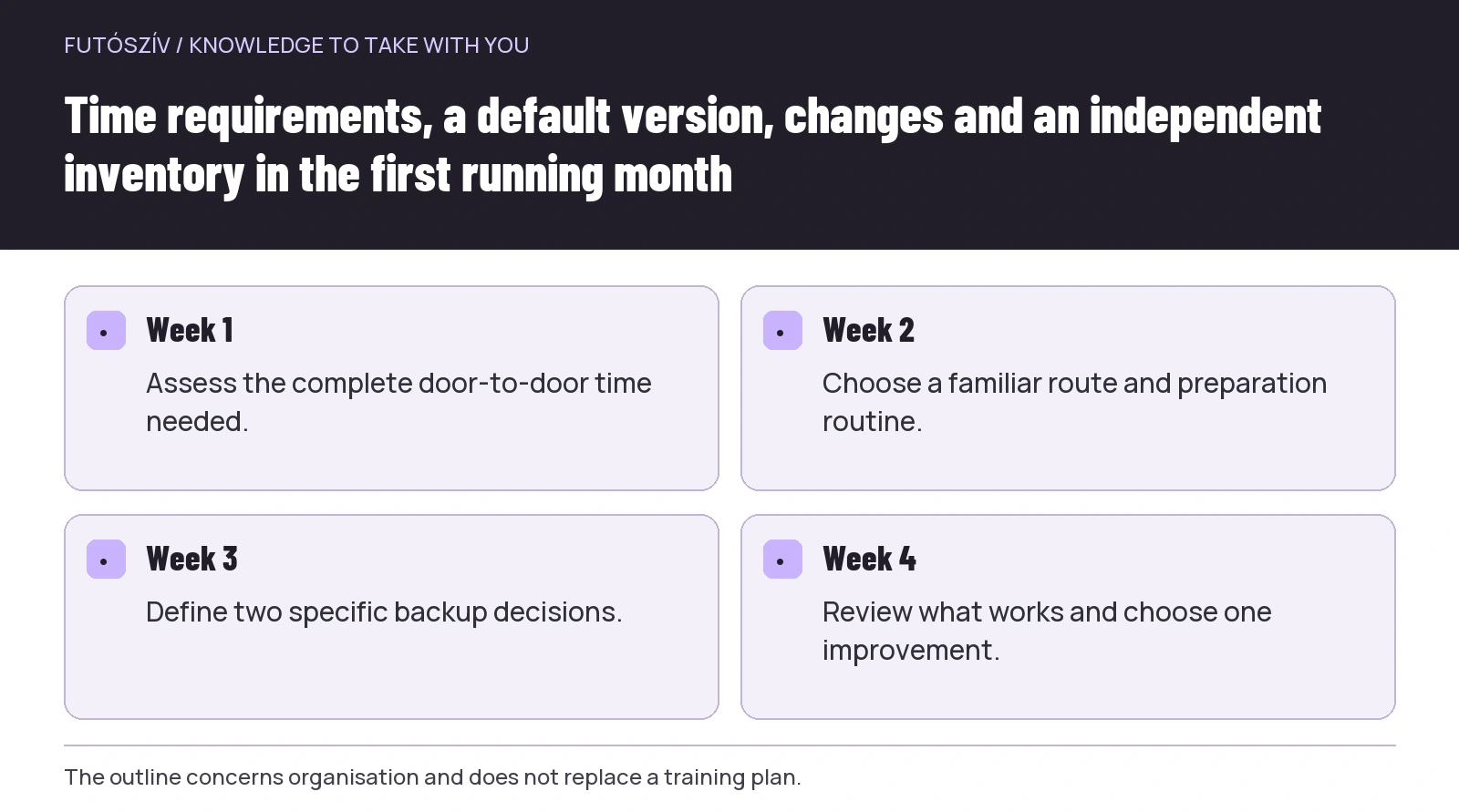 Enlarge diagram
Text version of the diagram
- Week 1
- Assess the complete door-to-door time needed.
- Week 2
- Choose a familiar route and preparation routine.
- Week 3
- Define two specific backup decisions.
- Week 4
- Review what works and choose one improvement.
Week one: learn the full time requirement
Observe when you start getting ready, when you leave the door and when the whole outing ends. Many other activities may accompany the twenty minutes recorded in your running app. Ignoring them means choosing too narrow a slot next time too. An accurate time window can be more freeing than another motivational notification.
Choose one way to reduce the organisational effort of leaving. It could be prepared clothing, an already familiar route or a division of tasks at home agreed beforehand. Try a single change. If you transform every detail together, it will be harder to recognise which helped.
At the end of the week, do not evaluate your schedule by kilometres. Ask whether the time slot was realistic and which part slipped. Clarifying access, changing clothes or the journey home is a concrete result. It can make week two fit your actual days better.
Week two: choose a reliable default version
Based on the first week’s experience, select a default route and a way of setting off that goes with it. A default has the advantage of demanding fewer new decisions. You know where you are going, what you carry and how long you will be away altogether. Every outing does not need to be a new discovery to be valuable.
If weather or a closure requires another route, separately check whether you genuinely know it. A backup plan should also be specific. “I will run somewhere” leaves many open questions until departure. A short nearby section you have walked may be a better backup than a distant park you have never seen.
Do not call the default an eternal obligation. Its purpose is to give you a tested option to return to. You can expand your route library later, but in the first month even one thoroughly familiar loop can resolve considerable organisational uncertainty.
Week three: practise how to make changes
A routine’s usability also shows in what you do when something intervenes. You do not need to create an obstacle deliberately. If the week genuinely brings a change, observe your options. Can you move the outing into an actual free slot, shorten the whole programme, or would it be better to choose the next suitable day?
Write two simple “if–then” sentences. For example: “If we do not confirm the shared evening start by the day before, I will plan my own familiar loop.” Or: “If the park entrance is closed, I will switch to the street version I have already walked.” These are organisational rules. In illness or pain, a calendar sentence like this does not determine whether returning is appropriate.
After a missed day, do not make filling an empty space in the app your first question. The next outing needs to fit the current week. You are practising a forward-looking decision rather than retrospectively repairing the past. This is particularly useful for people with changing work schedules.
Week four: see what you can now do independently
At the end of the month, make a brief inventory. Do you know how much time your usual outing takes? Do you have a route whose access and shortcut you know? Can you say whom you need to coordinate departure with? Do you know how to change things when one condition of the plan is missing? These questions reveal your developing system.
Choose a single next improvement. If the time window already works, you might walk a new route. If the location is settled, simplify getting ready before departure. If everything is decided at the last moment, advance weekly arrangements may be the next task. Base the decision on where real uncertainty remains.
You do not need to commit automatically to more outings or a greater distance next month. Stabilising organisation and changing training are different decisions. If you have your own programme or a plan agreed with a professional, progress accordingly. A new digital month is not, by itself, a reason to increase load.
| Week | Organisational question | Tangible result |
|---|---|---|
| First | What is the full time requirement? | A realistic door-to-door time window |
| Second | What is the default version? | A familiar route and preparation routine |
| Third | How will you make changes? | Two specific backup decisions |
| Fourth | What already works independently? | A brief inventory and one next improvement |
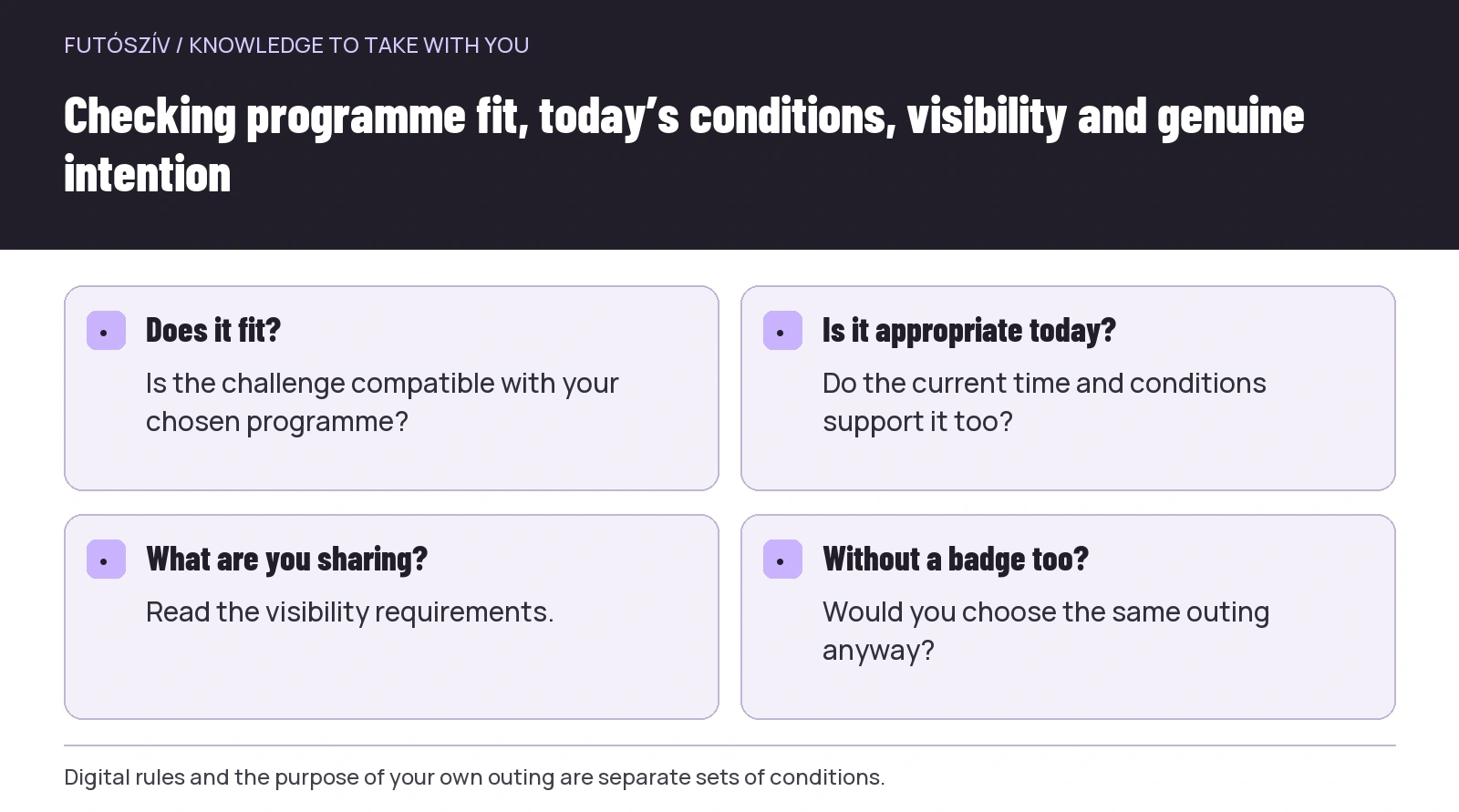 Enlarge diagram
Text version of the diagram
- Does it fit?
- Is the challenge compatible with your chosen programme?
- Is it appropriate today?
- Do the current time and conditions support it too?
- What are you sharing?
- Read the visibility requirements.
- Without a badge too?
- Would you choose the same outing anyway?
A badge’s rule may differ from your own goal
Before joining a digital challenge, read which activity, period and visibility it requires. Movement that was useful and planned for you may not count under the challenge’s technical conditions. This says nothing about the value of the real outing. They are two separate sets of conditions.
Strava’s official page on activity visibility , for example, notes that some challenges may require public visibility. Make a separate decision about sharing data. If you want to log activities for personal use, a badge does not mean you automatically need a wider audience.
App terms and interfaces can change. The current official description and the particular challenge’s own rules are the guide. The general principle remains useful: know what you are agreeing to before joining, rather than trying to work out the rules on the final day.
Four situations in which to pause an automatic decision
You are only a little short of the monthly goal. Ask whether you would consider the extra programme appropriate without a badge. If only the gap on the screen prompts it, return to your own earlier plan. Today’s circumstances matter to the decision, rather than how close a colourful icon has become.
A streak would break. Check what your programme calls for and why the day would be missed. Rest or a necessary adjustment is not an organisational failure. A continuous row of marks is easy to understand, but does not contain the whole story. Preserving your chosen framework is particularly important in the first month.
Other people share more activity. A feed shows visible fragments from different people’s lives. It does not reveal everyone’s full schedule, aims and background. The length of someone else’s post cannot therefore answer your own organisational question. Your next outing has to find a place in your calendar.
A notification feels urgent. A deadline may be real within the challenge’s system, but that does not make every other part of your programme secondary. If you are interested, decide about the challenge in advance. If it does not fit your month, you can choose another playful aim later. Every available challenge does not need to become your personal task.
Your own feedback in four simple lines
You can use a monthly sheet with four questions instead of a kilometre target. “Which departure was easy to organise?” “What made the others harder?” “Which preparation helped?” “What should the next single change be?” The answers can produce a concrete next step. The sheet is useful if you can read it later and make a decision from it.
You do not need an assessment for every day. Your system can be as simple as the task allows. If one weekly sentence makes clear that an evening programme does not fit because of the journey home, that is important information already. Detail serves understanding, not increasing the amount of administration.
The CDC guide to overcoming barriers also discusses reviewing time windows and seeking social support. Your own sheet can therefore include specific requests for help: who can coordinate with you in advance, which time slot you can protect together and what division of tasks makes leaving easier.
A reward can relate to what you have built
If you want to celebrate the first month, choose an appropriate form. You could show a friend your newly familiar route, arrange a walk together there or make a small map of your established loop. These remind you of what you can now manage more easily.
A material reward is not compulsory either. If you would like to buy something, start from concrete experience: was something genuinely missing, and what task would it serve? The first month’s inventory is a good basis for a purposeful decision. An uncomfortable pocket is a more precise shopping criterion than feeling that you now need new versions of every piece of equipment.
The routine developed by the end of the month is not a rule finished once and for all. It can change again with the season, work schedule and family situation. The most important practical result of this first period may be knowing how to review the conditions and turn them into a clear next outing. No missing app badge can take that knowledge away.
How Futószív articles are prepared: our editorial guidelines.