A seasonal change in your running wardrobe is more than swapping the positions of shorts and long trousers. Transitional days may require several combinations, and layers worn some time ago may no longer be in the condition they were in when you put them away. A good reorganisation therefore starts with practical purposes: what should be easy to reach, which garments work together, what needs care or repair, and what can be stored properly for longer? This guide takes you from assessment to trying the complete outfit, rather than offering a single weather threshold or a clothing list for everyone.
Describe the actual situations in which you set out
Think through typical runs in the coming period: when you leave, in what environment, on what route and how you get home. The aim is not to produce a weather forecast but to recognise equipment needs. For departures around dusk, access to lighting and visibility equipment matters; in rainy weather, the appropriate outer layer may take priority. Your journey there and home may require separate clothing in your circumstances. Do not confuse a layer worn while running with what you travel in afterwards; they serve different roles in the wardrobe.
Write down a few genuinely common situations and combinations that have worked for them. If you have no experience yet, start with the manufacturer’s intended use and your own circumstances, then try things in a calm situation where adjustments are easy. There is no need to assign a top to a universal temperature, because wind, precipitation, intensity and personal comfort may all differ. Organising the wardrobe aims to make the necessary garment findable and usable when the situation arises. The particular daily choice still needs to match current conditions.
Four groups instead of emptying everything at once
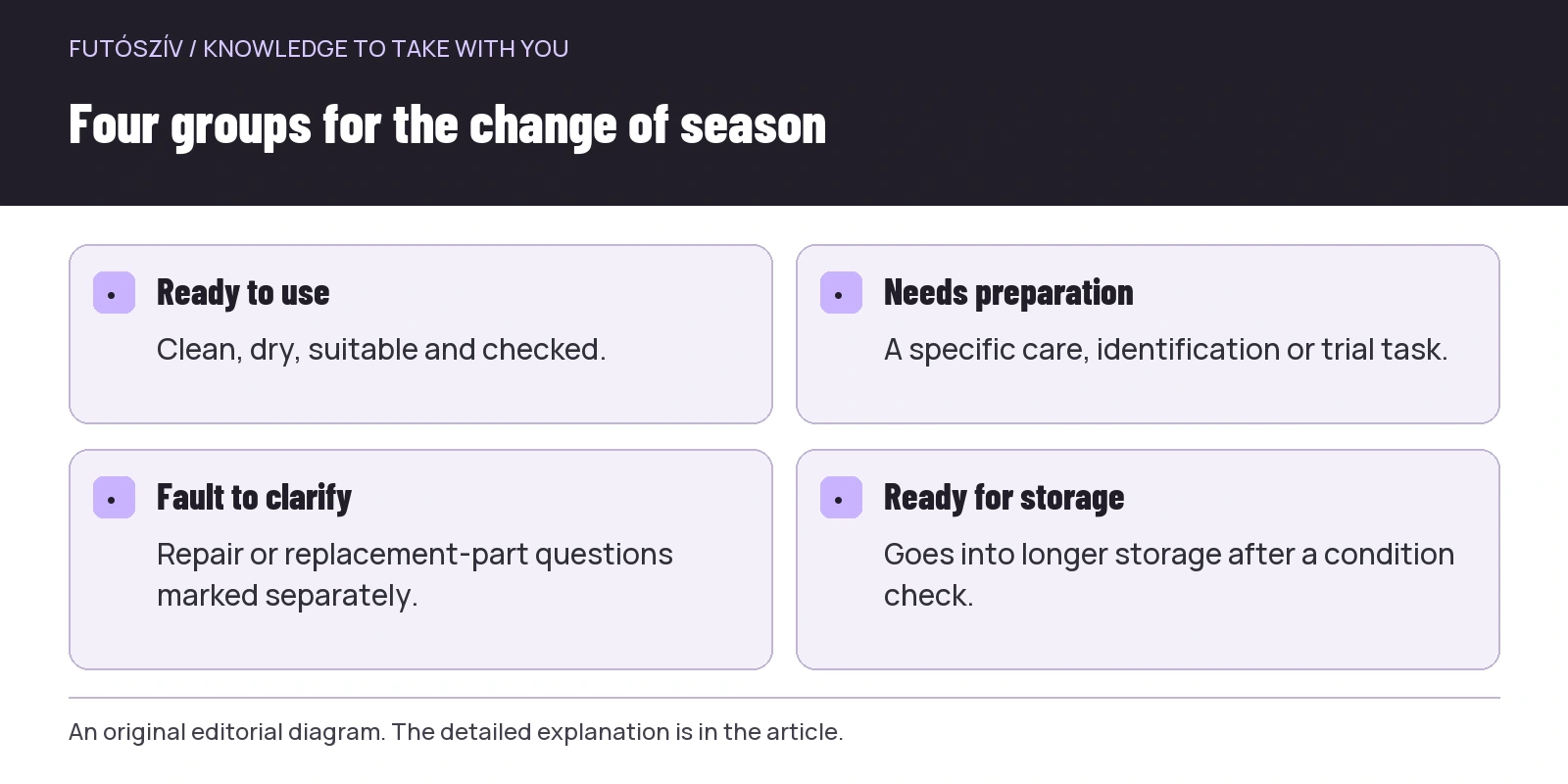
Create four working groups: immediately usable, requiring preparation, awaiting repair or clarification, and suitable for longer storage. Begin with clothing needed in the coming period; do not empty every drawer at once if you lack room to finish. Anything called usable should be clean, dry and in appropriate condition. A jacket taken from the wardrobe is not automatically ready simply because you have used it before. Checking fastenings, fabric and accessories now is a smaller task than scrambling to find a repair just before departure.
In the preparation group, make the action specific: finding care instructions, cleaning according to the label, identifying a missing accessory or trying the garment when dry. Keep clothing awaiting repair separate because it may not be an available spare. For garments to store, examine whether you might still need them during transitional conditions and whether they are in suitable condition for storage. The four groups are not value judgements but a working arrangement. They help ensure that a neatly arranged wardrobe reflects actual usable equipment behind the appearance.
Try the layers together
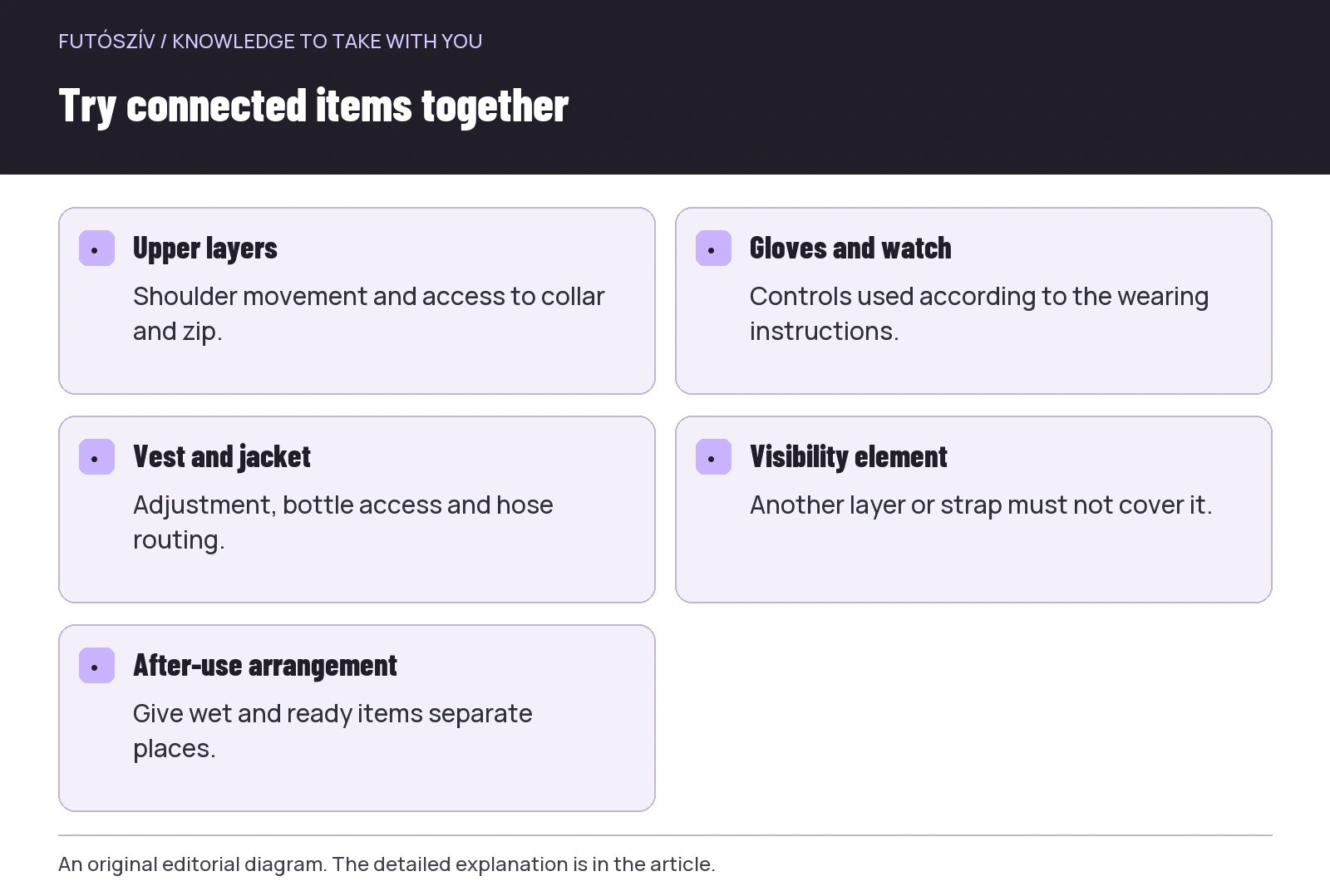
Put on the garments together that you plan to combine in the coming period. Check shoulder movement, where sleeves and cuffs meet, access to the zip and the waist area. A top comfortable on its own may pull or bunch under another layer. The collar, hood and headwear combination is another separate question. Use normal intended movements during the trial; you do not need to pull the fabric forcefully. The aim is to recognise fit issues that occur in the full outfit but are invisible when trying on a single garment.
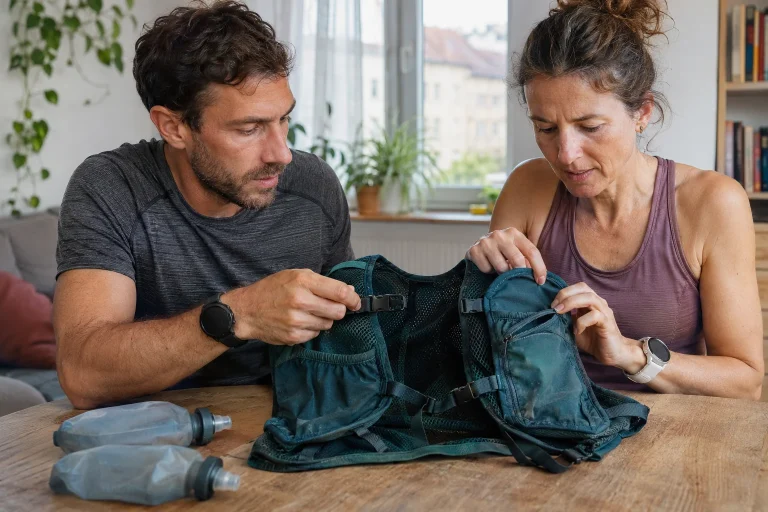
If you use a running vest or belt, check its position over the intended layers with your own appropriate equipment too. Adjustment, access and hose routing may differ over thicker garments or different surfaces. Know how to reach the bottle, open a pocket and put on or take off the jacket. You do not need to invent a new adjustment every day, but the previous summer setting may no longer suit. A short, calm trial reveals where to adjust according to the manufacturer and which garments do not form a working combination.
 Enlarge diagram
Text version of the diagram
- Ready to use
- Clean, dry, suitable and checked.
- Needs preparation
- A specific care, identification or trial task.
- Fault to clarify
- Repair or replacement-part questions marked separately.
- Ready for storage
- Goes into longer storage after a condition check.
Cuffs, gloves and watch buttons
Try gloves brought out for colder weather together with your watch and jacket sleeve. Can you reach the necessary button, does the cuff press it accidentally, and can the free end of the strap be managed? Follow the manufacturer’s wearing instructions, especially if using a wrist sensor. Access to controls and measurement conditions are different questions: wearing the watch outside clothing may make buttons easier to press without leaving every function equally usable. The manual helps establish which wearing positions and controls that particular model supports.
Check phone and key placement in the new outfit too. Instead of the summer trouser pocket you may need another holder, and a familiar small zip may be harder to use in gloves. Do not discover while setting off that a necessary item is reachable only after removing the entire vest. Test access in a well-lit place while keeping a secure hold of the items. There is no need to discard every working summer arrangement; check which remains appropriate alongside the changed layers and accessories.
Rain jacket: separate condition from care tasks
Examine the fastenings, seams, fabric and visible damage on the outer layer brought out for rain. Describe any known wetting problem accurately rather than automatically calling it a leak or merely a surface-treatment issue. The GORE-TEX explanation of water-repellent treatment distinguishes the role of the outer DWR treatment from that of the waterproof layer. An absence of surface beading is not a complete fault diagnosis on its own, and new water-repellent treatment does not automatically repair damage either. Apply the precise instructions for your own jacket.
If cleaning or surface care is needed, follow the procedure for the model together with its care label. The GORE-TEX outerwear care page also gives guidance with reference to the clothing manufacturer’s instructions and discusses exceptions relating to construction. Do not apply an identical heat-treatment recipe to every jacket. After care, allow the garment to dry completely and check its known functioning calmly. The seasonal change is a useful opportunity because there is still time to clarify missing information or repairs.
Check visibility on the complete outfit
A reflective section does not always remain exposed when covered by a jacket, vest or belt. So when rearranging clothing, do not merely count existing markings; examine their visible position on the outfit as worn. A lamp producing its own light and a surface reflecting external light serve different roles. Do not automatically infer the performance of one from the properties of the other. Check the particular product’s intended use, condition and position alongside the requirements of the route and circumstances.
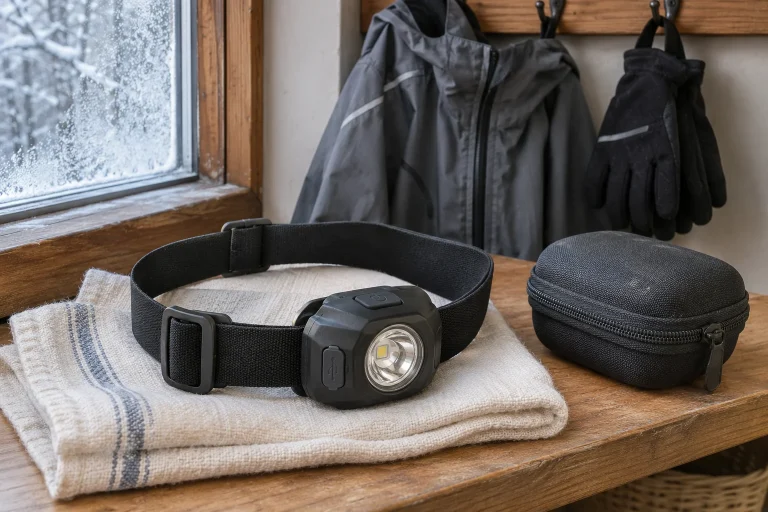
Include lamps, straps and suitable power sources in the equipment check, even though they are not garments. Follow the particular model’s manual for permitted care and storage. A strap put away wet or a forgotten switch lock is a preparation issue; damaged equipment is a separate repair matter. A brief flash does not prove sufficient runtime for the entire run, so power planning must also reflect the specific mode and conditions. The aim is an organised set of departure kit, not ticking off a lamp that exists in a drawer but has an unknown condition.
| Connected items | Trial question | What should you look for? |
|---|---|---|
| Two upper layers | Can the shoulder move freely and the fastening open? | Pulling, bunching, obstruction. |
| Gloves and watch | Can controls be reached as intended? | Accidental presses and difficult access. |
| Jacket and vest | Does the adjustment fit, and can you reach the bottle? | Differences caused by changed layer thickness. |
| Visibility element and outer layer | Does the relevant surface remain exposed? | A pocket, strap or jacket covering it. |
| Wet and dry kit | Can they be placed separately after use? | Becoming wet again and overcrowded storage. |
Garments going into storage should not be unfinished tasks
Care for less frequently needed clothing according to its own label and dry it completely before longer storage. Empty pockets, remove unrelated objects and document visible faults. The official GINETEX guide to care symbols helps interpret separate washing and drying conditions. Putting summer clothes away is no reason to use the same procedure for all of them. Prints, linings, stretch panels and other additions are covered by the finished product’s own care instructions.
Choose storage compatible with the product instructions that keeps clothing in a clean, dry place without pressing it against sharp objects. Zips, buckles or pointed fasteners should not press into thin fabric. Do not store a garment awaiting repair as though it were usable: its label should name the specific action needed. That avoids rediscovering the same fault when you next bring it out. The storage should be identifiable, but every T-shirt does not need its own box; a simple arrangement by functional groups is generally easier to understand.
 Enlarge diagram
Text version of the diagram
- Upper layers
- Shoulder movement and access to collar and zip.
- Gloves and watch
- Controls used according to the wearing instructions.
- Vest and jacket
- Adjustment, bottle access and hose routing.
- Visibility element
- Another layer or strap must not cover it.
- After-use arrangement
- Give wet and ready items separate places.
What should really stay close at hand?
Put garments needed regularly in the coming period and in suitable condition somewhere easy to reach. A less frequently used layer with a realistic transitional role may also remain accessible and clearly separated. You do not need to crowd every other piece of equipment beside the door for daily departures. Location should indicate condition: ready-to-use items, those awaiting care and those drying should not become mixed. This is particularly helpful for early departures in darkness, when a clear storage arrangement reduces searching.
If several people share storage, adapt identification to your shared system. Similar gloves or lamp straps should not accidentally end up in someone else’s kit. Keep the product identifier and access to instructions with rarely used accessories. A photo of difficult threading or a proven adjustment consistent with the manufacturer’s directions may save time later. The aim is not complicated inventory management but linking the correct item with the information belonging to it. An organised wardrobe helps when it also supports practical use.
Two everyday seasonal-change situations
In the first illustrative situation, the garments are suitable individually, but the vest is too tight over a thicker top and the watch becomes trapped under a cuff. The first step here is not replacing the whole wardrobe but clarifying adjustment and access in the complete outfit. In the second example, summer clothing is put away in a bag that looks organised, but damp fabric and packaging remain in a pocket. What was missing here was emptying pockets and a full condition check before storage. These examples do not come from product testing; they show two different weak points in the process.
The shared lesson is that changing seasons involves assessing connections and conditions. Clothing forms a system together with other garments, accessories and care facilities. After the first few properly prepared uses, observe whether the new arrangement works. If you regularly search for an item deep in storage, move it somewhere better; if something remained in daily kit without justification, relocate it. The reorganisation need not be a perfect one-off solution. Actual use shows which points need small changes.
A prepared seasonal wardrobe means known condition
At the end, have a few complete, tested combinations for your real situations, with accessible accessories. Give garments awaiting repair a next step, and leave clothing stored for longer clean, dry and identifiable. You do not need a new purchase or separate compartment for every possible weather condition. What matters is finding suitable equipment for a particular departure, understanding its condition and having layers that work together. That makes the seasonal change useful preparation rather than merely a pile of clothes moved to another shelf.
Sources and further reading
How Futószív articles are prepared: our editorial guidelines.