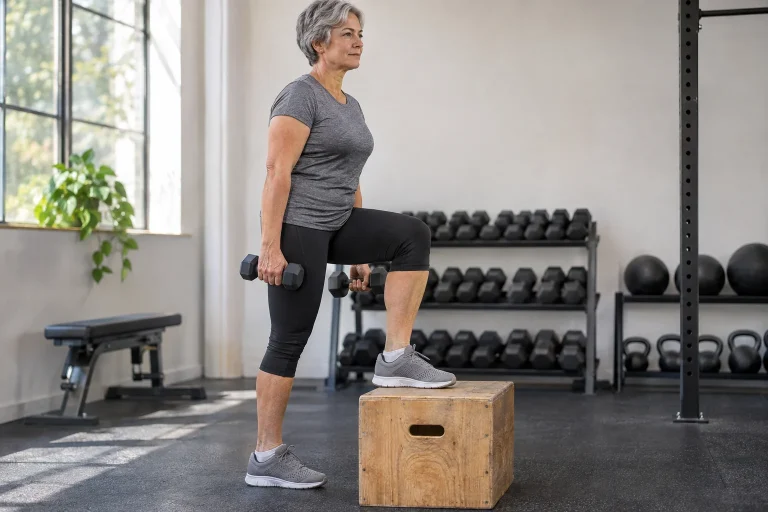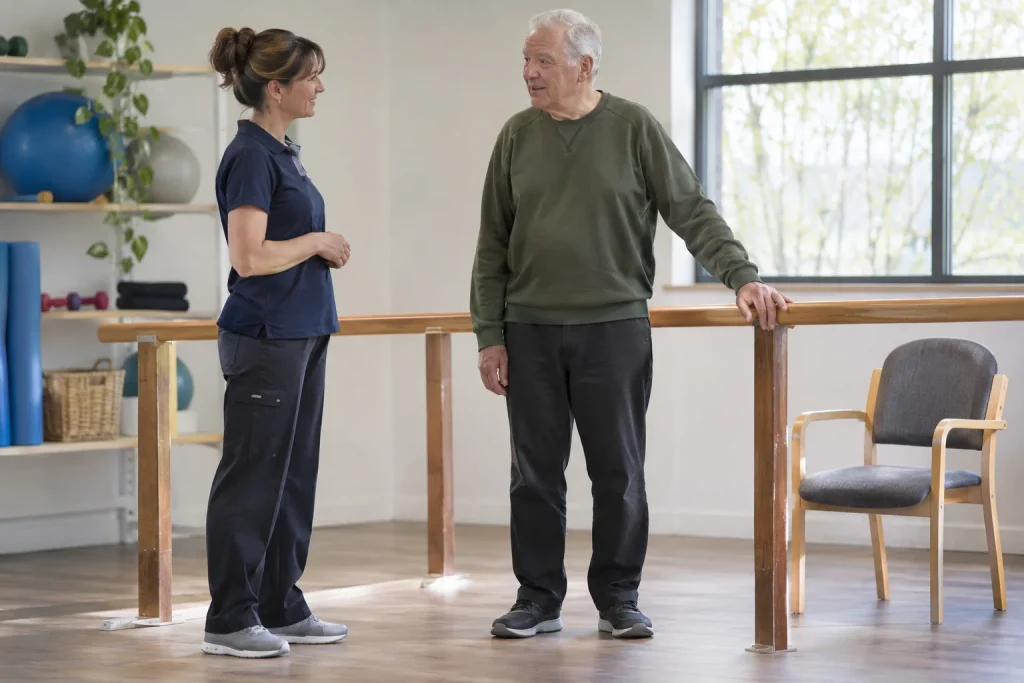
You can comfortably complete a longer walk, yet feel unsteady when turning or on a darker stretch of pavement. These experiences do not necessarily contradict each other. Sustained forward movement and maintaining balance are related but different tasks. Distance covered cannot reveal every detail of how you adapt to a sudden change of situation.
This does not mean that a long walk has no value, or that every older person has a balance disorder. Rather, it reminds us that movement uses several abilities at once. If you experience new or recurring dizziness, staggering, a fall or a feeling that you might faint, do not assess yourself by making the next walk longer. Stop safely and seek healthcare appropriate to the situation.
Distance shows one part of the whole movement
Completing a longer route gives you experience of how you managed the activity in those circumstances. Pace, surface, stops and familiarity with the route are part of that experience. The loop’s length does not separately record how easily you turned, how you responded to an obstacle, or whether there was a moment of unsteadiness. These details remain separate questions alongside the kilometre total.
The CDC’s physical activity recommendations for older adults separately identify aerobic activity, muscle strengthening and activity to improve balance. This illustrates why inferring every ability from a single activity is inappropriate. Walking a lot does not automatically establish the full state of your balance, just as a balance task does not tell you everything about endurance.
As a practical observation, record the situation alongside the route. For example, you moved comfortably along the straight, well-lit section, but turning at the gate felt unsteady. You do not need to turn this into a diagnosis. Your experience is already described more accurately when you do not compress the entire outing into a general verdict of “I coped well” or “I coped badly”.
Balance involves different kinds of information working together
According to the NIH NIDCD information on balance, the brain uses signals from several sources: vision, the inner ear’s balance system, and information associated with muscles and sensation in the feet all contribute to orientation. The system helps regulate posture both at rest and in motion. This does not mean that one home task can assess every part of it.
In daily life, you do not experience this organ by organ. You simply see the edge of the pavement, turn your head and keep moving. If unsteadiness appears in a particular situation, you may not immediately know which part is more difficult or why. Describing the experience accurately is therefore more useful than immediately calling it “weak ankles” or “poor endurance”.
Carrying out a movement also requires your body to respond appropriately to the situation. A personal assessment may therefore examine several functions, rather than only whether you can stand for a specified time. This complexity is not a reason for alarm; it helps explain why you need not draw a definitive conclusion about yourself from an online test.
 Enlarge image
A familiar route makes different demands from a changing environment
On a familiar path, you know where it turns and where the kerb appears. In a new place, you need to notice more details while also organising your movement. Distinguishing familiar from unfamiliar surroundings can therefore help you understand your experience. The purpose is not to test yourself on increasingly difficult courses, but to identify more precisely which situation raised a question.
The same loop can change during the day. The stretch beside a bench may be empty or crowded; the pavement bright or shaded; the entrance clear or temporarily closed. A lap time reports none of this. If a previously comfortable route feels uncertain today, consider changes at the location before assessing only your own ability.
A simple route note can include separate lines for surface, lighting and places to stop. This is not a risk score. It is an organisational tool that may later explain why two outings of similar length differed. Choosing the environment remains useful even when symptoms also require an individual healthcare assessment.
Planning the daily route can include deciding where to stop for your phone, bottle or keys. You do not have to deal with these while moving just to keep the recorded moving time continuous. A calm, safe stop preserves the outing’s purpose even if it interrupts forward progress. You then do not have to watch the route, operate a lock and follow your companion’s rhythm all at once. This is an organisational choice, not a new balance exercise.
Clarify what you mean by dizziness and unsteadiness
“I felt dizzy” can describe different experiences. The NIDCD account distinguishes, for example, a spinning sensation, unsteady standing and a feeling of impending fainting. Your task as a reader is not to establish the cause, but to explain your own experience as clearly as possible. Saying that your surroundings spun is different from saying that you had to hold on because your next step felt uncertain.
You can also note whether it happened while moving, standing up or resting, and whether there were other symptoms. You do not need to reproduce the symptom. In particular, do not start independent head-turning or eyes-closed tests to find a more precise explanation. The situation you already observed can provide a starting point for an appropriate assessment.
The NHS information on dizziness also highlights discussing recurring symptoms and accompanying problems. If you are uncertain, ask for help; with severe or sudden illness, safety and care take priority over note-taking. A good walking distance is no reason to dismiss a new experience as insignificant.
Reviewing vision and medicines is not a criticism of fitness
If you are very active, questions about your vision or medicines in connection with unsteadiness may feel unfamiliar. Yet the CDC’s falls-prevention information includes these among the factors to review. The question is not whether you look sporty enough, but what may influence safe movement in the specific situation.
What you can contribute is whether something changed: perhaps you started using new glasses, were prescribed a different medicine, or noticed unsteadiness in a new location. A link in time does not establish a cause, but may provide useful information. You do not need to stop treatment or change glasses on your own before the assessment to conduct an experiment.
You can identify troublesome environmental details in advance too, such as poor lighting or a hard-to-see step edge. Professional assessment and simple improvements to the surroundings are compatible. Keep the distinction clear: an extra light or a better surface does not explain what caused the symptom; it can only change a specific obstacle.
Why is standing on one leg not enough to draw a conclusion?
A task’s result must be interpreted within its particular conditions. Support, flooring, footwear, vision and the exact instructions all matter. Online challenges often omit these details. A single time result is therefore not a certificate for your entire balance system, and cannot establish whether you can safely run a particular route.
Clinical assessment may combine several kinds of information, including your history and symptoms. Your task is not to replace this at home. If you are curious, take the question further: what does the particular test examine, why might it be needed, and what can it not establish? This is more useful than placing a test performed under uncertain conditions in an age-group ranking.
In particular, do not turn unsteadiness into an increasingly difficult challenge. Closing your eyes, using an unstable device or removing support is not a general next step for every older person. Choose the difficulty and safe conditions of an individual task with appropriate help. A movement can be brief yet still put you in an unsuitable situation.
 Enlarge image
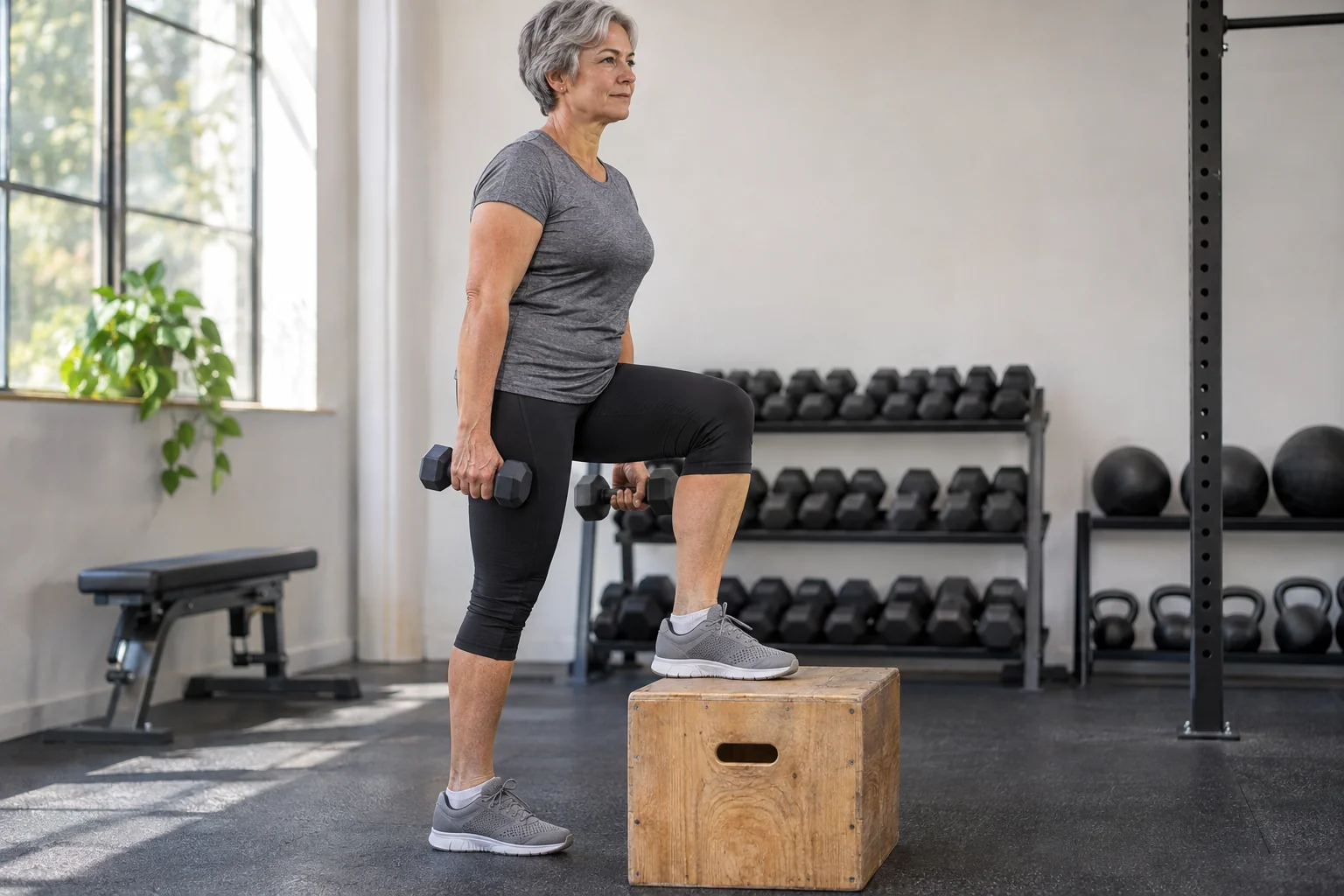
You can keep the long walk while making room for another ability
If your usual walk suits you and you enjoy it, there is no need to devalue it simply because we are discussing another function. An activity routine can have several parts. The question is whether a personal goal might also involve a different, appropriately selected form of movement. This differs from adding another compulsory programme to the existing one.
When looking for strength or balance sessions, consider more than the name. You can ask how individual modifications work, whether stable support is available and what background information the instructor requests. Good organisation allows participants to choose different levels of difficulty. When symptoms are present, however, a group class cannot replace an individual assessment that is needed.
The new element’s place in everyday life matters too. If fitting it in would require a long journey and rushing, another solution may be needed. A movement routine does not become comprehensive by containing as many programme titles as possible. It can become more useful when you understand each task’s purpose, circumstances and your own way of participating.
Describing a situation helps more than the label fit or unfit
Imagine someone who walks regularly without difficulty on a straight path, but had to hold on when stepping through a gate. They need not declare all their previous activity unsuccessful. Equally, they need not put the incident aside by pointing to the many kilometres covered. The specific situation can be assessed separately without placing the whole person under a single label.
| Instead of a general label | A more precise observation |
|---|---|
| My fitness is good, so there definitely cannot be a problem. | The longer straight route was fine, but I had to stop when turning. |
| I must just have become clumsy. | This unsteadiness is new, and I can identify where I noticed it. |
| I should practise even more. | First, what made that particular situation difficult needs clarification. |
Such a description is neither a diagnosis nor a new self-scoring system. It helps prevent your experience from disappearing behind general judgements. The next decision might involve an environmental change, an individual assessment or a different, appropriately selected activity. Previous walking distance alone does not decide this.
Sources
NIH NIDCD: balance disorders and how balance works; CDC: different forms of activity in older age; CDC: preventing falls; NHS: dizziness. Checked: 20 November 2026. The editorial examples are not tests to perform at home, and balance cannot be assessed from a single performance measurement.
How Futószív articles are prepared: our editorial guidelines.