The group’s arrangements need to be visible behind the phrase
The running invitation says no one will be left behind. A new participant takes this to mean some support and a shared programme they can follow. The organiser, however, may mean only that everyone will be waited for at the finish. There can be an entire route’s worth of difference between those meanings. A good community promise can therefore be broken down into concrete organising tasks.
This article offers considerations for planning shared sessions for adult running groups. It does not prescribe the same leadership method for every location or promise complete freedom from risk. The aim is to match the advertised commitment to staying together with participants’ experience and the actual route.
First clarify what kind of shared programme you mean
A social loop moving together, a session divided into pace groups and an event completed independently on a defined course require different arrangements. Leaving no one behind can mean different tasks in all three. If you do not name the basic format, participants fill the gap with their own previous experiences.
The description should make clear whether you move together throughout, whether there are preannounced regrouping points and who helps people follow the route. Explain what happens if someone does not follow part of the programme or finishes early too. The boundaries of the shared commitment should not develop along the way.
Concrete information does not spoil a friendly atmosphere. It enables a new runner to choose an appropriate session. The general description “inclusive” gains workable arrangements that returning members understand in the same way.
Have answers to four questions behind the invitation
| Question | What needs clarifying? | What remains unclear without it? |
|---|---|---|
| Who keeps track of the back of the group? | An explicitly accepted role and communication | Everyone assumes someone else is watching |
| Where will you regroup? | Recognisable, suitable locations and a procedure | Those behind follow only retreating backs |
| How can the programme change? | Agreeing a shorter route or different finish | A change looks like accidental separation |
| When is it over? | An orderly finish for every participant | Waiting at the finish is confused with actually keeping track |
The table is not a complete leadership manual. The participant mix, location and organisation’s own rules may create additional tasks. The four questions help prevent the basic promise from remaining an unchecked slogan.
 Enlarge diagram
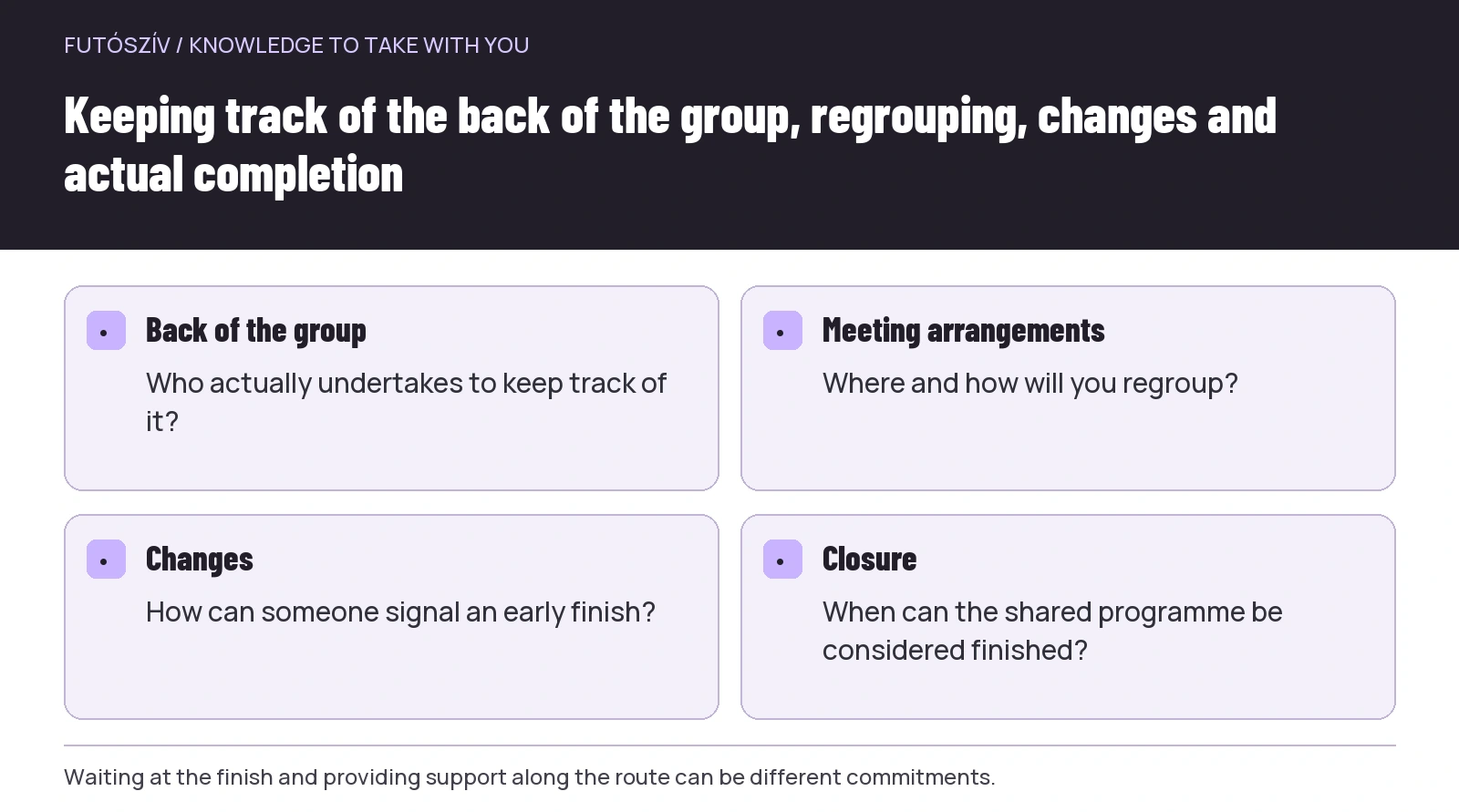
Text version of the diagram
- Back of the group
- Who actually undertakes to keep track of it?
- Meeting arrangements
- Where and how will you regroup?
- Changes
- How can someone signal an early finish?
- Closure
- When can the shared programme be considered finished?
The back-of-group role cannot be assigned by accident
If someone helps keep track of the back of the group, they should know about and accept the task. It should not automatically fall to the slowest runner simply because they happen to be at the back. The role requires knowing the programme, the means of contact and who makes organising decisions.
The official parkrun volunteer role description defines a separate Tail Walker role for moving at the back of the field and keeping track of participants. This is a role within parkrun’s own organised event system. A club does not become equivalent merely by calling someone a back marker.
What is useful in the example is the specificity of the role: someone owns the task, it has a known place in the arrangements and a connection to finishing. In your own group, adapt this to the local plan with suitable knowledge and organisational support. The name alone does not replace these conditions.
A regrouping point is for the whole group
The meeting point should be recognisable and suitable for stopping. A group waiting in the middle of a junction or narrow passage may obstruct others. Choose the place according to the actual route and expected group size, taking local rules into account.
Regrouping should not merely mean the last arrival appears for a moment and everyone else immediately sets off. Look at the point’s purpose: explaining the route, communication, sorting equipment or jointly deciding how to continue. Organise the restart accordingly.
If large differences build up at every point, review whether the programme format fits too. Another route, a smaller group or a separate session may be more appropriate. There is no need to explain a repeatedly recurring organising tension by characterising a single participant.
Looping back can be one method, not a rule for every location
Some clubs keep the group connected by having faster participants return towards the others. The Lawley Running Club description of its club nights also describes this kind of looping back under leader guidance. Faster runners can therefore cover a different distance during the shared session.
The method cannot be transferred blindly to narrow, busy or poorly visible routes. Local use rules, group circumstances and leadership conditions need separate examination. Running back does not justify unexpected changes of direction or ignoring other visitors’ movements.
If you use this format, newcomers should understand it beforehand too. They should not think a few people randomly appear coming the other way or disappear from time to time. The organising method should have a shared meaning, and differences in distance covered should be communicated accordingly.
Splitting into groups requires each to function independently
With several pace groups, each group should receive its own understandable programme. Who leads it, where does it go, how does it finish and what happens if something changes? Groups do not function merely because participants start running in different directions from the same point.
To choose a suitable group, the terms used in the description also need clarifying. What does the stated pace or distance refer to, and how does it fit into the whole session? Necessary questions from a newcomer should be answered before departure. A shared start time does not mean every session suits everyone in the same way.
Discuss arrangements for changing groups later too. This is not a performance ranking but a way to match personal tasks with the group format. Someone for whom another session is better should be able to choose it clearly and without social penalties.
 Enlarge diagram
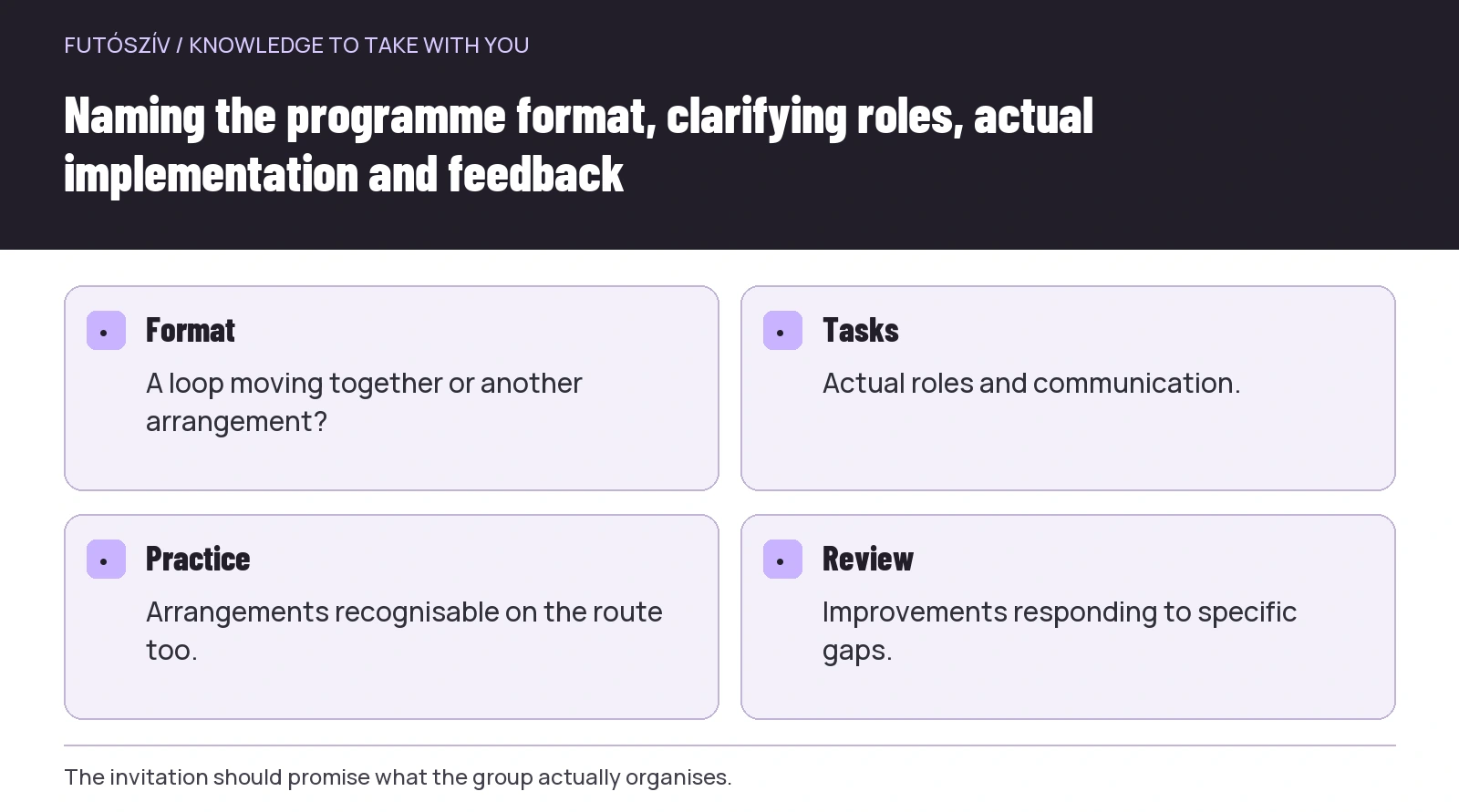
Text version of the diagram
- Format
- A loop moving together or another arrangement?
- Tasks
- Actual roles and communication.
- Practice
- Arrangements recognisable on the route too.
- Review
- Improvements responding to specific gaps.
Finishing early should not become disappearing
An adult participant may decide to finish their programme sooner in the previously agreed way. The group’s arrangements need to handle this. The appropriate person should know what changed, and finishing should be orderly. Disappearing from the route without a word leaves uncertainty behind.
At the same time, the shared promise should not become persuasion to continue. Leaving no one behind cannot mean someone must stay with the others at all costs in a programme no longer suitable for them. Where necessary, appropriate help or professional consultation takes priority over the original plan.
Do not invent an unfamiliar shortcut on the spot for an early finish. Thinking through an understood return option and communication beforehand helps. The specific solution depends on the participant’s circumstances and the environment, so a short article cannot give the same automatic procedure for every case.
An edited example of two differently understood promises
An urban group’s invitation advertises a friendly shared loop, adding that no one will be left behind. A new runner expects support in following the route and at junctions too. Regular members, however, understand the phrase as waiting for everyone at the finish. The difference becomes apparent after the first few junctions.
The revised programme description clarifies the format. It names today’s leader, the role following the back of the group and the regrouping procedure. Participants know which route variant they are choosing and how to signal an early finish. After the session, the group checks whether the promised arrangements actually happened.
The example does not claim every urban loop needs identical staffing levels or technical systems. It shows the relationship between a promise and the actual task. A community phrase helps when the organiser and newcomer understand its meaning similarly.
A participant’s question is not distrust
When someone asks what staying together means, they are requesting concrete information. There is no need to answer that they should not worry because everyone here is nice. Personal kindness matters, but it does not explain arrangements at the next junction or finish.
A usable answer briefly describes what actually happens. If something has not yet been worked out, that too can be named and resolved before the session. Clarifying a limitation beforehand provides a better foundation than a promise too broad to fulfil on site.
Do not judge participants’ sensitivity in feedback either. Examine whether the invitation was accurate, the briefing understandable and the programme consistent with it. This produces an organising task that will help the next newcomer too.
Volunteer support needs boundaries too
Clarify in advance what helpers in the group are undertaking. In every difficult situation, organising should not fall to the same informal member who arrived for their own session. The role requires both the actual task and appropriate support.
Helpers should be able to ask questions and indicate when a session needs different arrangements. Accepting a task does not mean they must provide a solution alone for every circumstance. Those responsible for the group’s operation should know the agreed boundaries too.
If a role requires training, organisational rules or another condition, fulfil it within the appropriate system. An overseas club example does not automatically confer a Hungarian qualification. The article offers considerations for clarifying tasks, not a qualification or insurance promise.
Include actual feedback in closing the session
At the end, establish whether participants have completed their agreed session in an orderly way. The precise arrangements should match the group format. Faster runners reaching the finish does not automatically mean the whole programme is over.
Briefly assess where staying together worked, where uncertainty arose and which information was missing. Clarifying a junction or how to signal completion can be concrete improvements. There is no need to redesign the whole system after every session.
In the next invitation, promise what you can actually organise. Leaving no one behind can then be shorthand for understandable arrangements, rather than a reassuring sentence replacing the details. Participants can recognise the community’s openness on the route and at the finish too.
How Futószív articles are prepared: our editorial guidelines.