Instant pace on a running watch changes constantly, and it is easy to respond physically to every new number. You accelerate, the display reacts later, then shows a value that is too fast, so you ease off. By the end of the run, you have looked at your watch a great deal without necessarily learning how your chosen pace feels.
A track section of known length provides a different kind of feedback: the distance is fixed, you can measure the split simply, and meanwhile observe how it feels. It does not require an elite interval workout. Practising pace awareness can be a manageable, precise and calm task.
Step one: know what you are measuring
Not every oval running circuit is four hundred metres long. School, park and indoor tracks may differ. First establish the lap length, usable markings and designated running line through the facility’s official information or local specialists.
The background to standard athletics track dimensions and markings is described in the World Athletics technical documents . Different lanes and start markings are not freely interchangeable. If running a full lap in an outer lane, do not assume that starting at the same point gives exactly the same distance as an inside lane.
Local rules take precedence during training. Ask beforehand which lane you may use, the direction of running and how overtaking works. Accurate split measurement is no reason to create danger or disturb others.
Step two: calculate the time in advance
First convert pace per kilometre into seconds. Five minutes per kilometre means three hundred seconds for one kilometre. Multiply this by the section’s length in kilometres for the theoretical split: sixty seconds for two hundred metres, one hundred and twenty for four hundred, and two hundred and forty for eight hundred.
Another example: five minutes thirty seconds per kilometre is three hundred and thirty seconds. For four hundred metres, forty per cent of that is one hundred and thirty-two seconds, or two minutes twelve seconds, at an even pace. These are mathematical examples, not individual training paces.
The formula is simple: split time in seconds = kilometre pace in seconds × section length in metres / 1000. Write down the one or two numbers you need before setting out. Mental division while running a bend does not necessarily support calm movement.
Minutes and decimal numbers are different
Five minutes thirty seconds is not 5.30 minutes but 5.5 minutes. The conventional display for running pace uses minutes:seconds, while a spreadsheet or calculator often expects a decimal number. This can easily produce an incorrect target time.
If unsure, perform every calculation in seconds and convert back at the end. One hundred and thirty-two seconds is two minutes and twelve seconds. The same method works when calculating kilometre pace from the time taken for a completed section.
Check the proportion: at the same even pace, twice the distance requires twice the time. If your target for four hundred metres is not twice the two-hundred-metre target, a formatting or calculation mistake has probably occurred. Better to notice at home than follow it on the track.
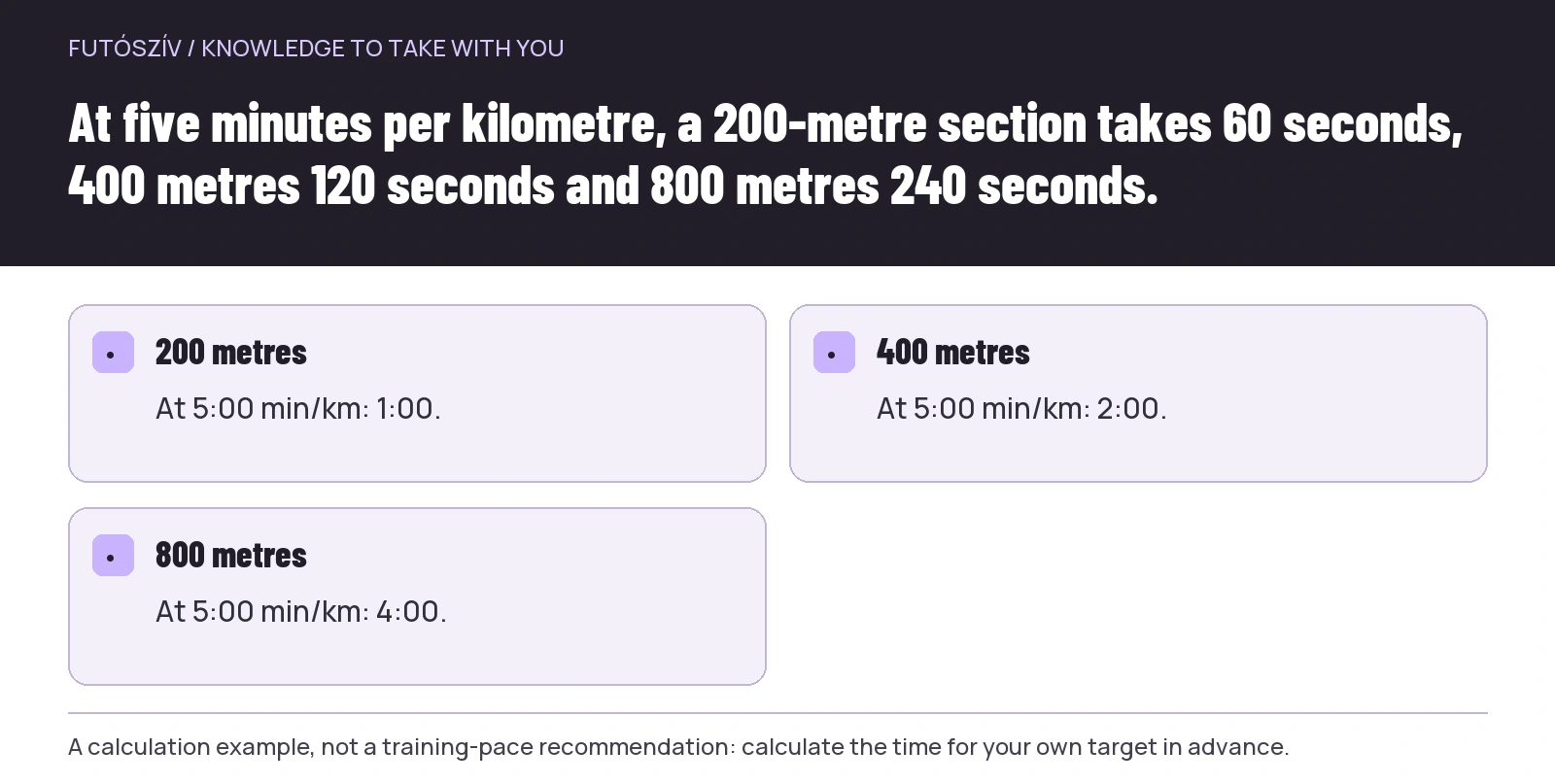 Enlarge diagram
Text version of the illustration
- 200 metres
- At 5:00 min/km: 1:00.
- 400 metres
- At 5:00 min/km: 2:00.
- 800 metres
- At 5:00 min/km: 4:00.
Step three: choose a manageable learning task
You do not need to run at your limit to practise pace awareness. Choose an effort that leaves attention for movement and checking. If you are waiting only to stop at the end of every section, little room remains to connect sensation with time.
The practice can fit into an otherwise appropriately planned run. The exact number and length of sections depend on your background; do not build a whole workout from a numerical example in an article. Repeatability is the main goal here, not accumulating as many fast laps as possible.
Working with one pace may be enough initially. If every section is a different task, recognising what you have learnt becomes harder. Before introducing variety later, gain experience of starting and maintaining a particular manageable rhythm in an organised way.
Step four: estimate before checking
As you approach the marking, tell yourself whether you think the section was faster, slower or close to the intended time. Only then look at the clock. Your watch then provides feedback on your own estimate rather than simply issuing instructions.
Notice a few simple sensations: how settled your breathing is, how much attention maintaining the rhythm requires, and how rushed your steps feel. You need not analyse every movement. The aim is a recognisable overall picture that you can draw on later on the road too.
An inaccurate estimate is useful information. It shows exactly what is worth practising. When learning pace awareness, disagreeing with the stopwatch is not failure but information; a small, considered adjustment may be enough for the next section.
Step five: measure at the marking, not by the satellite
On a known track section, a physical marking and manually recorded split connect more directly with the task than the point where an automatic lap alert happens to sound. Start and stop at the same clearly identified point while moving safely.
A measurement study examining eight positioning-enabled sports watches found different distance errors in different environments, including the track. The result applies to those devices and settings, but gives reason not to automatically override a known distance because the display differs by a few metres.
Manual measurement can also go wrong: pressing late, mistaking the line or accidentally recording twice. Do not draw major conclusions from one odd time. Mark the faulty section and evaluate the more reliable repetitions.
A lap average does not mean an even lap
Running four hundred metres in two minutes gives an average of five minutes per kilometre. But that can include a fifty-second first two hundred and a seventy-second second half. The average is exactly the same; the execution is entirely different.
For learning purposes, checking an intermediate marking can sometimes help, provided it genuinely indicates the correct distance. This may reveal whether you repeatedly start too fast and then slow down. However, there is no need to look at the watch every few metres; excessive checking fragments attention.
Make the task clear in advance: are you practising similarity between complete sections, or pacing within one section? These questions are related but require different data. Knowing what you are attending to lets you learn more from fewer numbers.
Do not turn a correction into a punishment sprint
If a lap is a few seconds slow, you need not regain everything in the next opening straight. This can produce uneven running and shift attention away from rhythm. Instead, adjust effort slightly, then review the result of the next complete section.
The same applies after a fast lap. Do not brake suddenly or change direction in front of others. The aim is to develop a manageable rhythm, not manipulate the clock to the exact second. Remain predictable for runners alongside you too.
Fit acceptable variation to the purpose of the task. A learning session does not necessarily warrant restarting a repetition for every small difference. Weather, overtaking and manual timing can all cause variation; the pattern matters more than a flawless sequence of numbers.
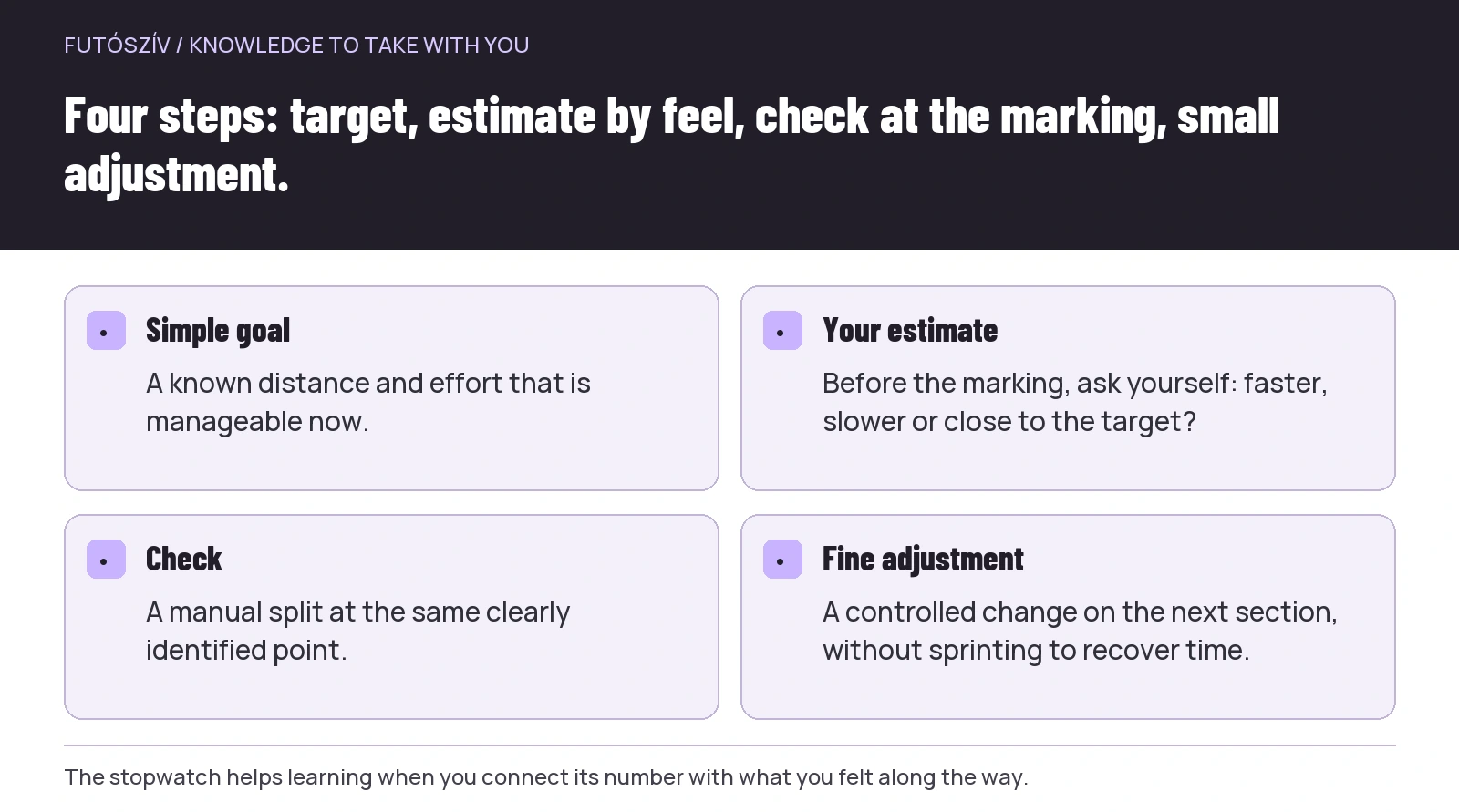 Enlarge diagram
Text version of the illustration
- Simple goal
- A known distance and effort that is manageable now.
- Your estimate
- Before the marking, ask yourself: faster, slower or close to the target?
- Check
- A manual split at the same clearly identified point.
- Fine adjustment
- A controlled change on the next section, without sprinting to recover time.
Keep recovery time separate from running time
If doing a task divided into sections, make recovery duration and form clear too. Do not confuse the running sections’ times with the whole session’s average pace. An app’s overall figure may also include walking, standing or jogging between them.
What preceded each repetition matters to learning too. An easy lap after much longer recovery may not be directly comparable with one after shorter recovery. You need not regulate everything rigidly, but record the difference.
If the task was pace awareness, finishing very tired should not be the sole outcome. Check whether your estimates improved, starts became more controlled and fewer major corrections were needed. These more directly reflect the purpose of the practice.
Two common errors behind the numbers
Starting too fast: the runner accelerates vigorously in the first few steps, then eases off as the target time approaches. The whole lap may still look right, but movement fluctuates. Next time, focus on a calmer, gradual start rather than another increase in pace.
Adopting other people’s rhythm: the runner speeds up unnoticed alongside a faster companion, then slows when alone. Clarifying their own task in advance helps here. A group can work at different target paces; every start need not be a shared race.
Describe the error factually. Instead of “I ran badly”, “the first two hundred was regularly faster than planned” is more precise. This can become one clear focus for the next attempt.
How much feedback is enough?
In an experiment with recreational runners, external pace feedback did not clearly change the chosen submaximal running pace. This does not mean a watch is useless or that the same amount of data is best for everyone. Feedback’s role depends on the task and experience.
On the track, you can try checking at the end of every section initially and less frequently later. The purpose is to strengthen independent estimation. If less checking makes the task fall apart completely, return to using more reference points.
Learning is not about abandoning the watch. It is about using numbers and sensations together. This is valuable even when the surroundings on a road route prevent holding the same speed at every moment.
What should you take home from the track?
Choose three observations: how the start felt, how accurately you predicted the time, and how effort changed between repetitions. Write split times alongside these, not instead of them. This makes the next session easier to compare.
The rhythm learnt on the track is a reference on the road, not a command. Uphill, into wind or on a crowded route, the same effort can produce a different pace. Good pace awareness helps you recognise this rather than force the same number for the display’s sake.
If you finish the practice with less rushing, more deliberate starts and more accurate self-estimation, the main purpose has been met. The track need not be only a place for fast training. It is a known measurement environment where you can learn more about your own rhythm too.
Sources
- World Athletics: official technical documents and track markings.
- Accuracy of Distance Recordings in Eight Positioning-Enabled Sport Watches: Instrument Validation Study – measurement accuracy dependent on device and environment.
- External Feedback Does Not Affect Running Pace in Recreational Runners – a specific submaximal running experiment, not a universal prohibition or prescription.
How Futószív articles are prepared: our editorial guidelines.