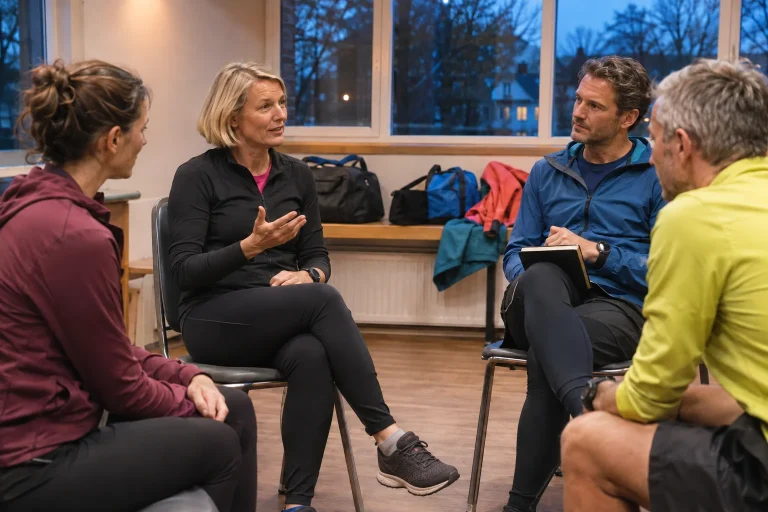
“Designed especially for you,” says the running programme, and for once its picture does not feature only people with competitive athletes’ physiques. That can feel liberating. Addressing beginners in larger bodies does not, however, prove the offer accommodates participants’ different histories, health circumstances or everyday lives. To assess it, slow down the sign-up process: first name exactly what is promised, then look for what supports it.
You do not have to become a researcher or coach to ask targeted questions. A useful programme description makes clear what happens at sessions, who leads them, which modifications are possible and what counts as success. This article helps with choosing; it does not recommend running for everyone in a larger body or provide an individual training load. If you are looking for answers because of pain that has already appeared during the programme, do not assess it through a reassuring advertising sentence.
Turn the promise into a claim you can check
“We’ll change your life” sells a feeling. “By a given date every participant will lose the same weight and run the same distance”, however, is a specific claim that would need evidence and conditions. Separate claims about weight, running performance, health and experience. They are not interchangeable outcomes: an enjoyable group session does not substantiate a promise to eliminate a condition, and crossing a finish line does not establish that the programme was suitable for every participant.
The US NIDDK guide to choosing a programme highlights, among other things, exaggerated adverts promising rapid weight change and before-and-after presentations that seem too good to be true. It recommends checking professional background, safety, costs and outcome data. This is US information about weight-management programmes, not a rating system for Hungarian running schools. Its principle of asking verifiable questions is useful when reviewing sports offers too.
Guaranteed kilograms, “no chance of joint symptoms” or a target time regardless of any previous condition need particularly strong clarification. The question is not whether one participant ever experienced such a change, but what justifies a guarantee applying to you and everyone who signs up. If the answer is only motivational language, evidence for the specific claim is still missing. Honest uncertainty is often more useful information than an appearance of complete certainty.
Who was the programme actually designed for?
A “beginner” might never have run but regularly cycle; for someone else, the starting point is a long inactive period or a return after illness. “In a larger body” is likewise not a uniform health or movement condition. A single label is therefore insufficient to tell you which participant the programme expects. Ask which history is assumed, what they ask at registration and whether some situations prompt a recommendation for an appropriate healthcare discussion first.
The description should also explain what a session means in practice. Is there a long walk from the meeting point, what is the surface like, how easily can it be shortened and where does it end? A “short group run” can actually mean a long total journey if the group moves far from the start. Knowing the details lets you compare the offer with your own circumstances without guessing participation from body shape.
The NICE recommendations on physical activity for adults emphasise considering current fitness and ability, with an approach built around agreed goals. They do not prescribe one running programme for every body weight. We use that general consideration from British care recommendations here, rather than turning their population activity amounts into personal beginner doses. An advertisement’s target-group label does not establish the right load for you.
 Enlarge image
A before-and-after picture does not tell the whole story
Even an authentically produced pair of photographs shows only two selected moments. It does not reveal how many people started, who was left out of the presentation, what other changes or treatment occurred or how long follow-up lasted. Pose, clothing and lighting can also affect appearance. You do not need to question the person pictured to assess the advertisement’s evidential strength separately.
A testimonial may answer a different question from yours. If someone says they finally found supportive company, that can be a valuable account of their experience. It does not establish a loading method’s health effects or whether the same thing would happen for you. Check exactly which claim the account is being used to justify. Social satisfaction, weight change and injury occurrence would need different data.
The same applies to a celebrity or fast runner in the advert. A sporting result does not explain how programme participants were selected, how symptoms are handled or how effects were studied. A less spectacular but detailed answer about how sessions work may be more useful than numerous atmospheric videos that do not reveal the beginner’s situation.
What should you ask about a “research-proven” claim?
Ask for an accessible reference and check whether the advertised programme itself was studied. The link may discuss health benefits of activity in general, while the advertisement attributes every result to a particular short running package. That is too large a leap. General exercise research does not automatically replace an investigation of this package, just as results in a group of different age and history do not establish identical effects for every beginner.
When reviewing a study, the participant description, actual sessions and measured outcome are the three main anchors. What did people do? What was it compared with? How long were they followed, and what counted as an outcome? If research followed an entire multicomponent lifestyle programme, for example, its result cannot necessarily be attributed only to the running session. Your questions seek the connection between evidence and the advertised sentence, not the mere presence of a scientific label.
Do not let the argument shift between different outcomes either. Participant satisfaction is not the same as a change in a health condition. An improving average does not mean every person changed equally. Completers’ results alone do not show what happened to those who stopped. If interpreting the numbers is uncertain, independent professional discussion of the claim is a better route than relying on the advertiser’s confidence.
Ask for a denominator and timeframe alongside the percentage
“Most of our clients reach their goal” makes sense only if you know which people and which goal are meant. Was it calculated among applicants, paying customers or only those who attended every session and answered the follow-up question? You do not need to demand a formal research report from a friendly running group. If a paid offer uses a numerical success rate to persuade you, however, understanding how it was produced is reasonable.
The timing matters too. A satisfaction question on the final day gives different information from tracking later attendance or a health outcome. Ask how people who could not finish are handled, whether anyone left because of symptoms and what actual follow-up data exists. Missing data alone does not prove harm, but an unknown outcome should not be presented as certain success.
A few simple notes on your own comparison sheet are enough: “The website gives a specific goal but does not identify the participants”; “The reference concerns another programme”; “They explained the modification process.” These are not scored suitability results. They are reminders to help ensure that, on decision day, you retain more than the atmosphere of the last and most persuasive advert you saw.
What happens if it hurts or you cannot complete the task?
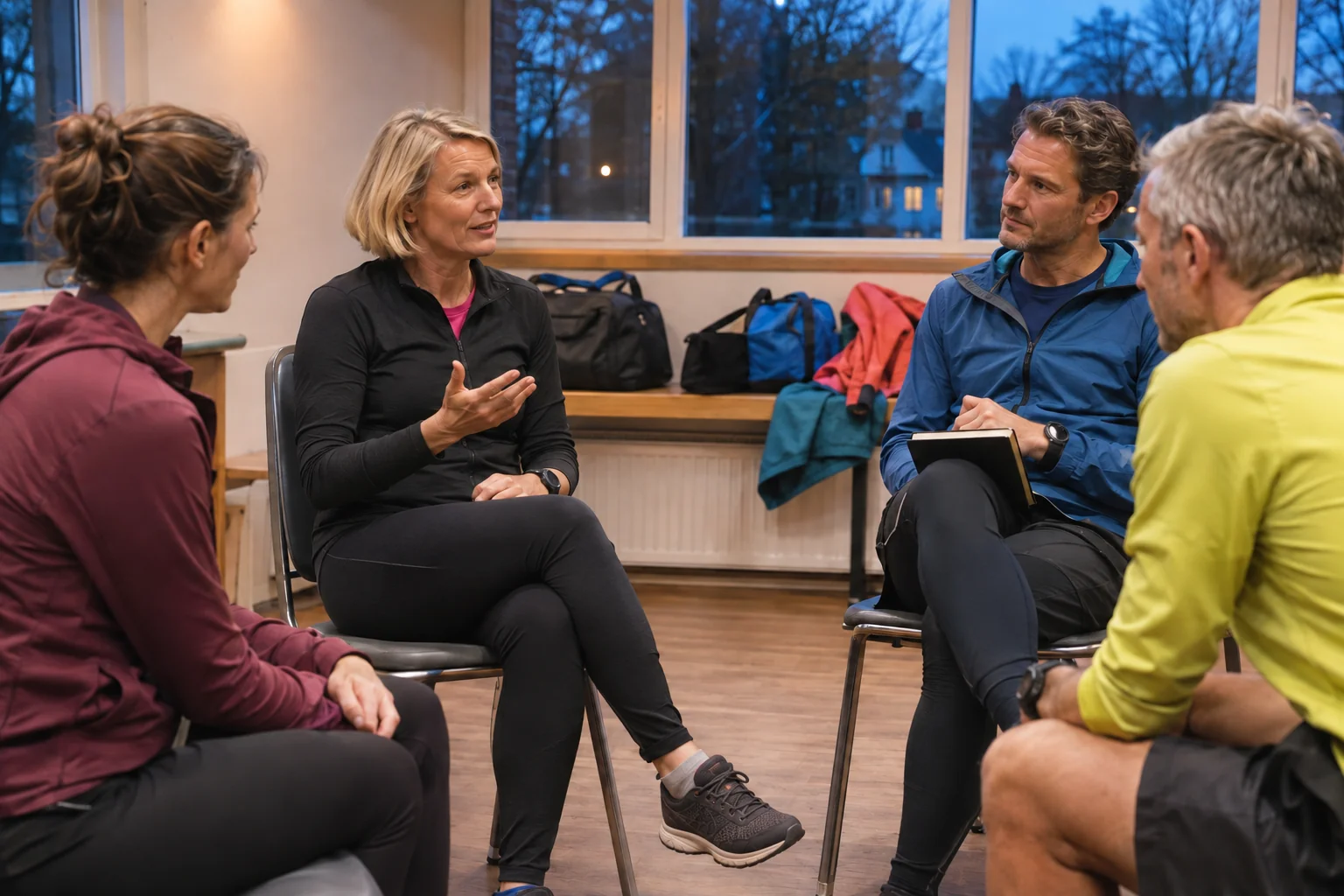
Ask this before signing up. Behind “Everyone at their own pace”, there should be an actual procedure: whom you notify, how you remain in contact with the group, whether another way of participating is available and what happens if you must stop that session. The option to turn back and the instructor’s availability are practical questions. If the only answer is that sufficient willpower will prevent problems, important details remain unclear.
The NIAMS information on sports injuries warns against working through injury pain and advises stopping the activity if movement causes pain. Persistent or worsening symptoms may need healthcare assessment. This does not mean a web article can determine the cause of pain. That is precisely why a generic advertising rule treating every symptom as an obstacle necessary for success is inappropriate.
A modification cannot be merely a theoretical option. If someone who stops a task will be left alone far from the group, they need to know beforehand. If there is an accompanying person or another session leader, their role should be clear. A specific answer about participation arrangements does not guarantee freedom from injury, but says much more about how the programme works than a general slogan of “safe for everyone”.
 Enlarge image
Who takes responsibility, and what are you buying?
The introduction page should identify who leads sessions, their qualifications and experience and which questions fall outside their role. An athletic profile picture or a course logo alone provides little information. Ask about experience with different beginner situations and how they work with an appropriate healthcare professional when necessary. Stating boundaries clearly is not weakness: teaching running does not mean someone can take on every medical or dietary question.
For costs, separate the basic fee from apps, equipment, compulsory products and later consultations. Also ask about the actual conditions for missed sessions, stopping and any refunds. We do not define Hungarian contractual rights or mandatory procedures here: the aim is to know your agreement and seek suitable legal or consumer-protection information if necessary. Pressure that “This price is only for today” does not make these details less important.
If the programme also sells a product, ask whether buying it is genuinely required to participate in the sport. Do not let package extras be used as evidence that the running plan is appropriate. An expensive measuring device, colourful log or supplement does not itself justify the training load. You can assess the parts of an offer separately even when marketing presents them as a single lifestyle solution.
Compare two offers using the same question
Imagine two fictional programmes. One advertises striking transformation photos and the same outcome for everyone but does not explain what happens if you cannot manage the task. The other makes a more modest commitment: it explains the session process, starting conditions and modification options without guaranteeing kilograms or race times. What makes the second more useful is not merely modest wording, but the amount of verifiable information.
Ask both offers the same specific question about your circumstances. For example: “Sometimes work means I must miss a session; how will we decide which task I return to?” Or: “If the load is unsuitable at the venue, what actual options do I have?” The answer may reveal dialogue and organised solutions, or a tendency to treat every deviation as the participant’s fault. You do not have to share personal medical details publicly to ask.
A good choice ultimately requires an understandable commitment and manageable circumstances, rather than perfect certainty. If important questions go unanswered, postponing sign-up can be a deliberate decision too. Refusing to treat loud advertising as a ready-made plan does not judge your interest in activity. You are looking for an opportunity whose actual operation you understand and that makes room for your own feedback.
Sources and the article’s limits
NIDDK: Choosing a Safe & Successful Weight-loss Program; NICE NG246: Physical activity and diet; NIAMS: Sports Injuries – Diagnosis, Treatment, and Steps to Take. The programme comparisons are original fictional editorial examples. The article does not assess a specific provider or make an individual decision on fitness for running.
How Futószív articles are prepared: our editorial guidelines.