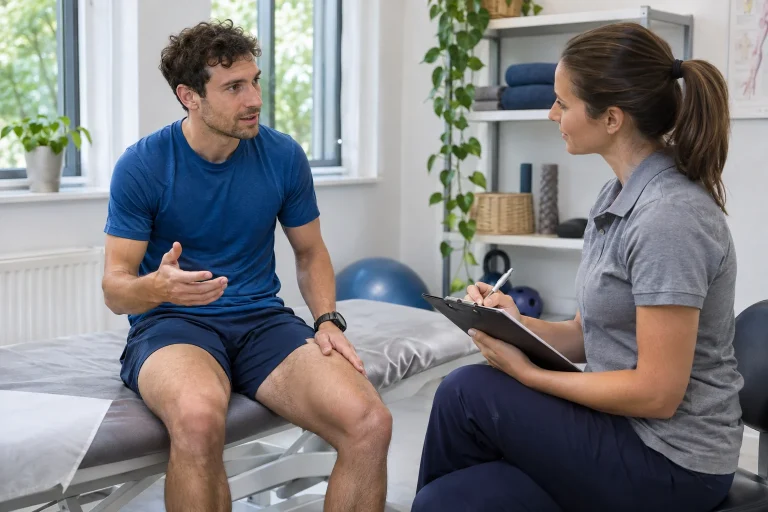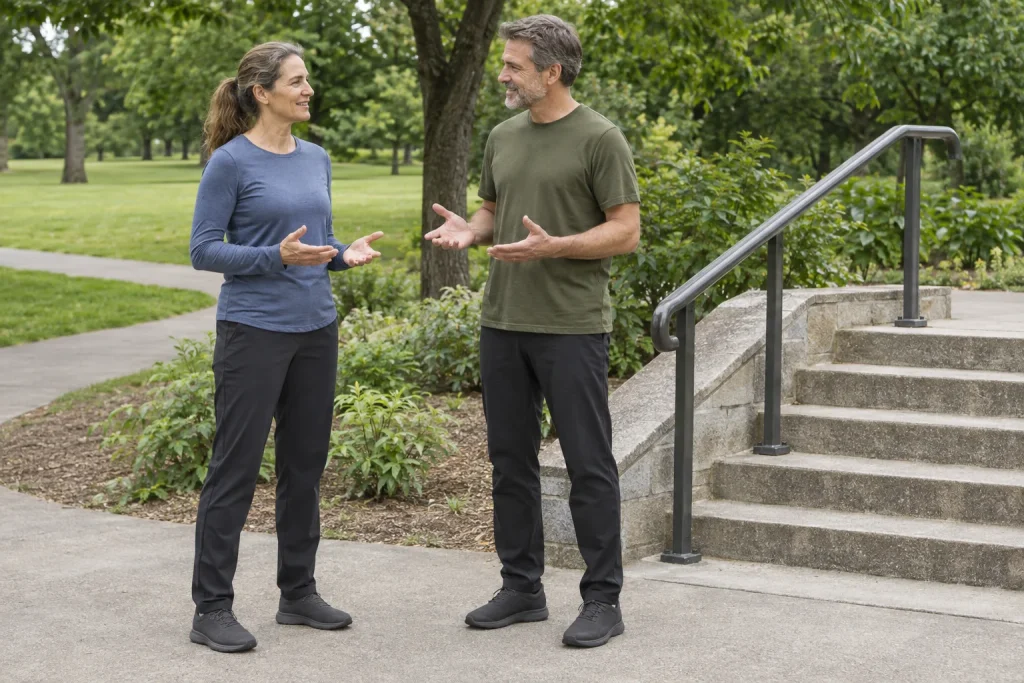
You notice your knee less while running in the park, yet pain around the kneecap returns on the stairs home. This can lead to two opposing conclusions: either running must be fine because it hurts less, or stairs prove some hidden damage. Neither conclusion follows from the difference alone. The pattern is useful information, but the cause and appropriate movement need individual assessment.
Urgent warning: if your knee is very painful, cannot move or bear weight, is significantly swollen, has changed shape, locks or gives way, seek prompt healthcare help. A hot, red knee with fever or feeling unwell may also require urgent assessment. The NHS knee-pain information identifies these as specific warning situations. Do not search for an answer through a running test or repeated stair climbing, and do not wait for the next planned session.
The kneecap area is a location, rather than one diagnosis
The kneecap, or patella, sits at the front of the knee and has a role in the joint relationship with the thigh bone during movement. You can describe pain location without naming the painful tissue. “Around it”, “behind it” or “more below it” can begin a conversation, but location does not establish which condition is present. Several knee problems can point to partly similar areas.
The AAOS information on patellofemoral pain describes pain at the front of and around the kneecap that can occur on stairs and in other situations involving knee bending. The everyday term “runner’s knee” does not mean only runners are affected or that every runner’s front-of-knee pain is the same. Applying an online label to your symptom does not replace examination.
Another important distinction is that describing pain does not automatically describe the extent of damage. A loud crack, a diagnosis given to someone you know or an anatomical diagram you have seen cannot settle your situation. Being unable to point to the location precisely does not prevent seeking help either. Professional assessment can obtain more information from the history, function and examination together.
Why can stairs and running differ?
The two activities do not repeat the same movement situation. Knee bending, support, movement rhythm, direction and surroundings may differ. The IASP overview of patellofemoral pain describes pain around or behind the kneecap aggravated by at least one weight-bearing activity with the knee bent. Its examples include stairs, running and squatting. Pain need not be equally strong in every listed situation.
Your own stair situation can vary too: upwards or downwards, on the first few steps or after a longer climb, empty-handed or carrying bags. Explain these details when you already know them from everyday experience. You do not need a series of tests comparing every version. This article prescribes no new stair technique, step height or compulsory gait pattern to resolve symptoms.
Running circumstances vary too: a level park, downhill, frequent stops or steadier movement. “Less painful when running” is therefore important but still broad. Clarify the session’s circumstances rather than assuming an activity’s name alone means safety or danger. Assessing an individual task involves more than ranking two activities by pain.
 Enlarge image
The difference is not a home diagnostic test
IASP explains that clinical assessment of patellofemoral pain also requires considering other identifiable causes. The symptom pattern can be an important part of the picture, but is not a single sign answering everything. Pain on stairs and less pain while running alone confirm neither a patellofemoral diagnosis nor a particular ligament, tendon or cartilage origin. A web article cannot make that distinction for you.
Do not force an answer through painful squats, jumping or pressing hard on the kneecap. A task used in examination has a purpose and appropriate setting. Repeating it at home may not produce interpretable results and could cause further symptoms. Record what has already happened; you do not need to manufacture new evidence to be taken seriously.
It is also unreliable to conclude that a movement can be done in any quantity because it hurts less. A smaller symptom is not an individual exercise plan. The NIAMS sports-injury guide warns against working through injury pain. With a new or unexplained problem, the task is not to find a way to complete the original programme despite pain.
Consider the whole day
The distance recorded by your running watch may be only one part of what affects your knee that day. Commuting, stairs, carrying things, prolonged sitting or a new home task can all belong in the story. AAOS also discusses changes in activity frequency, duration and intensity as important history. The kilometres in a sports log are not the only relevant detail.
If your travel changed recently, the lift broke, you carried more bags or received a different work task, mention that too. It does not prove the change caused the symptoms. It helps explain what changed in your actual day. Alongside “my running stayed the same”, other circumstances worth a professional knowing can become visible.
Record the sequence simply: when symptoms began, what happened beforehand and how they changed. You do not need to count every stair or monitor the whole day compulsively. A few important real memories may be more useful than many figures uncertainly estimated afterwards. The aim is to understand the overall picture, rather than hunt down a faulty movement.
Everyday functioning deserves attention of its own
Your knee may bother you less during sport while stairs at home or work are already difficult. That does not make the problem less important. An individual goal can concern daily travel and tasks as well as completing a running activity. In the professional conversation, explain which part of life is obstructed rather than comparing only sporting performance with the past.
If a different route or approach is temporarily needed, arrange it within your own surroundings. A lift, another entrance, help with bags or different timing may exist, but none is available to everyone. These are practical options, rather than treatments. Organisational support aims to avoid unnecessarily difficult situations while appropriate assessment and a plan develop.
Do not derive complete, lasting avoidance of stairs from this article either. If you have individual rehabilitation guidance, clarify its boundaries with the treating professional. Arranging temporary access, assessing new symptoms and later building up activity are different tasks. One general “avoid it” or “get used to it” instruction is too little to answer all three.
What direction can individual assessment provide?
The symptom history, current function and necessary examination can clarify the next step. Knee position in one photograph or a single running video does not explain every case of front-of-knee pain by itself. IASP describes patellofemoral pain as multifactorial; assuming the same mechanical fault in every affected person is unjustified. This does not question whether symptoms are real, but marks the limits of a simple explanation.
The 2024 best practice guide for patellofemoral pain prioritises exercise therapy with education based on understanding the individual situation. It discusses therapeutic work directed at the knee and, as needed, the hip, with individually considered supporting interventions. This is a framework for professional treatment of an established condition, rather than an exercise list to follow from this article. We do not adopt repetition counts, pain thresholds or a compulsory accessory for every reader.
In an appropriate plan, understand what an activity is for, how it can be modified and which changes to report. If function later fails to improve or a new symptom appears, reassessment may be needed. Learning within therapy is different from ignoring symptoms. Professional guidance can help you avoid choosing the next step from self-testing pain or a running friend’s story.
 Enlarge image
What should you bring to the conversation, and what need not be produced?
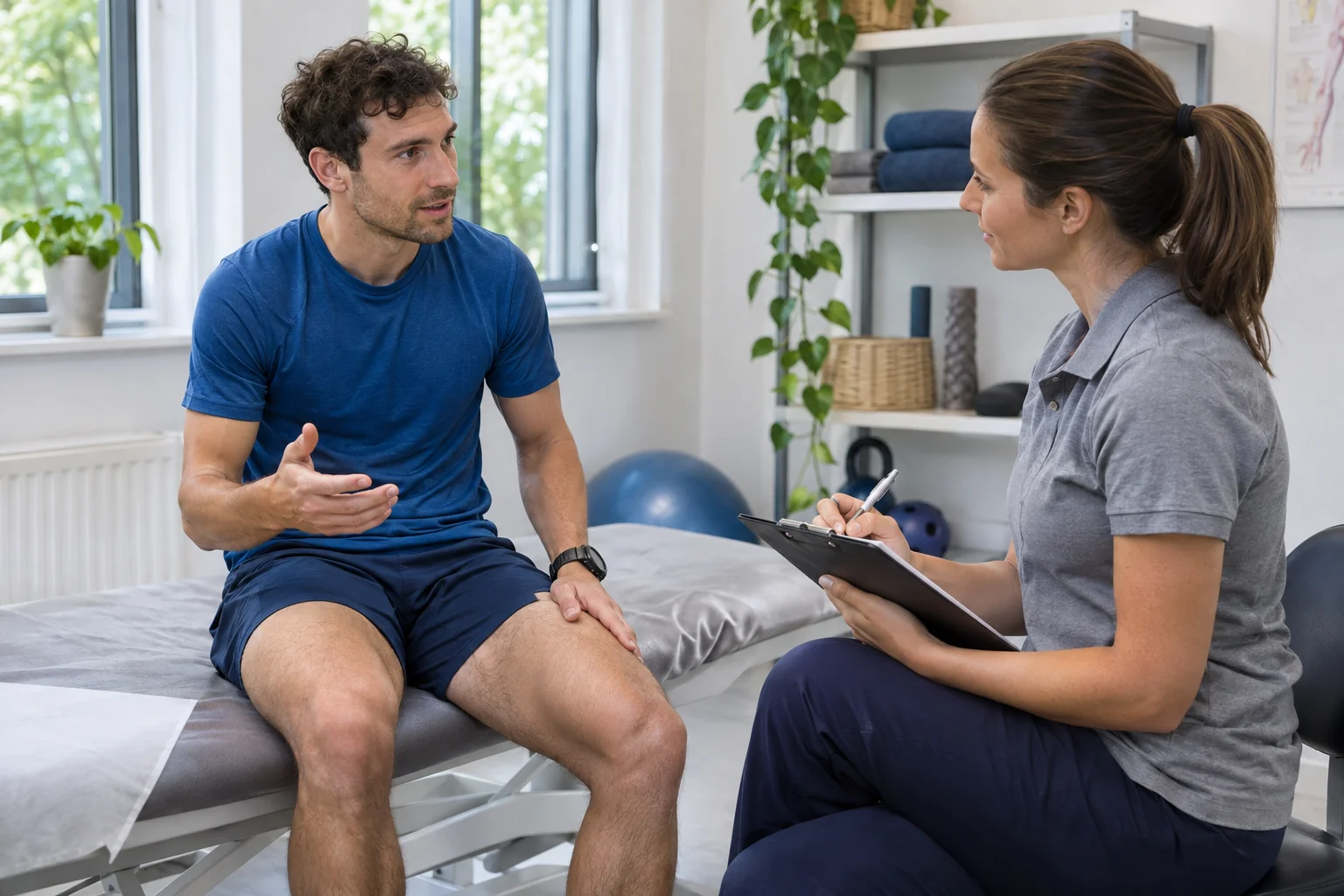
Bring your description of the location, onset, difference between stairs and running, and changes in everyday function. An injury event, swelling, locking or a feeling of instability is particularly important information. Earlier care and instructions can belong in the account too. You need not decide in advance which detail is the diagnostic key; assessing the connections is the professional’s task.
You do not need a new running best, a painful stair video or a sequence of treatments tried at home. Existing documents may help, but imaging needs should also be considered for the particular situation. You do not need to order your own investigation from online information. Ask what information is missing for assessment and how the next step would change the plan.
A different level of summary may suffice for a coach: symptoms now need clarification, the original activity cannot automatically continue, and planning will resume later within the agreed framework. You do not need to deliver a detailed public health report. The aim is for the sporting programme not to proceed as though the new information had never appeared.
Let the difference improve description, rather than prompt a quick verdict
In a fictional situation, a runner simply says they can still run, so there cannot be a more significant knee issue. A fuller account reveals that everyday stair use has changed, which they had not previously considered information relevant to sport. The story illustrates no diagnosis; it shows why describing the whole day and different situations is worthwhile.
Different symptoms on stairs and while running can therefore be a valuable observation. They help describe the situation more accurately but neither replace appropriate assessment nor set a running amount by themselves. Your history, function and necessary professional framework can support the next step. You need neither prove the pain nor decide everything about your knee from one difference.
Sources and interpretation limits
AAOS: Patellofemoral Pain Syndrome; IASP: Patellofemoral Pain; NHS: Knee pain; Neal and colleagues, 2024: Best practice guide for patellofemoral pain; NIAMS: sports injuries. We do not diagnose from symptom location and pattern; the story is a fictional example.
How Futószív articles are prepared: our editorial guidelines.