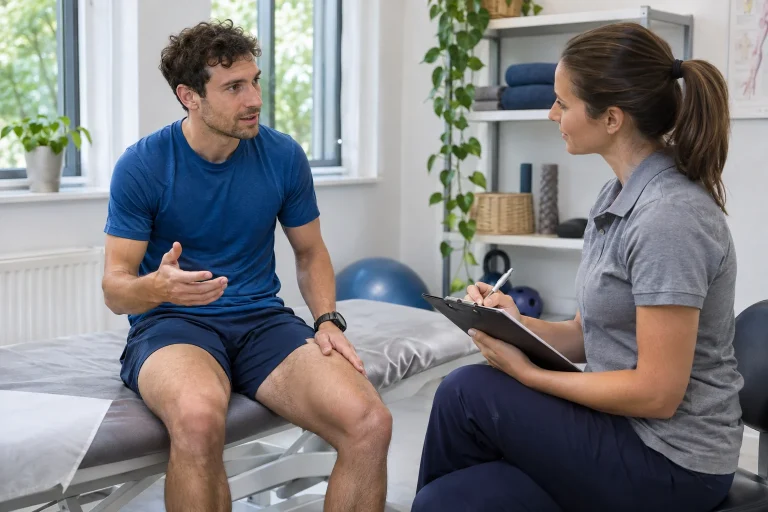
At the end of training, or later, you notice that your knee is more swollen, feels tighter or perhaps moves differently. You may remember no particular misstep, or only recall a turn afterwards. Do not automatically call swelling a natural part of training. Describing its onset, changes and effect on everyday functioning may support assessment, but necessary help must not wait for a perfect diary.
First, the urgent signs: very severe pain, substantial swelling, a change in shape, inability to move the knee or bear weight, locking or a feeling that it gives way require prompt healthcare help. A hot, red knee with fever or feeling unwell may also be urgent. The NHS knee-pain information lists these as specific warning signs. You do not need to photograph it, measure its circumference or prove the problem through another workout first.
Describing swelling is different from naming its cause
Explain what you see or feel: does the whole knee seem larger, is one area visibly different, does it feel tight or harder to bend, or does clothing feel tighter around it? You do not need to decide in advance exactly where or what fluid or tissue change is involved. Appearance alone cannot show the joint’s internal condition. Your observation and medical assessment serve different purposes.
The NIAMS sports-injury overview describes both sudden and gradually developing injury situations and mentions swelling in connection with several problems. That does not allow your knee swelling to be assigned a single label from a description. “After exercise” states a temporal relationship; it does not prove the cause was necessarily the last running activity or that the issue is exclusively sports-related.
Less pain does not make swelling irrelevant either. Someone else’s stronger symptoms or an earlier episode that improved on its own cannot assess the current situation. For a new, recurrent or uncertain problem, clarify the next step individually. It need not be obvious to everyone in a photograph before you can mention it.
The first useful note is the onset timeline
Write down when you first noticed it and in relation to what. Was it apparent during training, immediately afterwards, while resting that evening or the next day? That differs from when the underlying process actually began, which you may not know. Accurate wording might be: “I did not pay attention to it during the run; I saw the difference when I got home.” This is more factual than inventing a certain onset afterwards.
If an event occurred, mention it: a turn, fall, collision, unusual movement or sound. If none occurred, that is information too. You need not reconstruct the story by repeating the movement. The NHS inform guidance on knee problems specifically highlights swelling that develops quickly after a twisting injury, for example. Describing its speed and the event matters more than choosing an injury name at home.
The timeline can include what happened after training: a longer journey, further walking, work or another activity. Record these as parts of the day, rather than automatically labelling them as causes. If your memory is uncertain, say so. Assessment needs an honest distinction between what is known and what is assumed, rather than a flawless story.
 Enlarge image
How has it changed since?
The next question is whether swelling is increasing, seems unchanged, is decreasing or returns periodically. Describe this from everyday experience rather than a forced comparison test. You do not need to check your knee constantly, and note-taking must not become a reason to delay care. If rapid deterioration or an urgent sign appears, seeking help takes priority.
Mention accompanying symptoms too: pain, warmth, redness, a sense of instability, locking or feeling unwell. Do not try to assess temperature and general condition from one picture. Skin appearance can also vary with lighting and individual characteristics. If uncertain, describe your impression rather than turning missing information into reassuring evidence.
A new symptom matters even alongside a previously known knee problem. An old diagnosis does not necessarily explain every later episode of swelling. In individual care, distinguish the usual pattern from what is different now. Rather than generally reusing an earlier recommendation, the current situation may need reassessment.
Describe function through everyday examples
Can you use your leg as before in usual tasks? Has walking changed, has standing up or using stairs become harder, or have you had to leave something out of your day? You need not measure these as performance at all costs. Having to approach an ordinary activity differently, or being unable to do it, is information you can report in itself.
Do not force your knee to bend or straighten to provide an exact range of movement at home. You do not need to squat, run or jump to check how usable it is. An individual examination has its own purpose and appropriate setting. Describing changes that have already occurred in everyday life is enough to start the conversation; no additional symptom-provoking test is required.
Inability to bear weight, substantial restriction of movement or instability may affect how urgently help is needed, rather than merely being diary details. Arrange safe transport too, rather than continuing the planned workout to the meeting point. Ask for appropriate help if getting around is uncertain. Being independently active does not oblige you to manage everything alone with a troublesome knee.
Give specifics about training and the rest of the day
For assessment, it may matter what activity you did, whether frequency, duration or intensity changed, and what felt unusual for you. The NIAMS diagnostic information describes reviewing injury history and recreational or occupational exertion. Other movement, work and earlier events may therefore belong in the picture alongside running mileage.
If there was a new route, equipment, group activity or another sport, describe it factually. You need not identify one change as the culprit in advance, nor does replacing one product imply that swelling will resolve. A confident explanation substituted for an uncertain cause can divert attention from necessary assessment. Your information is what happened, rather than which tissue supposedly had to be injured as a result.
Discuss relevant previous conditions, injuries, treatment and medicines with the appropriate professional too. Bring an existing list or document if available. Do not change medication or randomly start a new product so you can complete the sporting programme despite symptoms. Medication decisions are not a tool for fulfilling a training plan.
Photographs and measurements can remind, not certify
If you already have a picture of the change taken in calm circumstances, you can show a professional, but creating photographic documentation is not compulsory. A picture cannot show the whole condition, circulation, the joint’s internal relationships or the significance of symptoms. Angle, light and clothing may also affect comparison. Do not let how striking a picture looks determine whether you seek help.
Measuring circumference does not give a home diagnosis either. A number shows only what you measured in that particular way, rather than why it changed. You do not need a new measurement system or a fitness threshold calculated against the other knee. If a provider requests monitoring, understand its method and purpose with them. The brief notes suggested here are not a clinical scale.
You do not need to give a coach or group every picture and health detail. It may suffice to say that new swelling requires assessment and clarification of a plan, so the original activity will not automatically continue. Match detailed personal-data sharing to the actual purpose and appropriate contact. You do not have to authenticate symptoms with a public group photograph.
 Enlarge image
Swelling disappearing is not a return plan by itself
A visible difference decreasing is an important observation, but may not answer every question. The cause, function and individual conditions for continuing may still need clarification. Avoid returning every missed session to the calendar at one better moment. Returning is about developing an appropriate plan, rather than working off omitted tasks.
The NIAMS injury guidance advises against working through injury pain. If you already have an individual rehabilitation plan, discuss its boundaries and the meaning of a new symptom with the treating professional. That differs from new, unexplained swelling. A general article cannot prescribe identical rest days, running amounts or an automatically safe alternative sport to everyone.
A practical plan should make clear who assesses the problem, what changes to report and what happens to the sporting programme meanwhile. This may be a simple discussion, but avoid assuming everything will become clear by itself at the next group session. Resolving both professional and organisational matters helps prevent the calendar or money already paid from deciding a health question.
A short overview that becomes a useful account
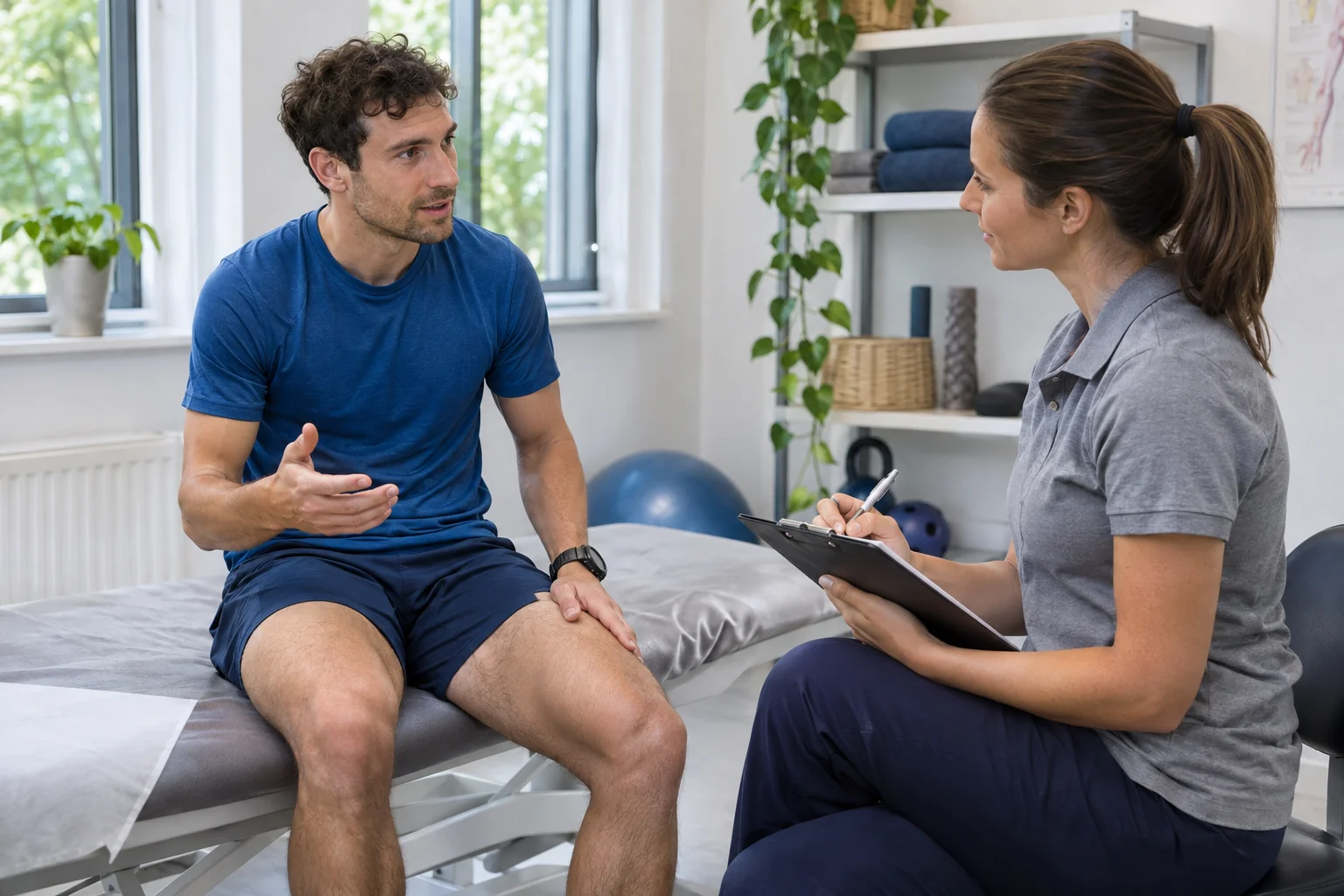
Your note can consist of a few sentences: when you noticed it, whether an event occurred, how it changed and what it impedes in everyday life. Add relevant history and actual changes in exertion. You need not choose a certain cause or measure everything first. With an urgent sign, this overview can be given verbally while seeking help; it is not homework to complete before care.
In a fictional example, a runner does not know exactly which training minute the swelling began. They can explain when they noticed it, whether a turn or fall occurred, what has changed and how they can walk. That is enough to begin an individual conversation. The example offers no diagnosis; it shows why honestly marking uncertain details is more useful than inventing the missing story.
Knee swelling after exercise is information to take seriously and assess in your own circumstances. Good notes are brief and factual and do not force another painful test. Symptoms and function can determine urgency, rather than how striking a photograph is or how “hard” the workout was.
Sources and the role of notes
NHS: Knee pain; NIAMS: assessing sports injuries and next steps; NIAMS: sports-injury overview; NHS inform: Knee problems. The note-taking suggestions are not a diagnostic test, and the story is fictional. We do not classify every instance of swelling as normal adaptation to sport.
How Futószív articles are prepared: our editorial guidelines.