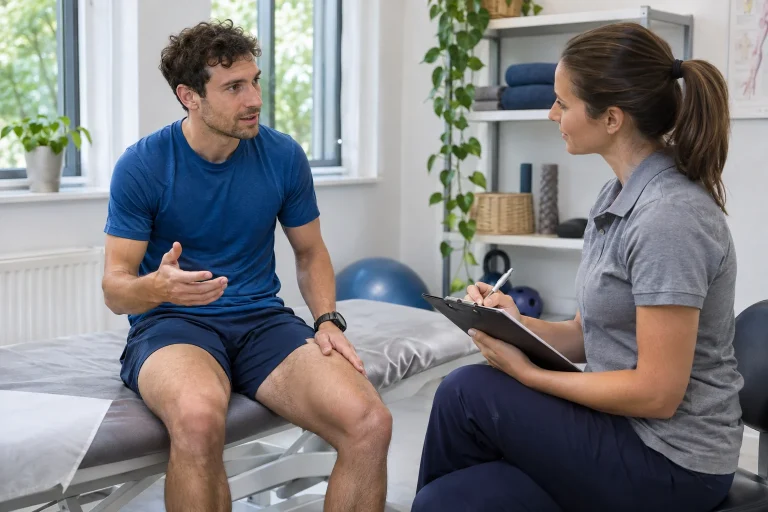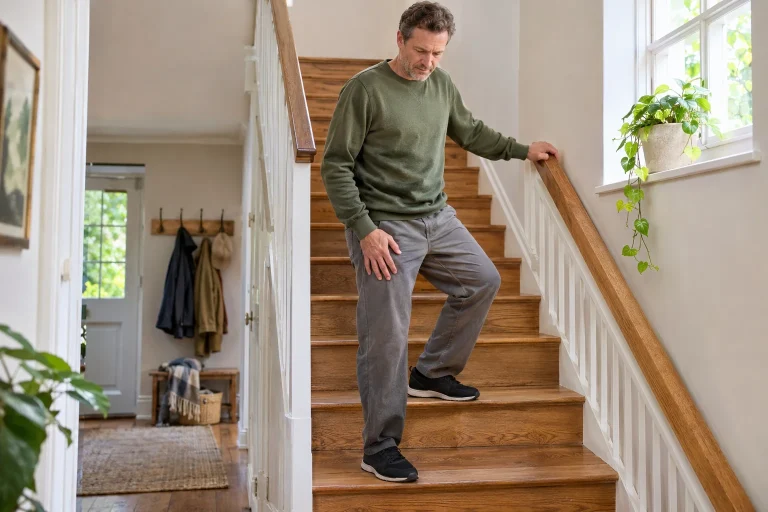
You usually feel fine on level ground, but the park’s sloping exit or stairs down at home make your knee sensitive. That is not contradictory; it is a situation-specific symptom worth describing precisely. ‘It hurts going down’ is not a diagnosis, but can start an assessment. You need not repeat the painful section again and again to make your account convincing.
If the knee is very painful, substantially swollen or changed in shape, cannot move or bear weight, or suddenly locks, seek urgent medical assessment. A hot or red knee with fever, shivering or illness can also be urgent. The NHS information on knee pain treats these as specific warning signs. Fine-tuning a route does not replace seeking help.
Bending a loaded knee differs from the movement alone
The knee is more than two bones meeting. The kneecap moves in a groove in front of the thighbone during bending and straightening, with muscles and tendons participating too. The AAOS explanation discusses several structures and symptom situations. Visible movement therefore cannot establish one tissue’s condition.
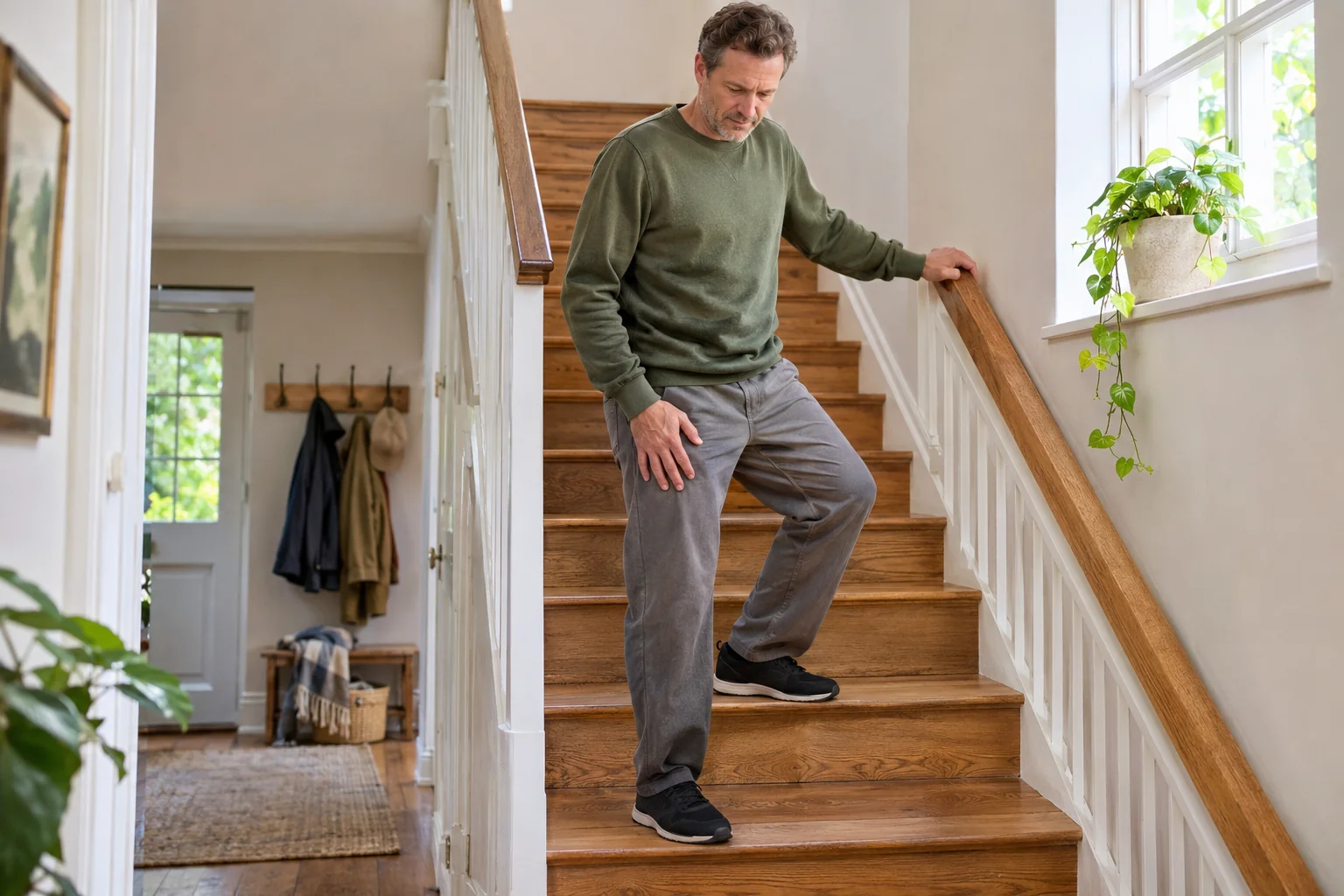
Bending a leg while seated differs from doing it while stepping down with body weight. This does not make one movement necessarily harmful and another always appropriate. It means the task belongs in the symptom description. ‘I can bend it’ is less precise than ‘seated bending is fine, but going downstairs is uncomfortable’.
A clinician decides which examination is needed. This article gives no home squat, stair or jump test. You do not need a particular height or repetition count for symptoms to deserve attention. Describe a change already noticed in daily life without a separate movement to prove it.
Pain on descent does not identify one condition
The IASP information on patellofemoral pain describes symptoms around or behind the kneecap that may worsen during loaded knee flexion, such as stairs or running. Recognition needs clinical assessment. A similar pattern does not automatically place every painful downhill knee in that group.
Location helps, but an anatomical dictionary is unnecessary. Say front, inside, outside or back, or that pointing to one spot is difficult. Uncertainty can be reported. Do not choose a diagnosis because your wording seems insufficiently technical. Linking symptoms, history and examination is the clinician’s role.
Onset matters too. A change after a specific twist differs from gradually developing recurring symptoms. This is timeline information, not home severity classification. The everyday term ‘runner’s knee’ is too broad to replace these distinctions or decide appropriate action.
A downhill laboratory study is not a personal loading rule
In original 2018 biomechanics research, twenty recreational runners ran on level, uphill and downhill treadmills. The model estimated higher peak patellofemoral stress and stress accumulated over stance downhill than in the other conditions. The slope therefore changed the joint-loading measures examined under those experimental conditions.
The research cannot identify how many downhill metres you may do, the cause of your pain or a therapeutic posture for you. A modelled variable is not an injury diagnosis, and a treadmill differs from a rocky winding trail. Use the study as background explaining why the descent deserves separate description, not as an exercise prescription.
For your account, add task characteristics to total distance. Calling it a short loop can lose a long downhill section at the end. Kilometres do not describe every route property. A specific situation may matter more to assessment than calling a programme short or easy.
 Enlarge image
Going downstairs is not always the same task
A wide, visible indoor staircase differs from irregular outdoor steps. A handrail, bags, urgency and lighting matter. Not all concern knee condition directly, but they influence execution and feasibility. Location can therefore belong in the symptom description.
You need not count every step or build matching stairs at home. An everyday comparison may suffice: no problem at home yet, but the longer workplace stairs are difficult. Mention using a handrail or slowing down if that happened. An adjusted task is not the same experience as an unchanged one.
‘I could go up, so I must be able to come down’ is an unhelpful judgement. Directions can produce different experiences and deserve separate descriptions. One does not automatically authorise the other, and descending symptoms need no willpower demonstration. The aim is visible, real function in assessment.
Describe the timeline, not just the route name
Note where symptoms began: the first downward step, near a long descent’s end or later on stairs going home? This does not establish one cause. Timing separates immediate experience from what you attribute to the whole outing. Next-day changes in getting around may matter too.
History includes tasks outside running. Mention substantial stairs, carrying bags or prolonged standing that day. Not to blame yourself, but so the clinician sees more than sports-log numbers. A short workout within an otherwise active day has a different context from the same programme under other circumstances.
Use simple sentences: ‘I felt nothing on the flat section, pain appeared at the front on the downhill exit, and stairs became harder later.’ This says more than a self-selected diagnosis. Mark uncertainty rather than inventing precision afterwards.
A level alternative may be a practical adjustment, not a cure
If route changes belong in your activity plan, choosing a more suitable environment may be part of it. But a level alternative does not prove every further running load appropriate. It may make one outing easier to manage; symptoms’ cause and rehabilitation remain separate. ‘Less painful’ and ‘possible indefinitely’ are different claims.
Assess the alternative as a whole route too. A seemingly flat map section may be inaccessible, poorly lit or longer. Travel may include stairs, an underpass or long walking. Omitting these can make the middle look favourable while the whole day remains difficult. Discuss actual transport too.
Agree with companions that completing the usual loop at all costs is not the goal. A meeting or another agreed activity can be organised separately. Your symptoms need not compete with others’ route preferences. A plan-based change does not require justification that another runner completed the descent without difficulty.
Why is repeating a painful descent not a general strengthening task?
Therapeutic exercise has an individual purpose, selection and follow-up. Repeating a painful movement does not become rehabilitation by calling it adaptation. If given a stair or knee-loading task, understand its exact execution from your professional. A general article cannot provide universal step height, sets or pain limits.
A controlled task and a long downhill route are not identical. The former can have individually chosen conditions and evaluated response; a forest descent may include rocks, bends and the need to get home. Sharing a downward direction does not justify merging their purposes.
If you understand advice only as having to endure pain regardless, ask for clarification. Describe symptoms and functional difficulty. Checking understanding does not reject therapy; it prevents a task becoming an independent loading experiment built from an internet sentence.
 Enlarge image
A few well-chosen details may be enough for feedback
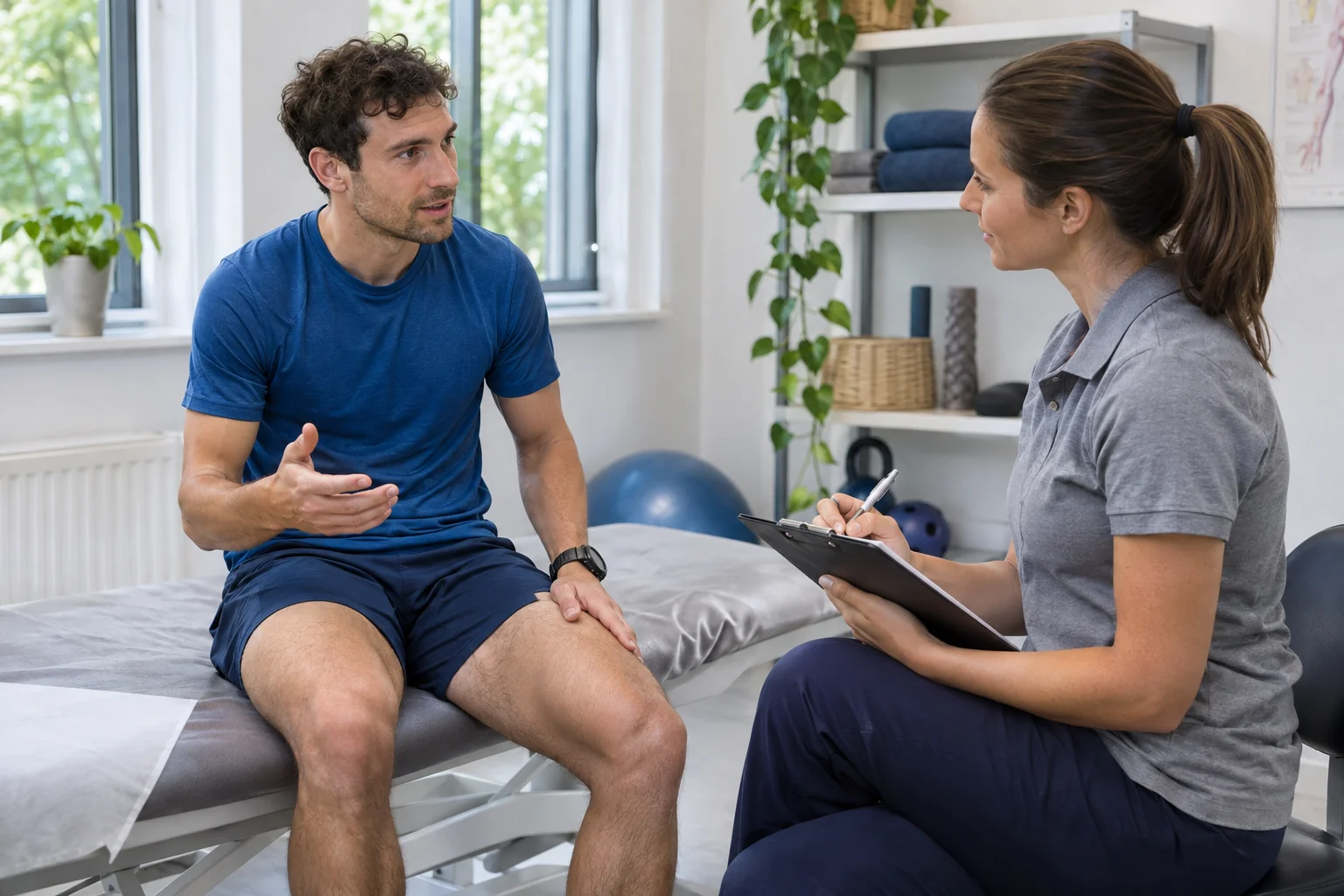
Observation is not checking your knee all day. Organise what you already noticed: location, task, timeline and later function. A symptom restricting work or getting around at home matters too. These details can help choose treatment goals.
| Detail | Example of clarification |
|---|---|
| Direction and task | Name going downstairs, downhill running and seated bending separately. |
| Location and onset | Front, inside or difficult to locate; sudden or gradual. |
| Environment | Actual handrail, bags, surface and lighting. |
| Later function | How were getting home and usual travel the next day? |
This is not a diagnostic list. You need not find a symptom for every row, and missing data do not prove safe continuation. Give the professional your own history rather than one adapted to a selected diagnosis. A precise account remains useful with uncertain details.
Connect the next question to your real day
Ask: ‘This is what happens on the flat, but this changes going down. What does that mean in my assessment, and how should everyday travel and activity fit the plan?’ It includes the difference prompting help without a preselected diagnosis. The answer can clarify appropriate activity, follow-up and action for new symptoms.
If symptoms persist, worsen or affect more everyday tasks, seek review. An earlier good response on level ground does not override later change. Nor does a temporarily better day require retrying an unpleasant descent. Follow-up concerns the full history, not one successful movement.
Descending sensitivity becomes useful information when situation, timing and function are described together. The goal is neither perfect proof of pain nor conquering a slope. Seek an individual explanation and plan that includes stairs, work and getting home alongside the running route.
Sources
- IASP: patellofemoral pain and clinical assessment
- AAOS: symptoms around the kneecap and knee anatomy
- Ho and colleagues, 2018: biomechanical comparison of uphill and downhill treadmill running
- NHS: knee symptoms requiring urgent assessment
How Futószív articles are prepared: our editorial guidelines.