Access begins with the first message
A running session can be welcoming on the day while its invitation is almost impossible to decipher. Abbreviations, times scattered across five places, registration pages referring to one another and phrases such as ‘arrive in the usual way’ make joining harder. Someone attending for the first time has no usual way. Clear information can be particularly important for participants with intellectual disabilities, but the support needed differs between individuals. A diagnosis does not tell you who reads independently, who uses pictures, who asks for spoken help or who knows the neighbourhood better than the organiser.
The aim is for participants themselves to understand what they are agreeing to, what they can choose and how to say they would prefer something different. That means more than giving every detail to a relative. Address an adult runner as an adult. We can simplify a sentence without using baby talk, patronising pet names or automatically turning to their companion.
Clear text and an Easy-to-read version
The European guides from Inclusion Europe provide language and presentation principles for producing easy-to-read information and emphasise involving the people concerned. The Publications Office of the European Union also explains the roles of plain language and the targeted Easy-to-read approach. Not every short text qualifies as checked easy-to-read information.
A running club should therefore describe honestly what it has produced. It may be a ‘short, plain-language session description’ or an easy-to-read version developed together with readers concerned. There are specific conditions for using the recognised easy-to-read logo; do not add it merely as decoration. It matters more that the information actually works than that the organiser acquires a label.
The invitation should tell one complete story
Write the invitation in the order of the participant’s journey. First explain what the activity is, who it is for and whether registration is required in advance. Then give the day, time, precise meeting point, what will happen, equipment needed and contact details. If participation costs money, do not hide the amount and payment method at the bottom of the page behind another document.
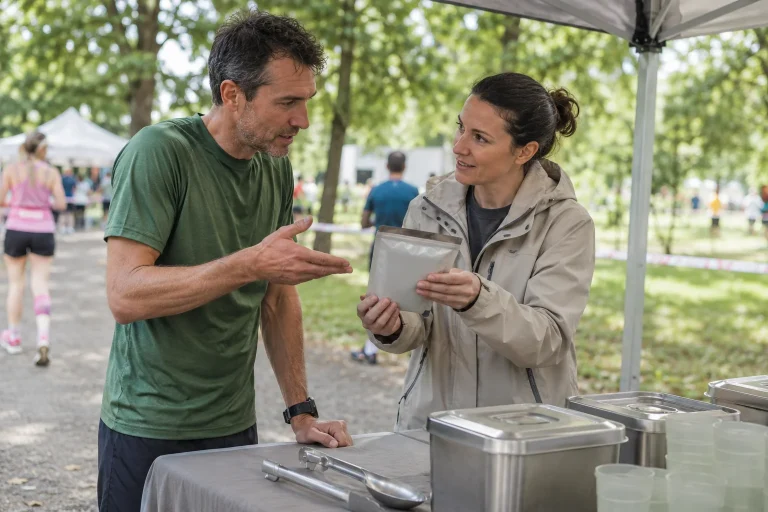
‘The park entrance’ is often insufficient: there may be several entrances. You can use a recent photograph of the actual gate, taken by you, with a short caption. Separate steps describing the route between the bus stop and gate can help, but only if you have actually walked it. Roadworks or a closed passage are not minor editorial details: they are changes that can prevent arrival.
Provide a written address alongside a map link. Not every participant uses a smartphone or mapping app. Basic information accessible without logging into the social-media event is useful. If someone asks for paper, they should not have to justify their digital habits.
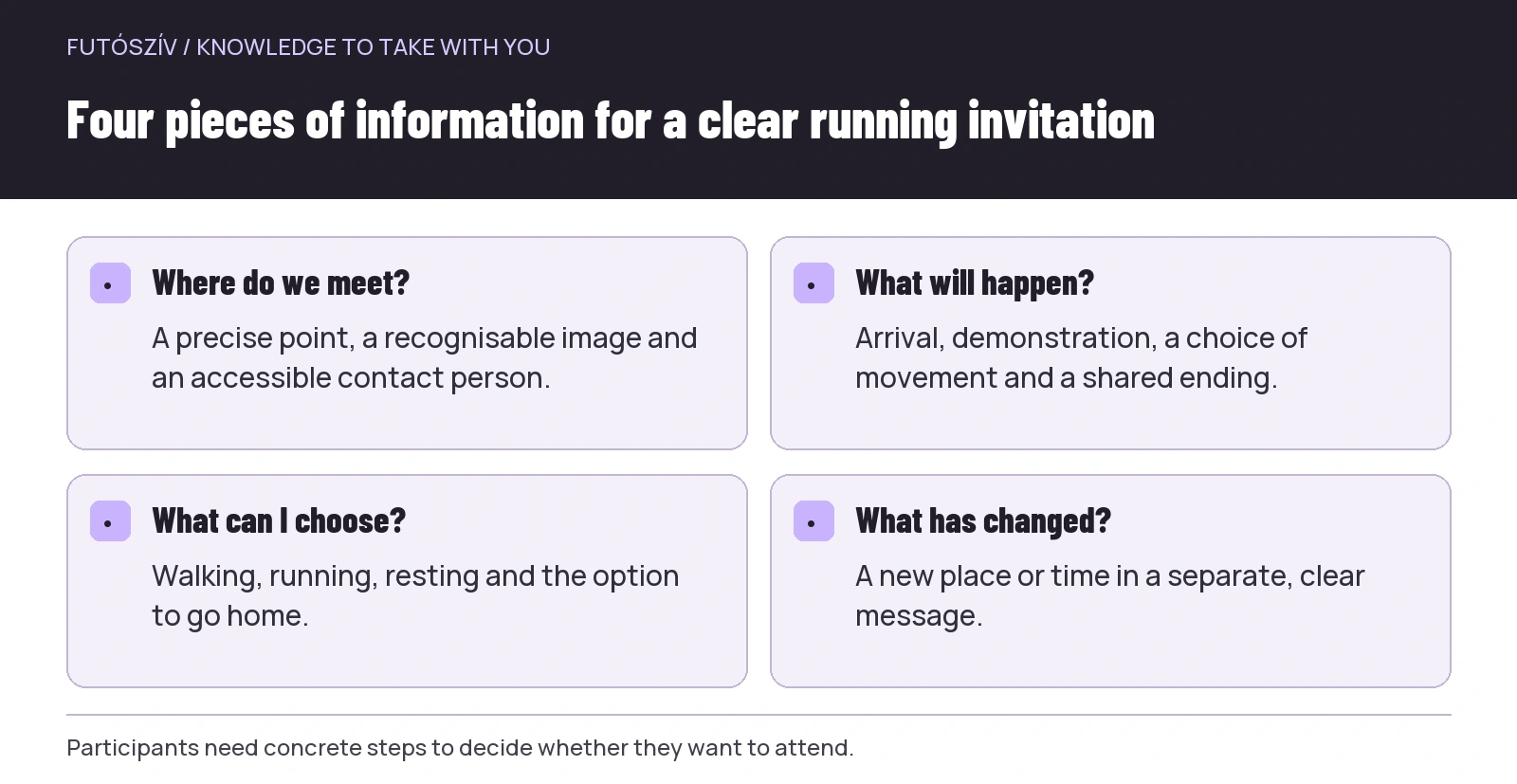 Enlarge diagram
Text version of the diagram
- Where do we meet?
- A precise point, a recognisable image and an accessible contact person.
- What will happen?
- Arrival, demonstration, a choice of movement and a shared ending.
- What can I choose?
- Walking, running, resting and the option to go home.
- What has changed?
- A new place or time in a separate, clear message.
Give one task per sentence
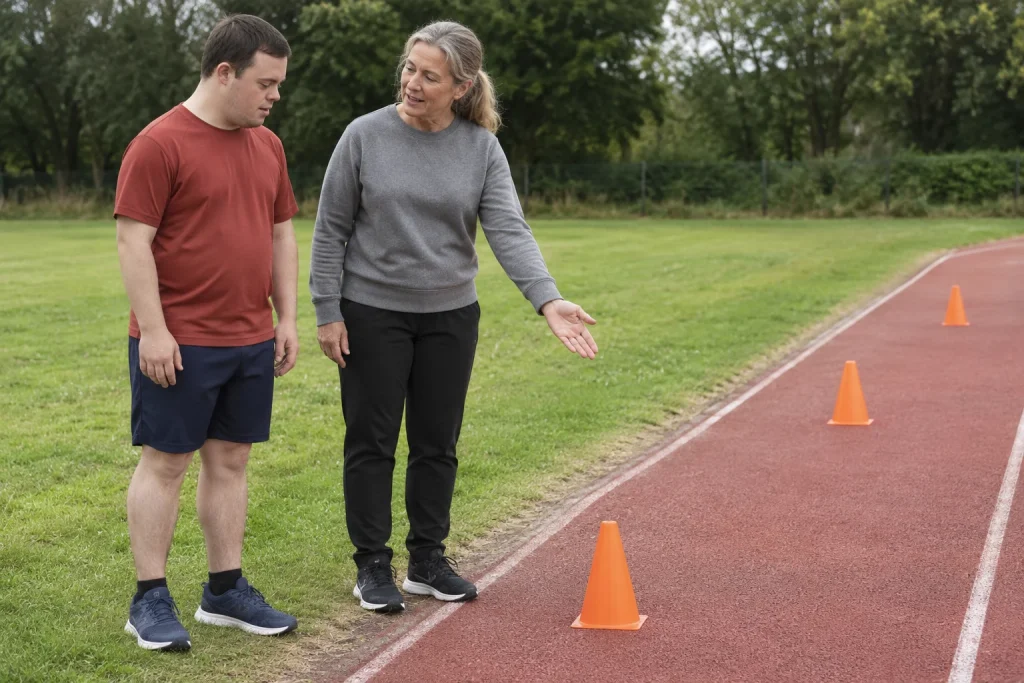
To the organiser, ‘after warming up, take the usual loop, shortening it if needed’ may be perfectly clear. For a new participant, it contains several unknown elements. It is better to explain first where to stop, then demonstrate the first movement and try it together. Communicate the next step when it becomes relevant.
That does not mean everyone should hear only one word at a time. Ask what kind of explanation works for them. Some people want to see the whole programme in advance; others find short, successive cues helpful. Explain jargon or replace it with precise everyday language. Instead of a ‘recovery block’, for example, you can explain that you will now walk slowly and decide whether you want to continue.
Use consistent wording. If you call the same meeting point the base, then the depot, then the assembly zone, you create unnecessary interpretation work. Consistency does not mean dullness: the session can be fun while important things each have one name.
Pictures should help people recognise things, not merely decorate
A spectacular photograph of a finish arch is less helpful for arrival than an image of the actual meeting point. Beside a drawing of a bottle, it helps to write ‘bring something to drink’, but do not assume the picture’s meaning is obvious to everyone. Test pictures with users just as you test text.
Do not crowd a page with large numbers of icons, logos and background patterns. Present the session’s stages in distinct sections with readable type and enough space. Do not distinguish information through colour alone: make the walking and running groups’ names or symbols readable too. Decorative flashing and automatically moving elements do not necessarily belong in participation information.
Make choices genuinely workable
‘Everyone at their own pace’ sounds good, but it is not enough if the only group disappears after a few minutes. Choice needs organising: where can people walk, who stays on the shorter route, where can someone stop and how does someone who finishes get back? Offer options for which people, time and space are available.
Participants can choose running, walking, watching or not moving today. An earlier yes does not apply forever. Agree in advance how to signal stopping; it could be a word, hand signal or another method usable by the person. Someone must actually respond to that signal, rather than merely recording it in the organiser’s paperwork.
Allow time to decide. Showing two concrete possibilities is often more useful than an open ‘well, what would you like?’, but that is not a universal rule either. It is not a choice when a helper keeps asking until they receive their own preferred answer.
The companion is a partner; the participant is central
A relative or supporter may bring important knowledge: which communication works, which previous experience was unpleasant and what deserves attention. Still, address the participant first. Ask whether they want their companion to stay, hear the briefing together or help with particular matters.
Clarify the extent of support too. A running-club leader does not automatically become a personal assistant, healthcare professional or the person responsible for getting someone home. If a task requires separate support, discuss how it will be arranged beforehand. Stating a boundary can be inclusive when it comes with a search for concrete options rather than a blanket refusal made on the participant’s behalf.
Share health and other sensitive information only as necessary. The entire group does not need to know someone’s diagnosis to communicate patiently and respectfully. Individual medical suitability may require a separate professional assessment; this article about information provides neither clearance nor a general ban on sport.
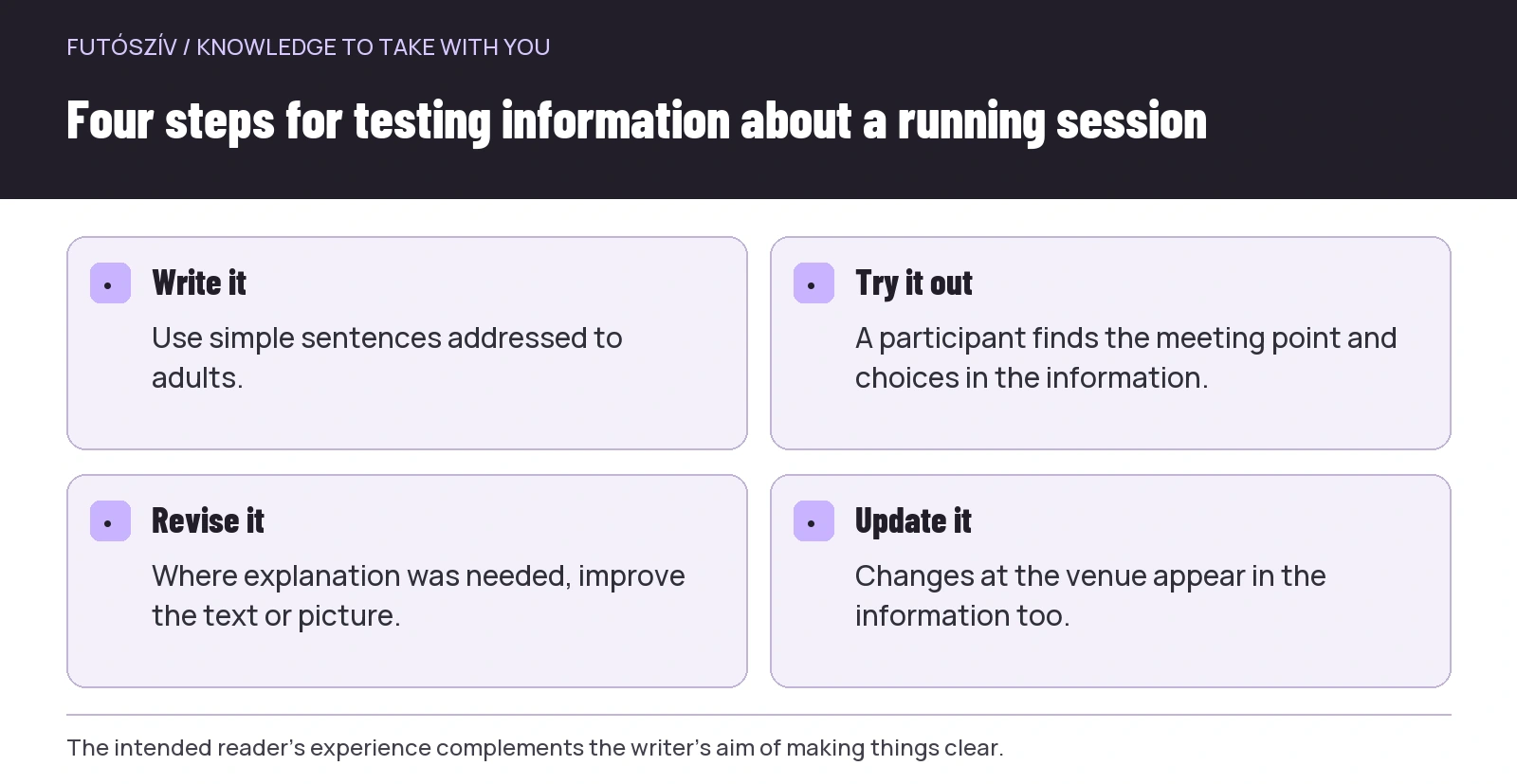 Enlarge diagram
Text version of the diagram
- Write it
- Use simple sentences addressed to adults.
- Try it out
- A participant finds the meeting point and choices in the information.
- Revise it
- Where explanation was needed, improve the text or picture.
- Update it
- Changes at the venue appear in the information too.
Try the information in practice without testing the person
A yes to ‘do you understand?’ does not necessarily reveal whether the information works. Invite readers to show where they find the arrival time, which picture will help them recognise the place and how they can signal stopping. Explain beforehand that you are checking the text, not examining them.
If they get stuck, improve the document. Important information may appear too late, a photograph may be unrecognisable or the difference between two times may be unclear. Do not simply write on the feedback form that the person needed help. The question is what you will change so that they face fewer barriers next time.
Recognise the work of the person taking part in testing. Do not regard the same single person as representing everyone with an intellectual disability. Other people may have different reading, communication and movement experiences. A range of feedback can build a better programme.
An original example of a short invitation
The following organisational example is a starting point, not a checked easy-to-read publication: ‘On Saturday we will walk and run together in the park. We meet at nine in the morning at the gate shown in the picture. The organiser will be wearing a green vest. First we will look at the route. Then you can choose walking or running. You can rest too. If you want to finish, tell the organiser. At the end of the session we will return here.’
Use this only alongside a real location, contact details, duration, cost and working support arrangements. The example still does not replace participant feedback. If the event is actually a long, noisy mass gathering, do not create the impression of a calm, small meeting in a park.
If it rains or the plan changes
Do not handle uncertainty by cramming every possible situation into one invitation. Instead, make clear when and where any change will be announced and who is available if a participant cannot find the message. A cancellation message should state that the activity on that day is cancelled; a crossed-out poster alone may not be clear.
When rearranging things on site, stop for a short explanation. Show the new meeting point, explain who will go with the group and ask whether the change is acceptable. Participants may also be entitled to decide that they no longer want to join under the new circumstances. Organisational flexibility does not mean they must silently adapt to every change.
Keep participants involved after the first session too
The Special Olympics Athlete Leadership programme supports athletes with intellectual and developmental disabilities in meaningful leadership roles. It also reminds us that participants need not only receive help. They can have views on the programme, lead a familiar task, help prepare the next information sheet or decide they do not want to take on those roles.
Evaluation should ask more than how many laps someone completed. Did they find the meeting point? Could they choose? Was there a moment when other people made decisions for them instead? Did they feel comfortable asking a question or saying no? Organisers can use those answers to make improvements that make participation clearer for the entire community.
Communicate changes for the next session separately. For a new venue, different contact person or changed schedule, do not resend the old poster with a tiny note. Supporting predictability and independence is continuing organisational work, not a task to tick off after the first inclusive event.
Sources and further reading
- Inclusion Europe: European easy-to-read guidelines.
- Publications Office of the European Union: plain-language and easy-to-read information.
- Special Olympics: athlete participation and leadership roles.
How Futószív articles are prepared: our editorial guidelines.