An injury sometimes takes away more than a workout
If running is a regular part of your life, an injury does more than remove sessions from the calendar. You may lose your time alone after work, familiar meetings and a setting in which you felt confident. ‘Just rest for now’ can therefore seem insufficient both practically and emotionally, even when restricting activity is professionally necessary.
This article explores naming your relationship with running and your personal needs when you cannot currently run. It does not establish an injury’s cause, provide rehabilitation or decide when to return. Those questions need an appropriate healthcare professional. Personal meaning and clinical decisions can both matter alongside each other.
Running identity is more than kilometres covered
Running can mean curiosity, persistence, community, outdoor time or a chosen challenge. If your identity as a runner depends only on current training volume, injury can leave very little room. Identify what you miss most. Not every part directly depends on the distance you complete today.
The NCAA’s 2025 consensus recommendations on mental health best practices discuss sporting transitions, support and a multifaceted identity within college sport. This is not a diagnostic description applying to every recreational runner. It provides professional context for attending to relationships and roles outside sport during change.
First name what you miss
Make a short list: morning solitude, conversation with friends, exploring routes, regular contact with a coach or a clearly defined daily task. The list does not require every absence to be immediately replaced. It helps distinguish needs that one activity previously met together.
For example, another meeting can support social connection while activity restrictions remain unchanged. Time to yourself may have a calm setting unrelated to sport. Discuss activity appropriate to your health separately, however. Naming a need is not permission to independently replace prohibited running with another equally demanding activity.
Community connections can remain, but need not stay the same
You may want to meet the group after a run or have a separate conversation. Hearing about others’ training may also be difficult for now. Both needs can be expressed. Maintaining a relationship does not require the same role at every event, or matching your feelings to a community’s expected enthusiasm.
If you want less running content for a while, you can choose that without settling the future permanently. A group leader can separately ask which invitations would feel welcome. An injured member should not automatically disappear from the community, but should not receive another participation obligation to prove they belong either.
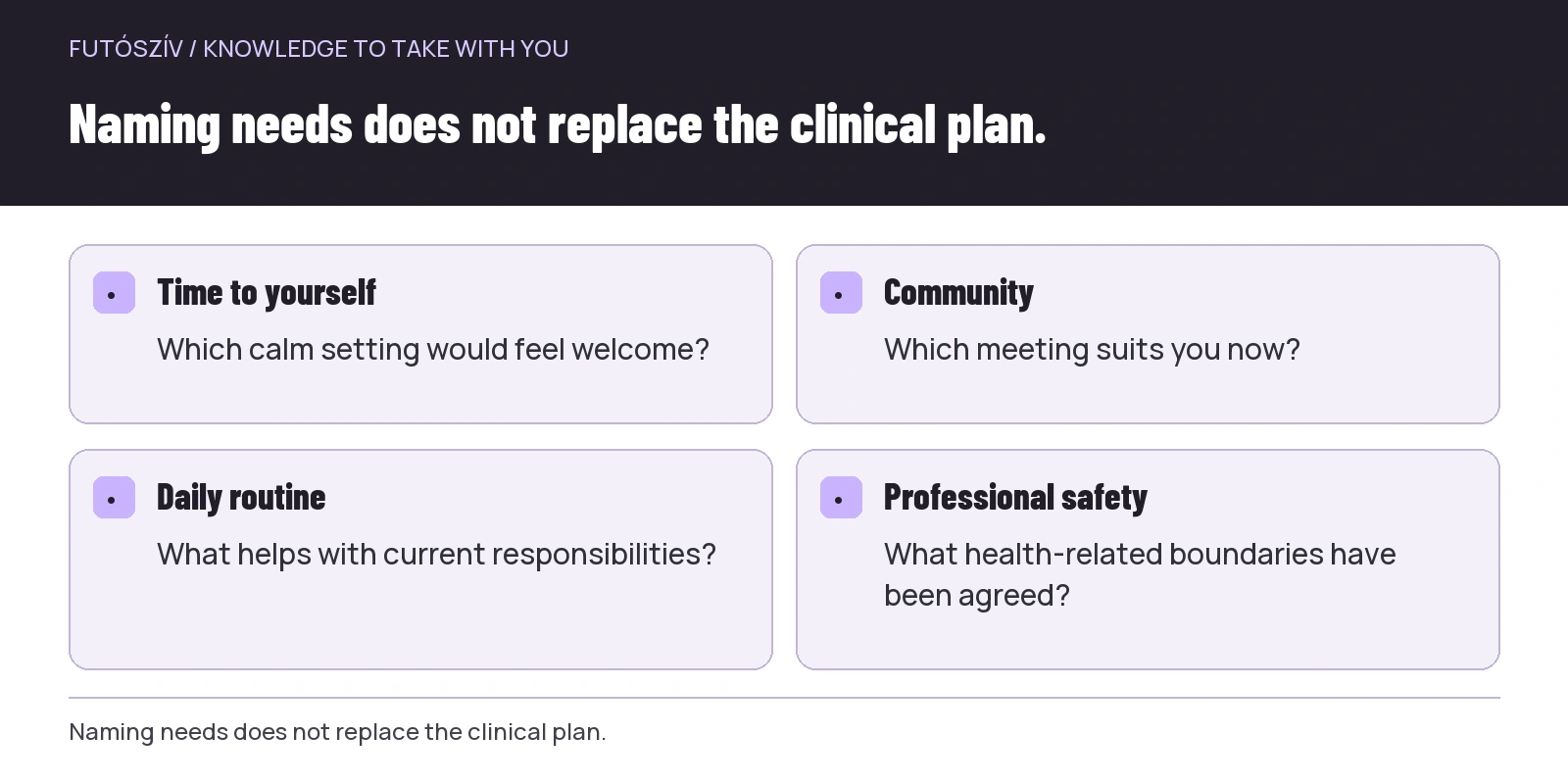 Enlarge diagram
Text version of the illustration
- Time to yourself
- Which calm setting would feel welcome?
- Community
- Which meeting suits you now?
- Daily routine
- What helps with current responsibilities?
- Professional safety
- What health-related boundaries have been agreed?
Volunteering should remain a genuinely optional opportunity
Injured runners are often immediately offered organising duties. This can be an enjoyable connection if they want it and it fits their condition. Prolonged standing, early travel or watching an entire race does not suit everyone, however. Discuss the task’s health and practical requirements just as you would those of a sporting activity.
An invitation should not imply that without running, only useful work earns a place in the community. A friendly meeting can have value on its own. When choosing participation, ask what the other person wants, how much they can manage and how arrangements can change. Helping roles require agreement too.
Rehabilitation is not a new name for the old training competition
Following professionally prescribed tasks can matter, but they do not need a new leaderboard. Doing more exercises or increasing load faster does not, by itself, establish better progress. Individual condition and treatment goals determine the appropriate programme, rather than others’ stories presented as comparable.
If an instruction is unclear, ask its purpose and what could justify changing it. Reporting symptoms is not evidence of indiscipline. Your treating professional needs actual experience, not merely confirmation that the task was completed. Do not independently alter rehabilitation to recover the feeling of your previous sporting performance.
Returning and regaining previous performance are not the same point
The 2016 Bern return-to-sport consensus distinguishes return to participation, return to sport and return to performance. This helps explain why every opportunity to move does not mean full readiness to race. Decisions about a specific injury and person nevertheless require appropriate professional evaluation, rather than being derived from the terminology alone.
The IOC’s 2026 mental health consensus also considers psychological readiness and social support in returning after injury. This does not mean you must independently achieve perfect confidence. Discuss fear and uncertainty with the team supporting treatment, with an appropriate specialist involved if needed.
There are more precise questions than ‘When can you run again?’
As a running friend, ask how discussions are progressing or which social plans would be welcome. Every meeting need not begin with a return date. An injury’s course can be uncertain, and repeated requests for a deadline may demand an answer the person cannot yet give.
As a personal boundary, say you are following the treatment plan and will share new information when there is something to share. You do not owe every acquaintance detailed results or explanations. Shared topics outside running can maintain the relationship too. An injured person’s day is not only about injury, even when a running community mainly knows them through that role.
Roles outside sport should not be compulsory consolation prizes
You may be able to revisit an interest previously left little time, but every lost training hour need not become productive. Injury is not a compulsory self-development project. If something else feels good now, it can have a place; if arranging daily life and care is already demanding, take that seriously too.
Naming several roles simply means describing yourself through more than training. You may be a friend, family member, colleague, learner or member of another community, with different priorities. These roles do not need to compete. The aim is not to deny running’s significance, but to recognise that your personal value can have several sources.
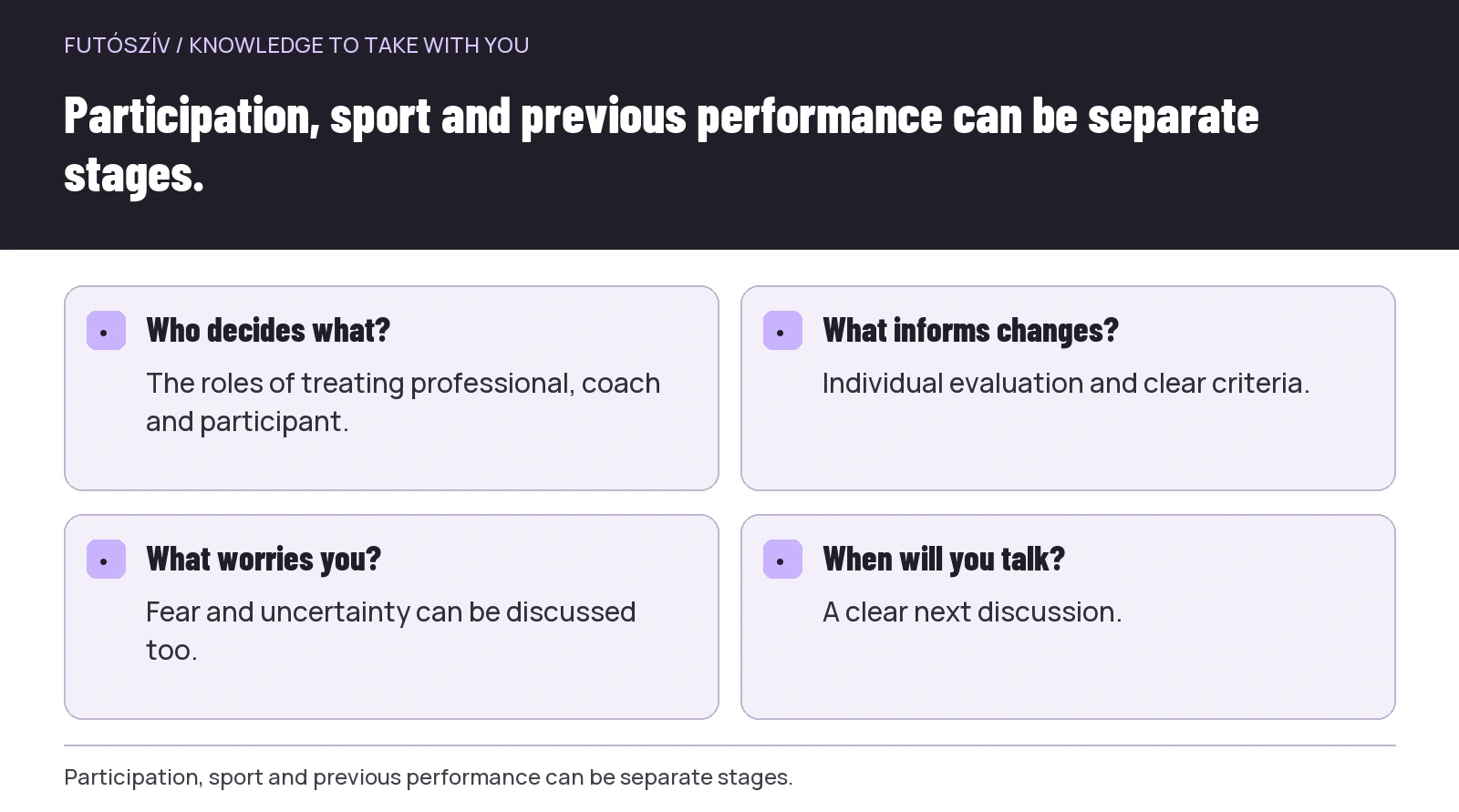 Enlarge diagram
Text version of the illustration
- Who decides what?
- The roles of treating professional, coach and participant.
- What informs changes?
- Individual evaluation and clear criteria.
- What worries you?
- Fear and uncertainty can be discussed too.
- When will you talk?
- A clear next discussion.
Public updates are not a compulsory part of recovery
If you enjoy writing about your experience, decide beforehand which details to share. Results, treatment and personal feelings are not automatically community content. You do not have to publicly document every step of the return or make it inspirational. Your own experience can remain uncertain and unresolved.
Other people’s injury stories are not personal prognoses for you either. Even identically named injuries can involve different circumstances. Bring questions prompted by a story into professional discussion, but do not reshape treatment around social feedback. Public sharing and clinical decisions serve different purposes.
Discuss fear during professional consultations too
At the next consultation, you can discuss more than pain location and completed tasks. Explain fear of reinjury, difficulty missing the community or uncertainty about a safe next step. These are not distracting side issues. They can help the plan and communication connect better with your actual situation.
Ask who is responsible for each decision, which information can change the programme and when reassessment will happen. If advice from coach and clinician seems contradictory, seek clarification. Shared decision-making does not mean you must resolve every professional difference alone. Roles and next steps should be understandable.
Persistent emotional difficulty deserves separate support
If injury brings persistent low mood, substantial anxiety, sleeping difficulties or a state disrupting everyday life, contact an appropriate mental health professional too. This is not an inevitable part of being an athlete that must be endured until running resumes. Physical rehabilitation and emotional support can be needed together.
Seek immediate urgent help for an immediate risk of self-harm or a mental health emergency. New or alarming physical symptoms also require appropriate healthcare. The community and practical ideas in this article do not replace an emergency plan. Safety and professional support take priority over maintaining sporting roles.
An example of a connection that can be retained
An injured runner tells a friend that race reports are difficult to hear now, but another kind of meeting would be welcome. The friend does not immediately demand enthusiasm or arrange a new sporting challenge on their behalf. They agree on a meeting that suits both, without physical exertion or a medical update.
The example is not a recovery prescription. It shows that a relationship can continue in a changed form while medical and rehabilitation questions are handled appropriately. Before the next meeting, they can ask again whether the arrangement still suits both. Running identity does not need a final answer during one period away. Understanding, safe care and retaining chosen connections can be the next tasks for now.
Sources and further reading
- Ardern et al.: 2016 Bern consensus on return to sport
- NCAA mental health best practices: consensus recommendations, 2025
- IOC consensus on mental health in elite athletes, 2026
How Futószív articles are prepared: our editorial guidelines.