The 10,000 or 20,000 millimetres in a running jacket’s description can easily seem to answer precisely how long you will stay dry. Yet the number describes a material property related to water pressure, rather than a countdown started in the rain. There is no general conversion that lets you divide the hydrostatic head rating to obtain the number of minutes you can safely spend training. Choosing well means considering the number’s meaning, the construction of the whole jacket and your own circumstances separately.
This guide focuses on interpreting the measurement and comparing garments in a shop. We do not declare a threshold sufficient for every runner or rank brands. Our examples show which question to ask next when two product pages present two different numbers that each look convincing on their own.
Here, millimetres refer to pressure, not accumulated rainfall
The height of a column of water can illustrate a particular pressure. Water density, gravitational acceleration and the column’s height together determine the hydrostatic pressure at its base. The millimetres stated for clothing therefore serve a different purpose from the rainfall mentioned in a weather forecast. Sharing a unit of length does not mean that the two can be subtracted from one another.
A simple example: 10,000 mm on a label represents the height of a ten-metre water column. It does not claim that ten metres of rain must fall on the jacket before water gets through. The physical conditions and measurement conditions are quite different. Likewise, a 20,000 rating does not imply twice as much time in the rain as a 10,000 rating. A pressure-related measurement does not become a duration simply by preserving the ratio between the numbers.
If a salesperson says that “this withstands all-day rain”, clarify the statement as a promise about use. What activity, layers, garment condition and arrangement of openings do they mean? Their answer may be useful, but it is not the same as explaining a laboratory value. You can put these two types of statement on separate lines in your notes.
First ask what was measured, and how
The public summary of ISO 811:2018 describes measuring fabrics’ resistance to water penetration using hydrostatic pressure. This clarifies what the material test examines; a short number on a product page does not replace the standard’s complete procedure. Stating the measurement method and the sample’s condition therefore provides important context alongside a jacket’s advertised figure.
When comparing two labels, note whether they identify a standard or another recognisable test procedure. Is it clear whether the sample was new material, had undergone some pretreatment, or was in another condition? Missing detail alone does not prove that a jacket is poor. It means that you do not yet have all the information needed for that comparison. Inventing a precise ranking in this situation is unhelpful.
Imagine two product pages. One prominently displays a higher figure but names no procedure. The other gives a more modest number alongside a clear description of the material and testing. From the available information, you can say that the stated values and their documentation differ. You cannot say that the higher-rated garment is proven to perform better on your run. Naming the uncertainty is a more accurate conclusion than guessing.
 Enlarge image
A fabric sample and a finished jacket are two different objects of testing
A finished garment has sleeves, a hood, fastenings, a hem and several joined sections. Water does not necessarily have to follow the same route as in a test on an intact piece of fabric. Rab’s manufacturer guide explains coated and laminated waterproof constructions and differences in layer structure. These provide background for understanding construction; they do not replace the specification for the particular finished garment.
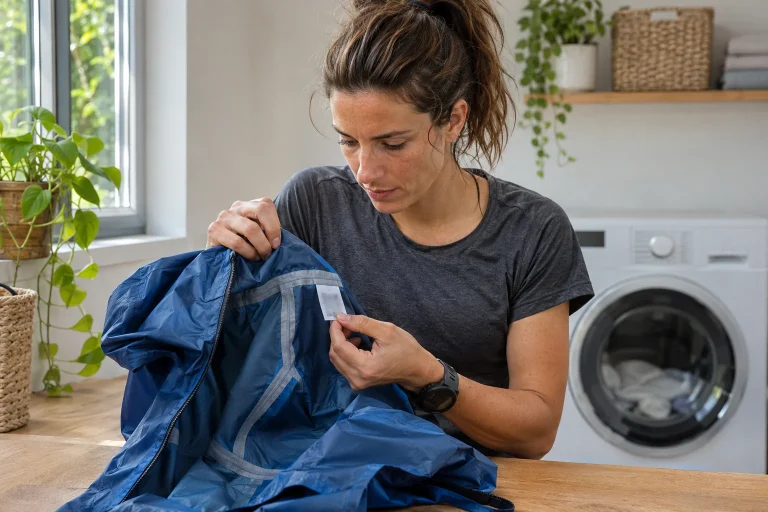
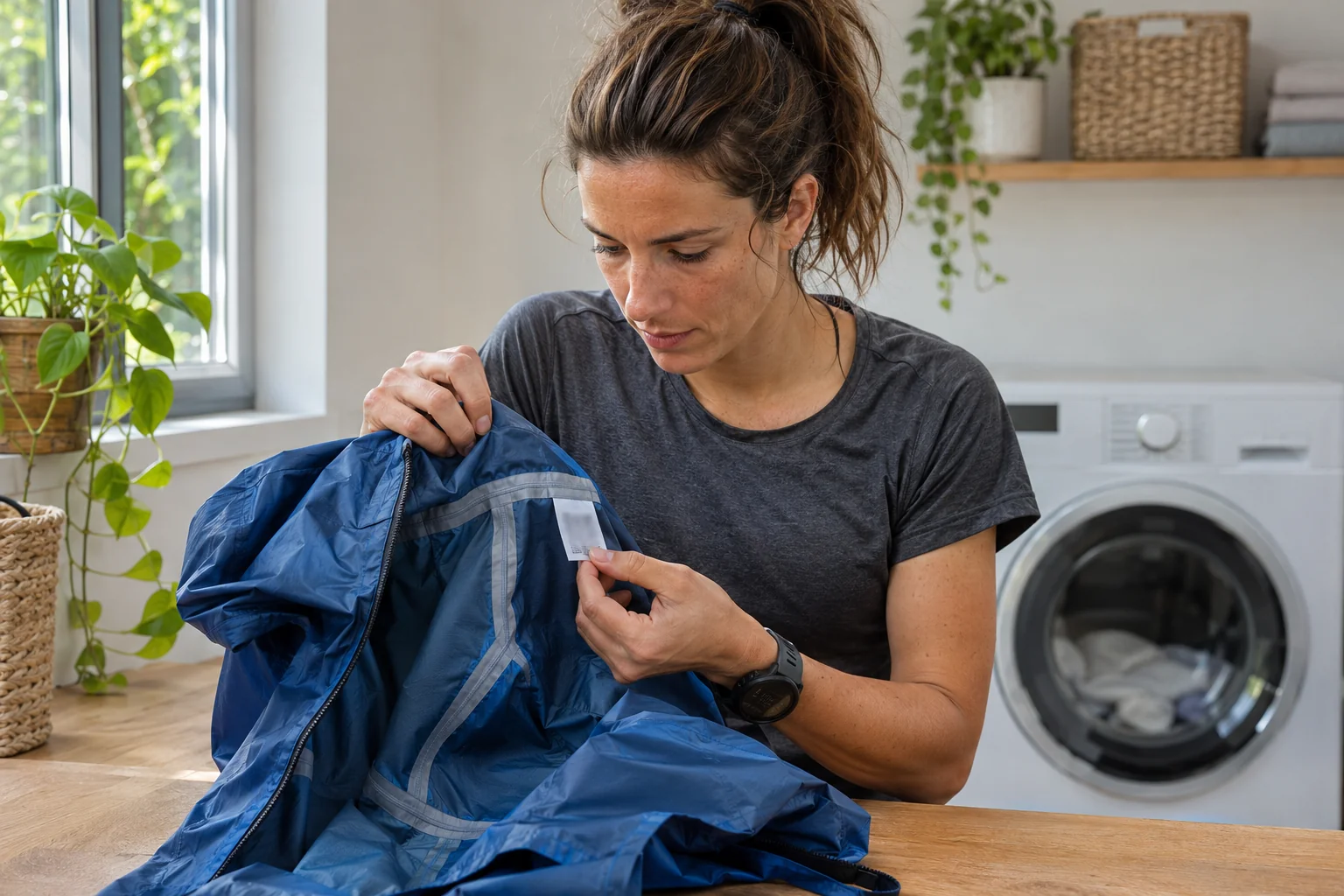
Turn the sample garment inside out as far as the shop allows and inspect the joins. What does the description say about sealing the seams? Is there a specially designed flap in front of or behind the zip? Where could water enter around your neck or wrists if the jacket is too large or too small for you? Do not turn these observations into a homemade certification, but use them to formulate questions for the salesperson.
Pockets also belong to the complete system. Calling a jacket waterproof does not necessarily promise that your phone will stay dry in any of its open or closed pockets. Read the pocket information too. If protecting the device from water is a separate requirement, do not try to infer that protection from a different property.
Check movements during a fitting, not just your reflection
Try the running jacket over the layers you intend to wear, first checking that you can fasten it properly. Then gently move your arms as you usually do when running, turn your head and reach for the pocket you plan to use. The aim is not to imitate a whole workout in the shop. Look for details that need further clarification: does the hem ride up, does the hood restrict looking around, and can you reach the fastening?
If you would wear it with a running vest, ask whether you can try them together. Wearing the vest over the jacket and wearing it underneath produce different access and fit. During a fitting, you can observe whether the zip remains accessible, whether the fabric bunches awkwardly, and how the hood fits. This does not produce laboratory data, but it gives you a much clearer picture of your practical requirements.
Write one short sentence beside the garment: “Neck area needs clarification”, “Not yet tried with my vest”, or “Need to check the sleeve adjuster with gloves on”. These are better shopping reminders than the general comment “It was comfortable”. Detailed notes help because after trying a second or third jacket, specific differences can easily blur together.
Localised pressure and material condition raise another question
In use, a jacket does not behave like an untouched sheet of fabric. Straps may contact it, it may fold, brush against a railing, and equipment may repeatedly rub the same area. Gore’s technical material also distinguishes material testing, assessment of the complete clothing system and evaluation in actual use. The document concerns occupational protective clothing, so its requirements must not be adopted as requirements for running jackets; distinguishing the levels of testing is the useful lesson.
For a used garment, ask how it was stored and cared for, and whether it has been repaired or has any known damage. You can also request a photograph of a reported problem area, but a photograph cannot establish complete waterproofness. The original factory figure in an advertisement and the present condition of that specific garment are two separate pieces of information. Keep them separate even if the jacket looks attractive from the outside.
For your own jacket, remember the conditions of previous successful outings: which route, layers and equipment felt comfortable. If the same garment behaves differently next time, this gives you a starting point for investigating. Do not try to attribute every wet patch to a single cause afterwards, or apply a homemade pressure test that the manufacturer does not recommend.
Do not automatically equate moisture inside with water leaking in
Moisture can also enter your clothing from the inside while you run. Protection against water and comfort related to water vapour therefore need separate interpretation. A high hydrostatic head alone does not prove that your base layer will feel dry during your own intensive run. Rab’s construction guide also distinguishes the waterproof layer from the water-repellent treatment on the outer surface; do not interchange these terms.
If you return home damp, first describe the circumstances. Where was the clothing wet? How fully was the jacket fastened? Were you wearing a vest, what base layer did you set out in, and did you change your pace? Such observations do not diagnose a membrane fault. They help ensure that a conversation with the manufacturer or repair service goes beyond simply saying “It leaks”.
When comparing your experiences, do not change every condition at once and then attribute the difference to the jacket. If the weather, base layer, route and effort all changed, several explanations remain possible. You do not need to build a laboratory around running: it is enough to distinguish clearly what you observed from what those observations cannot yet establish.
 Enlarge image
How to make a useful comparison sheet
Choose a few criteria important for your running and complete the same fields for both garments. An empty field can stay empty. Writing “Ask about this” beside missing information is more accurate than imagining that another model’s or brand’s data apply. The sheet below is an editorial aid, not a certificate of conformity or a mandatory order of purchasing priorities.
| Criterion | What to record |
|---|---|
| Water-pressure-related rating | The stated number, unit and identifiable measurement method. |
| Finished-garment construction | The particular model’s description of seams, zip, hood and pockets. |
| Fitting with your own equipment | The specific fit issue observed with your base layer and vest. |
| Care and condition | The label, manufacturer’s instructions and, for a used garment, its known history. |
| Open question | The document still missing or claim needing clarification. |
If one jacket is easier to operate with gloves while the other provides more detailed material data, do not force these differences into an invented overall score. First decide which property matters to you in which situation. A short nearby loop and a longer outing far from home may require different arrangements, but hydrostatic head alone cannot guarantee complete safety for either.
Make the next rainy trial an observation, not a proof
Trying new equipment is a chance to become familiar with it. Choose a time and place where you can easily alter or end the outing; assess weather hazards separately. Testing a jacket is no reason to set out despite a warning or dangerous conditions. You can get to know the garment gradually, without having to live up to the number on its label.
Once home, follow the care instructions, then write down your specific experience. For example: “The hood got in the way when turning”, “The right pocket was hard to reach with gloves”, or “I still want to clarify where the moisture around the neck came from”. This creates a useful question for your next trial or for customer service. Hydrostatic head then becomes one piece of information in your decision, rather than obscuring every further question.
Sources and the limits of this explanation
Background on what is measured comes from the public summary of ISO 811:2018, while understanding garment construction is supported by Rab’s manufacturer guide to waterproof clothing. For the different levels of testing, we used Gore’s technical material, keeping its occupational protective-clothing scope separate. We did not analyse the standard’s full paid text; the examples and comparison sheet are our own editorial aids. Sources checked: 20 November 2026.
How Futószív articles are prepared: our editorial guidelines.