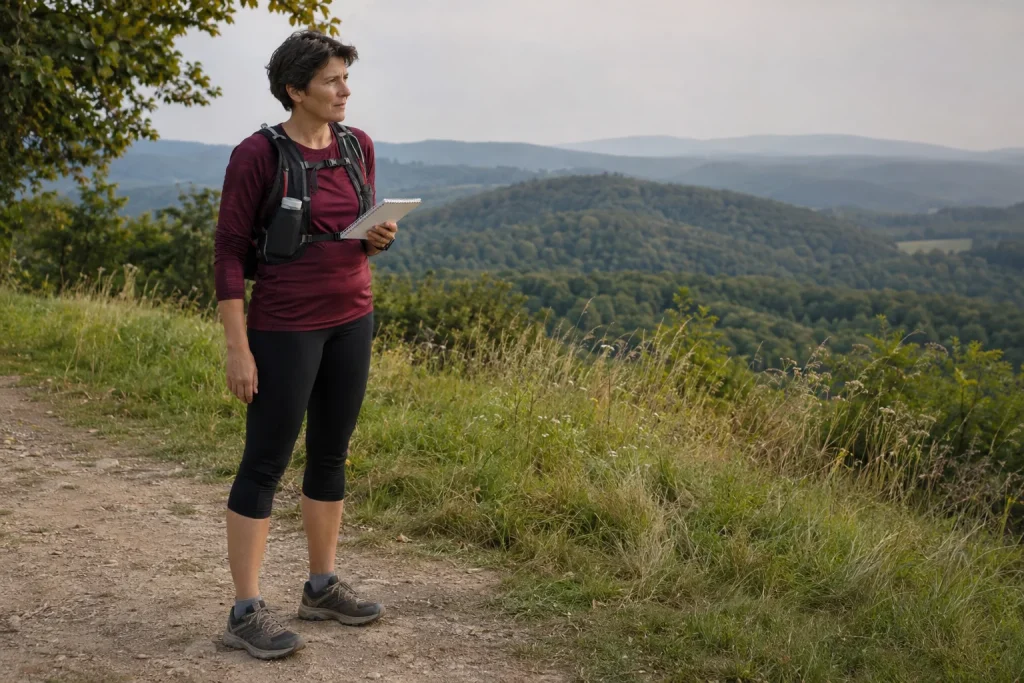
When choosing a longer trail goal, the greatest number of kilometres previously run is a tempting starting point. Yet it does not fully describe your experience. A familiar daylight loop with many access options teaches different things from an unfamiliar route with separate endpoints. A next goal becomes easier to consider when you add experience of terrain, navigation, independence and whole-day organisation alongside length.
This guide provides a goal-selection and organisational framework. It does not determine medical or fitness readiness for a distance or give a universal increase ratio. Appropriate professional help from someone familiar with your situation may be needed for those questions. Here we examine which information should inform a choice, what remains unknown and how to distinguish an attractive future idea from an activity genuinely manageable now.
Review earlier days by their characteristics
Choose a few trail days that left you with real experience. Describe the course, conditions, navigation method, social arrangements and travel. You do not need to reprocess every outing in detail. Find examples showing what you handled yourself and where you relied on others’ help.
Look at how things worked alongside completion. Was the route followable? Did you have appropriately planned access to necessities? Were group-movement arrangements clear? How well did getting home from the finish work? These do not replace evaluating physical preparation, but provide concrete information for organising the next day.
Do not retrospectively improve the quality of earlier decisions because of the final outcome. Everything turning out well may still have depended on an unchecked condition luckily working. Equally, cancelling or shortening a day can provide good decision-making experience. For choosing goals, understand what was deliberately arranged and what remained uncertain.
Name the real attraction of a longer goal
You may primarily want a new landscape, a longer shared day, a special event or more independence rather than more kilometres. These are different goals. An impressive ridge need not be reached only through the longest distance. If the social experience matters, several short routes can create something new without increasing the commitment in every dimension.
Write a short goal statement. For example, you want to know two neighbouring parts of a mountain range better, or have a manageable longer daylight outing with familiar companions. The statement is useful if it also helps you let go of an impressive option designed for another aim. ‘I want something big’ is more an initial feeling than a completed decision criterion.
A goal can also be long-term. Every exciting idea does not immediately need an entry or specific date. Keep it on a separate list while the required experience, time allowance and information come together. Retaining interest is different from committing now.
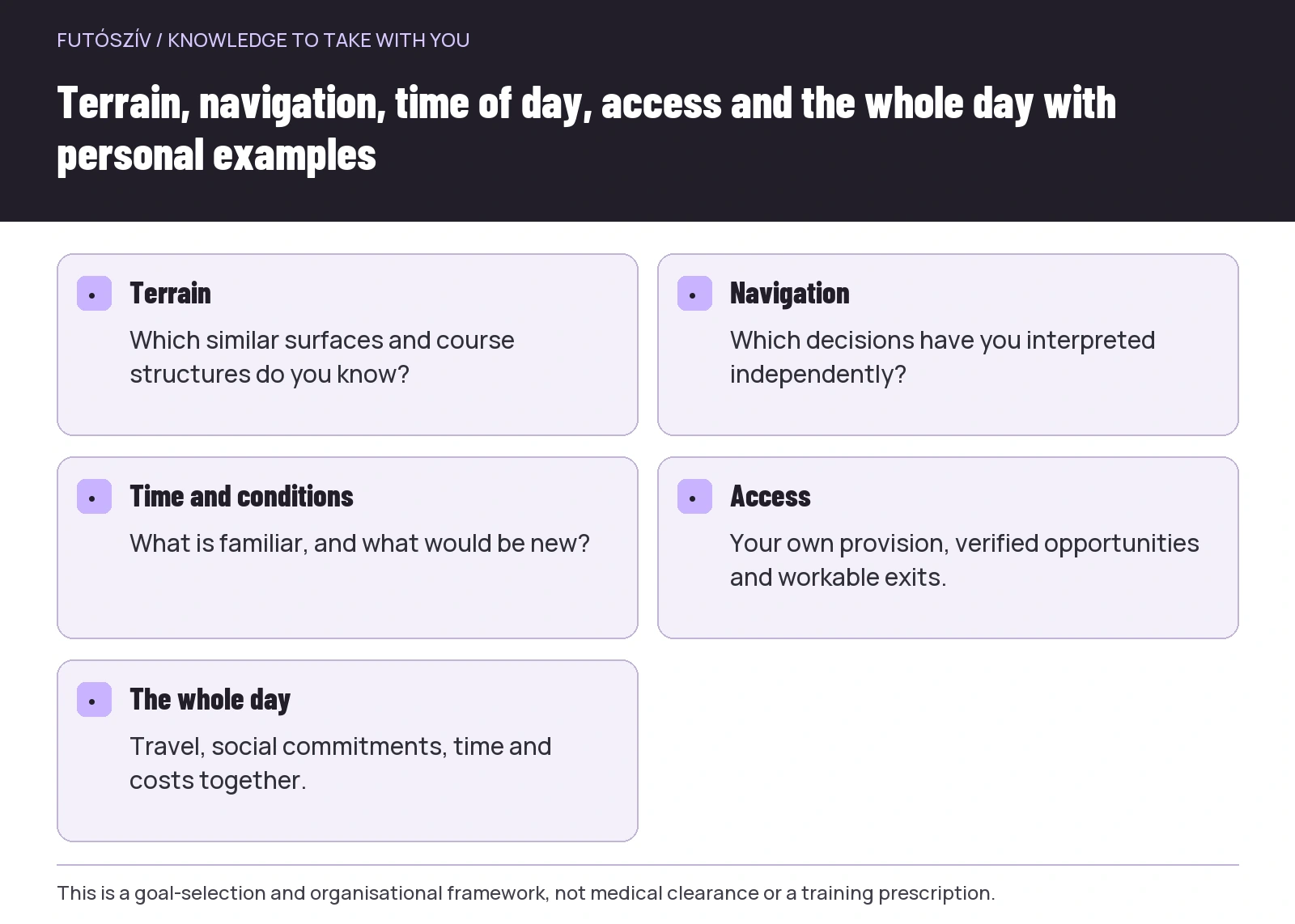 Enlarge diagram
Text version of the diagram
- Terrain
- Which similar surfaces and course structures do you know?
- Navigation
- Which decisions have you interpreted independently?
- Time and conditions
- What is familiar, and what would be new?
- Access
- Your own provision, verified opportunities and workable exits.
- The whole day
- Travel, social commitments, time and costs together.
Map familiar and new elements
Describe the next activity by its features: distance, climb locations, surface, navigation tasks, time of day, access and transport. Beside each, record a personal example or that you lack an appropriate reference. A gap is planning information, not a judgement. It can lead to a question, practice or looking for a simpler version.
| Element of the goal | What personal example do you have? | What may remain as the next task? |
|---|---|---|
| Terrain and surface | Observing a route of similar character | A concrete course description or targeted local knowledge |
| Navigation | Independently interpreting a route and junctions | Appropriate skill development |
| Time of day | Experience of the planned period | Clarify conditions and your own provision |
| Access | A workable personal supply and exit plan | Confirm uncertain points |
| Social format | Agreed group movement or independent organisation | Clarify roles, meetings and ending |
| The whole day | Manageable travel and time allowance | Recalculate the parts outside the course |
The table is not a suitability scorecard. A particular number of yes answers does not make every goal appropriate. It shows which details you can discuss concretely and which you only assume. That makes accumulating unknown elements easier to notice.
Skills and equipment are separate questions
A new watch, downloaded course or larger bag does not automatically make new terrain familiar. Equipment becomes a solution alongside appropriate use. Check which functions you can actually operate and where you still rely on another person. Accurately knowing your own limits helps choose a more realistic goal.
The Mountain Training introduction to Hill Skills treats planning, packing, navigation and understanding conditions as separate skills too. The British training is not a Hungarian certificate of trail-running suitability, and this article does not recommend a particular course. The principle is useful: independence outdoors consists of several learnable parts, not mileage alone.
If an element requires training or knowledgeable support, plan that separately. Paying an entry fee should not be the method for postponing missing knowledge. A nearer-term goal can build on usable skills while you gradually gain experience for the more distant idea.
Do not measure experience only by repetitions
Many outings on the same route led by someone else do not necessarily provide as many independent navigation decisions. Equally, deliberately observing a familiar loop can teach something new. What matters is which tasks you undertook: did you plan, interpret the map, select an appropriate alternative and understand why? The number of occasions alone does not explain all that.
The Mountain Training professional FAQ on gaining experience emphasises judgement and decisions developed through experience in leadership learning. You do not need to adopt it as a personal runner-rating system. It reminds us that processing experience matters, not just accumulating days.
A few concrete lessons are enough in your own notes. Which assumption proved inaccurate? Where was there a workable alternative? Which information would you have sought earlier? These can support a better next decision. A general ‘I’m experienced now’ says less about what you can build on.
Count the longer activity’s full cost in time too
Travel, preparation, possible collection, waiting and getting home can accompany time on the course. A more distant goal is a larger commitment outside running too. Check whether your circumstances provide the time and agreement needed. Do not mark only the interval between the start and hoped-for finish in the calendar.
Companions’ time is also a real commitment in a shared activity. If someone drives, waits or helps at the endpoint, agree precisely. A new goal should not rely on others’ unspoken availability. Clarify the boundary between help they can provide and your own independent arrangements. If no workable framework exists, choose another format.
Financial planning should include necessary travel and other expenses alongside entry. New equipment is not automatically compulsory for every goal, but genuinely necessary equipment cannot be ignored for a lower total either. A decision fitting your means is part of choosing a goal, not an objection raised afterwards.
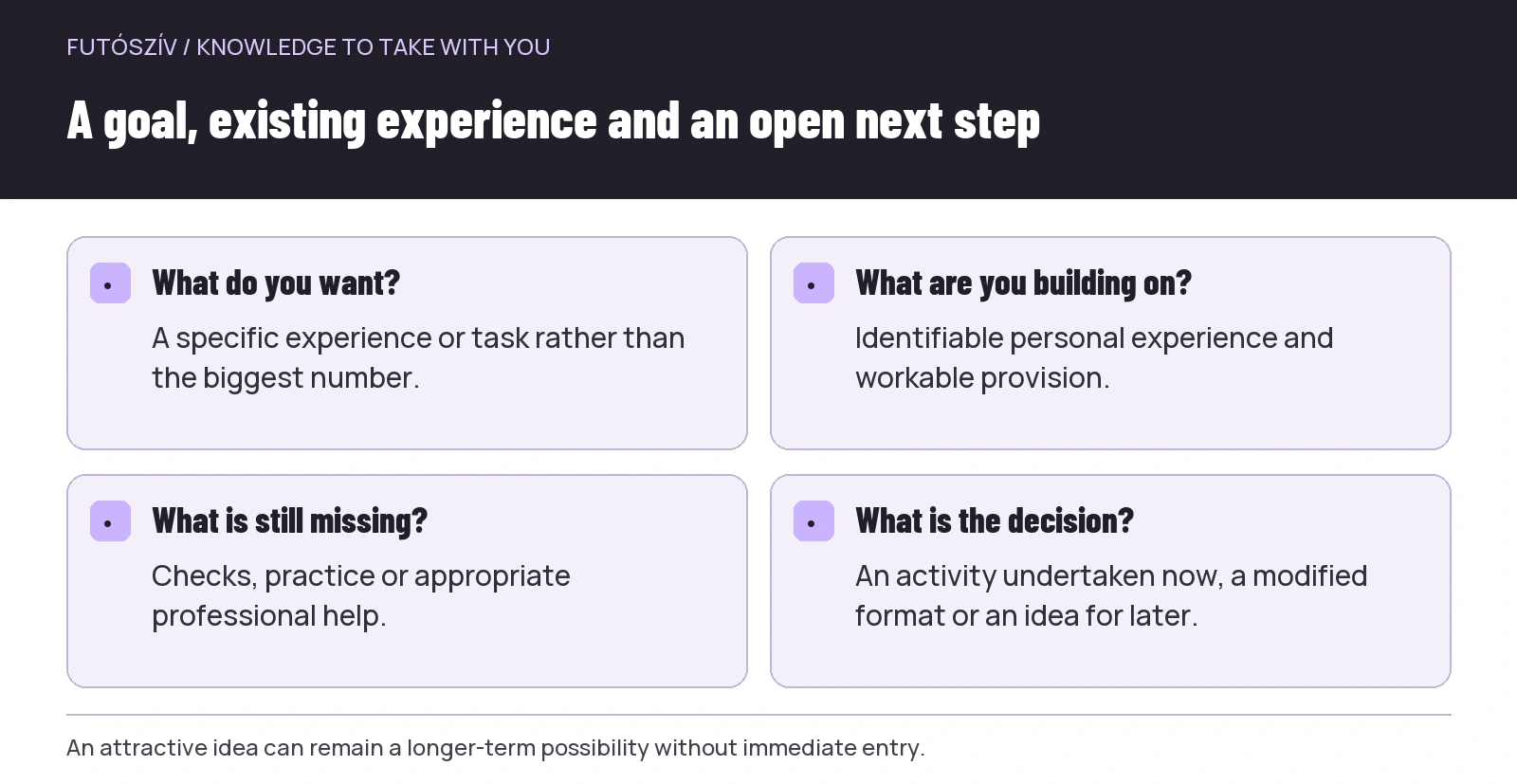 Enlarge diagram
Text version of the diagram
- What do you want?
- A specific experience or task rather than the biggest number.
- What are you building on?
- Identifiable personal experience and workable provision.
- What is still missing?
- Checks, practice or appropriate professional help.
- What is the decision?
- An activity undertaken now, a modified format or an idea for later.
Choose a next step whose difference you understand
Expanding a goal can mean another route format, a new landscape, a different community role or a longer activity. You do not need more novelty in every element simultaneously. Organisationally, naming one main change while other conditions remain familiar may be simpler. This is a way to review uncertainties, not a universal training rule.
A longer daylight route over familiar surfaces with a workable exit, for example, differs from a shorter but unfamiliar night course. Kilometres alone cannot rank them. Your experience and goal statement determine which parts have an appropriate foundation and what needs clarifying first.
The next step does not have to be a race. A well-planned familiarisation day with appropriate companions can help you understand a new question. An organised independent outing and an entered event can involve different support, rules and organisation. Consider that separately rather than only the existence of a medal or entry link.
Make the option to step back part of the goal
A shorter version identified beforehand or a plan moved to another date does not make a goal unserious. It shows the activity depends on conditions. State which missing essential information or commitment would prevent you finalising participation. External access, companions’ confirmation or adequate information can be such organisational conditions.
For a race, check current change and withdrawal terms with the organiser. A backup kept in your head does not automatically provide an entry transfer or another distance. For an independent activity, a shortcut needs to be genuinely followable and accessible. A backup plan is more than a reassuring word at the end of a description.
If a goal becomes less suited to your circumstances, reassess it. Earlier interest does not bind you to every subsequent decision. Knowledge gained and runs already experienced are not lost because you now choose another day or activity. The goal serves your running, not the other way around.
A fictional example of two attractive future options
Eszter gains experience from several familiar daylight woodland loops. Two new ideas attract her: a longer loop over similar surfaces and a shorter evening route with different endpoints. By kilometres, the second appears smaller, but the organisational table reveals a new time of day, journey home and part of the route. She does not automatically regard those as simpler.
Her goal statement concerns a calmly manageable, longer day in nature. She investigates the similar-surface option further and retains the other as a future idea. She addresses physical preparation separately within the appropriate framework. The choice does not mean the evening activity is generally bad; it reflects where she currently has more usable experience and workable provision.
After the next day, Eszter records more than distance. She examines timing estimates, access and coordination with companions. These refine the questions for the next goal. Development is represented not by one continually increasing number, but several understood, usable experiences.
Be able to give three sentences at the end of the decision
The first should explain what you want from the goal. The second should name the earlier experience you build on. The third should identify what still needs checking, practice or appropriate help. When these are clear, choosing a goal is more than saving an impressive event. If one is missing, the idea need not be rejected, but the commitment is not yet ready.
A longer trail goal becomes your own when you understand how it differs from earlier days. Kilometres and ascent matter, but navigation, conditions and the full organisational framework belong to the decision too. A next step has value because it builds coherently from your present knowledge and situation, not because it looks bigger than every alternative.
How Futószív articles are prepared: our editorial guidelines.