“Running improves memory” is both an appealing statement and an overly broad one. It might mean distinguishing similar images more accurately in a task, obtaining a different result on a spatial-memory test, or a change in the imaging-estimated volume of a brain region. These may be related, but they are not the same. When reading about the hippocampus and exercise, preserving this distinction is particularly important: a striking brain finding does not automatically mean a general improvement in memory across every situation in life.
Three separate questions about memory
Everyday memory can involve recalling a name, recognising a route or distinguishing whether you saw an object today or yesterday. Research usually tests a particular component of these processes. One score cannot address everything at once. The hippocampus is an important area of memory research, but mentioning its name does not turn the result of a specific task into a measurement of memory as a whole.
Structure is a second question, and function a third. A volume estimated using structural MRI is neither your performance on an image-recognition test nor the functional signal measured during a task. Keep these three levels on separate mental shelves. If a news report discusses one and ends with a promise about another, an important evidential step may be missing. An interested runner need not become a neuroscientist to notice this.
A year-long programme with older adults
Erickson and colleagues’ 2011 randomised study involved 120 older adults without dementia. An aerobic-exercise group was compared with a stretching and toning control programme over one year. Researchers measured an approximately two per cent increase in hippocampal volume in the aerobic group and a decrease in the control group; the difference mainly involved the anterior hippocampus. This was not uniform growth of the whole brain.
An important nuance in the detailed findings is that spatial-memory task accuracy improved in both groups, with no significant group-by-time interaction detected for this outcome. Within the aerobic group, volume change was associated with memory change. The title therefore does not justify promising that the aerobic programme demonstrably improved every participant’s memory more than the control. The structural finding and the between-group test result need separate assessment.
What does two per cent not mean?
The percentage change in volume is not the percentage change in memory. It does not mean remembering that many more names, learning a language faster or certainly avoiding a disease later. “A younger brain” can also suggest more than a comparison of one region’s average volume. Age-related function cannot be described by a single number, and one programme does not reverse a person’s entire biological history.
Two per cent is therefore not a useful personal target. You cannot track it in a running log like distance covered. Even interpreting a genuine laboratory measurement requires professional context and an appropriate comparison. Nor can the size of the hippocampus be calculated backwards from a memory game played at home. Leaving a finding at the measurement level where it arose does not make the research less interesting.
 Enlarge image
A short exercise session asked a very different question
In Suwabe and colleagues’ 2018 work, healthy young adults took part in two separate experiments: twenty in the behavioural study and sixteen in the imaging study. Ten minutes of very light recumbent cycling was compared with rest in a within-person design conducted on different days. The task involved distinguishing similar, previously seen and new images. After light exercise, researchers found better discrimination under certain similarity conditions.
In the imaging experiment, changes in functional connectivity between the hippocampal DG/CA3 regions and other areas were associated with the task benefit. This was an acute functional finding, rather than lasting volume growth demonstrated within ten minutes. The thirty per cent used referred to a laboratory workload linked to peak oxygen uptake, not a simple percentage of maximum heart rate. The study concerned neither running nor dementia treatment; longer-term conclusions require further research.
Distinguishing similar memories in everyday life
Running life offers an accessible illustration of discrimination. You might complete two very similar loops in the same park, yet on different days with different people. In your memory, distinguishing which occasion included a conversation may matter. This merely illustrates why handling similarity is interesting; it is not the study’s image task or a diagnostic test to perform at home. A personal story can make the question clearer without being called a test.
However, a laboratory benefit does not justify explaining all everyday forgetfulness as insufficient exercise. Forgetting where you put your hat cannot establish the condition of a brain region. Rushing, divided attention and putting objects in inconsistent places are also different questions from a memory disorder. A runner’s personal experience and a research outcome should not be joined through a diagnostic inference.
Structure, function and tests: why can they not replace one another?
A home’s floor area and how you can move around it are related but different information. The analogy has limits, yet helps explain why one structural number cannot answer every functional question. A difference in a brain region’s size does not by itself reveal someone’s performance on a particular task. A functional-connectivity signal is not simply the number of “wires in use” from which unlimited performance can be read.
Studies use several methods precisely so these levels can be compared. Variables changing together represent an interesting association. The direction and conditions of an explanation still need clarification. When reading research, the distinction between “was associated with” and “caused” often matters more than all the technical terms in a figure. Precise language protects the finding from exaggerated promises.
MRI does not directly count new nerve cells
A popular statement in exercise communication is that running grows new cells in your brain. However, the human imaging studies discussed here cannot directly reveal an individual cell count. Volume estimation and functional signals are other types of measurement. Connecting mechanisms from animal experiments with human findings is a research task; the appearance of the word exercise in both is not enough.
BDNF deserves similar care. A protein level measured in blood and a process occurring in the brain are different data. An associated relationship cannot become a personal promise that a particular run will produce an exactly defined number of new memories or nerve cells. We need not exaggerate molecular details to find exercise and brain-adaptation research interesting. How something is demonstrated matters at least as much as the proposed mechanism’s name.
What can an older runner restarting now take from this?
These findings do not make running compulsory for people for whom another activity is currently appropriate. Neither the year-long programme nor the short cycling study was a competition won by the person undertaking the greatest load. A personal aim might be enjoyable regular activity, a social occasion or a sustainable daily routine. Access, individual exercise capacity and, where needed, a framework agreed with the treating professional matter more in shaping this than an attention-grabbing brain headline.
If you have been inactive for a long time, do not copy a study’s percentage workload into your watch’s heart-rate zones. Laboratory-defined characteristics may involve separate measurements. Planning activity that fits daily tasks is practical: where, with whom and under what accessible conditions can you participate regularly? A research finding can inspire a thought, but does not replace a decision suited to your condition or remove the need for an indicated assessment.
 Enlarge image
A memory game can be fun rather than a health judgement
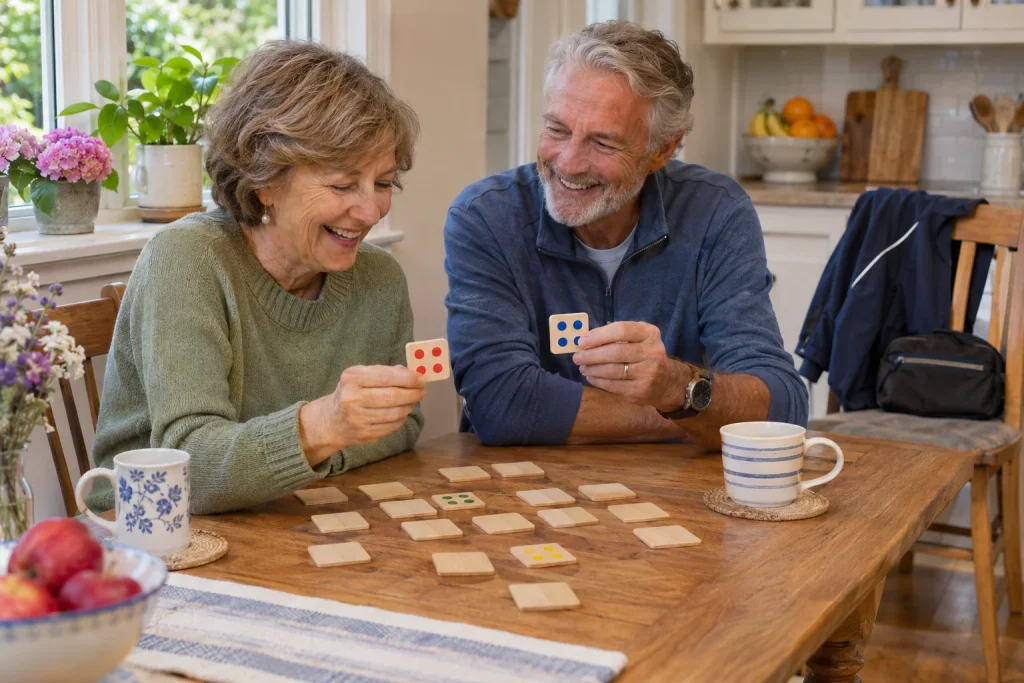
A family matching game, route puzzle or learning a new name can be enjoyable. Every result need not become a report on your brain’s condition. More mistakes one day do not mean yesterday’s run was unhelpful. Familiarity with the task, surroundings and attention can change too. A game’s value often lies precisely in offering shared time and curiosity instead of examining you.
If memory difficulties persistently interfere with everyday life, however, an exercise article is not an appropriate self-assessment tool. Discuss the change with a healthcare professional rather than waiting for a running programme’s success to settle the question. Sport can be part of life within agreed limits, but cannot be used to prove there is no problem. Seeking help and being interested in exercise are compatible.
How can the conclusion remain precise?
First identify the timescale: one short session or a year-long programme? Second, the participants: healthy young people or older adults? Third, the outcome: volume, a functional signal or a precisely named memory task? Without these three details, “improves memory” can mean almost anything. Together, they form an interesting, verifiable and proportionate account of the relationship between exercise and memory processes.
For a runner, the strongest lesson is not a guaranteed brain benefit. Rather, understanding exercise does not require exaggerated shortcuts. A structural finding can be called a structural finding, and an advantage on a specific task a specific task benefit. A personal activity programme can then be built around real circumstances instead of fulfilling a promise. Research can keep asking: for whom, after what activity, for how long and exactly which memory process changes?
Sources
Erickson and colleagues: Exercise training increases size of hippocampus and improves memory, 2011. The full results section discusses volume and the memory task’s between-group difference separately.
Suwabe and colleagues: Rapid stimulation of human dentate gyrus function with acute mild exercise, 2018. Short, very light cycling and memory discrimination in healthy young adults.
How Futószív articles are prepared: our editorial guidelines.