Heel-striking runners are often frightened with the claim that injury is inevitable. Forefoot strikers are sometimes promised that they have already found economical technique. Both statements make the same mistake: trying to write a complete health and performance story from a single movement characteristic. Foot strike may matter, but its meaning comes from the whole run, loading history and individual situation.
You do not need to change your movement immediately if a video places you in a different category from a role model. First understand what the category describes, which questions research investigates and why you would want to change.
What is a foot-strike pattern?
The description usually refers to which part of the foot first contacts the ground. With a rearfoot strike, the heel region arrives first; with a forefoot strike, the front part arrives earlier. The definition of the middle category can also vary with the measurement method.
This concerns first contact, not what happens throughout stance. After a forefoot landing, the heel may also come down while the body continues over the supporting foot. One moment does not replace observing the entire movement.
Categories are useful simplifications, but their boundaries are not sharp in every situation. Shoe geometry, camera view and the selected frame can also affect classification. Do not treat uncertain footage as a precise diagnostic tool.
Your own sensation is not always an accurate classification
While running, you may not accurately sense which part lands first. Sound, pressure underfoot and shoe movement mix several kinds of information. If the question genuinely matters, appropriate footage or professional measurement can help.
Do not search for one frame at all costs. Watch several steps at similar speeds and see whether the pattern stays the same. A fatigued section, bend or reaction to a pebble may differ from habitual movement.
Self-observation should not become fault hunting. If you have no symptoms and no specific performance question, learning your category may be enough in itself. Not every piece of data requires intervention.
Speed and shoes matter too
Research involving recreational runners examined the relationship between foot-strike pattern, speed and footwear conditions. The findings remind us that movement is not necessarily unchanged in every situation.
Comparing a fast race section with a slow warm-up is therefore not a pure technique comparison. Likewise, footage in new shoes does not necessarily show only the effect of a deliberate instruction. Describe the circumstances when tracking a change.
Terrain can also alter step choices. On climbs, descents and uneven surfaces, safe progress is a different task from running on a flat track. There is no need to force a single foot-strike picture on every section.
Loading is redistributed rather than disappearing
Different landing patterns can affect work at the ankle, Achilles tendon, foot and knee differently. A smaller mechanical measure at one area may mean greater demand elsewhere. “Load-free running” is therefore not a useful general goal.
A study analysing cumulative tissue loading across foot-strike patterns evaluates these differences using several calculations and movement characteristics. Modelled forces are not the same as certain predictions of future injury, but help explain trade-offs.
When changing your movement, it is therefore not enough to notice whether the originally symptomatic area feels different. Adaptation to the new situation and any new symptoms also need monitoring, with a professional if necessary.
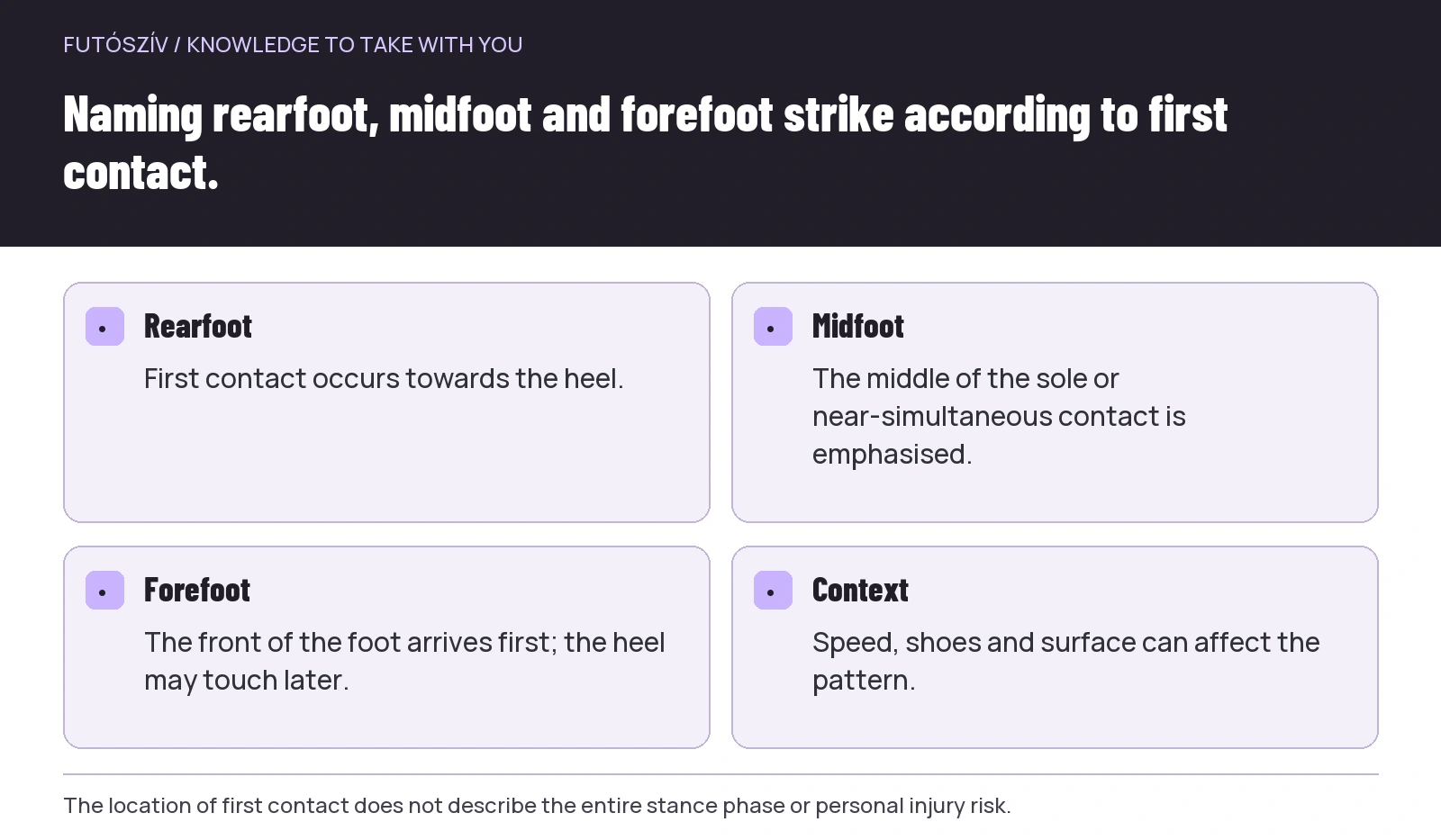 Enlarge diagram
Text version of the diagram
- Rearfoot
- First contact occurs towards the heel.
- Midfoot
- The middle of the sole or near-simultaneous contact is emphasised.
- Forefoot
- The front of the foot arrives first; the heel may touch later.
- Context
- Speed, shoes and surface can affect the pattern.
Economy cannot be read from foot contact
Running economy means the energy required to run at a particular speed. You cannot establish it solely from whether the heel or forefoot arrives first. Whole-body movement, fitness and individual habits all matter together.
A meta-analysis summarising benefits and risks of changing foot strike examined economy and injury questions too. The data do not justify a compulsory switch to one pattern for every symptom-free runner.
When someone switches from their habitual movement to another, the new task may initially feel unfamiliar or harder. This is not automatically useful adaptation, nor does it prove long-term change is impossible. A monitored intervention tied to a goal differs from switching because of fashion.
Why can injury studies give different pictures?
The retrospective study by Daoud and colleagues found different injury rates between foot-strike categories in a particular group of runners. It raised an important question, but a retrospective association does not prove that switching would itself prevent injury.
A later twelve-month prospective RISC study also found other relationships between running movement and subsequent injuries. Different findings show that the sample, participants and variables investigated substantially affect conclusions.
Do not simply select the study that supports your favourite technique. The whole evidence picture and personal situation matter. Foot strike is one possible element within a system containing many risk factors, not a decisive label in its own right.
Retrospective and prospective studies
Retrospective research may examine the relationship between earlier injuries and observed movement. This raises the question of whether the pattern preceded symptoms or was already partly their consequence. The runner may also have changed shoes, loading and technique in the meantime.
In prospective research, participants are followed after the initial measurement. This may clarify the sequence of events, but association still does not automatically mean causal certainty. Many other factors can change during observation.
Intervention research would be better placed to assess the benefit of switching preventively. Understanding differences between methods helps resist overconfident technique promises.
Barefoot, minimalist shoes and forefoot: three different concepts
The absence or characteristics of footwear are not the same as a foot-strike category. Changing shoes can alter several conditions at once: cushioning, stiffness, geometry and sensation. Do not dismiss all this with a single “more natural” label.
If trying new footwear, do not also increase distance substantially or start a new intensive programme at the same time. Otherwise, the response will be hard to interpret. Gradual progression here is a planning principle, not a personalised kilometre guarantee.
Barefoot or minimal-shoe running also has environmental conditions. Ground, injury hazards and individual health background matter. Visual aesthetics are no reason to attempt a risky trial on an unknown surface.
A quiet landing is not an accurate force measurement either
The sound of ground contact can influence how movement feels, but loudness cannot directly calculate every internal load. Surface, shoes and recording surroundings also change what you hear.
An instruction to land more quietly may be a learning tool, but its purpose and effects need tracking. If you change only to make a video sound better, you can easily lose the actual question.
Likewise, shoe wear is not a complete movement analysis. It can be a useful observation, but use, material and route all influence it. Do not diagnose from a single worn patch.
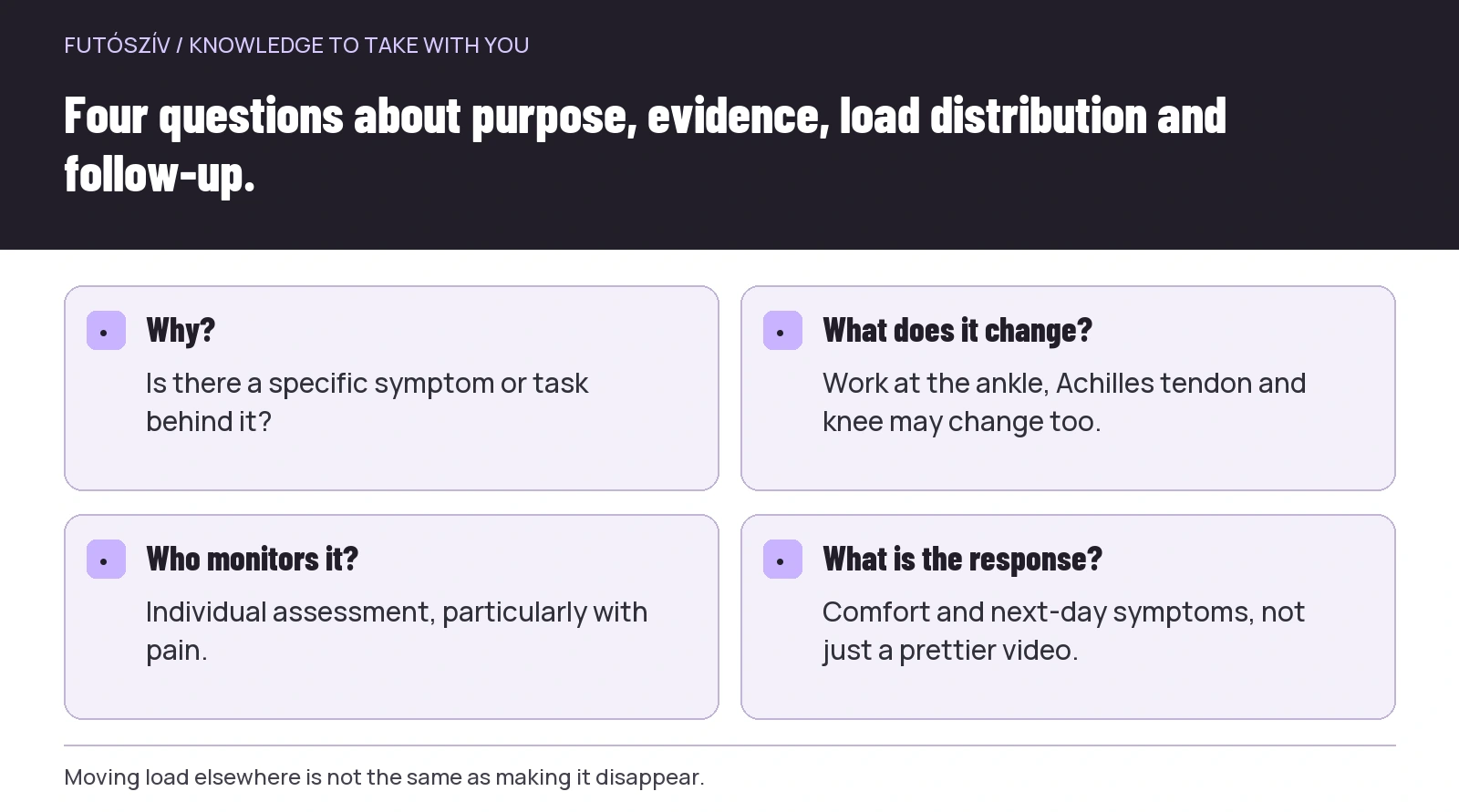 Enlarge diagram
Text version of the diagram
- Why?
- Is there a specific symptom or task behind it?
- What does it change?
- Work at the ankle, Achilles tendon and knee may change too.
- Who monitors it?
- Individual assessment, particularly with pain.
- What is the response?
- Comfort and next-day symptoms, not just a prettier video.
Foot strike and overstriding are different
Where first contact occurs on the foot and where the foot sits relative to the body are separate characteristics. Heel contact does not automatically mean an excessively long step, just as a forefoot landing does not imply perfect foot position.
Speed, cadence and movement phase shape the picture together. Name these separately when evaluating video. Precise description helps avoid expecting one technique change to solve every problem.
For individual symptoms, a professional may weigh several options. Completely changing foot strike will not necessarily be the first or only step. Loading background and symptoms are equally important.
A habitual pattern and one being tried are different situations
Comparing two people who have long run differently is one question; measuring the same runner with a new instruction is another. The first includes previous adaptation and many individual differences. In the second, unfamiliarity with the new movement can affect the result.
A short laboratory trial or a few minutes of your own experimentation cannot therefore establish with complete certainty what would happen with a change maintained for months. State the method and timescale alongside the conclusion too, particularly if someone promises a certain performance benefit.
If you nevertheless decide on a change
Have a clear reason, observation method and option to adjust. Ask under which conditions to try the new pattern and what to observe during, afterwards and the next day. The total running load also needs adapting accordingly.
Do not begin switching in the middle of a long race. Fatigue and the constrained situation leave little room for controlled learning. A new landing forced on the basis of an internet video may create unfamiliar work.
With new or worsening pain, stop and consult. Do not automatically regard discomfort as the compulsory price of correct technique. The aim is usable movement, not changing category at any cost.
What should you bring to a professional discussion?
Describe your running week, recent changes, shoes and symptom timing. If you have footage, explain the speed and circumstances. A full background allows better questions.
Ask what benefit you expect from the change and what remains uncertain. A good explanation offers an understandable aim and a plan you can follow, rather than a promise of injury-free running. Reassess the intervention’s outcome over time.
If you have no symptoms and no clear reason to switch, continuing with your familiar movement can be a valid decision too. The value of regular, manageable running does not depend on a single foot-strike label.
Sources and verification
This article cites a meta-analysis, injury studies using different methods and biomechanical research. Retrospective and prospective associations have been separated from proof of preventive effects. Changing foot strike is not a general prescription; symptoms may require individual professional help. Sources checked: 18 November 2026.
How Futószív articles are prepared: our editorial guidelines.