
One of the best-known training sayings suggests increasing weekly distance by no more than ten per cent. It appeals because it is memorable and easy to calculate in a spreadsheet. Problems begin when it becomes a personal safety guarantee. Running injuries and training load have a more complex relationship than one percentage deciding every next week correctly.
Gradual progression still matters. The question is how to apply it while keeping session content, your own history and responses visible alongside the number. Careful research interpretation and everyday calculations can help.
What does the ten per cent rule actually say?
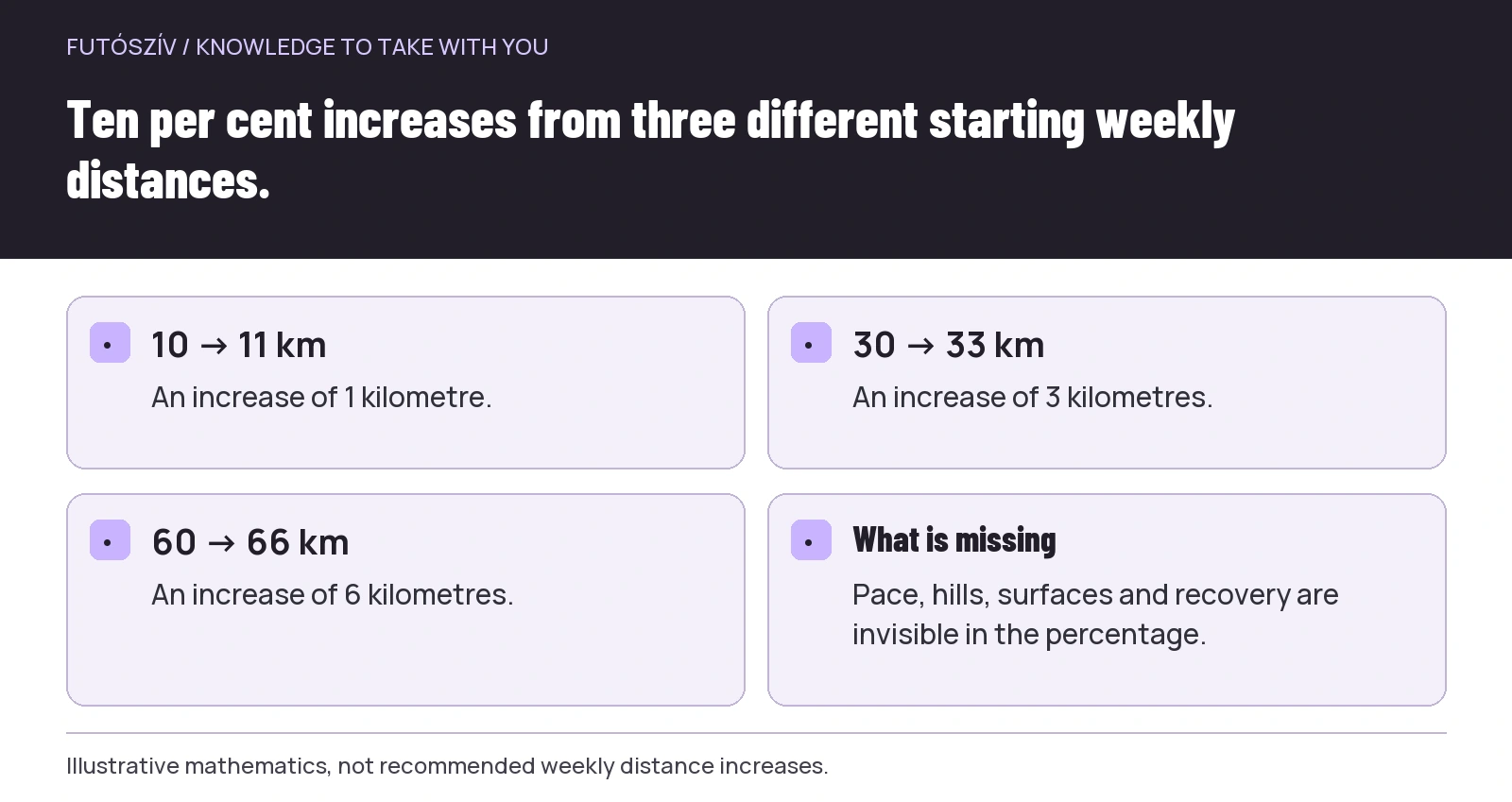
The familiar version compares next week’s increase with the previous week’s total distance. After ten kilometres, the next allowance would be eleven; after thirty, thirty-three. The mathematics is exact, but important questions remain unanswered.
Why use the previous week? What if travel made it unusually short? Do races, warm-ups and trail walking count? What if distance barely increases while speed, hills and hard days change together? The percentage does not answer.
Distinguish a simple reminder to be patient from an alleged injury-prevention method. The first is a modest, more defensible role. The second requires evidence that applying it reduces injuries compared with an appropriate alternative.
What did a trial with beginners show?
In the randomised study by Buist and colleagues , 532 novice runners prepared for a recreational event. A longer programme based on the ten per cent principle was compared with shorter standard preparation. Injury incidence showed no preventive benefit: proportions in the groups were very similar.
This does not establish that sudden large increases are irrelevant for everyone. The trial assessed a particular programme, participants and injury definition. The conclusion is narrower: in this setting, the longer programme based on the principle did not show fewer injuries.
Such a trial is valuable because it does more than ask injured people retrospectively how much they ran. Still, one study does not resolve every loading question. Findings cannot automatically transfer unchanged to runners with different histories, distances and surfaces.
What can observational data tell us?
Following runners can reveal load changes associated with more injuries. Research by Nielsen and colleagues examined relationships between weekly distance increases and particular injury types. Findings also caution that different injuries may relate to load differently.
An observed association does not mean crossing a percentage threshold alone caused symptoms. Runners may differ in experience, earlier injury, age, body mass or training methods. Studies try to account for some factors, but uncertainty can remain.
The review by Damsted and colleagues analysed evidence on load changes and running injuries. Few studies with differing methods prevented a simple progression recipe for every runner. This uncertainty calls for careful planning rather than excusing unconsidered increases.
 Enlarge diagram
Text version of the illustration
- 10 → 11 km
- An increase of 1 kilometre.
- 30 → 33 km
- An increase of 3 kilometres.
- 60 → 66 km
- An increase of 6 kilometres.
- What is missing
- Pace, hills, surfaces and recovery are invisible in the percentage.
Another perspective: the length of one session
A study published in 2025 following 5,205 runners also examined individual-run distances. Overuse injuries were more frequent when a run exceeded the longest run in the previous thirty days by more than ten per cent. This differs from the old rule about weekly totals.
Retain the limitation: an observational result does not experimentally establish that staying below an exact boundary prevents injury for everyone. The authors also consider further prevention trials necessary. Men and certain geographical areas were overrepresented.
The practical message can still help: a weekly total does not reveal everything. Keeping total distance unchanged while suddenly concentrating much of it into one long day substantially changes the week’s structure. Notice this separately.
Three calculations showing the limitations
A short starting week. If travel left only five kilometres, adding ten per cent to that week gives five and a half. This alone does not describe preceding months. The reason for the gap also matters: lack of free time differs from illness or injury.
The same total, a new long run. Previously you ran four similar loops; now you omit two and place most remaining distance on Sunday. The weekly number can match while session length and recovery needs differ. The percentage hides this.
Less distance, more intensity. Kilometres fall while fast sections and hills increase. The distance rule suggests a restrained week, yet the task may be harder. A brief description of speed and route therefore matters in the diary too.
The same percentage means different absolute amounts
Ten to eleven kilometres adds one; sixty to sixty-six adds six. Runners’ histories and capacities can differ too, so neither absolute increase nor percentage stands alone.
For beginners, time spent running and the run–walk balance may be particularly useful. More experienced runners benefit from intensity and terrain detail alongside distance. Tasks need not all use one metric when it fails to reflect them.
Do not let mathematical precision create false reassurance. A carefully calculated 9.8 per cent increase is not a personal risk boundary because decimal places are used. Your body’s response is not obliged to follow a spreadsheet formula.
Where should the next step start?
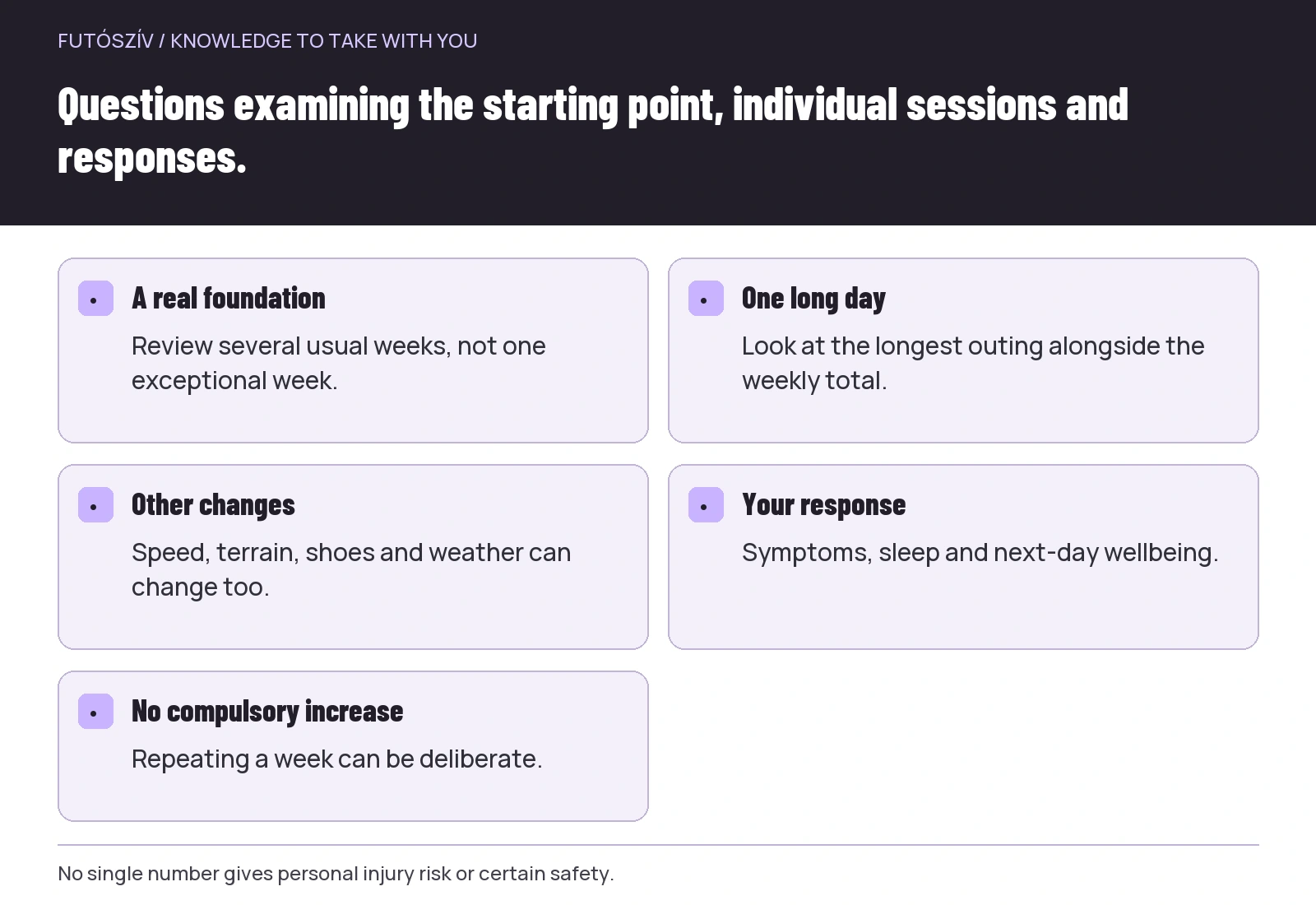
First review familiar, manageable recent load. Seek a picture across several weeks rather than one record week or an unusually short one. The aim is not calculating an average at any cost, but understanding what you genuinely became accustomed to.
Then name the reason to change. More time running easily? Gradual preparation for a longer race? Learning faster sections? Without a clear purpose, another week passing does not require an increase.
Finally consider accompanying changes. New shoes, terrain, little sleep or a busier working week can change the meaning of the same distance. Let the calendar adapt to reality rather than become an automatically rising number sequence.
 Enlarge diagram
Text version of the illustration
- A real foundation
- Review several usual weeks, not one exceptional week.
- One long day
- Look at the longest outing alongside the weekly total.
- Other changes
- Speed, terrain, shoes and weather can change too.
- Your response
- Symptoms, sleep and next-day wellbeing.
- No compulsory increase
- Repeating a week can be deliberate.
One change is easier to follow than five
When increasing running time, you need not simultaneously speed up and choose more hills. A simpler change makes your response easier to understand. This does not guarantee avoiding injury, but creates a clearer decision system.
Repeating a week can make sense too. With unfamiliar demands, allow experience across several sessions. Every easily completed outing need not trigger another challenge. Consistency and feasibility are goals in themselves.
Tell your coach if you ran more than prescribed or a group run became faster than planned. Next week can rest on reality only with accurate information about the last one.
Make response part of the plan
Notice how you feel during the run, that evening and next morning. Unusual fatigue, deteriorating everyday movement or recurring symptoms provide information no percentage replaces. Every difference does not mean injury, but repeated patterns deserve attention.
For worsening, sharp, swollen or gait-changing pain, do not invoke the “permitted increase”. Stop and seek professional help as needed. This article does not provide individual clearance for returning from injury.
A good diary includes what actually happened, not just the plan. If you regularly must shorten sessions, rethink the starting plan rather than treating each as an isolated exception.
After an entirely running-free week, percentage comparison also has a mathematical limit: ordinary percentage growth from zero cannot be calculated. The reason for the break and earlier load history become particularly important. A missing formula justifies neither immediately returning to an old maximum nor inventing an arbitrary rule.
What should you ask about a ready-made plan?
What history does it assume? Why does load grow at that rate? How can it adapt after a missed week? Which outing is longest and what other work accompanies it? Is there genuine easing or continual growth only? These reveal usability better than one familiar percentage.
An online plan can inspire ideas, but does not know your health, work or running history. A race date does not automatically accelerate adaptation. If preparation fits only through hurried increases, changing the goal can also be sensible.
The rule’s place among sound decisions
Use the ten per cent saying to remember that rapid increases deserve consideration. Do not use it to disregard pain, fatigue or an unusually long single session. Gradual progression means more than following a number.
Before next week, review the real foundation, individual sessions, other changes and your response. Discussing these gives far more information than an automatically calculated allowance. Planning for safety requires thought and professional help where needed.
Sources and editorial note
This article cites a randomised beginner-runner trial, an evidence review and two observational studies. Association is distinguished from demonstrated prevention. Calculations are our own illustrations, not recommended weekly distances. Sources checked: 18 November 2026.
How Futószív articles are prepared: our editorial guidelines.