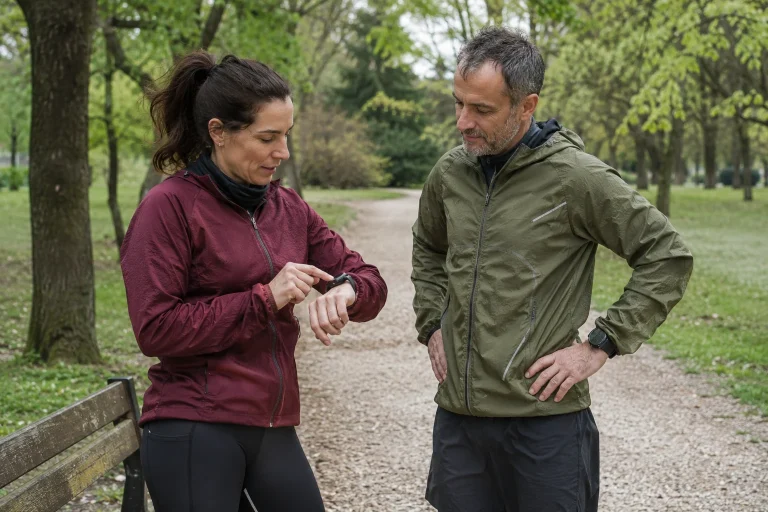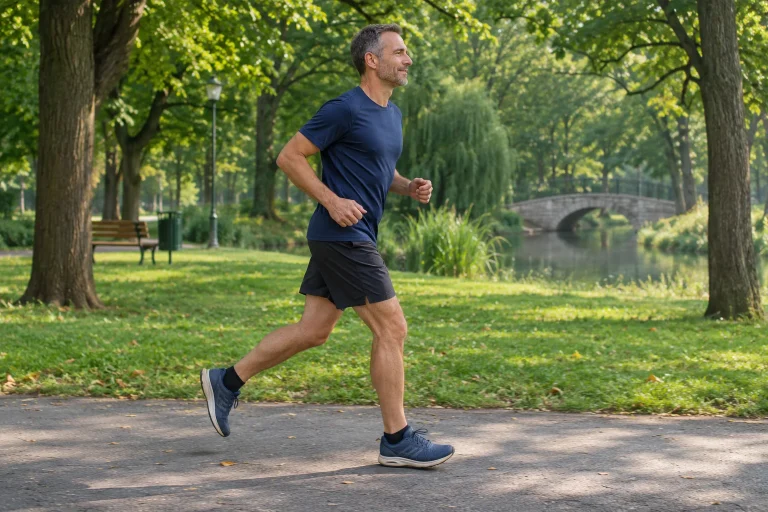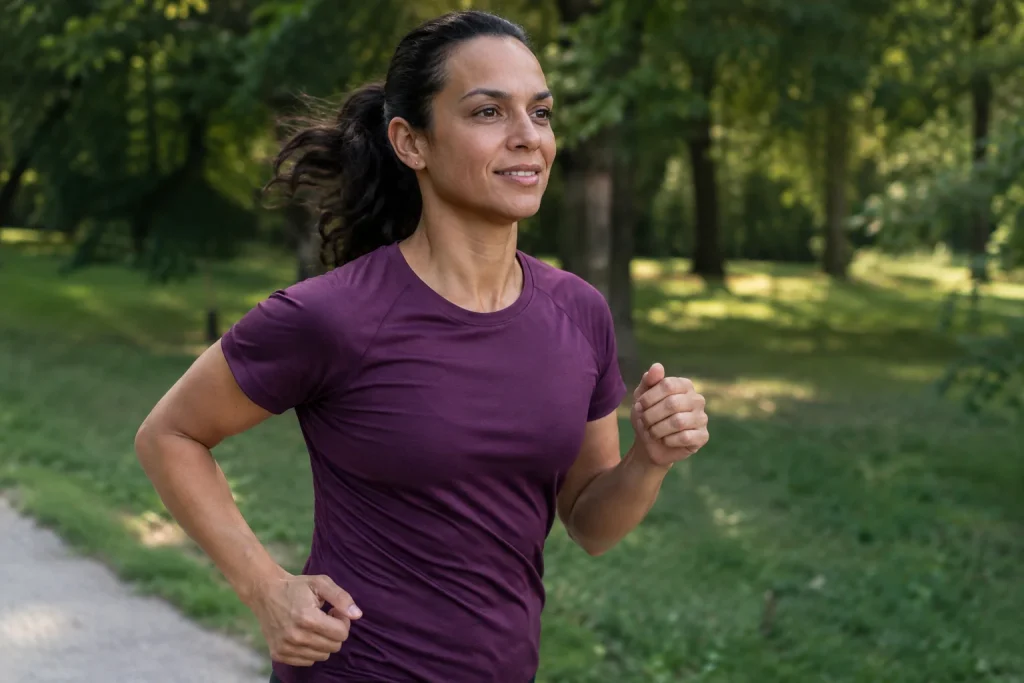
We rarely think about our arms while running until someone tells us: drive them back, hold them at ninety degrees, do not cross, relax. Several instructions at once can easily produce stiff, unfamiliar movement. Arm action is part of the whole running movement, however, and you do not have to consciously direct every detail. First understand its role, then choose a specific question to observe.
This article provides general guidance on understanding technique. Shoulder, neck, elbow or hand pain, numbness and persistent movement restrictions may require individual professional assessment. Arm movement that looks prettier does not replace understanding the cause of symptoms.
Arms are not decorative additions to running
The legs move together with the rest of the body. Arms, shoulder girdle and trunk move in an interconnected system. It is therefore unhelpful to treat arm action as an engine entirely independent of the legs.
Research by Pontzer and colleagues examined the control and mechanical function of arm movement in walking and running. The work emphasises connections between different body parts and adds nuance to explanations that are simply “active” or “passive”.
In practice, this means examining a difference in arm action alongside the whole run. Hand position is not necessarily the primary issue if speed, ground or a carried object has also changed.
What does artificially restricting the arms show?
In an experiment by Arellano and Kram , natural arm movement was compared with different fixed arm positions. Net energy cost increased in the restricted positions, and shoulder and pelvic rotation changed too. Free arm movement can therefore have a measurable role.
This does not mean natural arm action should be made as large or forceful as possible. The experiment compared habitual movement with artificial restriction. It was not a complete technique test ranking every possible elbow angle and hand path.
Do not turn the finding into a general promise of time gains. It cannot establish that a few deliberate hand movements will make every runner faster by the same amount. Your own aim and an observable problem should remain the starting point for change.
Why is ninety degrees not compulsory for everyone?
Runners’ elbows are often more bent than during comfortable walking, but this does not establish a single angle to maintain throughout. Movement is dynamic, and arm position changes during the step cycle too. Rigidly fixing it may obstruct precisely that natural variation.
A small experiment by Yegian and colleagues examined different straight- and bent-arm positions in walking and running. The research asks interesting questions about arm posture associated with gait, but does not justify prescribing the same precise elbow angle to every runner.
If an instruction makes you constantly check your arm position, it probably demands too much attention. The aim is a solution that helps the task and, over time, requires little conscious control.
Shoulder comfort is a useful first observation
During an easy run, occasionally ask whether you are raising your shoulders, holding your neck rigid or feeling clothing squeeze somewhere. The question does not imply that every shoulder movement is wrong. It simply helps identify uncomfortable tension.
Consider pace and circumstances first too. If a run intended to be comfortable is actually very hard, a single instruction to relax the upper body may not solve the situation. The load may need adjusting.
Do not try to manage persistent shoulder and neck pain solely by “running more relaxed”. Symptoms may relate to other movements, your working environment or health circumstances too. Seek an appropriate assessment as needed.
 Enlarge diagram
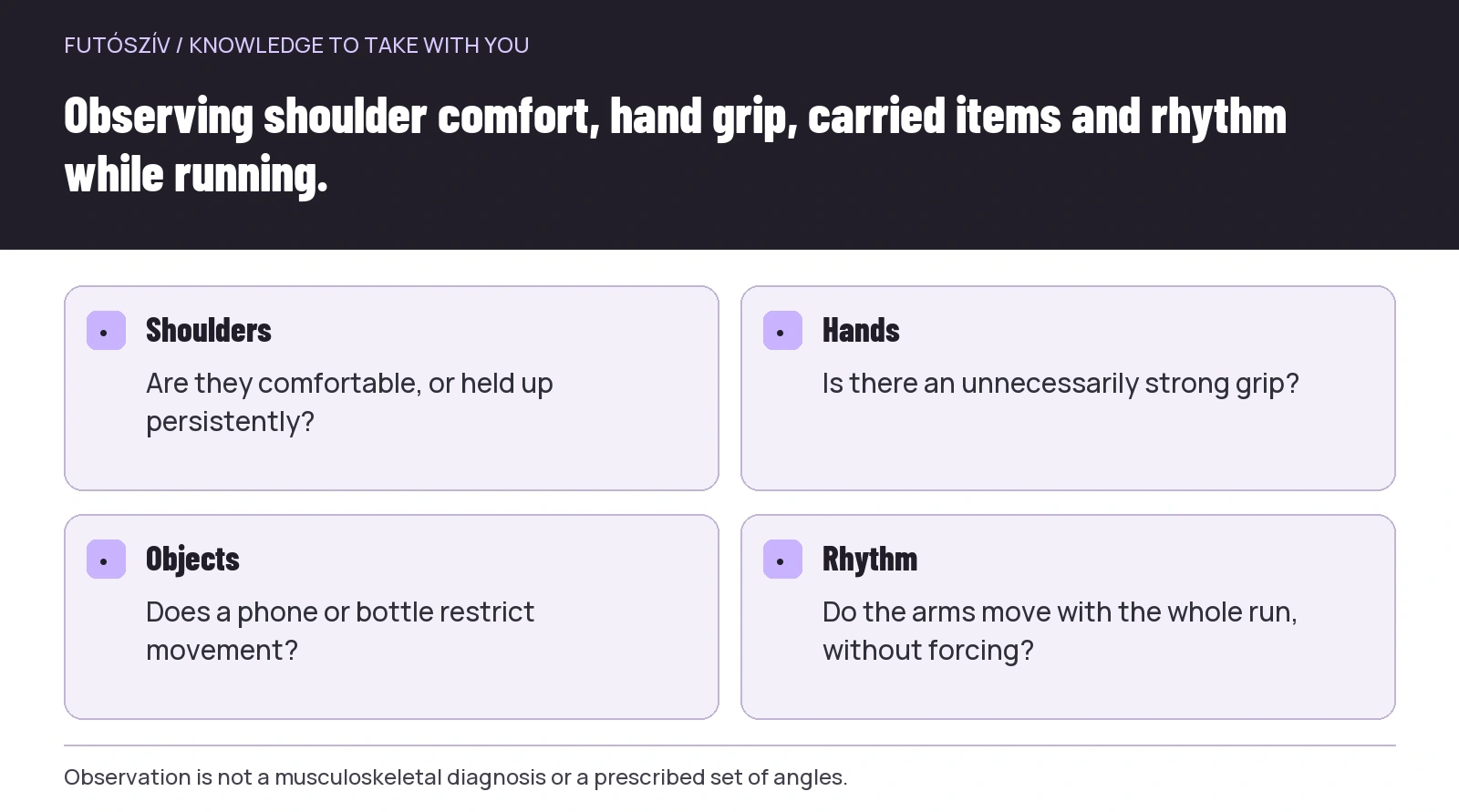
Text version of the diagram
- Shoulders
- Are they comfortable, or held up persistently?
- Hands
- Is there an unnecessarily strong grip?
- Objects
- Does a phone or bottle restrict movement?
- Rhythm
- Do the arms move with the whole run, without forcing?
Your hands do not need to grip tightly all the time
Notice how tightly you hold keys, a phone or gloves. Holding an object and squeezing unnecessarily hard are different things. A more comfortable storage solution often helps more than another instruction about arm action.
Do not try to maintain a perfect hand shape throughout the run. Hand and finger position can change, particularly in the cold or during different tasks. General comfort matters more than precisely copying a pose seen in a photograph.
If numbness, weakness or pain occurs, treat it as a separate symptom. Do not hide it inside a technique label. Observing a movement pattern does not replace assessing such symptoms.
A phone in your hand: a comfort question too
Holding a phone can change how freely you move and occupy your attention. There is no need to automatically turn this into an injury story, but it is worth observing whether another storage method is more comfortable.
Try a pocket, belt or another established solution on a short outing. The phone should not bounce or pull on clothing, and should be easy to reach when necessary. A good choice suits your own equipment and movement.
You can stop in a protected place to look at your watch or phone. While running, raising an arm towards the screen and turning your gaze adds a task, particularly on uneven ground. Checking data should not impair awareness of your surroundings.
Bottles and bags: the whole system matters
When running with a handheld bottle, grip, fastening and weight are all part of the experience. A vest or belt distributes equipment differently. No single solution is equally good for every distance and person; a trial helps you learn about usability.
Do not test only with an empty bottle. The fill level expected during a race or longer loop, pockets and clothing all matter together. If something interferes with movement, adjusting equipment may be the first step, rather than constantly adapting your body to it.
Switching between left and right hands or giving up handheld carrying may be personal comfort options, but do not present them as general biomechanical treatment. Symptoms require separate assessment.
Asymmetry alone is not a diagnosis
On running video, the two arms often do not move identically. There can be several reasons, and a single image cannot establish its significance. Hand dominance, a carried item, a previous injury or the current task may all be part of the background.
The questions are whether it is new or longstanding, whether there are symptoms, and whether it changes the comfort or task of your run. Not every difference needs cosmetic correction. Complete symmetry is not, in itself, a sports-health target.
If a change appears suddenly or comes with pain or weakness, seek professional help. “Just poor arm action” may then be too limited an explanation.
Different movement can be natural on trails and bends
On uneven ground, arm position may differ from flat, straight running. You do not need to maintain the same narrow hand path on every section. Movement adapts to the environment and task.
Research also discusses the relationship between arm action and balance with nuance. A study analysing lateral balance did not support the arms being the main mechanism for every such control task. The statement “arms are only for balance” is therefore too simple as well.
As a practical aim, look for room to react, avoid colliding with others and keep your hands from being unnecessarily occupied. Control on terrain does not come from one technical detail.
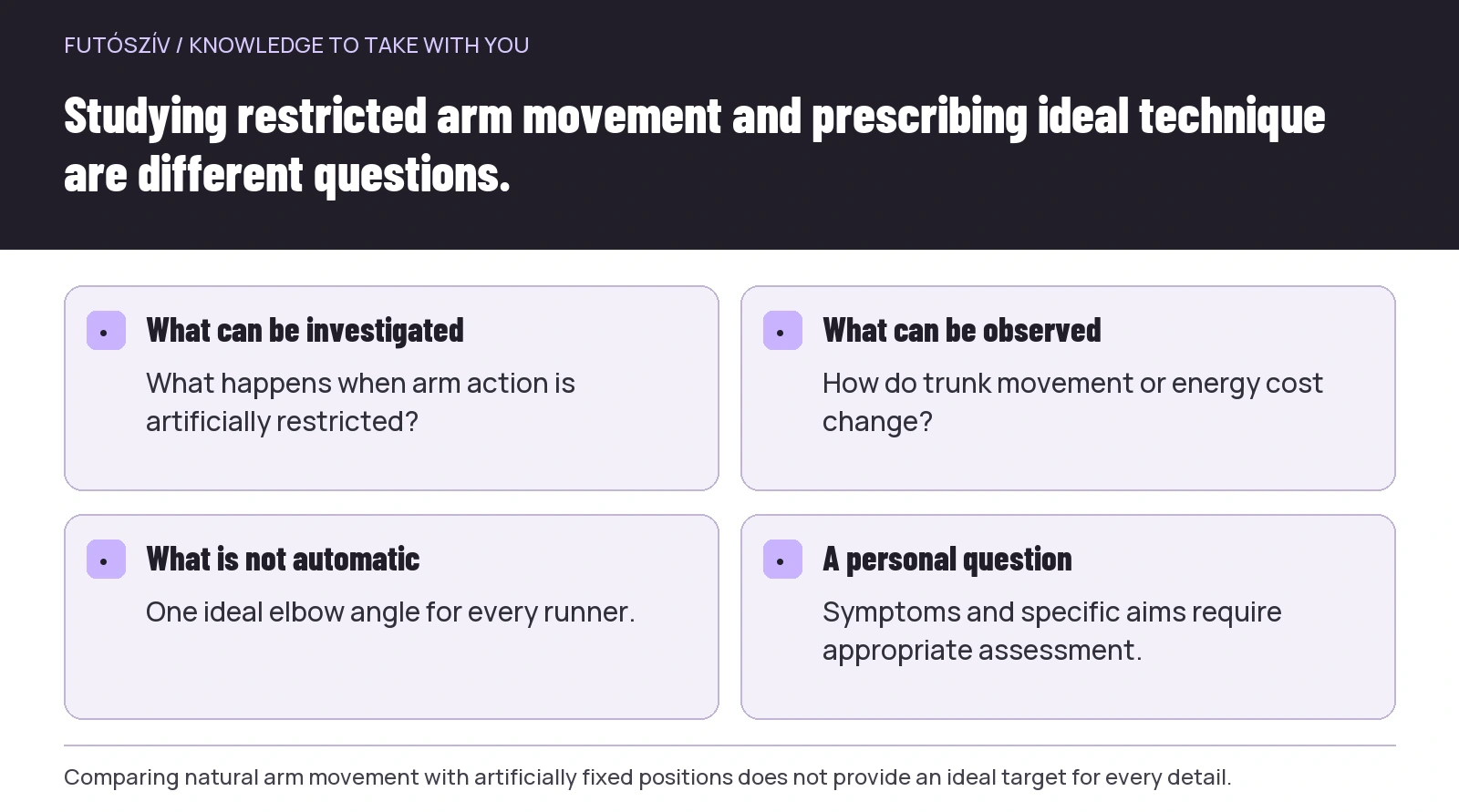 Enlarge diagram
Text version of the diagram
- What can be investigated
- What happens when arm action is artificially restricted?
- What can be observed
- How do trunk movement or energy cost change?
- What is not automatic
- One ideal elbow angle for every runner.
- A personal question
- Symptoms and specific aims require appropriate assessment.
When fatigued, do not immediately force a new movement
Towards the end of a long or difficult run, upper-body sensation and movement may change. First consider whether effort is still appropriate for the day’s aim. A very fatigued state is not necessarily a good time to learn a new arm pattern.
If your shoulders feel stiffer, after a brief observation you can ease the pace or take a calm section. The aim is not to hold a perfect pose through sheer will while the whole movement becomes increasingly hard to control.
Describe a recurring pattern: when it began, with what equipment and during what task. This is a more useful basis for a professional conversation than the general statement “my arm action gives out”.
Several views and steps help on video
A short recording can show shoulder and arm movement, but the view matters. Different things are visible from the side, front and rear. An angled camera and clothing can also affect interpretation.
Do not start from a single selected frame. Watch several consecutive steps at similar speeds. The aim is to recognise a recurring pattern, not find the strangest moment.
If you show the footage to someone else, explain the circumstances and your question. Rather than “what should I correct?”, it may be more useful to ask whether the phone or bag restricts movement, or whether the same feature appears across several occasions.
A simple observation trial
On a safe, easy run, choose a single topic. For example, notice shoulder comfort when you put your phone away. After a few brief sections, return to your natural running and note the difference. This is not a performance test.
Another option is checking your grip or clothing. Observation does not require maintaining a new movement throughout. If the task demands too much attention, simplify or ask for individual help.
Do not introduce a new rhythm, foot strike and arm action at the same time. The changes interact, making it difficult to decide what helped. An interpretable trial can provide a smaller but more useful experience.
What question should you take to a professional?
Explain whether there is pain, how long it has lasted, at what speed it occurs and what you carry while running. Total training volume and other daily loads may matter too. The hand’s path is only part of the story.
Ask the purpose of the proposed change, how to try it and what will show that it is useful. Good technical advice provides more than a body position; it also offers ways to monitor and adjust.
For a runner without symptoms, it may be an acceptable answer that no major transformation is needed. Not every measurable or visible difference is a fault to correct. Understanding your movement is a valuable outcome in itself.
Sources and editorial note
This article cites experiments examining arm movement, energy cost, elbow position and lateral balance. Findings from restricted arm positions have not been treated as technical prescriptions for every runner. The observation examples are original editorial suggestions; symptoms may require individual assessment. Sources checked: 18 November 2026.
How Futószív articles are prepared: our editorial guidelines.