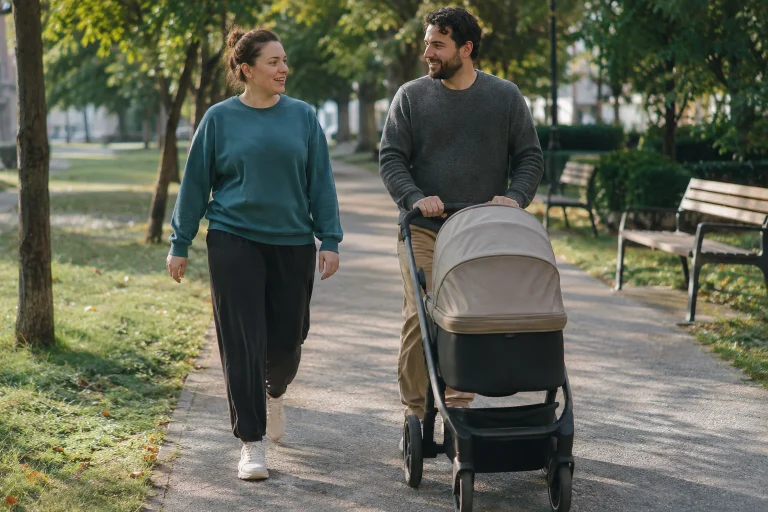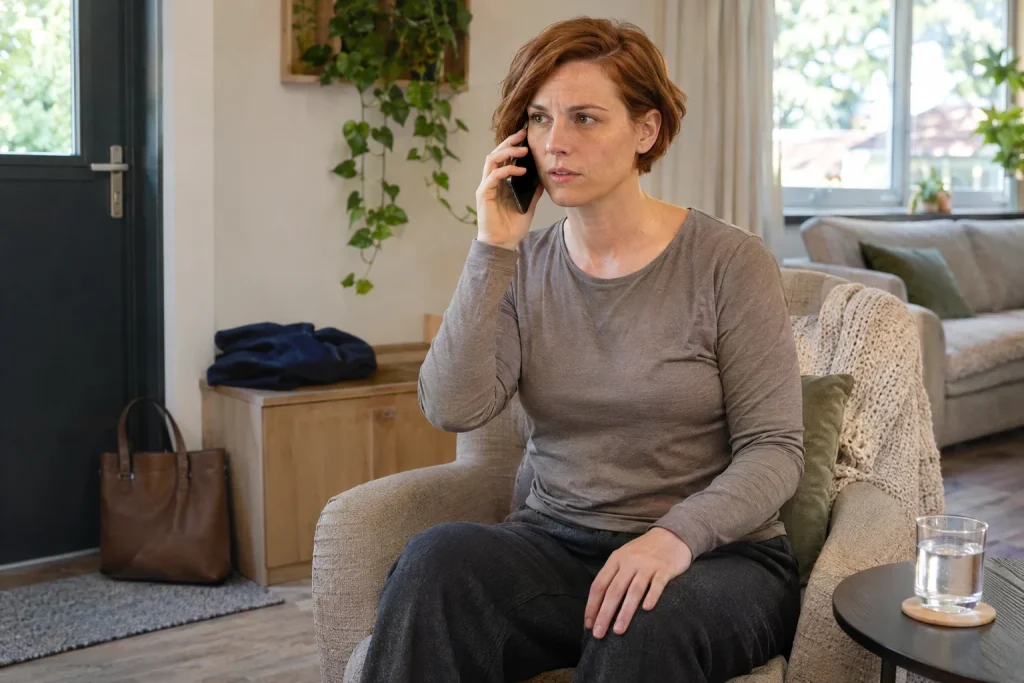
At the end of a short walk after childbirth, you notice more bleeding than before. As a runner, the obvious conclusion may be that today’s distance was too much and you should walk less tomorrow. The circumstances of activity are important information, but do not explain the change on their own. Changes in postpartum bleeding can also have health significance, so an unusual increase should not be dealt with solely in a training-load spreadsheet. You do not need to establish the cause before asking for help.
Sudden very heavy bleeding, feeling faint, dizziness, a racing heartbeat or feeling severely unwell require immediate care; in Hungary, call 112. Contact your healthcare professional promptly with increasing, worrying or unusual bleeding even if the situation does not feel like an emergency. Shortening the next walk can be discussed later. What matters now is that the symptom reaches the right person and a quick explanation drawn from exercise does not close the question.
Postpartum bleeding is not a metric of training quality
The NHS page on physical changes after childbirth describes vaginal bleeding, or lochia, as part of the postpartum period. Bleeding generally gradually decreases and changes over several weeks. Knowing the pattern helps you understand what to expect; it is not a home method for classifying every difference as certainly harmless.
A training diary can help with questions such as when you left, how long you were away and which route you took. It does not tell you why bleeding changed. ‘I noticed this after the walk’ is an observation; ‘The walk definitely caused it, so I only need to walk less’ contains more claims than the information establishes.
You do not need to turn bleeding into feedback for planning activity. If you experience a new change that day, report it as a healthcare question too. Your healthcare professional can decide the next step from the symptom, history and current condition. Distance or pace should remain only one circumstance within that account.
A mild fluctuation is different from a warning change
An NHS hospital patient leaflet describes how the time of day, breastfeeding or a change in activity may influence bleeding. This does not mean every increase noticed after a walk is dangerous. Nor does it mean every increase is simply a normal response to exertion. The nature of the change and how you feel matter together.
If uncertain, explain when making contact what has changed from your own previous pattern. You do not need to compare yourself with other people’s postpartum bleeding or decide alone from a colour scale. Specific questions from a professional can help establish whether examination or another action is needed.
Reassuring general knowledge and personal caution can coexist. You can know bleeding changes while seeking help for a new, unusual situation. There is no need to make these two statements compete. The aim is not to experience every difference as a catastrophe, but to ensure a significant or worrying change is not lost within an overly broad ‘This must be normal’.
With heavy bleeding, do not spend the first moments measuring
The CDC page on maternal warning signs gives soaking through one or more pads in an hour as one example of heavy bleeding after pregnancy. This is a warning example, not a condition you must wait to meet before seeking help. With sudden heavy bleeding or feeling unwell, do not start a timer to first reach a threshold seen online.
The Irish HSE information on seeking help after childbirth treats suddenly increasing bleeding with feeling faint, dizziness or a racing heartbeat as an emergency. In Hungary, you can call 112 in this condition. Do not drive yourself or try to complete the original outing by walking home.
Estimating bleeding as a non-professional may be uncertain. You can still say that a pad soaked through quickly, you see significantly more blood than before or you do not feel well. There is no need to calculate millilitres or take photographic documentation before calling. Getting help requires describing your real observation and current condition, not laboratory-precision data collected at home.
 Enlarge image
Do not leave accompanying symptoms until the last sentence
Feeling unwell, dizziness or weakness alongside bleeding is important information. Say so immediately and explain that you recently gave birth. An increase in bleeding need not be separated from how you feel simply because you initially thought about the walk’s exertion. The professional needs to hear the whole current situation.
HSE also mentions foul-smelling discharge, fever and severe abdominal pain as changes requiring immediate contact with your healthcare professional. You do not need to derive a diagnosis yourself. What matters is describing the new change specifically rather than presenting the combination of symptoms as ordinary post-exercise tiredness.
‘Everything was fine recently’ is valuable history, but does not exclude a new problem. Hospital discharge or an earlier favourable check concerned the situation then. If a change occurs afterwards, it needs assessment according to your condition now. You do not need to wait until the next planned appointment simply because a date is already in the calendar.
| What to tell them | A brief, useful description | Do not make this a prerequisite for calling |
|---|---|---|
| When you gave birth | I gave birth this many days or weeks ago. | Finding the complete discharge report. |
| The change | It suddenly or noticeably became heavier than before. | Estimating millilitres at home. |
| How you feel | I am dizzy or weak, or also have a fever or new pain. | Proving it is not just tiredness. |
| Circumstances | This is when I noticed it; beforehand I walked or did another task. | Repeating the walk to check the connection. |
Details of the walk belong in the account, not in place of the cause
If the healthcare professional asks, describe the outing’s duration, surroundings and when you noticed the change. The time you noticed it is not always the time it began: perhaps it only became apparent when you got home. State that uncertainty rather than inventing a precise timeline fitted to when you started the watch.
Other activities during the day may matter too. Did you climb stairs, travel, shop or carry out childcare tasks? You can mention these briefly without counting every movement. The aim is background that helps assessment, not identifying the step at which you crossed a workload limit unknown to you at home.
Do not check the symptom with another walk. If bleeding becomes less noticeable later, describe that too, but do not draw a final conclusion yourself. Fluctuation does not make seeking help and following guidance unnecessary. Further activity can be discussed after appropriate assessment and individual advice.
A companion can be most useful now in getting help
If someone is with you, they can help make the call, give your location and take over childcare tasks. Your first joint task should not be reviewing step counts and deciding whether the loop was too long. With severe illness, reaching emergency help comes first. Other organisational tasks should fit around that.
If you are alone with the child, say this when making contact too. You do not need to minimise your own symptoms because of it. Knowing the real situation may also matter for arranging care. You can involve trusted help if available, but do not delay an emergency call until they arrive when you have severe acute symptoms.
A supportive statement can be simple: ‘We are arranging help now; we will discuss the walking plan later.’ There is no need to immediately name a cause or give a reassuring guarantee. Calm organisation and listening to the person’s own account may be more useful than using previous family experience to establish that others have had something similar.
Ask about activity separately after assessment
If your healthcare professional gives guidance, be clear what it covers: whether examination is needed, which changes to report and what to do about activity meanwhile. Not every phone or in-person contact is a general assessment of fitness for sport. Ask about your own next step rather than reading permission for your entire old plan into a reassuring sentence.
Gradually adapting postpartum activity is not the same as experimenting at home with doses of exercise in response to symptoms. If you noticed a new change in bleeding after today’s walk, do not simply reduce the next distance by a percentage to test the situation again. Individual guidance should precede planning the next outing.
The RCOG information on heavy bleeding after birth also emphasises reporting increasing or foul-smelling bleeding or feeling unwell. Care and follow-up matter independently of running too. Follow the actions you were given even when no sport appears in the calendar for a while.
 Enlarge image
The diary should support memory, not delay help-seeking
After speaking with healthcare services, you can briefly note when the change occurred, whom you spoke to and what guidance you received. This can be particularly useful on tiring days with much other information to remember. The task is not to start a detailed health data collection project, but to make your individual actions easy to follow.
The training diary may simply record that you stopped the session and further planning needs discussion. You do not have to share the whole health account in a public app. Tell a coach or companions what is needed to modify the programme and what you wish to share. Detailed symptom descriptions belong within your care.
Missed movement does not have to become a debt. Even after assessment of the symptom, the first task is not working out how to make up lost minutes. Understand the way forward suited to your present condition. A workload diary supports you when it recalls events; it confuses matters when it tries to replace a healthcare decision.
Precise reporting also gives reassurance a better foundation
You do not have to distinguish a mild change from an urgent situation alone through an online running rule. You can notice what has changed and ask for help assessing it. There is no need to feel ashamed about uncertainty over physical changes after childbirth. You are still getting to know your own previous pattern too.
If discussion with a professional establishes no urgent action is needed, making contact was not pointless. It allowed your individual situation to be interpreted and the next step clarified. If care is needed, prompt reporting helps you reach it. In neither case do you need to recount the symptom afterwards as a test of fitness or willpower.
In the story of a bleeding change noticed after walking, the walk is only one detail. The nature of bleeding, how you feel, your history and an appropriate care contact matter together. A sound decision keeps the symptom from remaining a row in a table: you tell someone able to provide the necessary assessment and further guidance for your situation.
Sources
- NHS: physical changes and bleeding after childbirth
- CDC: heavy bleeding after pregnancy as a warning sign
- HSE: when to seek help after childbirth
- University Hospital Southampton NHS: changes in bleeding during the weeks after childbirth
- RCOG: heavy bleeding and bleeding complications after birth
How Futószív articles are prepared: our editorial guidelines.