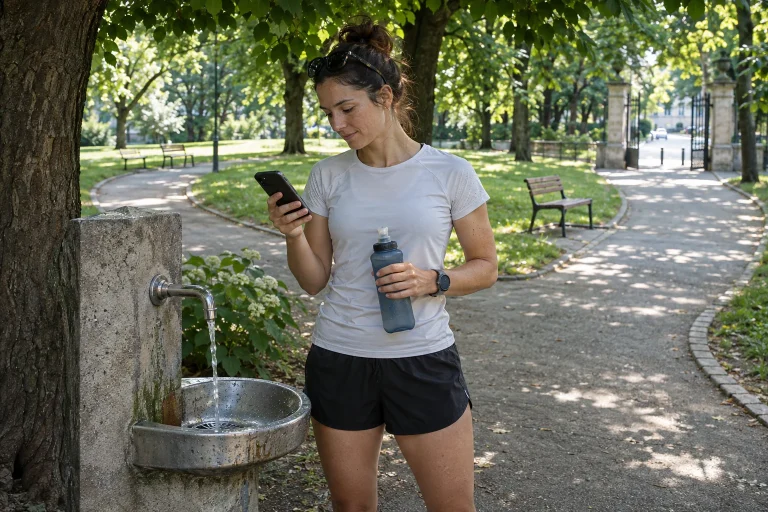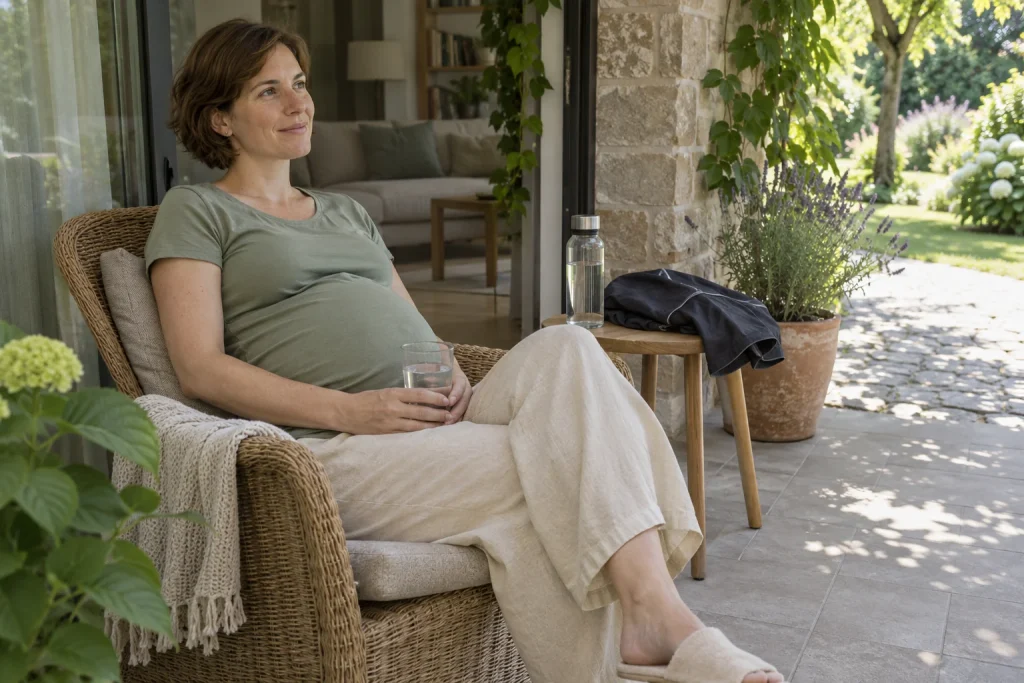
A running plan adapted to heat is not necessarily the same loop with a larger bottle. During pregnancy, reconsider the whole outdoor outing: when you would leave, what getting there would involve, where you could retreat, and what would happen if no suitable outdoor opportunity existed that day. A good plan accepts a change of activity in advance, rather than inventing it as a rescue idea after someone feels unwell.
The following considerations provide general orientation for activity discussed within your own care. We do not set a temperature below which running would be appropriate for every pregnant person, or prescribe quantities of fluid or salt. The emphasis is on recognising a poorly structured day before setting out.
Why do pregnancy and extreme heat need separate consideration?
According to the CDC, pregnancy can make heat-related illness and dehydration more likely. The additional demands involved in cooling both the pregnant person and the developing fetus also matter. The information recommends making an individual heat plan with the clinician providing care. The CDC’s pregnancy heat page concerns the entire hot day, rather than sport alone.
A run therefore cannot be treated as a separate bubble. If it follows a long journey, midday errands and waiting in the sun, its context differs from a genuinely cool morning spent at home. You need not create your own heat-exposure score from individual activities. Simply review where an accessible cool place is missing and which rigid elements of the day are hard to change.
Memories of managing summer runs well are not a personal guarantee. “I have always trained in the heat” does not answer how you are now or the conditions you are preparing to enter. Take that past experience into the discussion as information instead: what sport you did, what question has arisen, and what modifications you are considering.
Do not reduce the forecast to one afternoon number
Heat alerts and meteorological warnings are important public information. HungaroMet explains that warnings for high mean temperature relate to regional conditions and daily averages. The description of its warning system helps the public stay informed. The absence of a warning is not individual permission to run, and a general warning does not establish a personal exercise limit.
A declared heat alert and a meteorological warning are related but distinct pieces of information. Always consult current official information when organising your day, rather than a screenshot shared several days earlier. The public message’s date and area matter too: a notice for another city or day does not describe today’s route for you.
Do not separate temperature from location either. The pleasant terrace at your starting point may differ from the route’s sunny paved section. Check the official forecast and current information, then the actual conditions. The question is whether your plan’s conditions hold, rather than whether you can find a more favourable-looking number in an app.
An early start alone is not a complete plan either. The return journey may occur in different conditions, or your home and neighbourhood may not have cooled overnight as much as expected. Do not treat the alarm time as proof of protection. If you arrive to find your original assumption untrue, you can still replace the activity even though you are dressed and have travelled there.
 Enlarge image
Examine the hot day in three stages
Reviewing the outward journey, time at the location and return separately may be more useful than simply shortening the running route. Even a short loop can be preceded by a long wait at an unshaded stop. The journey home may involve a connection you treated as negligible on the map. Include these within the full time window.
| Stage | Detail to check | Question still open |
|---|---|---|
| Getting there | The route between the stop or car park and entrance; the waiting area. | What happens if transport or the meeting is delayed? |
| Location | Genuinely accessible shade, cooler space, water and seating. | What will I choose if the planned place is closed or crowded? |
| Getting home | Independent departure, an available companion and a known pickup point. | Can I leave even if the others stay? |
Enter specific places in the rows. Rather than “There is a café”, useful information includes when it opens, whether it is accessible and whether your whole outing depends on its queue. Rather than “A shaded loop”, identify where shade actually falls at your chosen time. You do not have to solve every eventuality: if too many basic conditions remain uncertain, another activity may be simpler.
A cooler alternative: access to the place matters too
An indoor option should be more than an imagined label in the plan. A gym or community venue may be closed or full, and reaching it may still require a long outdoor journey. If you plan to rely on it, check opening hours and actual conditions. Not every indoor space is cool, and not every covered place offers a pleasant retreat.
Adapt any change of activity to your own agreed guidance. A workout chosen instead of running is not automatically appropriate because it is indoors. Inform staff or the instructor about pregnancy and any individual restrictions. Equally, changing the day can simply mean rest or rearranging everyday tasks; you need not fill the remaining time with another workout.
At home, ask where it is most comfortable to be now, what can be shaded, and which task can wait. This need not become a special “heat workout”. The aim is not to complete the running plan’s volume on the terrace or indoors. A day adapted to heat is successfully reorganised even without a recorded sporting achievement.
A bottle provides access, not an exemption
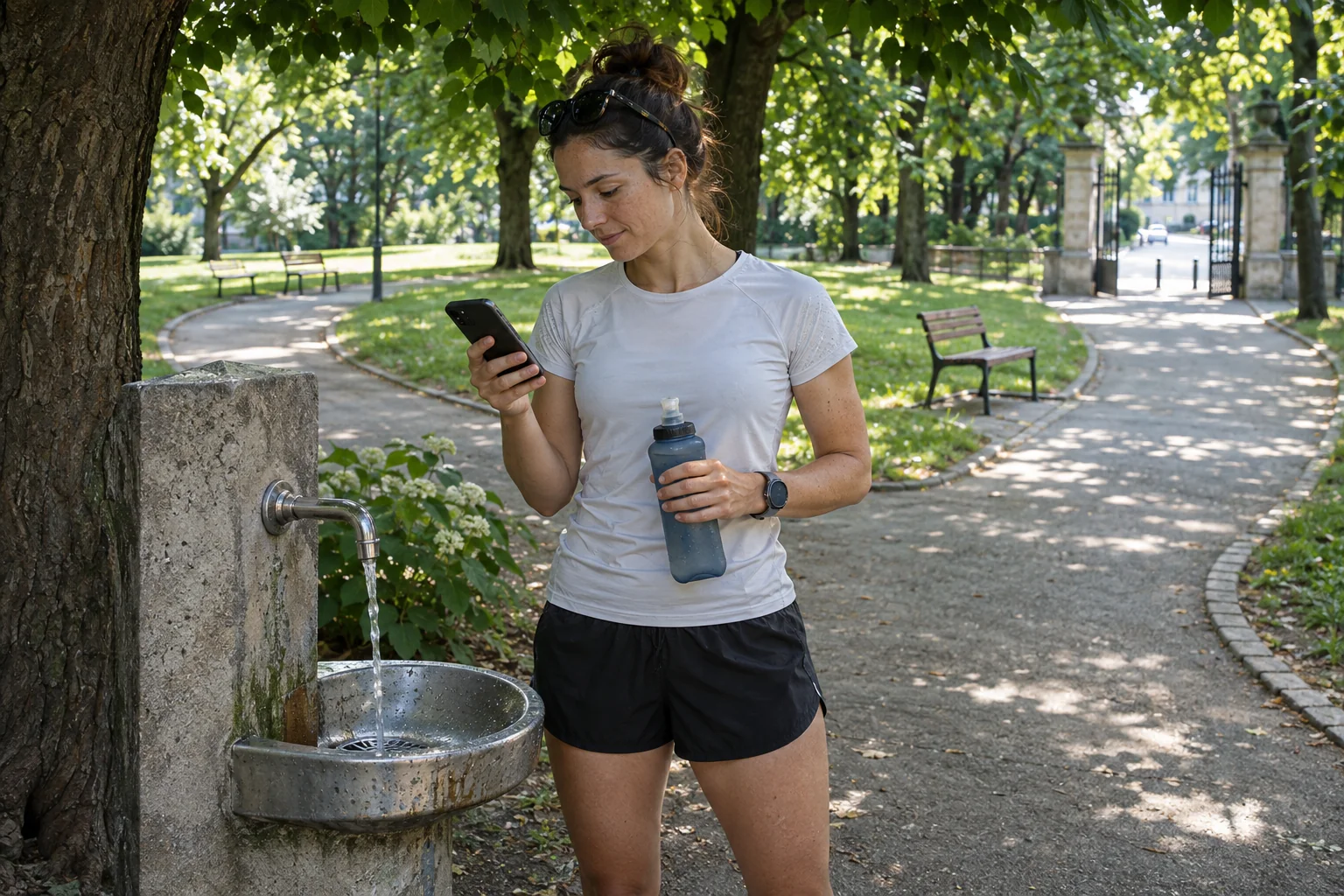
The NHS pregnancy exercise page highlights drinking fluids and keeping cool, and advises stopping exercise if you feel uncomfortable or overheat. The NHS information does not make carrying water a reason to continue in an otherwise poorly chosen environment. The bottle’s presence does not measure your heat status.
Your own plan contains two separate questions: what you have discussed about drinking, and whether the necessary access is available. A bottle in someone else’s bag is unhelpful when you are following a separate route. Likewise, do not assume that a drinking fountain marked on a map has been checked as working. If the plan relies on one source, be clear about what happens if it is unusable.
We do not give a universal number of litres or an electrolyte recipe. The CDC also identifies replacement of salt and minerals lost through sweating as a topic to discuss with your care provider. A product label does not know about your pregnancy or other health circumstances. A specific question for the discussion is how access to fluids and any individual dietary guidance should fit into your day.
Clothing and shade: expect only what they can provide
A lightweight layer or cap may be useful preparation, but cannot make a hot environment disappear. If the plan’s justification always points to another piece of equipment, pause at the organisational question: are the place and time genuinely appropriate? You need not collect products to feel entitled to change activities.
The usability of shade is practical too. Can you enter it, fit there, sit comfortably and reach it without another long section? Trees behind a fence or a courtyard that closes during the day are not reliable parts of your itinerary. Look for a place you can actually access, rather than green colouring on a map.
If going with others, divide responsibilities so that you are not carrying every shared bag. One person can check the meeting arrangements, another can change the travel plans. This does not treat symptoms; it reduces unnecessary organisational demands. Help is specific when you do not have to arrange every change by phone while standing and rushing.
 Enlarge image
If you feel unwell, do not try to repair the workout
The NHS lists dizziness, headache, weakness and nausea among possible symptoms of heat exhaustion; confusion, a seizure or loss of consciousness can indicate heatstroke. Heatstroke is a medical emergency. The NHS description of heat-related illness emphasises recognition and reaching a cool place. In Hungary, call 112 in immediate danger; mention pregnancy and the symptoms.
Thinking only about optimising the remaining loop is the wrong direction: which way is shorter, what pace could still get you home, or how much data would be lost. The sporting outing can end. Ask for help, and do not remain alone trying to interpret a concerning condition. A thermometer, sports watch or previous good experience is not a prerequisite for taking illness seriously.
You need not wait for every item on a symptom list. Follow the guidance from your own care team and the advice of the healthcare professional or emergency operator; do not construct a home observation period from an online article. Heat does not automatically explain every pregnancy symptom either. Describe what happened when reporting illness, rather than offering a ready-made diagnosis.
Two reorganised days, without a need to make up training
A morning park meeting. A fictional pregnant runner has arranged an outing with a friend. In the morning, they discover that part of the expected shaded path is closed and the detour is long and sunny. They do not extend the route with another water-stop diversion. They cancel the outdoor part and meet another time in a way that fits her individual guidance. Their advance agreement allows this.
An afternoon combined with errands. In the other example, the original plan included shopping, travel and later activity. Changing circumstances during the day lead them to skip the run, a companion takes the bags home, and further outdoor waiting is removed. This is not a performance strategy, but a rearrangement of the day’s tasks. The missed sport does not become a compulsory debt for tomorrow.
For the next discussion, note what genuinely remains a question: which condition you could not provide, whether symptoms occurred, and what guidance you want for similar days. A good heat plan creates flexibility in advance. It does not wait for another bottle or a shorter line drawn on a map to solve every environmental difficulty.
Sources
- CDC: heat and pregnancy
- NHS: exercise in pregnancy
- HungaroMet: the warning system
- NHS: heat exhaustion and heatstroke
How Futószív articles are prepared: our editorial guidelines.