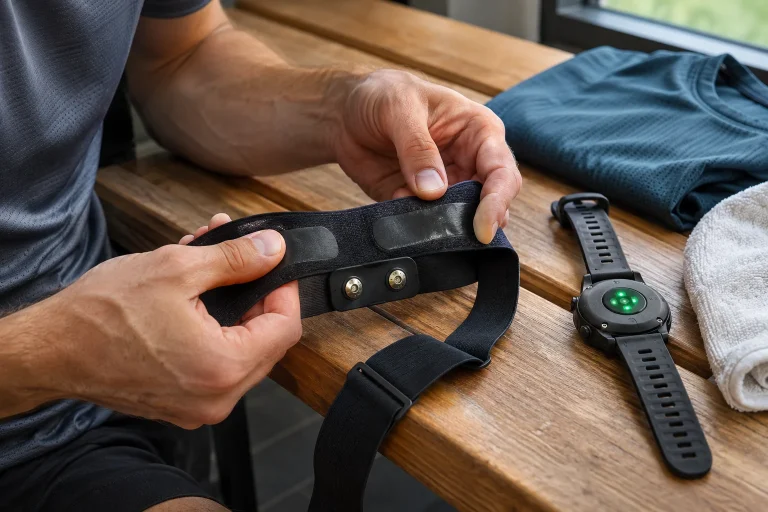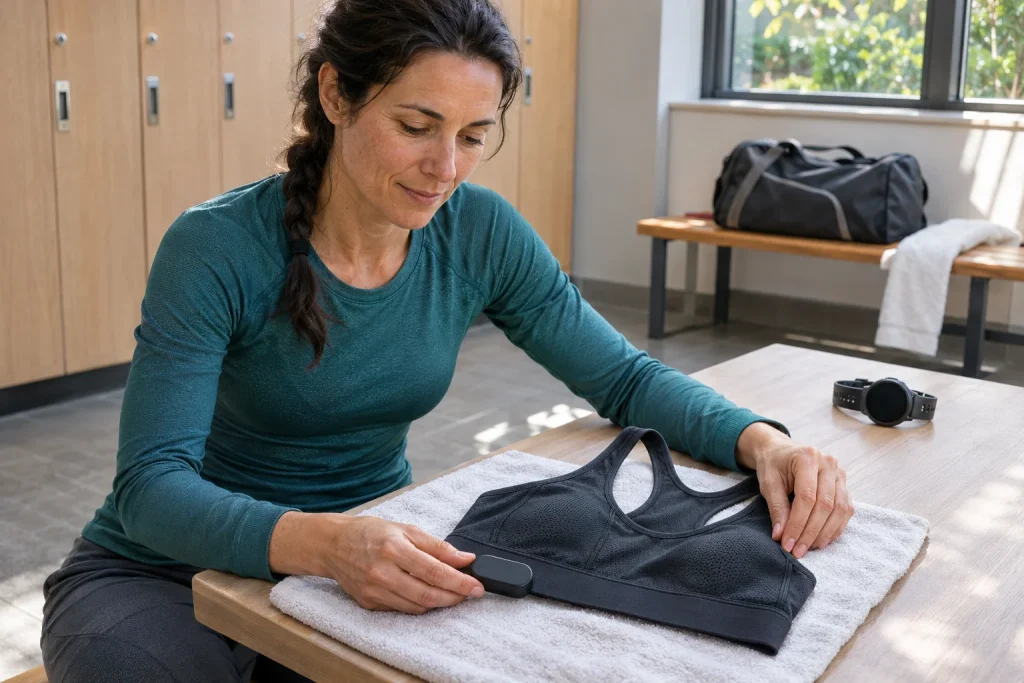
What makes the Garmin HRM-Fit different is not a new chest size or a fancier strap. This heart-rate sensor clips onto a sports bra’s lower band, using the support of a suitable garment to stabilise skin contact. It can be a practical alternative to a strap that goes around the chest, but the sports bra’s style and fit are part of its operation too. The most important buying question is therefore whether the system genuinely works with your own running kit.
This description is based on Garmin’s official product and support pages checked on 21 November 2026, not our own wear test. We distinguish the manufacturer’s attachment instructions from editorial points to check in a trial. The HRM-Fit is not a sports bra in itself, does not automatically increase a garment’s support and does not guarantee greater comfort for everyone. Capabilities beyond heart-rate measurement also require compatible watch support and data transmission.
The sports bra is one component of the measurement system here
With a traditional chest strap, adjusting the sensor’s own wraparound strap holds the electrodes in place. With the HRM-Fit, the sports bra’s lower band has an important role in this. If the band is loose, shifts or is unsuitable for the clips, the measuring elements can change position too. You cannot attach the device to the edge of any garment and expect the same operation as with the manufacturer’s specified placement.
The official clothing guide describes a medium- or high-support sports bra designed for running and similar activity. It calls for a flat, suitably snug lower band that holds the sensor steadily against the skin. This is not an invitation to deliberately choose a size that is too small. Clothing that causes pain, tightness or restricted movement does not become suitable because the sensor happens to slip less on it.
As preparation for buying, select the sports bra you will actually run in. A trial that only involves looking at the sensor over outer clothing does not show how the lower band works. If asking for help in a shop, keep your own comfort and personal space in mind too. Checking attachment is a technical task; it does not require intimate photographs or a public close-to-body demonstration.
Which lower band does the manufacturer specify?
Garmin presents an underband around the chest approximately 19–50 millimetres wide as the suitable range. An overly narrow edge does not give the clips enough area to grip, while a longline lower section may move the sensor to an unsuitable position. A front zip or obstructive decoration should not interfere with attachment. These are model-specific selection considerations, not general quality grades for every sports bra.
An original illustrative example: a flat band 30 millimetres wide falls within the stated range, but that alone does not establish suitable fit. Tension, folded material, seams and the actual clip positions matter too. The reverse also applies: a longline style that provides excellent support for you may be great running clothing while its lower construction is unsuitable for this sensor.
Compatibility is therefore not a simple brand list. A manufacturer’s sports bra appearing in a demonstration does not automatically mean its whole range is supported. Check your exact style and size. If you rotate several sports bras, each may need a separate trial. Any need to buy clothing that suits the device forms part of the total cost and everyday use too.
Three clips, flat fabric and direct skin contact
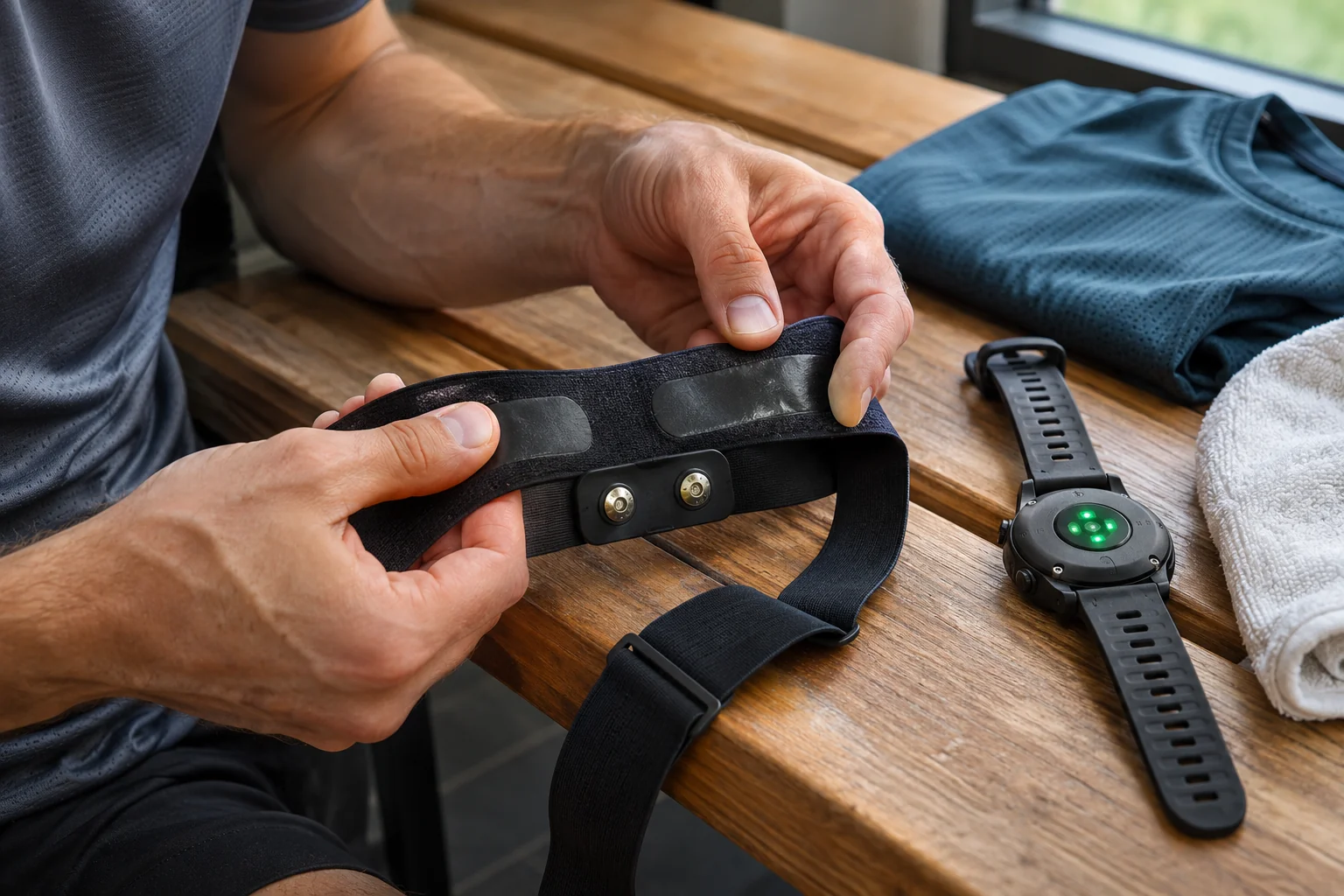
The manufacturer’s fitting procedure describes moistening the electrodes, then using the centre clip and the two side clips. The fabric should sit flat inside the clips; the sensor should lie beneath the band in contact with the skin. Clipping it to the outside of the garment away from the skin is not the same. A mirror check can help reveal a crooked or bunched-up section.
For the first fitting, do not rush to match a group about to set off. As your own trial routine, calmly check the centre attachment first, then the sides and whether the fabric lies flat. Next, watch for movement during your familiar, symptom-free motions. This is not an accuracy test or prescribed warm-up, just a check that wearing it does not immediately alter the carefully adjusted position.
Closing a clip and starting workout recording are separate steps. The HRM-Fit may be active and transmitting once properly fitted, but you still need to select and start the desired activity on your watch. After the first use, find heart rate in the saved log too. A completed recording demonstrates a successful recording chain, rather than a single live heart-rate number before the start.
 Enlarge image
Comfort is not a guaranteed product property for everyone
The HRM-Fit is designed to be worn with a sports bra, but your comfort cannot be predicted from its name. Some may benefit from not having a separate wraparound chest strap; others may be bothered by a seam, clip position or pressure beneath the sensor. Your own bodily experience is information for the decision just as much as the graph on your phone. You do not have to tolerate discomfort for a good measurement trace.
In your own notes, you could keep separate entries for ease of attachment, stability during movement, rubbing and removal. This lets you identify what changed when you later switch clothing. Do not schedule the first combined use of entirely new clothing and a new sensor for an important race. This is practical equipment organisation, not a prescribed test duration or another workout task.
The sensor does not replace the sports bra’s intended support or correct a poorly chosen size. Stop wearing it if skin symptoms, pain or numbness occur; recurrent discomfort should not be managed by closing the clips more tightly. Suitable specialist-shop help may be useful if the garment fit is uncertain. Clothing advice is not a medical diagnosis, however, and sports equipment does not become one either.
Heart rate and running dynamics may require different support
The HRM-Fit can send live heart rate to compatible watches, fitness equipment and apps. Check advanced running data separately for your own Garmin watch. The manual describes six running-dynamics metrics, such as cadence, vertical oscillation and ground contact time. According to this model’s documentation, these require a compatible Garmin device and an ANT+ connection. Heart rate received only through Bluetooth does not prove the same complete data package is available.
The HRM-Fit does not automatically gain the newer step speed loss capability of the HRM 600. Garmin’s model comparison treats these extras separately. The umbrella term running dynamics should not be taken to include every current Garmin metric. If you are buying for a specific data item, look for its exact name on the support page, in your watch’s own description and among the sensor’s capabilities.
A dynamics metric derived from movement is not a ready-made running-technique prescription. The reason for different numbers in an easy hilly run and a faster flat section cannot be determined from two averages alone. Recording the circumstances in your log may help, but do not change your movement solely for one colour scale. A knowledgeable coach can help interpret data; injury or pain may require other expertise too.
Daily summaries and a workout started on a watch follow separate paths
HRM-Fit activity tracking can send daily data such as steps, heart rate and intensity minutes into the Garmin system. Garmin support also requires an appropriate primary wearable in the account for this operation with HRM-Fit and earlier Pro models. This differs from the HRM 600’s standalone activity recording. An updated daily summary does not mean you can start a full running recording from Connect in the same way on the Fit model.
Another option is a timed activity started on a compatible watch, for which the strap may store heart rate even when the watch moves out of range temporarily. The official guide says the strap must be active and near the receiver when saving so data can transfer. Pairing before starting and actually beginning the recording therefore matter here too; simply putting the strap on afterwards is not enough.
An original workout-organisation example: for a session where you must remove the watch, check the supported recording method beforehand, then return to the watch afterwards and wait for saving. This does not justify claiming the system automatically repairs interrupted heart-rate curves in every external app. Transferring stored data to the receiver is a service with specific conditions.
Indoor pace and distance: information calculated from movement
The HRM-Fit can also calculate running pace and distance from the user profile and movement detected with each step. Its manual describes an ANT+ connection to a compatible Garmin device and Bluetooth to an appropriate external app. This may help on a treadmill or other runs without GPS. The feature is not mechanical certification of the treadmill, however, nor an accessory directly sensing belt revolutions.
An original fictional example: if the treadmill shows 6.0 kilometres and the log 5.7 kilometres, the difference is 0.3 kilometres, or five per cent relative to the treadmill value. This is not an HRM-Fit measurement result or proof that the treadmill is correct. The point is that we are comparing two data sources. Handle calibration for your own setup using the current instructions for the appropriate watch and data source.
Do not confuse heart-rate transmission with other treadmill connections either. A heart-rate number appearing on a machine is not NFC identification, automatic Garmin-account login or necessarily a complete workout upload. If you need all three, check them as three separate questions. After buying, you then will not expect HRM-Fit clips to provide a gym service unsupported by the receiving system.
Cleaning: hand wash, not a machine cycle with the bra
The HRM-Fit care instructions specify rinsing after every use and hand washing after seven uses with water no warmer than 40 degrees Celsius and a small amount of mild detergent. Do not put the device in a washing machine or tumble dryer. This is an important difference from some machine-washable textile straps with removable modules. Care instructions from another Garmin model cannot automatically be transferred to this one.
Detach the sensor from the sports bra before laundering the garment. The garment’s own washing label and the sensor’s hand-cleaning instructions apply alongside one another, not in place of each other. After rinsing, the manufacturer specifies air-drying flat with the clips open. Leaving sweaty equipment folded and wet in a bag does not become appropriate storage because the device bears a water-resistance rating.
An original practical arrangement might be a dedicated place for the drying sensor, where clips can remain open and it will not get mixed up with the next laundry load. This is a household organisation idea, not a new manufacturer requirement. Cleanliness matters for skin comfort and contact, but persistent signal faults also call for checking pairing and power. Washing is not a universal solution to every technical problem.
 Enlarge image
Battery replacement and durability: follow the exact model’s procedure
The HRM-Fit uses a CR2032 battery, with the manufacturer stating up to one year of life at one hour’s daily use. It is not rechargeable like the HRM 600, and you should not look for the HRM 200 strap slider as an opening tool. For the HRM-Fit’s own battery cover, the manufacturer describes using a coin or a larger flat tool. Check the closing direction and alignment against your own illustrated instructions.
Similar battery names across models do not imply the same assembly sequence. After replacement, check the cover position and a working data connection before an important run. Store batteries securely away from children and animals. If you see damage, contamination or uncertain closure, forcing the cover should not be the next step; seek manufacturer support appropriate to the exact product.
How should you choose between HRM-Fit and a traditional strap?
Settle the clothing and wearing method first, then the feature list. If you have a comfortable sports bra of a suitable style and the clips are stable for you, HRM-Fit can be a logical alternative. If your preferred garments’ lower bands do not suit it or you dislike the feel of the clips, another design may fit better. A general label saying “designed for women” cannot decide that for you.
Include the receiving watch, desired data, storage path and care routine in your final choice too. Heart rate and HRV for sport are not a clinical rhythm assessment, and running dynamics are not medical movement analysis. Do not override a symptom with a reassuring number. A well-fitting system leaves you wearing the device comfortably, knowing where your workout is recorded and able to carry out its cleaning consistently.
Sources and verification
- Garmin HRM-Fit: choosing a sports bra
- Garmin: the three clips and fitting procedure
- Garmin HRM-Fit: product features, battery and battery life
- Garmin: HRM-Fit running dynamics and the ANT+ requirement
- Garmin: stored heart rate for timed activities
- Garmin: indoor running pace and distance
- Garmin HRM-Fit: hand cleaning and drying
- Garmin: model-specific battery replacement, HRM-Fit
- Garmin: daily activity tracking and the primary-device requirement
- Garmin: different extra features of HRM 600 and HRM-Fit
How Futószív articles are prepared: our editorial guidelines.