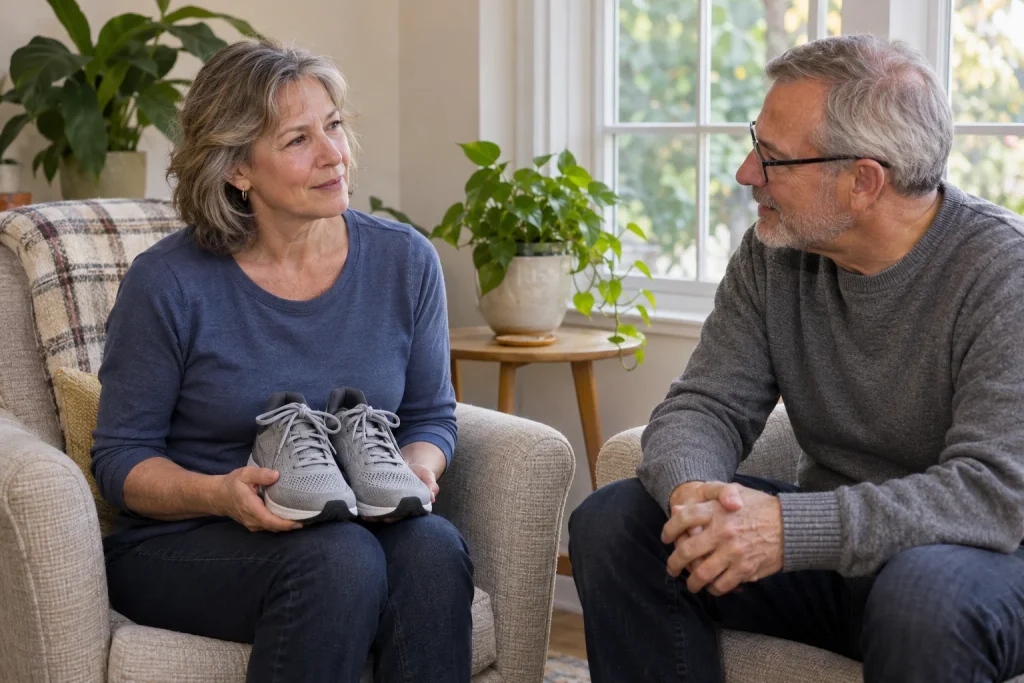
You may imagine yourself spending more time exercising in a new phase of life. Quiet mornings, familiar walking paths or shared runs might feature in the picture. This future self-image can be interesting and personal, but differs from your present schedule or actual exercise. Psychological research separately examines whether imagining an active future self changes behaviour and identity.
A randomised trial following recent retirees found no clear intervention advantage in this area. That does not mean thinking about the future is pointless. It highlights a distinction between a desired role, current self-image and actual participation. For runners, this can offer a perspective allowing personal imagination without a compulsory new identity or a guaranteed behaviour-change promise.
The possible self and present identity
An image of your future self concerns the person you would like to become or what you want in your life. Present identity describes how you think about yourself now. These may connect, but differ. An attractive, more active future does not necessarily make you call yourself a runner today, and that need not be a fault.
In everyday language, ‘I’m that kind of person’ may sound powerful. In research, self-image is explored through several questions, while behaviour is also measured separately. The relationship between a statement and actual exercise is not necessarily simple. Someone can be active without a sporting label, while the runner role can matter to someone currently exercising less.
Self-image comprises more than one characteristic. Alongside running, family, work, creative or community roles may be present. A new situation can rearrange their relationships too. Exercise need not rank above everything else to matter. Personal meaning is real even when it does not become the centre of your entire introduction.
What did the experiment with recent retirees test?
Perras and colleagues randomly assigned 294 people who had retired within the previous three years to three conditions: a single or repeated active-future-self intervention, or a control group. Exercise and exercise-related identity were measured through self-report questionnaires at baseline and weeks 4, 8 and 12.
No significant group difference was found in physical activity or exercise identity. All three groups showed increases over time, so these could not be attributed to the intervention targeting imagination of a future self. Neither the single nor repeated task showed an established advantage over control for the endpoints examined.
This is not a judgement about every retiree’s or runner’s future. The experiment used specified eligibility criteria, tasks and duration. Its value lies precisely in not confusing an attractive theoretical idea with an effect actually demonstrated. Thinking about a possibility and evidence of behaviour change remain different levels.
Why is improvement within a group insufficient?
When more exercise is measured after a programme, attributing change to it initially seems natural. However, we also need to know what would have happened among similar people without the intervention. A control group provides that comparison. If change occurs there too, it alone does not establish a distinct advantage of the tested component.
Several factors could contribute to improvement over time, but we need not settle them by guessing. What matters is that within-group change and between-group difference are different statistical questions. Reporting findings precisely prevents a favourable graph from automatically becoming a story about an effective method.
Keep this distinction in your own life too. Exercising more after a new idea may be personally important, but does not establish a single cause with certainty. Available time, weather or social opportunities may also have changed. There is no need to devalue the experience; simply express the explanation proportionately, without promising certainty.
 Enlarge image
Measuring running identity is not a membership examination
In developing the Running Identity Scale, Bejar, Fisher and Morrow used two independent runner samples of 437 and 367 people. Their findings supported an eleven-item, three-factor structure, with running identity related to other athletic-identity measures but distinguishable from them. The scale is a research instrument, rather than permission determining who can call themselves a runner.
Measurement aims to examine personal meaning more consistently and relate it to other variables. It does not make the concept a simple yes-or-no category. You need not give yourself a score, and a brief online label does not replace the validated questions. Everyday self-definition does not depend on passing a research scale.
The retiree experiment also measured general exercise identity, rather than using this running-specific scale. This distinction matters: the two studies examined neither the same programme nor an identical instrument. Placing them together clarifies concepts; it does not claim one directly confirmed the other’s result.
A new life phase is more than free time appearing
From outside, retirement is often imagined as a sudden series of freed-up hours. Personal situations may be much more varied. New schedules, caring responsibilities, social relationships and financial circumstances can emerge. If someone wants to exercise while their new routine is developing, a stronger sporting self-image is not necessarily what is missing; everyday conditions may need clarification.
Ending a former work role is not the same experience for everyone either. Some happily plan new activities; others need time to find a rhythm. Running can be one possibility, rather than a compulsory solution to every change. You need not prove a new phase successful by immediately becoming more active and sporty.
The same idea may help interpretation of other transitions, such as moving home or changing work schedules. This is an editorial example, rather than another population tested in the retiree experiment. Personal history and circumstances together shape exercise’s place. An imagined self does not automatically create a route, transport or suitable social opportunity.
What can make a future image personally useful?
Ask what exactly is attractive about it. Fresh air, meeting people, time alone or a curiosity long postponed? These meanings are more concrete than the general idea of becoming an active person. An answer can help connect the next decision to your own values, rather than an externally impressive lifestyle.
Details of the future image need not become tasks to complete. Imagining a pleasant morning may simply be enjoyable. If you want to prepare a decision, separately name one real next step, such as requesting information about an accessible activity. This is not the same as an already established change in identity or behaviour.
One sign of personal usefulness may be that the image widens choice. You see several forms you would enjoy, rather than only one ideal runner role. If the image instead creates constant comparison pressure against your present self, you can change it. A desired future need not portray your current personality as a defective version.
Being active and calling yourself a runner are separate choices
Someone may enjoy walking, cycling or moving in various ways without identifying with one sporting label. Another person values saying they are a runner. Neither definition is necessarily better. Actual movement and the personal language attached to it convey different information. You need not first give yourself a new name to participate in a manageable session.
Stating an identity does not itself require a certain volume. You need not accept every invitation or perform identically in every period to preserve a runner role. Its personal meaning can change with life circumstances. Present opportunities need not erase earlier experiences, and an absent label does not reduce today’s exercise’s value.
Others can also help prevent self-image becoming a membership test. We can be interested in each other’s experience without declaring who qualifies as a real runner. Personal meaning takes several forms. A relaxed outing, shared session and race goal can connect with self-image through different paths.
A new self-image does not replace concrete conditions
If you want more exercise, describe the opportunity in the present too. Is there an accessible place, appropriate time and a form suited to your condition? These are practical and, where relevant, professional questions. An enthusiastic future image does not rewrite physical capacity or replace health discussion when needed.
Asking for help does not contradict an active self-image. Arranging transport, information or a safe introductory opportunity may be the most important next step. Everything need not be solved through independent inner determination. Recognising real support can be more precise than repeatedly asking whether you see yourself sufficiently as a runner.
Keep room for rest and adjustment too. A self-image accepting only continuous achievement can become too narrow for changing life. Your interpretation of the role can allow attention to current condition. You need not ignore today’s justified limits for an imagined future.
 Enlarge image
A research null result is not personal failure
When an intervention shows no group advantage, it informs us about the tested procedure and outcomes. It does not mean participants were insufficiently open to a new life. Similarly, your own imagery having no expected effect need not become a personal fault. A thought can be interesting without producing measurable exercise change.
An uncomfortable gap between desired and present circumstances can become a conversation, rather than another task of proving yourself. You can examine what matters, what is excessive and what is genuinely possible today. If the transition creates persistent, substantial psychological difficulty, individual professional help may also be appropriate. A running self-image exercise cannot replace it.
Curiosity about the future can remain alongside uncertainty. You need not promise a definite effect to consider what you want to experience. The important difference is whether the image is a possibility or a compulsory benchmark. The former leaves more space for decisions at your own pace and real life conditions.
Let the future self be a possibility, rather than an entry requirement
Imagining your future active self does not guarantee more exercise or a stronger running identity. The trial with recent retirees demonstrates this particularly clearly. Personal reflection can nevertheless have a place when you expect no more than it offers: a perspective on what would be interesting and valuable to you.
Your next manageable session does not require first seeing yourself as a completely new person. An appropriate opportunity, a clarified question and your own decision may suffice. Exercise and self-image may connect over time, but neither must become the other’s mandatory prerequisite. Your future can allow several kinds of active life.
Sources and differences between instruments
Perras and colleagues: Impact of a randomized possible selves experiment on new retirees’ physical activity and identity — a randomised study of recent retirees. Bejar, Fisher and Morrow: Development and Validation of the Running Identity Scale — development of a running-specific instrument. The studies use different questions and instruments; examples about personal circumstances are not individual identity diagnoses.
How Futószív articles are prepared: our editorial guidelines.