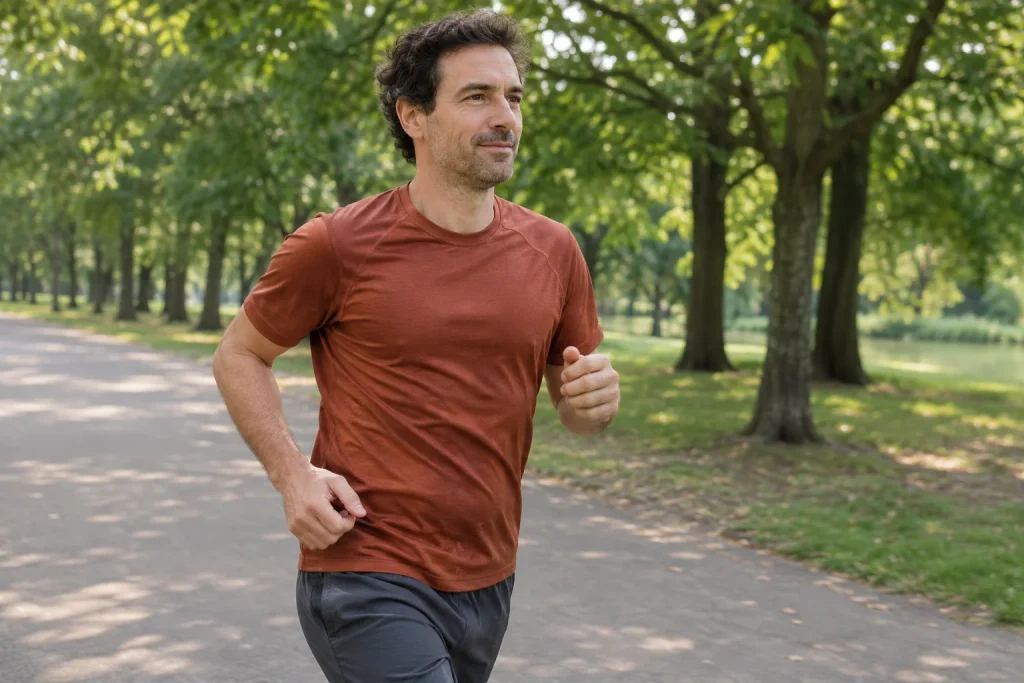
‘My steps just kept going, and I was completely absorbed.’ ‘By the end I felt so cheerful, as though everything was easier.’ Both can describe a memorable run without necessarily referring to the same experience. The first concerns immersion in the activity; the second, a strongly pleasant emotional state. It is therefore useful to distinguish flow from runner’s high, sometimes described as a running trance.
The distinction is not a rigid boundary between personal experiences. Several kinds of experience can occur in one run, and everyday language is not a research form. Clarifying the concepts nevertheless helps prevent every good session being described through the same chemical explanation or compulsory peak. Immersion can be interesting without intense euphoria, and feeling cheerful after a run does not, by itself, prove you were in flow during it.
Flow: when the task becomes a continuous experience
Flow often describes immersion in which an activity engages you without requiring you to judge yourself from the outside at every moment. Running can feel continuous, natural or easy to follow. This does not necessarily mean smiling, ecstasy or a record. An important feature may be that the activity itself takes centre stage, rather than outward evidence of it.
Everyday accounts can combine ease with strong engagement. The body is still working, however, and the surroundings still require real attention. Immersion does not mean noticing nothing or losing your ability to decide about the situation. A safe framework for running does not become unnecessary because a session feels particularly good.
You do not need to continually check whether you have reached flow during your next run. Searching for the label can create another evaluative task demanding a different kind of attention from moving freely. Your experience’s value does not depend on classifying it perfectly afterwards. Simply describe the section where you enjoyed being present and what made it memorable for you.
What did runners say about immersion?
Jackman and colleagues conducted interviews close to the event with sixteen recreational runners after runs experienced as positive and rewarding. They distinguished flow and clutch states in the accounts: flow was linked to ease and moving for the experience, while clutch involved a more effortful process directed towards completing a specific goal. This was qualitative, interpretative research, not an experiment producing or guaranteeing a state for everyone.
The two descriptions are interesting because a valuable run can be good in more than one way. One session may centre on effortless engagement; another on completing a chosen task. Interviews without an experiment cannot supply a certain causal recipe. The accounts give language for understanding differences in experience, rather than a compulsory sequence for every runner.
Moreover, the sample was selected around events experienced as rewarding. It does not reveal how often these states occur in every runner’s week. There is therefore no reason to measure ordinary sessions against a selected collection of experiences. The interviews’ value lies in detailed experience, rather than a standard imposed on an average running life.
 Enlarge image
Runner’s high: an emotional concept with a different emphasis
Research uses runner’s high to describe particularly good feelings, euphoria and reduced anxiety associated with running. The everyday phrase ‘running trance’ may refer to a broader or less clearly defined experience. Ask whether someone means immersion, strong cheerfulness, relief afterwards or a combination.
A strongly pleasant state does not necessarily appear in every run. You do not have to wait for a particular point after which your mood must change. Your experience may be quiet satisfaction, less dramatic pleasure or simply feeling glad to have moved. These are not failed versions of a superior running experience.
An everyday comparison with a drug experience is not a precise measurement either. Names for bodily and emotional experiences can be personal, but an analogy does not imply the same mechanism or state. Scientific questions need specific outcomes and methods. The expression provides no reason for substance use or for pushing exercise beyond a manageable framework to obtain an intense feeling.
Why is ‘endorphins’ not enough to explain everything?
In Siebers and colleagues’ double-blind, randomised, placebo-controlled experiment with 63 participants, blocking opioid signalling did not prevent post-run euphoria and reduced anxiety. Levels of some endocannabinoids in the blood also increased after running. The authors therefore interpreted these as important candidates in the phenomenon, rather than explaining every good running experience exclusively through endorphins.
This does not mean the chemical cause of flow described in an interview was also measured. The two studies answered different questions using different methods. A measured change in blood substances and a report of an experience are not the same measurement either. Opioid blockade was a medical research procedure, not an idea to try independently; the study duration was not a running programme prescribed for everyone.
A biological explanation helps when it does not obscure methodological differences. You cannot work backwards from a good feeling alone to calculate which substance, and how much, your body produced. Likewise, the absence of a favourable experience does not prove a system is faulty. How you feel matters, but does not replace laboratory measurement or healthcare assessment.
You can be immersed without euphoria and happy without flow
Imagine an easy, quiet run in which the route engages you and progress feels natural, without a particular emotional peak. On another occasion, after a more awkward session, you are glad to have finished and reached home despite checking the time frequently during it. These are editorial examples, not stories of specific research participants. They illustrate why the two concepts need not be locked together.
The distinction can ease your expectations too. Expecting euphoria from every engaged state can make a quieter experience feel lacking. Calling every cheerful feeling afterwards flow, meanwhile, loses what actually happened during movement. A more precise account leaves room for several kinds of good session through a less restrictive conceptual gateway.
Research boundaries between concepts are not intended to let someone else dictate what you may feel. Your personal account can keep its own language. Distinctions matter when building an explanation or general advice on it. Naming an experience and establishing its mechanism are not automatically the same.
Why is it difficult to produce a peak experience through willpower?
You can partly shape conditions for a favourable run: choose a manageable activity, leave time to set off and find a place you can use. This still does not guarantee a particular internal state. Sleep, daily events, surroundings and personal expectations can change together. Not every detail is under direct control, and not every good session can be repeated identically.
If you try to reproduce an earlier special run exactly, constant comparison can easily create another task. The same place and clothing do not create the same day. A previous experience can be a welcome memory without becoming a contract for the next outing. Variation does not make the old experience untrue.
A run is also allowed to be merely fine. It should not need to produce a special state to earn a place in your week. Alternation between pleasant, neutral and difficult sessions does not, by itself, prove your method successful or unsuccessful. If a specific problem recurs, ask a separate question about it rather than searching for a peak.
 Enlarge image
A good feeling should not override a manageable framework
When progress feels easy and joyful, going further to intensify the feeling can be tempting. But a favourable mood does not reveal the whole loading situation. Your condition, planned framework and surroundings still matter. You do not need to set every earlier consideration aside to preserve or amplify an experience.
Flow does not justify ignoring a warning sign either. Immersion can coexist with deciding, stopping and changing the route. An unusual symptom or feeling unwell should not be interpreted as proof of a special state. This article does not teach running through discomfort or provide personal permission to exercise.
Finishing the session need not ruin the experience. A good section can remain a memory even if you turned home or stopped in time. Running’s value need not be measured by the maximum duration of an internal state. Remaining able to use the activity later and keeping your freedom to decide can also belong to a good relationship with running.
How can you describe it more precisely?
A few specific sentences often say more than a label. What engaged you while running? Did the task feel easy or effortful? When did cheerfulness appear: during it, immediately afterwards or later when recalling the outing? You do not need to answer everything, but these questions can help separate engagement from an emotional peak.
The account can remain simple and personal without instrument-measured proof. You do not need to extract flow or endocannabinoid levels from watch data. Most everyday sharing aims to describe an experience, rather than establish its mechanism. Keeping these separate preserves your story’s value without claiming more about measurable processes than you know.
Flow and runner’s high therefore have different emphases and may meet in one run without being obliged to occur together. One helps name immersion in a task; the other a particularly pleasant emotional state. Running has no compulsory internal exam passed only by acquiring one of these labels. Your experience can be valuable, variable and simply human.
Primary sources
Jackman and colleagues: Integrating models of self-regulation and optimal experiences, 2021. Interviews with sixteen recreational runners after positive events, interpreted through flow and clutch; not an experiment producing euphoria.
Siebers and colleagues: Exercise-induced euphoria and anxiolysis do not depend on endogenous opioids in humans, 2021. A controlled human study with opioid blockade; endocannabinoids are important candidates, and the study does not biochemically identify flow. This article is not based on our own experiment or documented medical review.
How Futószív articles are prepared: our editorial guidelines.