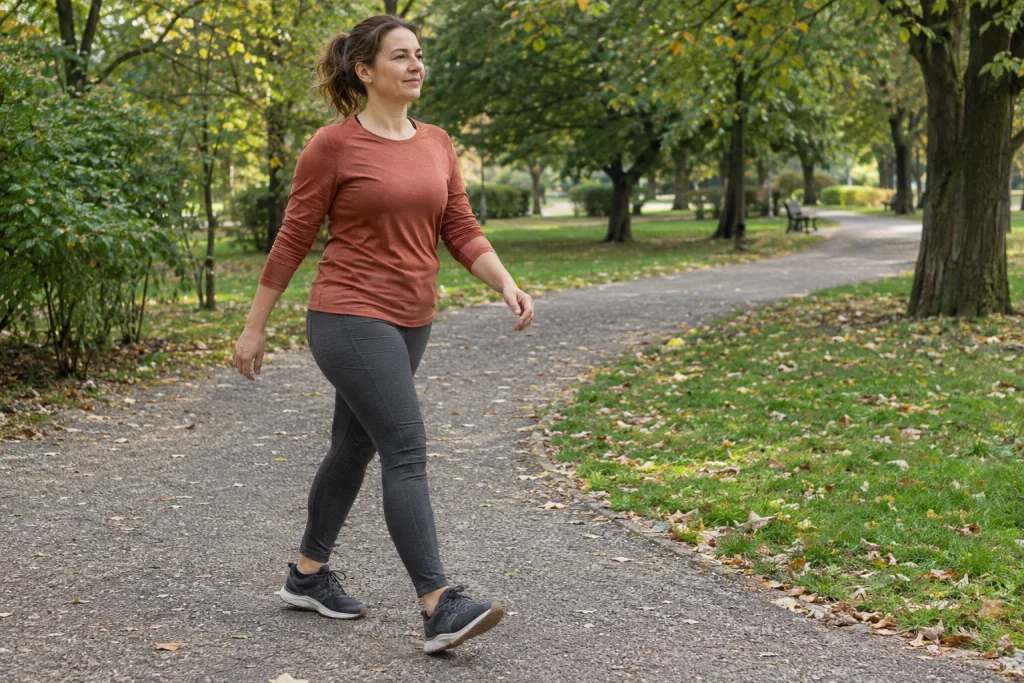
Your first good running session does not necessarily end with a record. A much more valuable outcome may be the feeling that you would happily do it again in a few days. Alternating running and walking gives you a framework: the walking is a planned part of the session, while the running stays short and easy enough to leave you attention for your route, breathing and how you feel.
This guide provides general information for healthy adults. When returning after injury or surgery, or while living with a long-term condition, follow an individual medical and physiotherapy plan. Chest pain, feeling faint or unusually severe breathlessness should not be treated as a normal part of starting exercise.
First, make room in your week
When you start, the calendar is often the biggest obstacle. If every session requires a free evening, ideal weather and the perfect mood, few opportunities remain. Choose two or three time slots that actually exist in your life. “Tuesday after work, in the park on my way home” is a more precise commitment than deciding that you will run regularly from now on.
Allow time to change, start with a walk and get home. Twenty minutes of activity can easily become a forty-minute outing. Accounting for this in advance makes it less likely that exercise will feel constantly at odds with family or work. Prepare a shorter option too: on a more difficult day, a nearby, safe loop is still useful.
The NHS beginner programme also alternates running and walking, with three sessions a week and rest days in between. Its nine-week framework can take longer, too. The important lesson is that a beginner programme provides a rhythm; the calendar deadline is not a compulsory test to which every body must adapt in the same way.
Look for a route that requires few decisions
A familiar, even and predictable stretch is a good choice for the first few weeks. It does not need to be a famous running track. Walk it to check for junctions, cycle crossings, high kerbs, poor lighting and slippery areas. A good beginner loop is one you can still navigate when more tired and from which you can get back easily.
A shorter loop has a practical advantage: it does not take you too far from your starting point, and it is easy to cut the outing short. An out-and-back route also works if you decide your turnaround time in advance. In a hilly area, the uphill section can be walked throughout. You do not have to cover every metre of the terrain in the same way.
If you share a track with others, learn its local rules of movement. Do not stop suddenly in a faster lane, and set up your phone at the side of the route. Your first outing is also a useful route test: notice where traffic disrupted you and change the loop the following week if necessary.
What does easy running mean?
For a beginner, easy running may look like very slow jogging from the outside. No single pace per kilometre suits everyone. The aim is to avoid using up all your reserves in the first few running minutes. You do not have to prove to people passing you that you are a runner; you are adapting your session to your own starting point.
The CDC talk test is a simple indicator of intensity: at moderate effort you can still talk, while vigorous effort leaves room for only a few words between breaths. It is not a medical assessment, but in the first few weeks it may offer more useful feedback than an arbitrarily chosen pace. If you can only gasp out an answer during a section intended to be easy, slow down or walk.
When running alone, you can say an ordinary sentence aloud, for example describing the park around you. Do not try to pass the test by artificially controlling your breathing. Forcing yourself to breathe through your nose or follow a rigid breathing pattern tied to a particular number of steps is not a prerequisite for running.
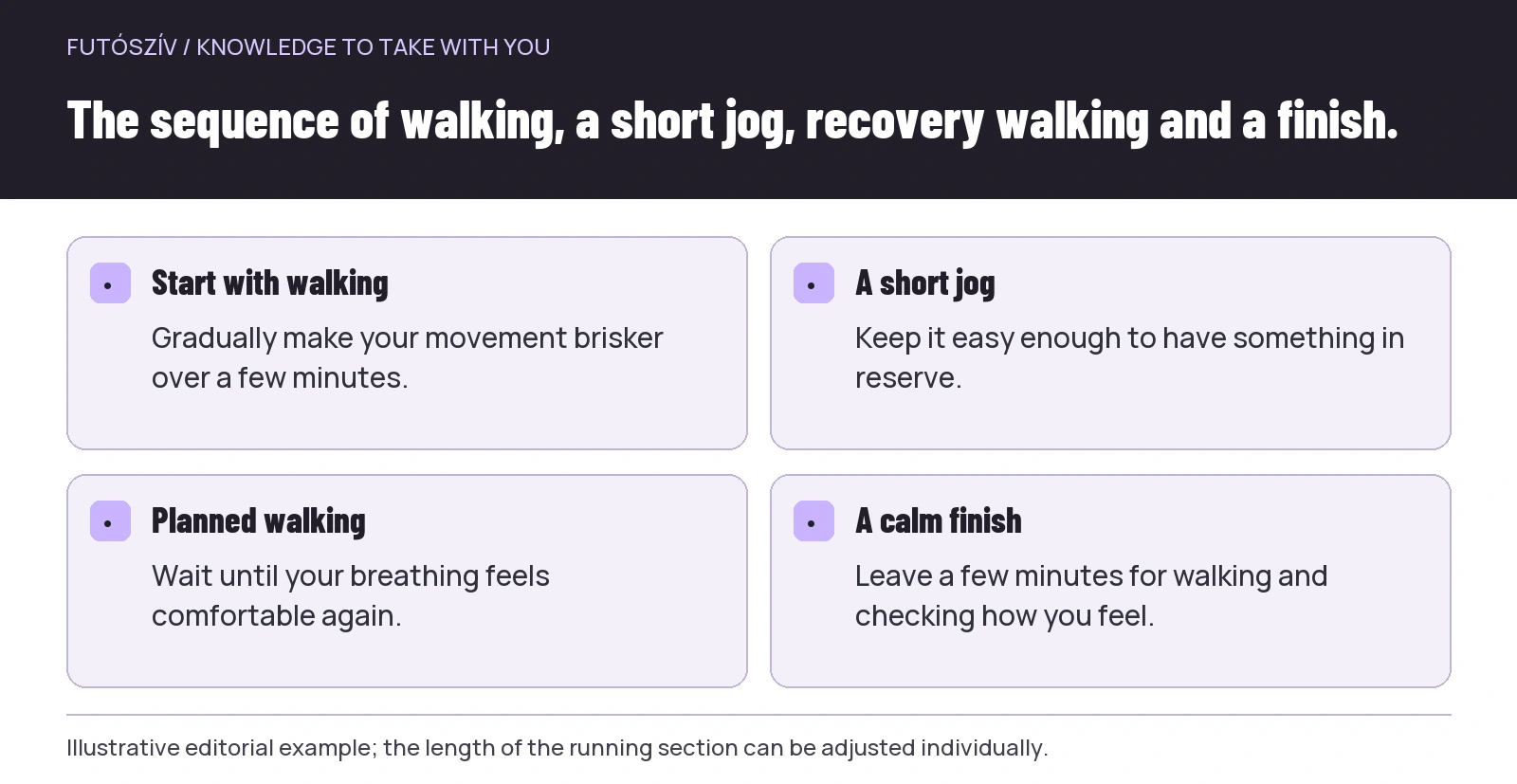 Enlarge diagram
Text version of the illustration
- Start with walking
- Gradually make your movement brisker over a few minutes.
- A short jog
- Keep it easy enough to have something in reserve.
- Planned walking
- Wait until your breathing feels comfortable again.
- A calm finish
- Leave a few minutes for walking and checking how you feel.
A first session that is easy to understand
The example below is an editorial illustration, not an individual training prescription. It can be a starting point if comfortable walking is already symptom-free. Begin with a few minutes of gradually brisker walking. Then switch to a short, easy jog, followed by walking until your breathing is comfortable again. Leave a few minutes of relaxed walking at the end.
| Part of the session | One possible approach | What to watch for |
|---|---|---|
| Getting ready | 5 minutes of comfortable, then brisker walking | Safe ground and a relaxed start |
| Alternating sections | Short jogs with longer walks in between | Keep the running comfortably repeatable |
| Finishing | A few minutes of easy walking | How you feel and feedback the following day |
As an initial idea, you could try half a minute of jogging with one and a half to two minutes of walking, repeated a few times. If that is too much, shorten the run further or make it a walking day. Even if it feels easy, you do not need to double it straight away on the first outing. How you feel the following day is also part of the information you use to plan your next session.
Change one thing during the first few weeks
Progress can take different forms. The easy running section might be a little longer, there might be a little less walking, or the same session might feel calmer. All three do not need to happen at once. If you increase the time, run faster and switch to a hilly route simultaneously, it will be difficult afterwards to understand which change was too much.
Use a simple sequence of questions. First: did you finish the sessions comfortably? Next: were everyday walking, stairs and your general wellbeing all right between sessions? Finally: does the thought of the next session feel manageable? If you are unsure about any answer, repeating a week is often a more sensible planning decision than forcing the next level.
The ten per cent weekly increase often mentioned online is not a personal insurance policy against injury. A percentage alone does not describe your starting point, the surface, how much you sleep or whether you have had an earlier injury. As a beginner, time spent moving, perceived difficulty and the following day’s response may be more useful together than mechanically following one rule.
What might a simple weekly rhythm look like?
If you can fit in three active days, you could choose Monday, Wednesday and Saturday. If only two fit, Tuesday and Friday can also work. Everyday walks on the days in between do not automatically need to become more running sessions. One task during the first weeks is learning to distinguish enthusiasm from the need for more training load.
A rest day does not necessarily mean a day without movement. It can mean walking comfortably, doing your everyday tasks and adding no further running stimulus. If you miss a session, do not try to make it up with two the next day. Revise the week to leave room for recovery. A sustainable calendar is more valuable than a perfectly ticked-off spreadsheet.
When travelling or during busy periods, plan a minimum option in advance. This might be a short, familiar walk–run loop. The minimum is not an obligation when you are ill or in pain; it is a practical answer to simply having little time. That way, your routine exists beyond ideal weeks.
Check comfort first when choosing equipment
You do not need a complete technical wardrobe to start. Choose shoes and socks in which you can move comfortably, without your toes being cramped or your heels slipping uncomfortably. Try anything new on a short outing first. The NHS information on running injuries also emphasises that starting out does not necessarily require expensive shoes.
With clothing, chafing, an accessible pocket and layers that suit the weather matter more than the brand. Your keys and phone should not bounce with every step. In the dark, think about both being visible and lighting the route. These are separate tasks: a driver seeing you does not necessarily mean that you will spot a defect in the pavement in time.
A simple timer is enough instead of a watch. Set it before leaving, and avoid watching the screen throughout every section. If a gadget demands more attention than it saves, feel free to simplify during the first few weeks. Your equipment is a good companion when it reduces the effort of organising the outing.
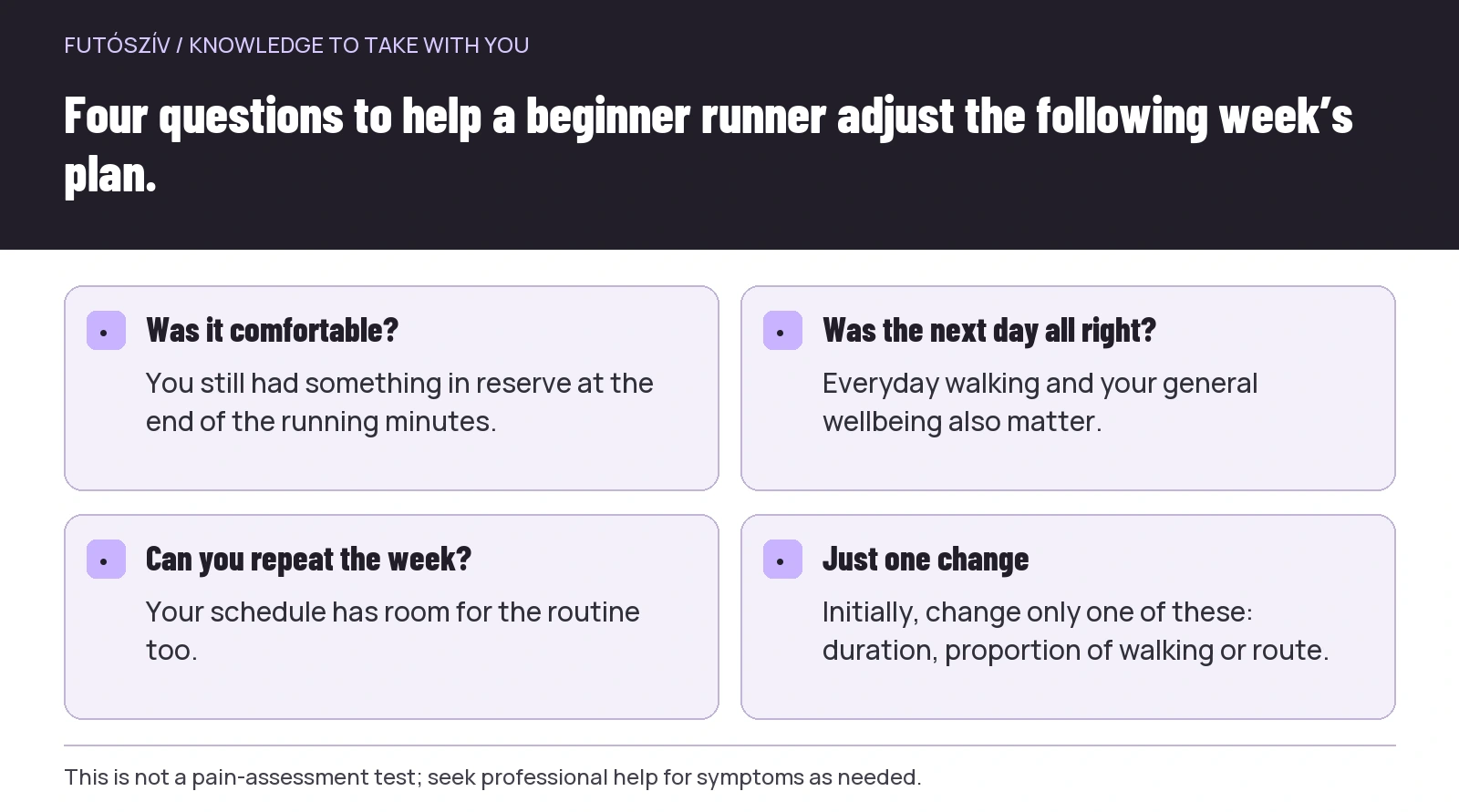 Enlarge diagram
Text version of the illustration
- Was it comfortable?
- You still had something in reserve at the end of the running minutes.
- Was the next day all right?
- Everyday walking and your general wellbeing also matter.
- Can you repeat the week?
- Your schedule has room for the routine too.
- Just one change
- Initially, change only one of these: duration, proportion of walking or route.
Keep a diary that helps you make decisions
An entry can be just four lines: how long you spent outside, how you alternated walking and running, how difficult it felt and how you felt the next morning. You can add the route and note unusually little sleep. More data is worth collecting only if you actually use it.
“I was slow” carries little information. “From the second section onwards, I could no longer talk comfortably” is much more useful. Instead of “it was a bad session”, describe whether the stretch into the wind, poor ground or starting too quickly caused problems. Your diary is not a report card; it is a brief collection of your own observations.
Once a week, review what made getting out easier. Morning exercise might suit you better than evening exercise. A group session might motivate you, while you prefer the others alone. These small, honest observations help make a running routine your own.
If you have pain, do not look to an app for permission
Pain that worsens, is sharp, comes with swelling or changes the way you move is a reason to stop and seek help as needed. The Berkshire Healthcare return-to-running guide specifically warns about symptoms that worsen during running. An online example cannot override your body’s signals or advice from the professional treating you.
After a long break, it is especially tempting to compare yourself with your old pace. Instead, put your current starting point at the top of the first weeks’ plan. Earlier results are experience, but they do not replace your present capacity. When returning from injury, ask for specific conditions: when you can run, what response is acceptable and what to do if you are worse the next day.
The next worthwhile goal: another repeatable week
At the end of the first month, there is more to count than minutes run. Do you know which route feels good? Have you found a time slot that works? Is it easier to choose between shortening a session and forcing it? These skills will stay with you later, on a five-kilometre run or during a longer training programme.
If an event appeals to you, look for one whose distance, time limit and run–walk options fit your actual routine. Entering can be motivating, but it should not make progress urgent. Your next run’s task may simply be to set out safely again, move comfortably and finish wanting to continue.
Sources and editorial note
For statements about intensity, starting out and symptoms, we used the NHS, CDC and Berkshire Healthcare information linked above. The weekly planning examples are our own editorial illustrations, not copied training programmes. This article has not received an individual medical review; discuss health questions with your own treating professional. Sources checked: 18 November 2026.
How Futószív articles are prepared: our editorial guidelines.