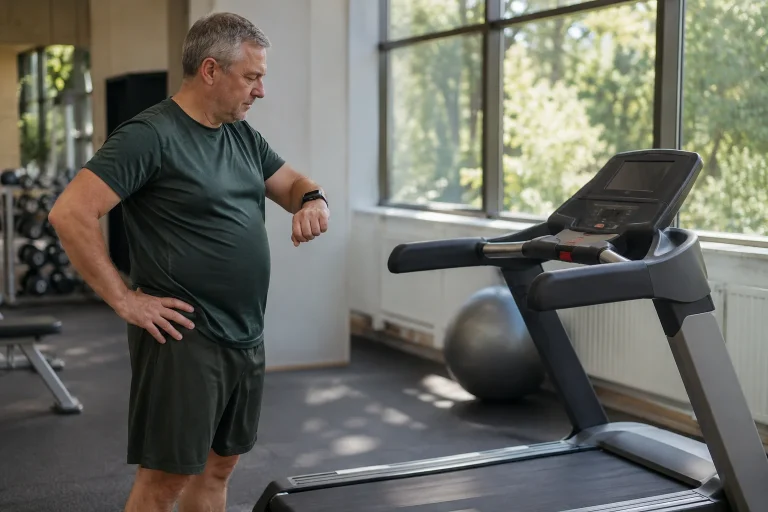
The Egofit Walker Pro M1 may appeal where a longer walking pad is difficult to accommodate. But its short exterior comes with two important features: a shorter walking surface and a fixed incline. These cannot be treated simply as a large treadmill scaled down. The decision is whether your actual movement and work task suit this design. This guide follows that question from dimensions through desk fit to controls.
The M1 and handrail-equipped M1T are different versions
The manufacturer calls the M1 Walker Pro and the M1T Walker Plus. The M1T’s own page highlights a folding handrail and separate safety key; the shared manual’s accessory list also associates the key with the M1T. This does not establish that the M1 offers the same control or support arrangement. Check the full name on the machine, order and instructions.
The current M1 page lists 1–5 km/h speed, an 87 × 42 cm walking surface and a 100 kg user limit. These are its published figures; check documentation for your actual unit separately. If walking without a handrail feels uncertain, compactness does not resolve that need. A photograph of another model does not replace the specific version’s capabilities.
As a runner, translating speed range into training pace is easy, but you are still assessing walking equipment. Mathematically, 5 km/h is 12 min/km, which does not automatically make a pad suitable for running. Define workday walking separately from running training. The place of walking in the training week helps avoid expecting the same from two different activities.
A fixed five per cent is not a selectable flat starting level
The current M1 page states a fixed five per cent incline, also shown in the linked shared M1/M1T manual. Fixed is more important than the number: this is not a motorised lift you can reset to zero before every session. If you also want a level surface, treat that as a separate requirement when comparing other models’ supported capabilities.
In our geometric explanation, five per cent means a 5 cm rise over a 100 cm horizontal projection. This equals approximately 2.86 degrees, not five degrees. The units are not interchangeable. This is not an angle measurement on the M1 or assessment of its mechanism; it explains the specification. If a seller uses another unit, request written clarification for the exact version.
Do not reduce incline to one promised calorie multiplier. Your movement, speed, posture and usage time jointly shape the situation; a striking product-page comparison is not an individual metabolic test. First establish whether fixed-incline walking is manageable for you. Do not plan homemade wedges, supports or modifications to ‘correct’ it; place the machine according to its documented purpose.
Assess the 87-centimetre belt with your own gait
One height rule cannot settle whether a short walking surface suits you. Position on the belt, the forward-and-back extent of steps and controls all matter. An 87 cm belt does not establish comfortable adequacy for everyone or inevitable unsuitability above a certain height. Such a boundary would require individual trials and knowledge of intended-use conditions.
In our calculation, 2 km/h is approximately 33.3 metres per minute. If cadence were 60 steps per minute, distance per step would be about 0.56 metres. This is simply a speed-and-cadence example, not a recommended cadence or measured M1 gait. You cannot conclude that a 56 cm step ‘fits’, so the machine must suit you: walking space requires more than one numerical quotient.
During a trial, notice whether you can remain in the appropriate usage position without consciously shortening or adjusting every step continually. You do not need the fastest setting to recognise uncertainty. If reaching the desktop pulls you forward or the machine’s end occupies your attention, reconsider the layout and equipment type. Compact space demand does not override manageable movement.
 Enlarge image
External dimensions are only the room plan’s first rectangle
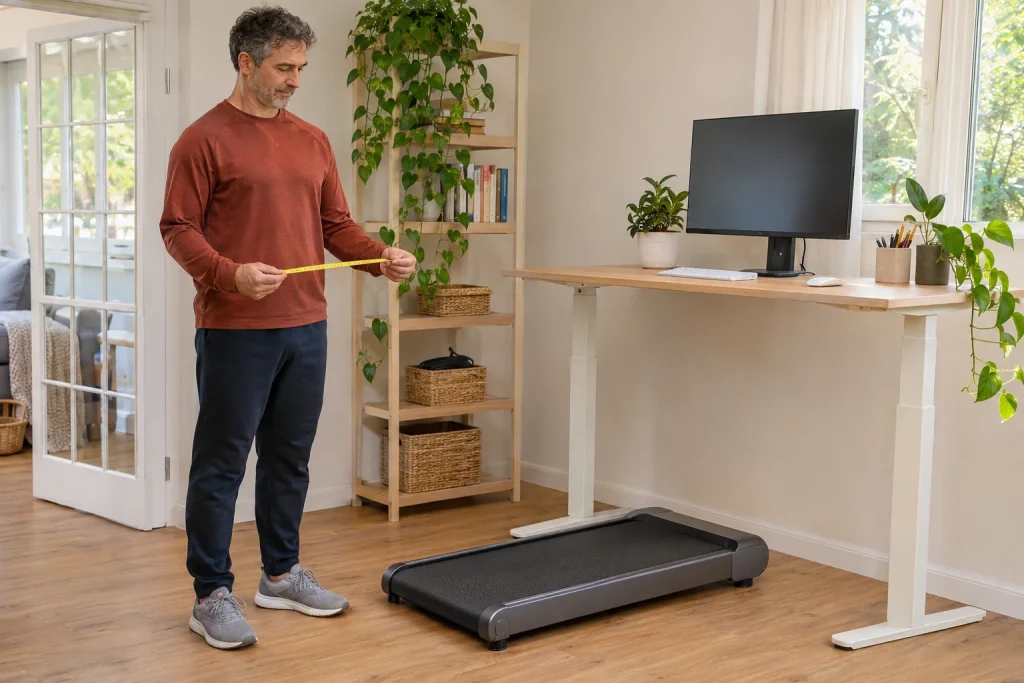
The product page lists M1 external dimensions of 97.5 × 55.5 × 17.5 cm and a net weight of 22 kg. An original footprint calculation gives approximately 0.54 square metres for the 0.975 × 0.555 metre rectangle. This illustrates the machine body’s area, not total operating space. A short machine still needs manual clearances, access and orderly walkways.
The manufacturer-linked M1/M1T manual specifies at least two feet clear at the front and sides and four feet behind. Reconcile this with your own version’s valid document, but the lesson is clear: an almost metre-long body does not promise an almost metre-long operating corner. Desk legs and furniture are not merely decoration independent of the machine’s edges.
Draw desk, chair and door movements on the room plan too. If switching to sitting, where do chair and pad go? If someone passes behind, is there a suitable route? A cardboard footprint helps identify furniture clashes beforehand but does not prove operating safety. Instead of the popular ‘under any desk’ wording, measure your actual workstation.
Where the fixed incline meets the desktop
Overall external height must not automatically be treated as the rise beneath your soles. The M1 frame, motor position and sloping surface represent different points. Your actual position relative to the desktop requires the walking level and your shoes. A shipping dimension does not determine the height placing hands and gaze appropriately.
In our geometric example, two belt points separated horizontally by 30 cm differ in height by 1.5 cm at a five per cent incline. This is not a desk-adjustment instruction or a measured M1 point. It shows that belt position matters alongside slope. Reaching the desktop should not force uncertain positioning while walking.
Monitor and input-device locations belong to the setup too. OSHA’s general workstation guidance treats the monitor within the whole environment; we do not use it as Egofit certification. Check practically how far you look down at a laptop, reach for a mouse or lean on the desktop. If walking combines only with an unfavourable work position, the setup is unfinished.
Remote, app and a separate desktop console
The product page mentions app and remote control. This does not establish identical app versions for every phone, direct watch connectivity or universal workout-data export. Check the current recommended app and support with the manufacturer. An older manual lacking app detail proves neither absence of current support nor every modern feature.
The manufacturer also offers a separate Desktop Smart Console. Its current accessory page limits compatibility to machines made after 2023 with the appropriate USB port, including the M1. Check a used or earlier M1’s version separately. Connector shape alone does not prove a suitable data connection or mean any USB accessory can control it.
For a control trial, first learn starting, adjustment and stopping from your instructions without working. Then assess which remote or supported desktop-console position remains accessible. The phone can be part of digital options, but the whole routine should not depend on searching uncertainly for a screen. Display access and controllability are separate questions.
Different work tasks may suit the fixed incline
You do not need to turn the whole working day into walking. After learning controls separately, your own task trial could start with a short, easily interrupted reading or phone task. For fine mouse movements or complex editing, you may choose another position. This is not universal productivity advice; the aim is observing compatibility between your setting and movement.
Afterwards, record how often you searched for controls or interrupted work and what result remained. ‘I moved a lot’ is not the same as a comfortably manageable task. Your observation is not a scientific performance test but helps identify realistic uses. The M1’s short fixed-incline design has value if you find a manageable situation for it.
Do not let displayed calories or steps retrospectively change the goal into compulsory continuation every time. The product page’s ten thousand steps are not a mandatory dose for everyone. If only a short walk fits that day, an advertising number does not decide its worth. Let equipment be an option chosen for your day, not constant pressure to fill a counter.
 Enlarge image
Storage and moving: a shorter machine still has weight
The short M1 may fit more readily at home, but its listed 22 kg remains significant weight to move. Wheels can help with permitted rolling, not lift it over stairs or thresholds. Follow the manufacturer’s authorised grip, moving method and storage position. Shortness does not imply easy handling by one person on every route.
Include starting out, turning through doors and the final position in your moving plan. Unplugging and organising the cable are part of it; a dangling lead or uncertain grip does not improve because the device is small. Measure storage using full external dimensions, and do not try to remove the fixed incline through homemade modifications while storing. Documented purpose and the actual route together form a useful plan.
Check purchasing region, power supply and support separately. The linked manual also discusses a 120-volt circuit, which is not a general electrical specification for a Hungarian device. Even with the same model name, you need suitable documentation for the locally sold unit. A foreign offer, currency or shipping label does not establish every condition of Hungarian use, servicing and warranty.
When is the M1’s short design worth choosing?
The M1 can be a sensible candidate if it fits your walking task, you specifically accept the fixed incline and the surface suits your movement. If you want level walking, a longer belt or another support arrangement, do not dismiss that requirement for compact dimensions. A machine fitting the room and equipment fitting you are separate conditions; both need to hold.
After a pre-purchase trial, be able to name the exact version, control route and intended work task. For discrepancies between displayed distance and a watch estimate, see investigating treadmill and watch distance. The best argument for the M1 is not that it is advertised as smaller than everything else, but that its particular short, fixed-incline walking situation works clearly in your day.
Sources and versions
Checked on 21 November 2026. The manufacturer’s M1 page, jointly linked M1/M1T 1.0 manual and desktop console compatibility description are separate sources. Geometry examples are original illustrations, not device measurements or installation assessments.
- Egofit Walker Pro M1 manufacturer’s product page
- Egofit Walker Plus M1T: the separate handrail-equipped version
- Manufacturer’s manual selector
- Manufacturer-linked M1/M1T manual, 1.0
- Egofit Desktop Smart Console: conditions stated for post-2023 machines
- OSHA: monitor placement within the complete workstation
How Futószív articles are prepared: our editorial guidelines.