In a running group, a starting signal, a shout before a turn and a training change announced on the move often seem straightforward. A participant who is deaf or hard of hearing may not have the same access to them. Simply speaking louder is not the solution. Communication agreed beforehand and shared arrangements that make important information available in several ways are needed.
Communication needs differ among deaf and hard-of-hearing runners. Some use sign language; others rely on speech, lipreading, writing or a combination. The presence of a hearing aid or implant alone does not tell you how someone prefers to communicate. The first step is asking the person, not making a ready-made assumption.
Let participants explain what helps them
The UK Deaf Sport guidance emphasises that communication needs are individual, so ask the person directly about the appropriate method. Before a first group run, a few brief questions may suffice: how do you prefer the briefing, which signals can you see well and how can we signal a need to stop?
You do not need details of a hearing test to organise an accessible outing. Focus on needs relevant to participation that day. Someone may also request different arrangements in different situations: one for a stationary conversation and another for movement or noise.
You can revisit the answer occasionally. Time of day, lighting, group size or route can change what works. An established system is not unchangeable, and participants need not accept a poorly functioning solution out of politeness.
Make important information available before leaving
Send the distance, pace, route, stopping points and purpose beforehand as understandable text. Do not make a voice message or video the only information source. The on-site briefing then need not be the only chance to understand what will happen.
Report changes through the same usable channel too. A changed meeting point or start should not be discoverable only through a brief phone call. A newcomer should know whom to contact with questions and how.
An accurate advance plan helps others too, but accessibility need not be justified solely on that basis. A deaf or hard-of-hearing runner has a right to understand the outing’s framework in their own right. They should not have to obtain every detail through another group member’s private explanation.
Choose the briefing location deliberately
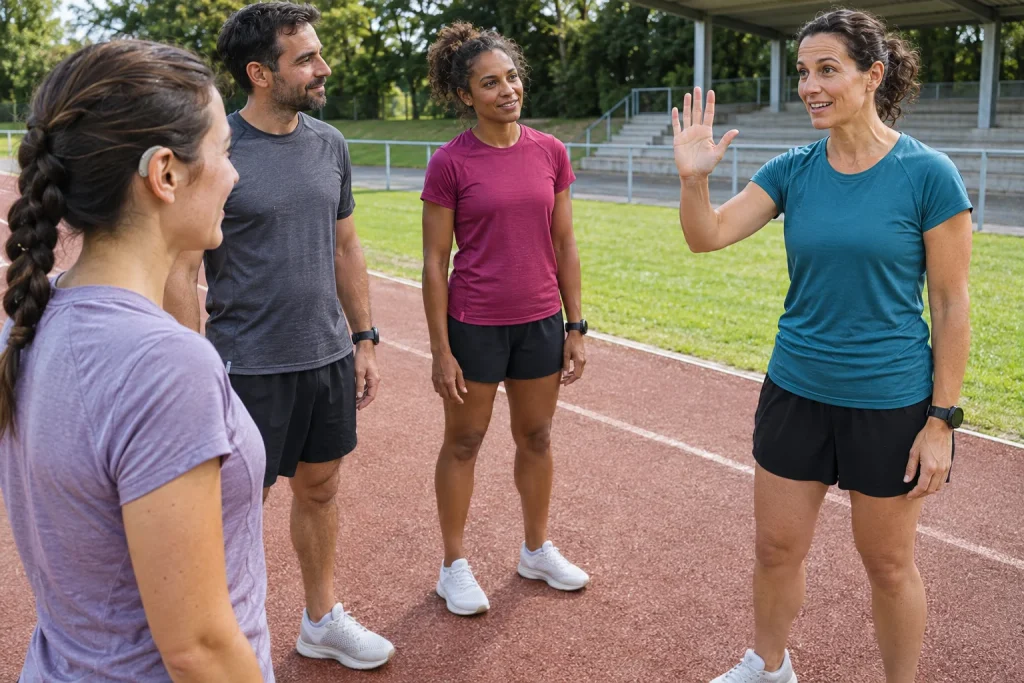
The SINOSZ communication tips highlight visibility of the speaker’s face and clear, understandable communication. Do not give a running briefing with your back turned, mouth covered or strong light behind you. The aim is not exaggerated articulation or shouting, but a situation people can follow.
Stand so the participant can see who is speaking, and preferably have only one person give important information at a time. If showing a map or movement, allow time to look, then explain. People should not need to follow several distant visual sources simultaneously.
If someone missed or did not understand the briefing, repeat or rephrase it. Do not take a nod as certain proof of complete understanding. You can ask specifically whether the next stopping point is clear without testing the participant.
When demonstrating an exercise, separate explanation from performance: first let everyone see and understand the task, then begin moving. Someone concentrating on the ground or their body position need not simultaneously follow a new detail given only in speech.
 Enlarge diagram
Text version of the illustration
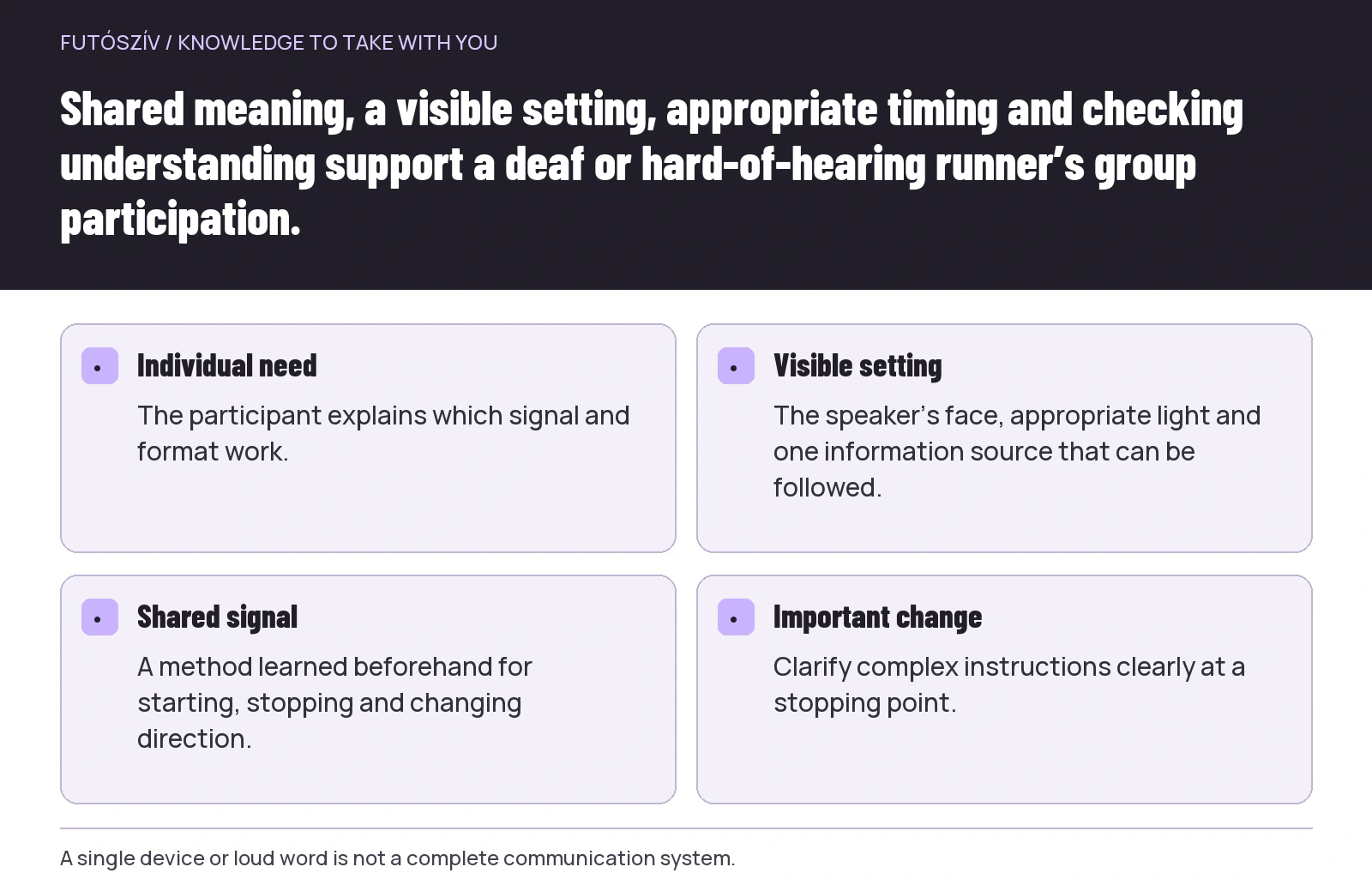
- Individual need
- The participant explains which signal and format work.
- Visible setting
- The speaker’s face, appropriate light and one information source that can be followed.
- Shared signal
- A method learned beforehand for starting, stopping and changing direction.
- Important change
- Clarify complex instructions clearly at a stopping point.
Agree the group’s own signals
Stopping, starting, slowing and changing direction can each have a clearly visible signal practised beforehand. Keep them simple and easy to distinguish. There is no need to improvise an entire sign language; shared gestures can help with a few tasks if everyone concerned understands and accepts them.
The UK Deaf Sport coaching materials support adapting communication and learning sport-specific signals. If a runner wants to teach the group a sign related to sport, you can practise together. The participant is not obliged to act as an instructor at every outing, however.
Clarify where and when a signal is given too. A hand movement behind someone does not help when they are looking ahead. The system needs to work during actual running, not only in the circle before setting off.
Sign language and a shared gesture are different things
The UK Deaf Sport collection of sports signs is specifically British Sign Language, or BSL, material. Do not automatically use it as a Hungarian Sign Language dictionary. Sign languages are not different decorations on one worldwide language.
If sign-language interpreting is needed, agree the appropriate language and arrangements with the participant. An interpreter’s role is not the same as a running companion who knows a few shared gestures. Do not reduce complex information needed for participation to a few signs when that is insufficient.
The group’s shared signal system can be summarised in writing and pictures, but explain the images’ meaning too. Let the participant’s feedback determine whether it works. General goodwill does not replace actual understanding.
Attention must be shared while moving too
During running, people need to watch the route and surroundings. Do not expect someone to keep looking backwards or at a speaker’s face for a complex explanation. If important training instructions change, choose an appropriate stopping point and clarify them there.
Brief, agreed signals can help during movement, but more complex communication need not be forced on the move. A group leader can plan a loop with clear regrouping and information points. Slower members or those at another pace should not miss information.
Agree in advance on touching someone to attract attention too. Do not grab a runner unexpectedly or assume everyone welcomes the same touch. If a situation is uncertain, make the plan simpler and easier to interrupt.
The route includes the communication environment
Lighting, crowds, noise and visibility can affect how information reaches people. The UK Deaf Sport accessibility guide treats adapting communication as fundamental to participation. A running route therefore involves more than its surface and elevation.
Discuss sections where more advance information or a stop is needed. Do not manage a busy crossing through a word shouted at the last moment. Traffic situations need appropriate arrangements discussed beforehand and attention on site.
For an outing in darkness, check whether shared signals are visible. Strong flashing is not needed to compensate for poor arrangements. Another meeting point, an appropriate stationary briefing or an adjusted route may work better. The aim is predictable information, not the greatest number of stimuli.
 Enlarge diagram
Text version of the illustration
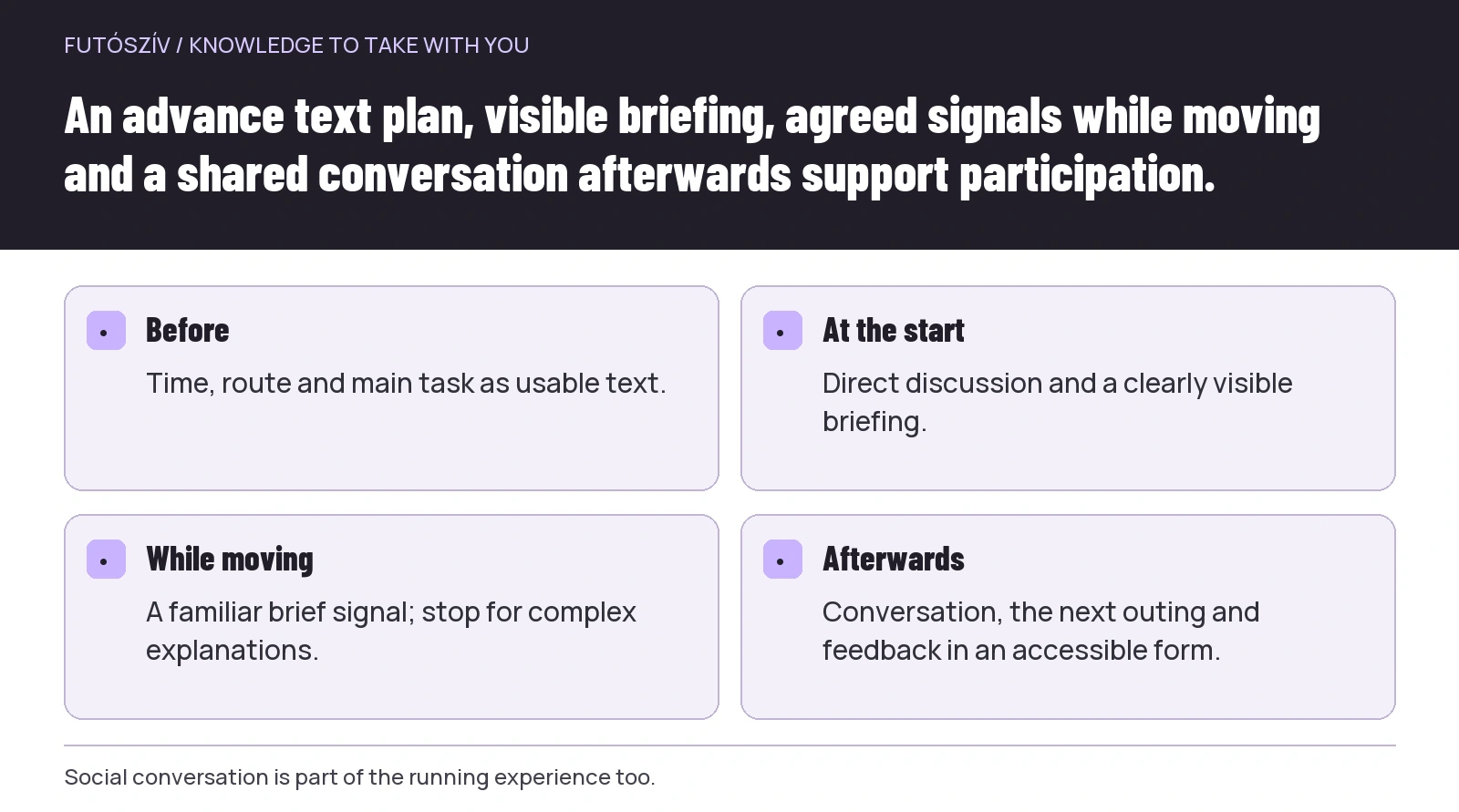
- Before
- Time, route and main task as usable text.
- At the start
- Direct discussion and a clearly visible briefing.
- While moving
- A familiar brief signal; stop for complex explanations.
- Afterwards
- Conversation, the next outing and feedback in an accessible form.
A hearing device does not resolve every situation
Do not assume a device automatically makes every word and signal accessible. Let the runner explain what they use and what works in that environment. Settings, water or sweat resistance and wearing arrangements belong to the device’s own manufacturer guidance and, where needed, audiological advice.
The group should not independently request volume or setting changes for training. If communication does not work in a situation, first change the arrangements. A participant is not obliged to compensate for every environmental fault through their device.
Have known signals for stopping and important changes without a device too, where appropriate for that participant. A backup helps beyond unexpected technical problems and can reduce the sense that participation depends on a single device.
Make group conversation accessible too
Socialising after running can easily become a rapid conversation with people talking over one another. Important training-related information should not get lost then either. Let one person speak at a time and, where needed, also summarise the next outing in writing.
Include the deaf or hard-of-hearing runner beyond the briefing. Informal connection belongs to community participation too. Ask in which setting conversation feels comfortable, and do not let a companion or another member automatically answer on their behalf.
A joke, quick aside or location change may matter too. If someone says they missed it, do not reply that it is unimportant. Briefly rephrasing is more respectful and useful than excluding them from the conversation.
Check race starting signals and information separately
An event’s start, emergency signals and course information may differ from the group’s familiar system. Ask beforehand which visual or other accessible signals are available and who can clarify details on site. Do not automatically assume the same solution at every race.
The need for a companion or communication support is individual. Clarify current entry and participation conditions directly with the organiser. Hearing loss alone does not mean every runner requests the same support.
A post-finish meeting point and communication of changes matter too. If everything is announced only over loudspeakers, request another suitable format. Connect your need to a specific task: which information you need to access, and when, to participate.
A brief check of shared arrangements
- Have we asked the participant directly about their chosen communication method?
- Are the route, time and main task available beforehand as text?
- During the briefing, is the speaker visible and can the information be followed at one time?
- Are signals for starting, stopping and turning known to everyone concerned?
- Is there a way to clarify important changes while out running?
- Can the participant also join post-run conversation and feedback?
The list examines the group’s organisation, not the participant’s abilities. Keep arrangements that work and adjust uncertain ones together. Adaptation is a regular part of shared outings, not a one-off gesture.
As a deaf or hard-of-hearing runner, you do not have to fill every information gap alone. As an organiser, you do not need to know everything beforehand to start well: ask, make essential signals visible and seek feedback. Predictable shared arrangements leave more room for running itself.
Sources
- SINOSZ: Communication tips
- UK Deaf Sport: How to communicate with a Deaf person
- UK Deaf Sport: Coaching Tips and Hints
- UK Deaf Sport: How to be accessible
- UK Deaf Sport: Compilation of BSL
How Futószív articles are prepared: our editorial guidelines.