Removing disposable cups needs a complete refreshment routine
A run can be organised without disposable cups while participants bring their own cup or another suitable vessel. The term “cup-free” can therefore be misleading. The point is not abandoning drinking equipment altogether, but planning how to receive fluid and manage waste beforehand.
This article addresses organisation. It prescribes no identical fluid or nutritional quantities for everyone; these belong to your personal running plan and professional discussion when needed. Your task here is knowing where and how to use tested equipment, what happens to packaging and how the whole outing ends.
At a race, read the specific requirement first
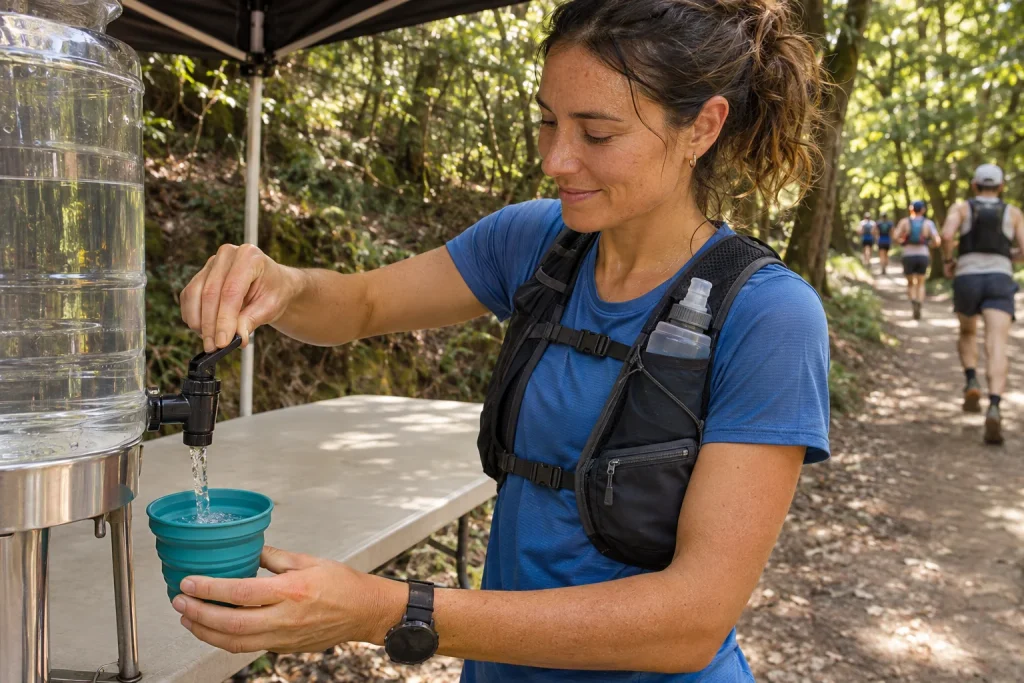
Events can use different refreshment systems. The official Tajga Trail information , for example, states that disposable plastic cups are not supplied, so participants need their own suitable means of receiving drinks. On the RUNaway WTF COLD page , a personal refreshment vessel also appears among equipment requirements.
These are specific event examples, not rules shared by every running race. Read the current year’s instructions for your own distance. Compulsory equipment, accepted solutions, station provision and local use arrangements can differ.
Besides meeting event rules, your equipment must suit the actual task. An easily packed cup and a flask carrying fluid while running do not necessarily fulfil the same role. Clarify function first, then choose from suitable items you already have.
Separate receiving, carrying and waste
Three different questions are involved. What receives your drink at the station? What carries it if your plan calls for that? And where does packaging generated during the run go? Buying one new product may not answer all three.
| Task | Your check | Common gap |
|---|---|---|
| Receiving drink | Is the vessel suitable and accessible? | Deep in a bag, requiring a search at the station |
| Carrying fluid | Can your equipment be used as intended? | Closure or placement has not been tried |
| Storing packaging | Is there a separate, closable place? | Used and clean items mix |
| Closing the outing | Where will emptying and cleaning happen? | Waste stays in a pocket until the next run |
The table shows organisational tasks, not an identical equipment list for everyone. Match choices to the specific event, route and personal programme.
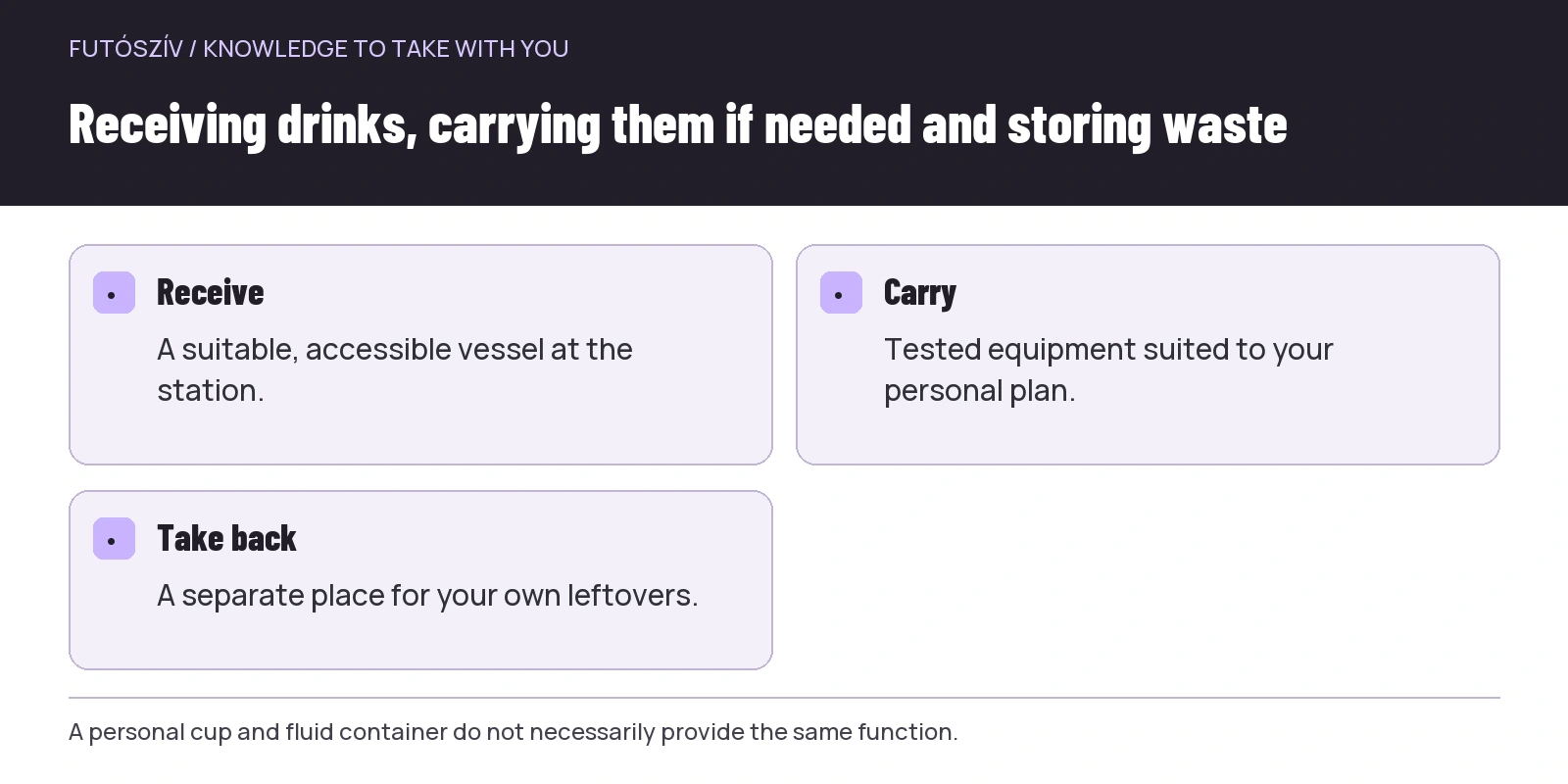 Enlarge diagram
Text version of the illustration
- Receive
- A suitable, accessible vessel at the station.
- Carry
- Tested equipment suited to your personal plan.
- Take back
- A separate place for your own leftovers.
Try your equipment in familiar surroundings first
A race aid station is a poor place for first use. At home and during an easy, familiar outing, check access, opening and putting away. For a container, follow manufacturer guidance to check use and closure.
The trial should cover the complete sequence. Retrieving the item, using it as intended and putting it away together form the on-site task. If it requires lengthy searching, change storage before departure.
Clean and used equipment may need different places in your pack. Consider handling the used state without spilling contents onto your phone, dry clothing or unused equipment. Base the specific solution on product care instructions.
Know the next step before the aid station
Check station locations and organiser information in the race instructions. Interpret this separately for your personal fuelling and hydration plan, but prepare the organisational sequence beforehand: knowing where equipment is, what information to read there and how to follow volunteers’ directions.
Do not begin prolonged packing while blocking others’ passage. If you need to stop or arrange equipment, choose a way fitting local arrangements and actual space. You can ask a volunteer for help, but should not expect them to know every function of unfamiliar personal equipment for you.
Identify food and drink through labels and organiser information. Questions about personal needs may require separate professional advice. Using your own vessel does not justify trying every available product for the first time during the event.
For hot drinks, intended use matters too
Some events offer warm drinks at the finish or an aid station. Not every lightweight folding cup or container suits every temperature. Consult your equipment’s manufacturer guidance and use it as intended.
Do not assume something working well with cold water handles another content identically. Local arrangements, equipment condition and storage matter together. If you cannot use it appropriately, request information or choose a solution suited to the situation.
Do not treat advertising claims about material or lifespan as complete care instructions either. Seek guidance for the specific product. Sustained appropriate use relates more closely to sustainability than accumulating many barely tried items.
The waste plan starts while packing
Review the objects and packaging you take out. These may include drink containers, food wrappers, paper or other waste associated with your task. Give expected items a storage place beforehand rather than seeking an empty pocket at the moment of use.
Store clean and used things in distinguishable ways. An accessible, suitably closable area can prevent small wrappers falling out when you retrieve the next object. The storage solution must also fit movement and your equipment.
You need not remove every possible packaging item before running. Preserve products’ intended and hygienic handling. The aim is justified organisation: know what you carry, consume and return to your pack.
Food scraps do not belong in nature either
The Duna–Ipoly National Park visitor guide emphasises taking waste home and does not regard discarding food scraps as a good solution. “It will biodegrade” is therefore no general exemption for leaving things outdoors.
Give these leftovers a place in your plan too. If something remains after eating, do not use the course edge or vegetation as storage. At a race, follow designated waste arrangements; on an independent outing, organise your own orderly transport back.
A collection point does not mean any waste belongs in any container. Read local signs and the bin’s arrangements. If unclear or unusable, you need not leave your waste beside it.
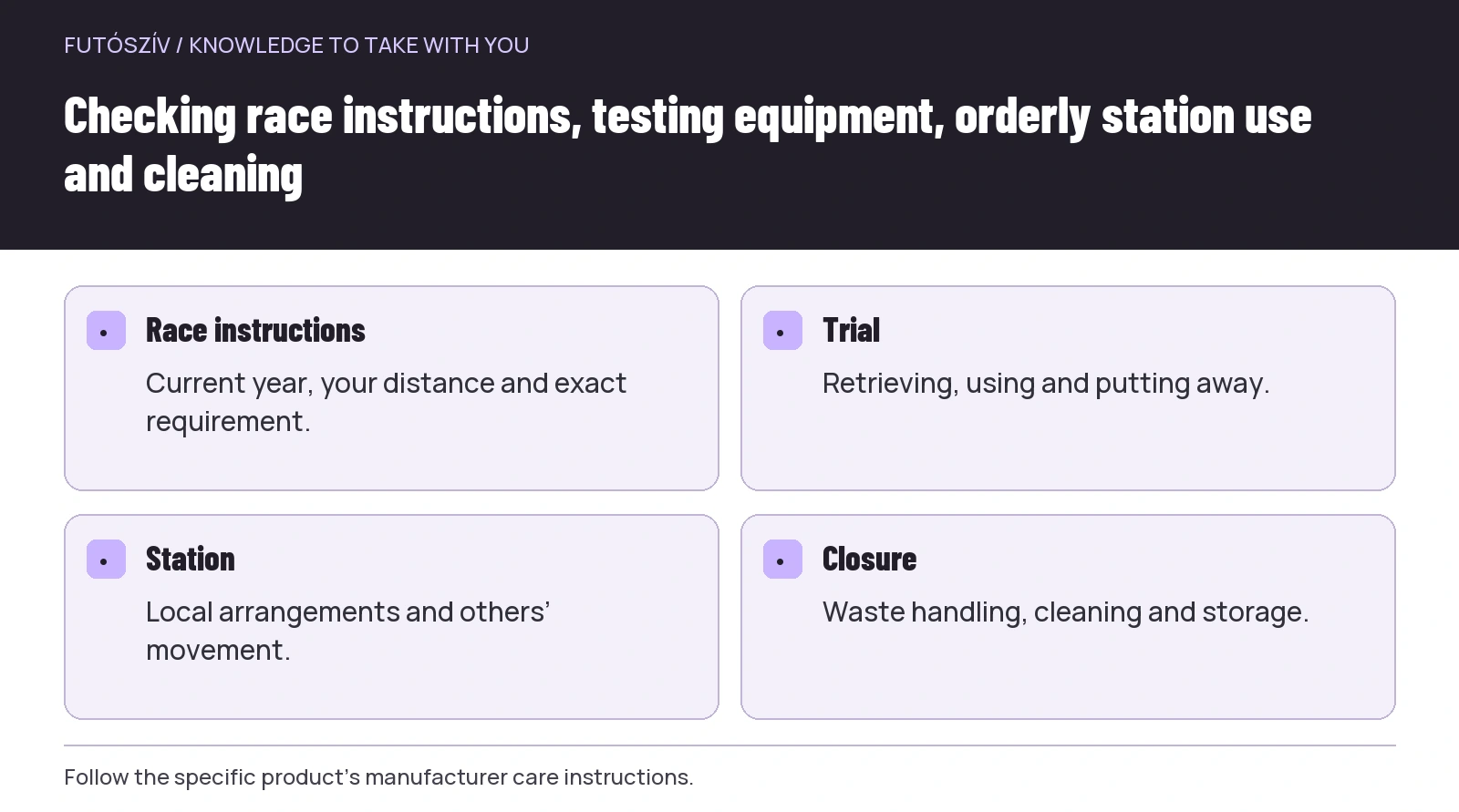 Enlarge diagram
Text version of the illustration
- Race instructions
- Current year, your distance and exact requirement.
- Trial
- Retrieving, using and putting away.
- Station
- Local arrangements and others’ movement.
- Closure
- Waste handling, cleaning and storage.
An illustrative three-pocket system
A runner creates three distinct places within their equipment. One holds unused items, another gives easy access to the drinking vessel, and the third carries packaging back. The pocket count is only an example: different clothing or bags permit other arrangements.
In familiar surroundings, they test whether retrieving equipment opens the waste section accidentally. After use, objects return to where they are expected for the next step. Every movement need not be timed to the second; a clear, repeatable order is enough.
After running, they close the whole system: manage waste appropriately, clean equipment as directed and prepare it for next use. The plan then does not stop at the start line or final aid station.
Do not assume full race services on a small shared run
For a friendly or community outing, clarify what the organiser provides and what each participant handles. Explain personal-vessel requirements, refreshment location and waste handling before departure. “Everything is sorted” is too broad if several personal-equipment tasks remain.
Do not plan around an unchecked water point or assumed opening hours. Check actual availability separately. A marked spring or building on a map is not automatically a usable service.
The group also needs orderly waste handling at the end. If someone brings shared equipment, agree transport and cleaning beforehand. Environmentally considerate organisation does not work by leaving unidentified objects for the last participant.
Your own cup does not make the whole day waste-free
Running equipment is only part of the outing. A drink bought en route, a finish package or food eaten travelling home can also produce packaging. Avoid making an exaggerated, hard-to-check claim that no waste was generated.
Improving specific processes is more useful. Did you genuinely replace a disposable item? Did your own item remain reusable? Did waste reach the right place? These are observable questions informing the next outing too.
Watch unnecessary purchases as well. First examine suitable existing equipment that meets the rules. Another item advertised as environmentally friendly may not improve your routine if it remains difficult to access or is not reused.
Cleaning and storage after the finish complete the cycle
Clean and store used equipment according to its instructions. Do not automatically adopt methods recommended for another material or model. Closure, drying and checks before reuse can belong to a lasting system.
Empty and clean the pocket or pouch allocated to waste too. The next run should not begin with retrieving clean equipment from old leftovers. If one storage solution failed, choose a concrete change for next time.
Three review questions suffice: was the drinking equipment accessible, did all your waste stay with you and was closing the day simple? A no becomes a useful organisational task. You need not replace the whole equipment system.
A short personal waste sheet for next time
Begin with the specific event’s equipment requirement. Then identify what receives the drink, what you carry and where generated leftovers are stored. Finally name the appropriate emptying and cleaning location. Recheck current instructions for each new event.
The system works when it needs little improvisation outdoors. Using personal equipment, carrying packaging back and post-finish tidying are one process. Removing disposable cups then becomes a real, practical change in the outing, supported by your own sequence of actions.
How Futószív articles are prepared: our editorial guidelines.