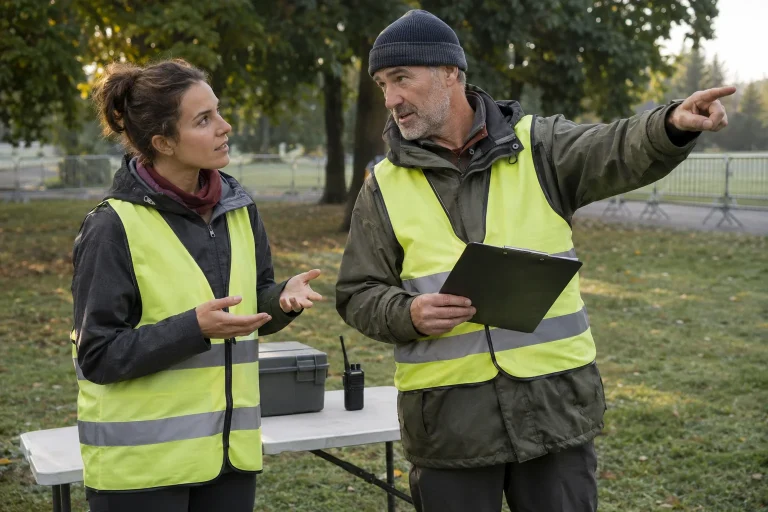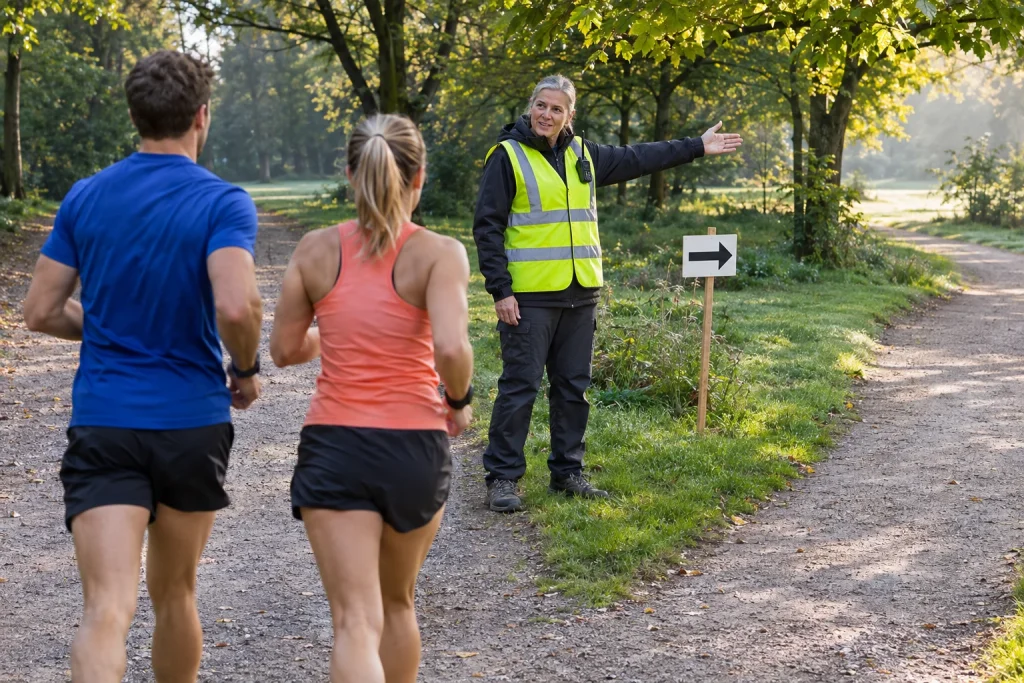
A course marshal or route volunteer standing at a junction can prevent a great deal of uncertainty with a few well-timed signals. Knowing the course as a runner is not enough for this. They need to know where participants approach from, which route each should follow and what information they may give within their role. Good information connects to the organiser’s plan rather than personal solutions invented on site.
Different events may use the title ‘course marshal’ for different roles. This article focuses on communication by a volunteer helping participants follow a route. It does not equate this task with the work of a qualified race official, police officer, traffic controller or medical staff. The particular task, authority and procedure are always determined by that event’s organiser briefing.
Make your own post clear on the map and on the ground
‘The junction after the bridge’ could mean several places. A designated post needs an identifier usable within the organiser’s system and a precise location. Know which side you approach from, where runners come from and where they continue. If the description and reality do not match, clarify this with the person responsible before starting the task.
Local knowledge does not replace the current course map. An earlier edition may have followed a different direction or branch, and the organiser may use a different arrangement now. Do not take up position based on last year’s memory or your usual training loop. Work from the current event’s latest approved information.
England Athletics’ Sector Marshal teaching material dated June 2026 considers the post identifier, location, contact arrangements and role-specific briefing together. This is an overseas professional education example, not a Hungarian qualification or authority requirement. Here we draw on its illustration of the organisational importance of describing a post clearly. England Athletics: Sector Marshal teaching material
Know the participant’s route, not just a direction
With several races, laps or distances, not everyone necessarily goes the same way at one point. At the briefing, ask which officially approved identifying feature distinguishes participants and when the post’s task changes. Do not infer a runner’s chosen distance from speed, age or equipment. Guessing can send them the wrong way.
Know if your role belongs to only one race too. You can pass a question from another race’s participant to the appropriate person, but do not give a definite answer about an unfamiliar route. ‘I do not know; I will check’ is more useful than confidence that sends someone in the wrong direction. Still try to show the next step specifically.
A fictional example: the final section of a short race and another lap of a longer race pass through the same junction in a park. The information for your role must describe both situations accurately if both have actually been entrusted to you. Adding ‘everyone goes left’ from memory can easily mislead here. Agree the precise content of the signal in advance.
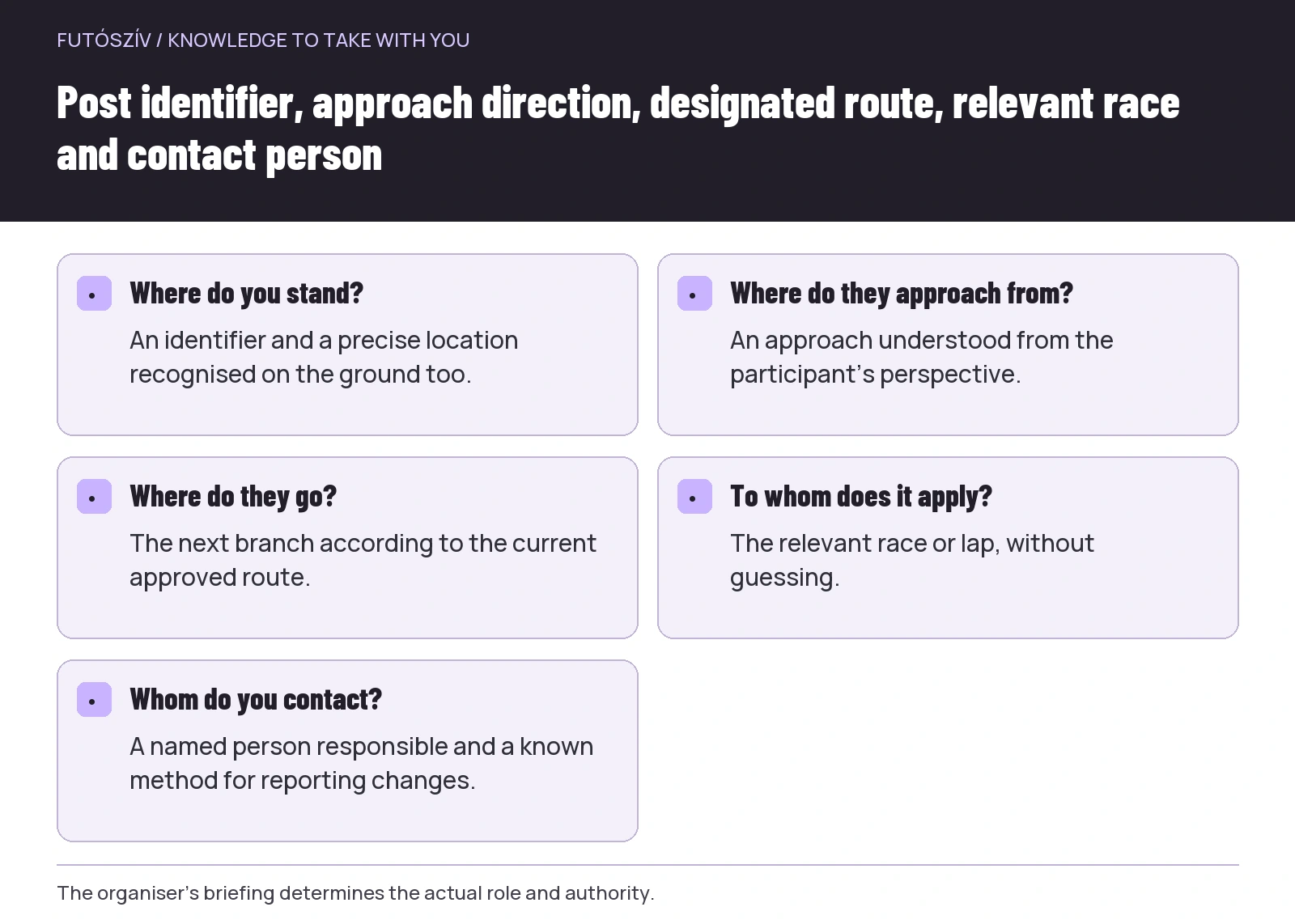 Enlarge diagram
Text version of the illustration
- Where do you stand?
- An identifier and a precise location recognised on the ground too.
- Where do they approach from?
- An approach understood from the participant’s perspective.
- Where do they go?
- The next branch according to the current approved route.
- To whom does it apply?
- The relevant race or lap, without guessing.
- Whom do you contact?
- A named person responsible and a known method for reporting changes.
Give information before the decision point
A direction is less useful once the runner has passed the junction. At the location designated by the organiser, provide information as demonstrated at the briefing. Visibility, keeping the participant’s route clear and an understandable signal all matter together. You should not independently choose an appropriate position from a general article.
Put the necessary information first in a short sentence. A direction hidden in long encouragement can easily be lost. Where a gesture is possible, verbal and visual signals should agree according to the instructions received. Left and right relative to your own body can be ambiguous, so practise a precise message understandable from the runner’s perspective on site.
The signal must not create another obstacle. Do not unexpectedly step into a participant’s path to make sure they hear, or try to redirect runners physically. The organiser must provide arrangements for handling such situations at their event. Communication works when runners can use the information to follow the designated course.
The sign and the person should say the same thing
An arrow, tape, barrier and volunteer’s information at a post must not become independent messages. If you see a discrepancy, notify the designated person responsible. Do not turn a sign, remove a marker or create a new route on your own initiative. Any change must remain traceable within the whole organising system too.
A missing or damaged marker is more than a cosmetic fault. The post leader needs to know so that action can follow the event plan. The volunteer’s task is to pass on the observation accurately and follow instructions. They do not need to secretly fix everything to make the post appear problem-free to the team.
| What you notice | What you can report precisely to the person responsible |
|---|---|
| A missing direction sign | The post identifier, location of the missing sign and participant approach. |
| Contradictory signals | Which two signals differ, and what does your own briefing say? |
| A new obstacle | Where is it, which designated section does it affect, and when did you notice it? |
| An unclear transition between races | For which race or time slot are instructions missing? |
| A communication problem | Whom did you try to reach, through which approved channel? |
The table is a reporting aid, not an independent intervention protocol. The event’s responsible person and the appropriate procedure determine further action. If you notice immediate danger, follow the urgent reporting arrangements you were given; everyday information does not replace safety action.
Giving runners information and managing traffic are separate roles
A route volunteer is not necessarily authorised to stop vehicles, direct traffic or change a closure. A high-visibility vest alone does not describe authority to act. If a post meets a public road or another traffic situation, clarify the relevant roles and limits with the organiser before accepting the assignment.
This article does not explain Hungarian traffic-control powers or provide methods for exercising them. The organiser must provide appropriate, lawful traffic arrangements and trained staff for the location. Your task can only be one actually entrusted to you, which you understand and for which the necessary conditions exist. An uncertain role must not be filled with your own improvisation.
If a driver or pedestrian asks something outside your role, direct them to the designated person responsible. Do not promise opening times or opportunities to cross from your own estimate. Do not combine separate information about participants’ routes and traffic arrangements into a general ‘the way is clear’ statement.
Other users of the area should receive clear information too
In a park or shared space, people may arrive without knowing about the event. A running race does not automatically explain where they can go or whom they can ask. Within your role, provide brief, factual information and show the options within the designated on-site arrangements. Do not speak as though their presence outside the event is inherently a nuisance.
The parkrun volunteer role description lists giving directions, reporting problems and informing other park users among a marshal’s tasks. This is that international programme’s own role description. It illustrates that attention at a post extends beyond the participant currently running in front of you. parkrun Support: Volunteer Roles
If someone is unhappy, you do not have to conduct a full debate on site about the event’s right to be there. Explain the verified information you have and whom they can ask further questions. There may also be a designated process for handling conflict. Calm information does not mean solving every problem alone.
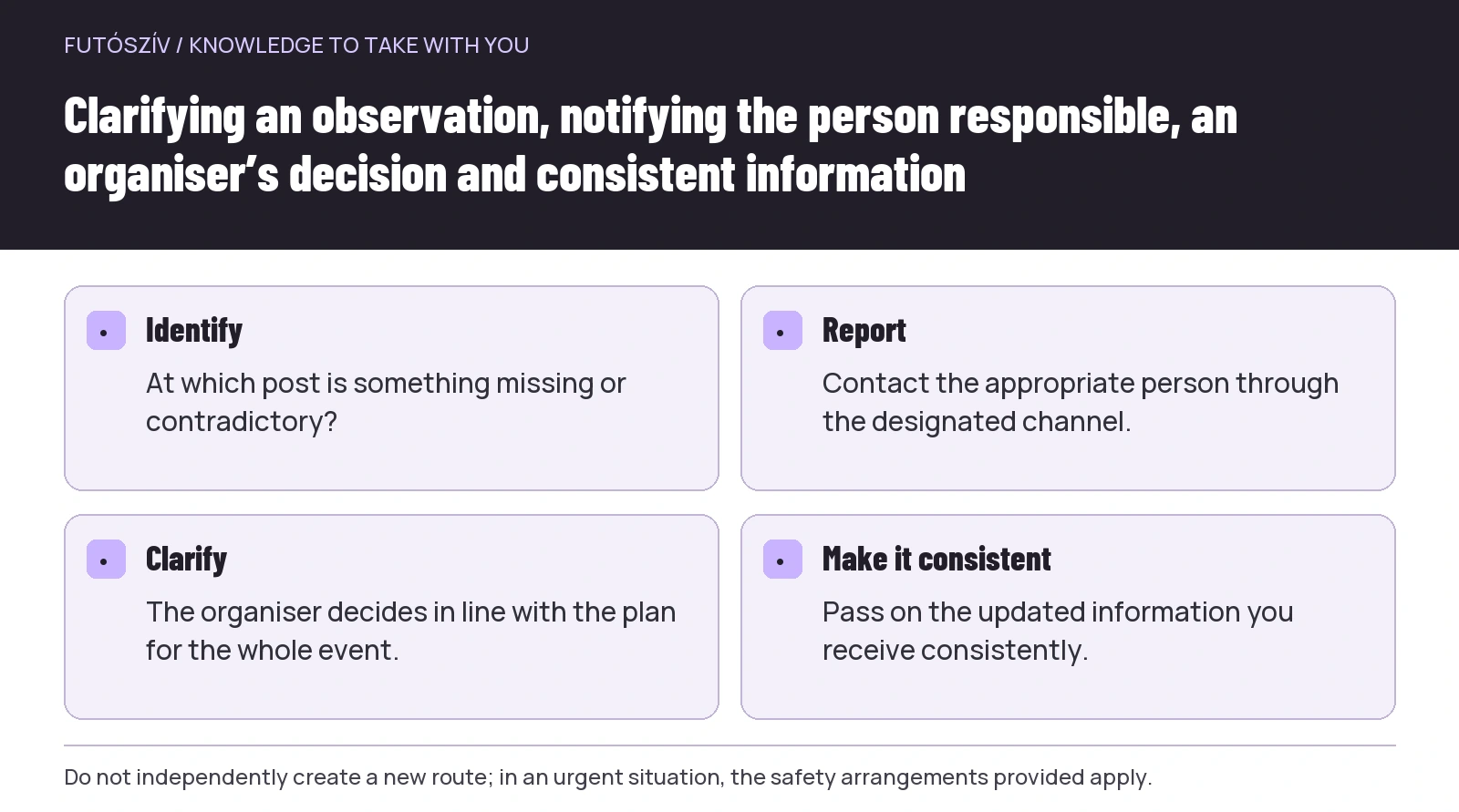 Enlarge diagram
Text version of the illustration
- Identify
- At which post is something missing or contradictory?
- Report
- Contact the appropriate person through the designated channel.
- Clarify
- The organiser decides in line with the plan for the whole event.
- Make it consistent
- Pass on the updated information you receive consistently.
Communication should work in practice, not merely exist on paper
Before starting, check the communication equipment and channel provided by the organiser as taught. Know which post identifier to give, how to report a problem and the backup contact if you receive no answer. A general race-office number saved in your phone is not necessarily the contact managing operations on site.
A short organisational message should say where you are, what you observe, which section is affected and what response you need. Do not mix assumptions into a definite observation. ‘The arrow at post three is not in the location previously specified’ is different from ‘Someone must have taken it.’ The first provides directly usable information to the person responsible.
In an urgent situation, the reporting procedure provided takes priority over ordinary conversation. Do not occupy the channel with irrelevant details, but give the necessary location and facts. Learn the specific communication protocol at the on-site briefing. This article’s own examples do not replace it.
If a participant has missed the direction
Do not automatically follow them and leave the designated post unattended. Resolve what to do according to event procedures and the responsible person’s instructions. If the runner is still within earshot, you may inform them with the signal taught, but handling the situation must not create another danger or misdirect more participants. Your post matters within the whole course.
Do not promise a result adjustment, time allowance or waiver of a penalty without authority to decide it. Responding sympathetically does not grant permission to change an official result. Direct the participant to the appropriate organiser or race-official contact and report necessary facts under the procedure provided. A personal impression is not an official decision.
If several people hesitate at the same place, reporting this is particularly important. The sign, positioning or separation between races may need organiser review. Do not immediately conclude that every participant is inattentive. A recurring observation provides valuable information for the next action and future arrangements too.
Relief and closing are part of route information too
Do not leave the post because runners arrive less often or your own acquaintances have passed. With several laps, separate races or a spread-out field, this may mislead. The end of the task needs to depend on the signal specified by the organiser. Agree necessary relief and break arrangements beforehand.
Give the next volunteer current information: which participants are arriving, whether anything changed, which question remains open and who the responsible contact is. ‘You will see’ is not an adequate handover at a junction. If the assignment requires a personal handover, do not replace it with a message sent later.
Remove markers and return equipment only under the designated procedure too. Your shift ending does not necessarily mean the entire route closes. A sign removed early may still be needed by another participant or race. Always connect completion of your own role to the operation of the whole event.
A fictional junction briefing sheet
In this constructed example, the post identifier is P4. The on-site sheet gives the precise meeting location, approach direction and branch runners should follow. A separate line states the race to which the task applies and who will notify any change. The volunteer repeats the essentials at the briefing and reports arrival on site.
During the morning, the volunteer notices that some participants slow uncertainly at the sign. Rather than turning the arrow independently, they send a precise observation to the person responsible. The organiser then addresses the situation in line with the event plan. The volunteer continues using the information received consistently.
This example is not an operational plan for a particular junction. It shows which information makes the role workable: an identifiable location, a clear participant route, current information and a functioning responsible contact. Good course information is not improvised control. It is the precise, attentive and consistent communication of the organiser’s plan to runners.
How Futószív articles are prepared: our editorial guidelines.