As a first-time volunteer at a running race, the most important thing is not knowing the entire event by heart. What matters is knowing what you signed up for, who assigns your work and what happens if something is unclear. Enthusiasm is a good starting point, but good intentions alone cannot organise a long shift, an unfamiliar venue and many participants’ questions. Precise questions beforehand help both you and the organiser.
This guide is for adults who would like to help at a running event for the first time. It does not provide operational instructions for activities requiring qualifications, official authority or specific organiser training. The particular event’s volunteer information and on-site briefing take precedence. The examples are constructed situations, not a complete procedure for a particular event.
Exactly which role are you applying for?
The umbrella term ‘volunteer’ can cover very different tasks. Handing out race packs, working at a refreshment station, helping in the finish area, giving information along the route and assisting with waste management involve different conditions and training. Alongside your interests, explain when you are available and the practical conditions under which you can attend. A role’s name alone does not describe the whole day.
The volunteer page for BSI’s Liget Élményfutás, for example, lists route-side, refreshment-station and pack-distribution roles. The page consulted belongs to the 2026 event, which has already taken place; we do not treat the remaining ‘registration coming soon’ notice as a new, open opportunity. The example illustrates the variety of roles, not a promise of current recruitment. Liget Élményfutás: Volunteering
Ask: what will my actual task be, and what falls outside it? For a route-side role, it is particularly important to clarify which information you can give, who handles traffic-related questions and where your own authority ends. A role name or a high-visibility garment does not by itself grant every kind of authority to intervene.
Applying does not always mean a confirmed assignment
An expression-of-interest form, a volunteer account and an accepted shift may be three different stages. Check what confirmation the organiser sends and when your place is definite. Do not set off for the event relying only on the memory that you entered your name somewhere weeks earlier. Keep the current contact method and your own assignment available.
London Marathon Events’ official London volunteering page, for example, mentions separate individual account registration through which people can hear about later opportunities. This is not the same as automatically receiving a specific assignment. The overseas example suggests a useful question for your own event too: what confirms that my application has become an accepted assignment? London Marathon Events: Volunteering
Even if you arrive with a group, know who your own on-site leader is. A club’s or school’s group application does not necessarily mean everyone works in the same place and at the same time. Individual contact details, arrival arrangements and taking over tasks should be clear between the group leader and organiser.
 Enlarge diagram
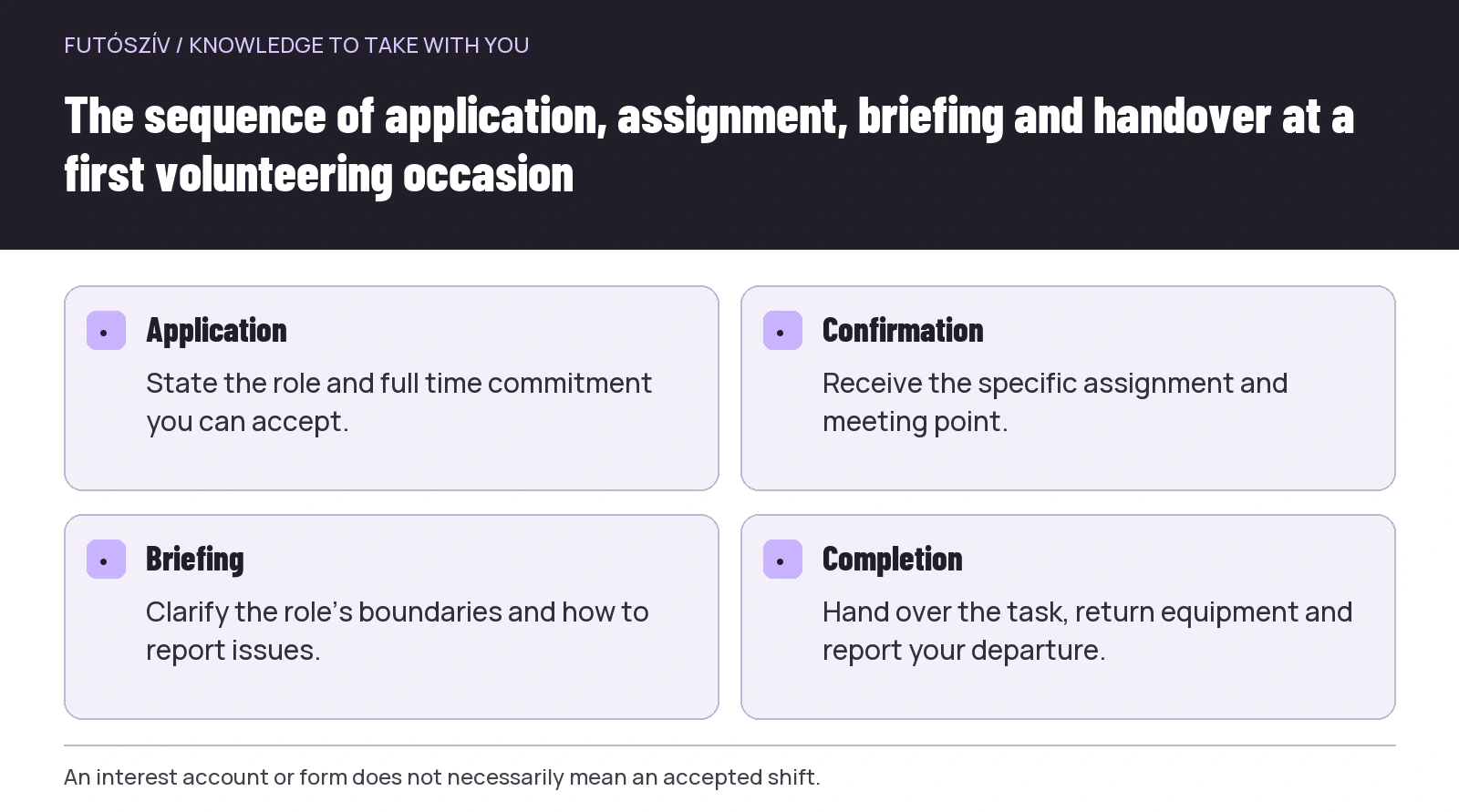
Text version of the illustration
- Application
- State the role and full time commitment you can accept.
- Confirmation
- Receive the specific assignment and meeting point.
- Briefing
- Clarify the role’s boundaries and how to report issues.
- Completion
- Hand over the task, return equipment and report your departure.
What is the full time commitment?
The race start and finish-area closure do not necessarily match the start and end of a volunteer shift. Preparation, briefing, handover and dismantling may belong to the role too. Ask for a precise meeting time and expected finish. If the finish time is uncertain, also find out the limits within which it may change and who will notify you.
A fictional example: the race starts at ten, but you need to be there at eight to prepare the station. If you planned only around the start time, you miss a substantial part of the work. The opposite misunderstanding can occur too: after the first runners arrive at noon, the station may continue operating for a long time. Do not infer the end of your shift from the arrival of your own acquaintance.
| Question about timing | Why is it needed? |
|---|---|
| When and where do I check in? | You need to arrive in time to take over the on-site task. |
| When is the briefing? | You need the information before starting the task. |
| What is the full shift I am committing to? | You plan your journey home and other commitments around it. |
| How do breaks and relief work? | The post must not be left uncovered without arrangements. |
| Who releases me at the end of the task? | Your departure should be a clear conclusion known to the team too. |
If there is a time after which you cannot stay, say so when applying. That is useful scheduling information. A limit announced at the last minute on site is much harder to handle. Equally, do not promise unlimited availability simply because you want to make a good impression on your first occasion.
Whom do you ask when you do not know the answer?
Your own team leader’s name, contact details and the method of contacting them are essential information. Ask who should be notified in which situations and whether there is a backup contact if the first is unavailable. Do not try to reconstruct the event’s management arrangements from another volunteer’s memory. Use the current guidance provided by the organiser.
Runners may ask many different questions, and you do not have to answer every one. ‘I will check that with the person responsible’ is better than a confident guess. When passing on information, say who is asking, where you are and exactly what is unclear. An incomplete message can lead to further exchanges while the participant keeps waiting.
Separately clarify how to report urgent or safety-related situations. The organiser should provide a briefing appropriate to your particular role. This article does not replace it or teach healthcare or traffic direction. Part of your preparation is recognising which question needs passing to the right person immediately.
What do you need to learn at the briefing?
You do not need to remember every detail of the whole event. Be clear about the location, timing, equipment, participant flow and reporting arrangements relevant to your own task. If several races operate simultaneously, ask which information applies to whom. An older map or one for another distance can easily cause confusion.
It helps to repeat the essential task back: ‘So at this point I give this information, and if anything changes I contact this person.’ This is not an exam, but a check that you understood the same thing. If something differs from what you applied for, mention it before starting. You do not have to silently accept a role change without understanding the new task.
Ask about updates during the day too. Where will you see a changed assignment, location or item of participant information? Which document is the latest version? Do not keep two contradictory sets of personal notes without marking the source of either. An accurate source matters for quick information on site too.
Under what conditions will you work?
Spending several hours outdoors requires different arrangements from working at a covered race-pack table. Ask whether shelter, seating, a toilet and designated storage for personal belongings are available. Do not assume every role offers the same facilities. Plan clothing and your daily needs from the information provided.
A T-shirt or vest supplied by the organiser is not necessarily a complete weather-appropriate outfit. Clarify what you receive on site and what you must bring. Have an arrangement for your valuables too; an operating refreshment table or open tent is not automatically secure luggage storage. Take only the personal belongings you need into the working area.
Discuss accessibility or individual participation needs beforehand through an appropriate channel. You need not disclose personal details in front of the whole team. The organiser needs to know which conditions will allow you to carry out your agreed task. If the role is unsuitable, another task can be discussed, but is not automatically guaranteed.
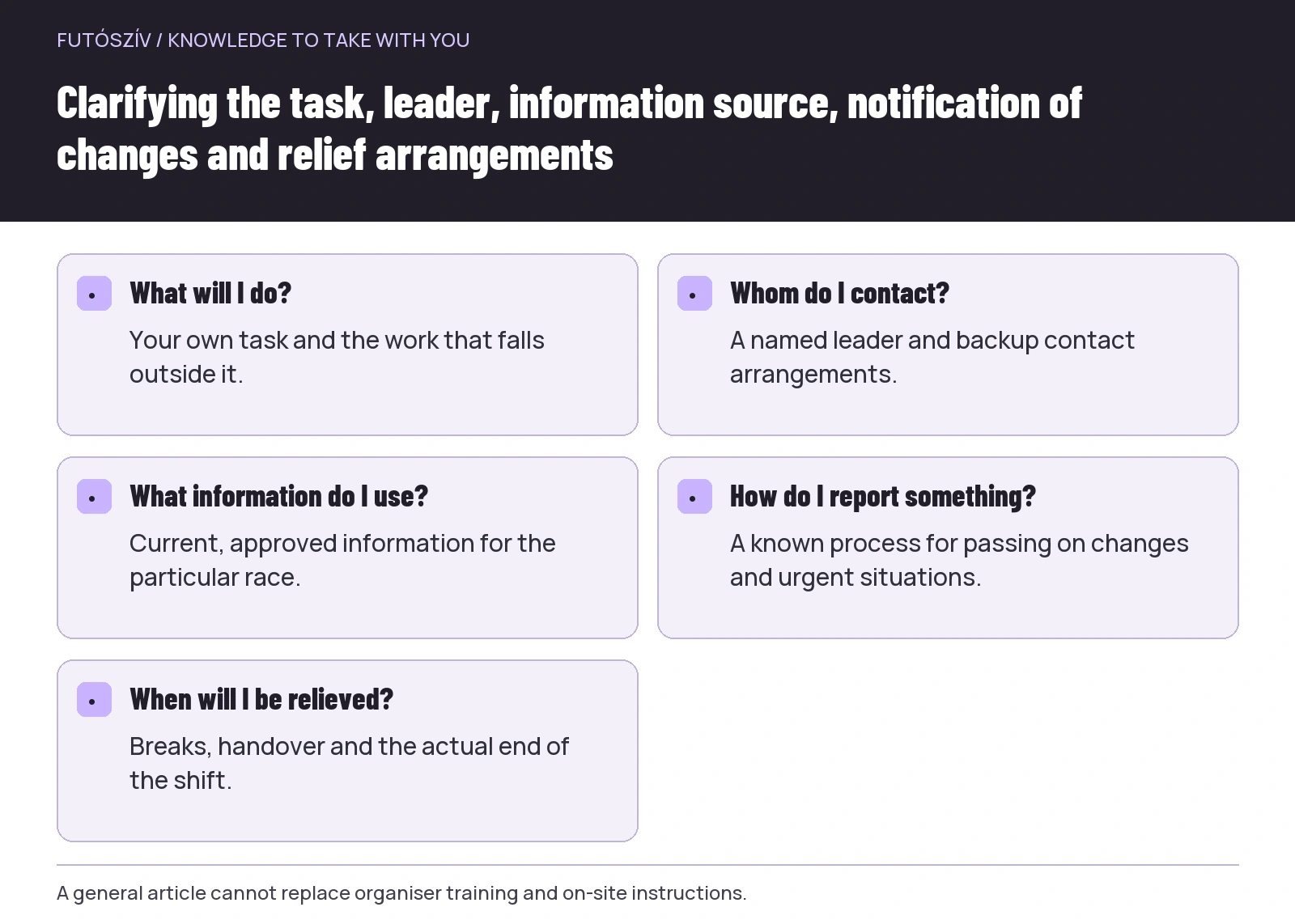 Enlarge diagram
Text version of the illustration
- What will I do?
- Your own task and the work that falls outside it.
- Whom do I contact?
- A named leader and backup contact arrangements.
- What information do I use?
- Current, approved information for the particular race.
- How do I report something?
- A known process for passing on changes and urgent situations.
- When will I be relieved?
- Breaks, handover and the actual end of the shift.
What does the organiser provide, and what remains your responsibility?
Meals, travel, clothing or any recognition can differ between events. Do not infer your own conditions from an account of another race. Ask for clear information about what to expect and, if a cost can be covered, how that is arranged. For financial and legal details, understand the specific agreement.
The official GetPRO Bath Half volunteer page, for example, lists food and parking options for its own event and mentions a separate recognition system. This shows how such conditions are tied to an event. They are not general volunteer benefits, and the overseas example does not establish any entitlement in Hungary. London Marathon Events: Bath Half volunteering
If you would like participation certified for school or professional purposes, clarify this with both the organiser and the institution concerned before applying. Do not infer from a general sentence on a website that every condition for your particular administrative process has been met. The form of certification, acceptable role and necessary documents may be separate questions.
Have a real plan for getting there and home
For an early check-in, the same transport service or entrance used by spectators may not be available. Ask for access information for volunteers and check your own journey. Event closures, accreditation or a distant post can mean that apparent proximity on a map does not translate into easy access. Do not try to enter an open event area by an assumed route.
The journey home matters too, particularly after a long shift or a late finish. If the organiser promises a shuttle, find out its actual arrangements and meeting point. If none is provided, have your own workable way home. Other volunteers’ well-meant help is a possibility, not a service booked in advance.
If you are late or cannot set off, report this promptly through the specified channel. The organiser needs to know whether the post will remain vacant and when to expect more information. You need not send a long story, but explain the essential change accurately. Disappearing creates more organisational uncertainty than an early, clear message.
A fictional check of a first shift
Suppose a runner applies to help at a refreshment station. The confirmation names the station and shift, but does not clearly explain where to meet the team. Instead of searching on race morning, the runner asks beforehand for the precise entrance and leader’s name. The reply explains that the team will travel to the station together, so the runner plans their arrival accordingly.
At the briefing, the volunteer learns which table they will work at, what information they can give participants and whom to notify about a change in supplies or another condition. They specifically ask about relief because they will need a short break halfway through the shift. At the end of the day, they report completion to the leader, return the equipment provided and only then leave.
In this story, the inexperienced volunteer did not solve everything alone. They accepted a well-defined role, asked for missing information and worked within the arrangements provided. This is a much more useful form of reliability than accepting every task without questions and then trying to work out the conditions on site.
Have questions about the end of the day too
Find out how tasks are handed over, equipment returned and brief feedback given. Is there an experience that needs reporting while still on site, and what can wait for a later summary? Pass important events to the appropriate person responsible, rather than merely telling a group of friends. Alongside the community experience, completing the role is part of the commitment.
After your first occasion, you can allow yourself to choose another role next time. Perhaps you enjoyed communicating with participants, but the long outdoor shift fitted your circumstances less well. This is not rejecting volunteering; it is experience of your own participation. You will already be able to ask more precise questions when you next apply.
A good first day of volunteering does not necessarily consist of dramatic stories. Often it means being there on time, understanding your task, feeling able to clarify things and notifying the right person when needed. That requires well-asked questions beforehand and clear on-site arrangements, rather than a ready answer to everything.
How Futószív articles are prepared: our editorial guidelines.