
When a freely chosen programme becomes compulsory
You love running yet increasingly feel you no longer decide about it. If a session might be missed, you arrange the entire day around catching up. At a family activity, your attention goes to when you can still leave rather than the company. One account cannot establish a diagnosis, but the situation deserves attention.
The useful question about exercise experienced as compulsive is not who runs too much in the club. Personal freedom to decide, health consequences and everyday impact provide better starting points. This article helps articulate difficulties and questions for seeking help. It provides no independent treatment or exercise-reduction protocol.
Weekly kilometres alone do not describe the relationship
Two people may run identical amounts in very different situations. One can change plans when ill or facing another important task; another experiences this only with strong guilt, secrecy or further catch-up. A simple ranking does not reveal the difference. Professional discussion therefore needs the story of decisions alongside numbers.
Mind highlights loss of control and negative effects on life or health when describing problematic relationships with exercise. Possible signs include continuing injured, strong distress about rest and concealed movement. These are not diagnostic boxes in an online test but experiences worth seeking help for.
Do not wait for an externally obvious condition
A problem can be substantial while others do not notice. What looks like consistency or motivation from outside may feel compulsory inside. You need not wait for worsening performance or someone declaring training officially excessive. Personal experience matters even when results show a successful period.
Difficulties associated with eating or body concerns can be described too. NIMH emphasises that eating disorders can affect different body shapes and genders, and appearance cannot establish severity. You need not match an imagined picture to seek appropriate healthcare help.
Observe the decision point, not only completed training
Recall a particular occasion: you intended to rest but went out anyway. What happened between the decisions? Which thought appeared, whose reaction concerned you and what were you trying to avoid? The aim is not self-blame. Detailed circumstances help a professional see more than kilometres totalled afterwards.
A few sentences can suffice. You might record feeling obliged to catch up after a club-challenge notification, or dinner seeming permissible only after movement. These are sensitive personal details. They need not be shared in a public running diary, and gathering them should not become another constant monitoring task.
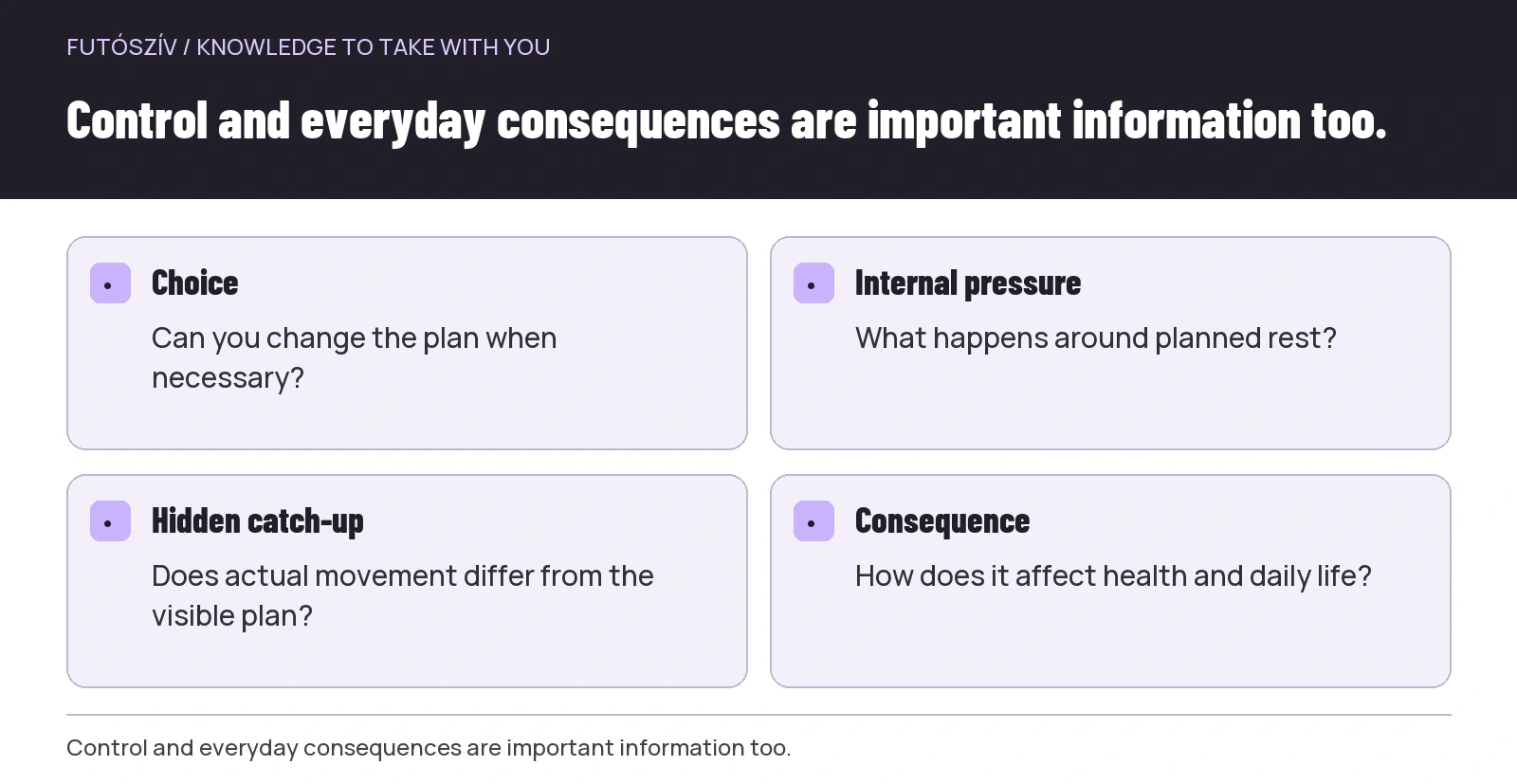 Enlarge diagram
Text version of the diagram
- Choice
- Can you change the plan when necessary?
- Internal pressure
- What happens around planned rest?
- Hidden catch-up
- Does actual movement differ from the visible plan?
- Consequence
- How does it affect health and daily life?
Following a training plan cannot override everything else
A plan can help, but actual condition and health decisions matter more than mechanically completing rows. Medical or rehabilitation adjustments are not shortfalls to secretly replace another way. If following such restrictions feels impossible, explain this separately to the treating professional.
Do not try resolving the question merely by inserting equal amounts of another activity instead of running. Changing sport does not necessarily change internal compulsion. Appropriate solutions depend on personal health circumstances and assessment. A general article cannot determine safe activity quantities or necessary temporary boundaries for you.
Hidden catch-up belongs in the account too
The programme visible to a coach may differ from actual movement. Extra short loops, concealed sessions or activity compulsively fitted into the day may remain outside the plan. Professional help does not require making these look better. The real picture supports safety and appropriate assistance rather than another performance assessment.
If speaking is difficult, write beforehand what you want to say. Begin with fear of reactions or losing community connection if relevant. Clarify with a treating professional how a coach should connect to the plan. Sporting-environment support may matter without sharing every personal detail with everyone.
Do not treat eating as a reward to earn
If permission to eat depends on distance or you regularly compensate for food through movement, report this to a professional. NIMH discusses eating-disorder care through medical, mental healthcare and nutritional support. Online calorie calculations or a clubmate’s diet cannot assess personal risk.
You need not prove figures or race weight-loss goals in discussion. Describe rules attached to eating, what creates guilt and how much these thoughts occupy the day. This article deliberately gives no compensatory quantities or body-weight targets. Help rests on understanding difficulty and safe individual care.
The running community’s language can change too
Club comments mocking rest or celebrating training through illness can seem normal. Organisers can choose different communication: adjustments should be discussable, health questions receive appropriate professional attention and community participation need not be justified solely by kilometres. Specific rules can express this.
For example, weekly reports need not demand explanations for every absence, and club challenges can permit withdrawal without consequences. Good organisation does not treat every personal problem but can reduce additional pressure. The IOC 2026 mental-health statement also emphasises shared responsibility for supportive sports environments and help access in elite sport.
How can you begin a conversation when worried about someone?
Start with specific observation and your concern: I see you trying to make up every session despite pain and want to ask how you are. Avoid public labels and jokes. You need not persuade someone to accept your chosen term. The aim is a safer conversation, not winning an argument.
Ask which support they would welcome in reaching professional help. They may want company finding an appointment or preparing for a discussion. Do not become a secret monitor or promise confidentiality that would prevent seeking help in immediate danger. Friendship presence and clinical care are separate tasks.
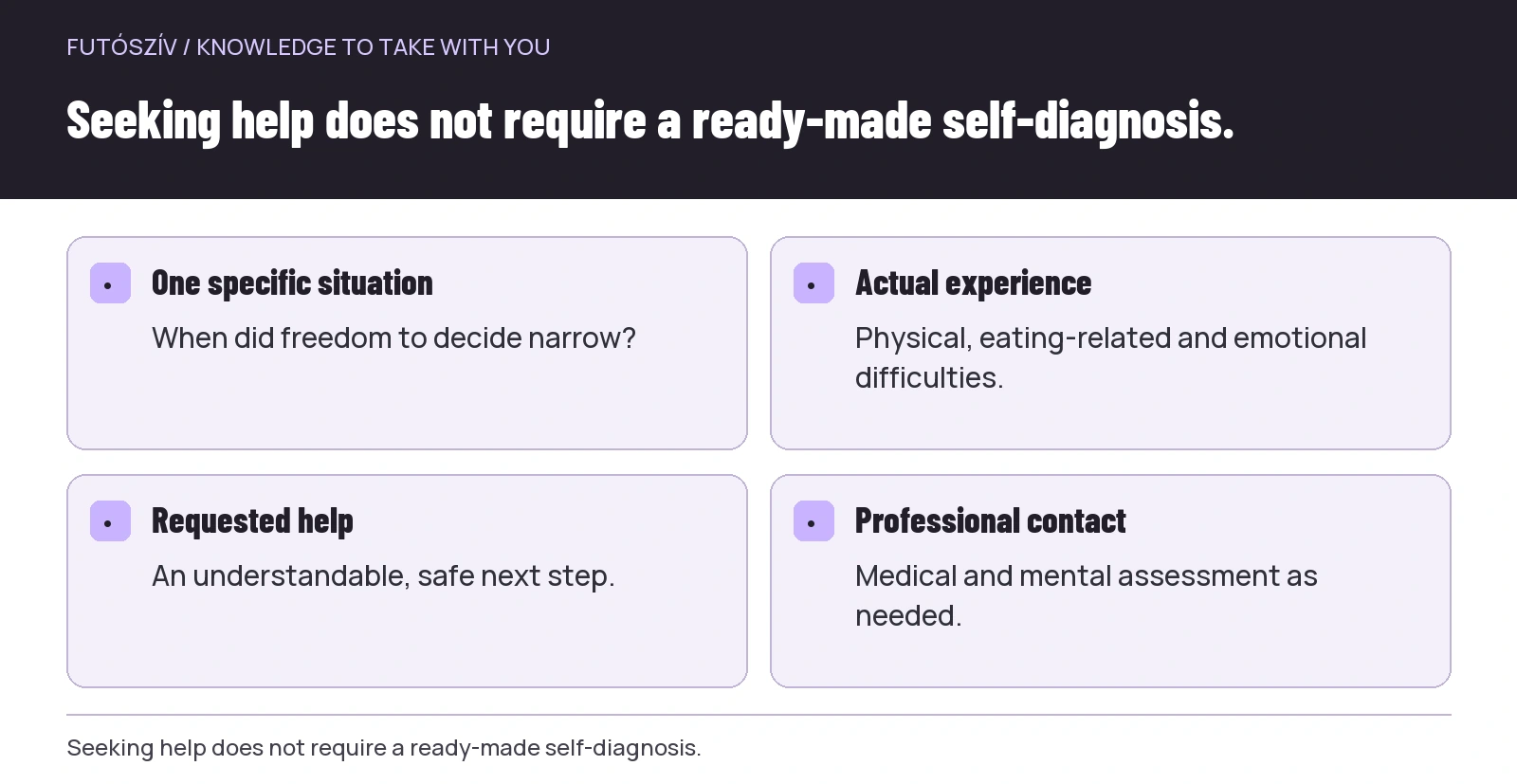 Enlarge diagram
Text version of the diagram
- One specific situation
- When did freedom to decide narrow?
- Actual experience
- Physical, eating-related and emotional difficulties.
- Requested help
- An understandable, safe next step.
- Professional contact
- Medical and mental assessment as needed.
Four pieces of information for professional discussion
First summarise why choice over exercise feels restricted. Second describe a specific occasion when planned rest proved impossible. Third explain accompanying physical symptoms, eating difficulties or daily conflicts. Finally state requested help, such as a safe next step and communicating with a coach.
The summary is not an examination paper. You can become stuck, ask questions and say something is difficult to discuss. Every earlier session need not be gathered as proof. A professional asks further questions and assesses health where needed. Understanding actual functioning matters more than handing over a perfectly organised sports database.
You need not resolve it alone before seeking help
If activity feels uncontrollable or the thought of rest causes strong anxiety, consult a GP and appropriate mental healthcare professional. Injury or symptoms suggesting an eating disorder also need individual assessment. A coach can cooperate within agreed boundaries without replacing healthcare examination.
Alarming physical symptoms, fainting, chest pain, severe illness or immediate risk of harming yourself require urgent help. Arranging the next session is not the first task then. The observational ideas here offer only general orientation; they do not determine symptom severity or required treatment.
Freedom to choose is a longer-term question
The aim is not necessarily another flawless streak, this time of perfectly executed rest days. If change becomes another strict performance task, the same pressure may remain in a different form. Professional work may explore uncertainty, expectations and roles outside running. Its course can be individual and changing.
You need not decide running’s future place permanently in one evening. What matters now is making the difficulty speakable and connecting appropriate help. A good sporting relationship accommodates changes alongside a plan. Personal worth does not depend on completed training in every calendar square.
A specific distinction for the next discussion
Imagine a weekend containing family activities and running. In one version, you agree departure time and can discuss a new plan if circumstances change. In another, days of dread precede missing training, secret catch-up is planned and the family activity feels like an obstacle throughout. The external calendar is similar but internal experience may differ substantially.
This difference may matter to a professional: what happens internally when change is needed, and how well can you adapt to actual circumstances? The example is not intended for independent classification. It shows why control and everyday impact deserve discussion even when sporting results or others’ praise make everything look fine from outside.
Sources and further reading
- Mind: Over-exercising and exercise addiction
- NIMH: Eating Disorders, What You Need to Know
- IOC: 2026 consensus, shared responsibility for athlete mental health
How Futószív articles are prepared: our editorial guidelines.