
“I cannot eat in the morning” can describe several situations. Some people do not want their usual breakfast in the first minutes after waking; others have no opportunity to sit down during the rush; others have a generally reduced appetite. As a runner, it is easy to dismiss all of this in one sentence and push a meal squeezed between training and work later each day. It is more useful first to name precisely what happens on your own mornings.
This guide offers questions and organisational ideas for adult runners. It does not diagnose the cause of appetite loss or develop dietary treatment for illness or weight loss. Discuss persistent, unexplained appetite changes or those interfering with regular eating with a doctor. Seeking help is not an admission that you organise breakfast badly: it can clarify questions a food idea alone cannot answer.
First separate time, food appeal and symptoms
The first question is whether you would have an opportunity to eat if you wanted to. If everything between waking and leaving home is a rush, the barrier may be partly practical. It is different if food holds no interest even on a relaxed weekend morning, or if you avoid it because of particular discomfort. Disliking one texture or smell while happily eating another breakfast is a separate question too. These situations should not be merged into one label.
Rephrase your own statement as an observable description. For example: “I get ready in ten minutes before leaving for work, so breakfast stays in the bag”; or “I do not want hot food immediately after waking, but I enjoy eating later.” Such clarification can already reveal a detail you can organise. “I have no appetite and have been eating less and less for weeks”, however, is a different kind of signal; do not treat it as a simple food-container problem.
Try recalling a few real mornings, rather than only the hardest one. Did an early-running day, departure for work and a day off differ? A difference does not establish a cause, but helps formulate which situation you want to understand better. Observation need not become a long diary. A short, honest description is often more accurate than retrospectively describing every morning with one general feeling.
What has changed from your earlier routine?
Consider whether this is new or your days have started similarly for a long time. Has your wake-up time, shift, journey or training schedule changed? Do you shop differently, has a previously familiar breakfast disappeared, or is there no longer a suitable opportunity to eat at work? Do not confuse changed access with certainty that your body needs less food. They are not the same information.
It is also worth telling a professional about a new medicine, significant stress, illness or another health change. According to the official Healthdirect health information , appetite changes can have many causes, and adequate nutrition is still needed when appetite is absent. This article therefore does not identify one definite cause in your situation. Do not stop your medicine or change its dose on the basis of a breakfast observation either; discuss such questions with your treating professional.
You can record changes in running load on a separate line. More movement, or a different kind, may also affect meal organisation, but an association between your training diary and appetite is not itself a diagnosis. The aim is to explain accurately at a consultation what changed and when. The professional then hears more than “I run and do not have breakfast”: your actual schedule and difficulty become visible.
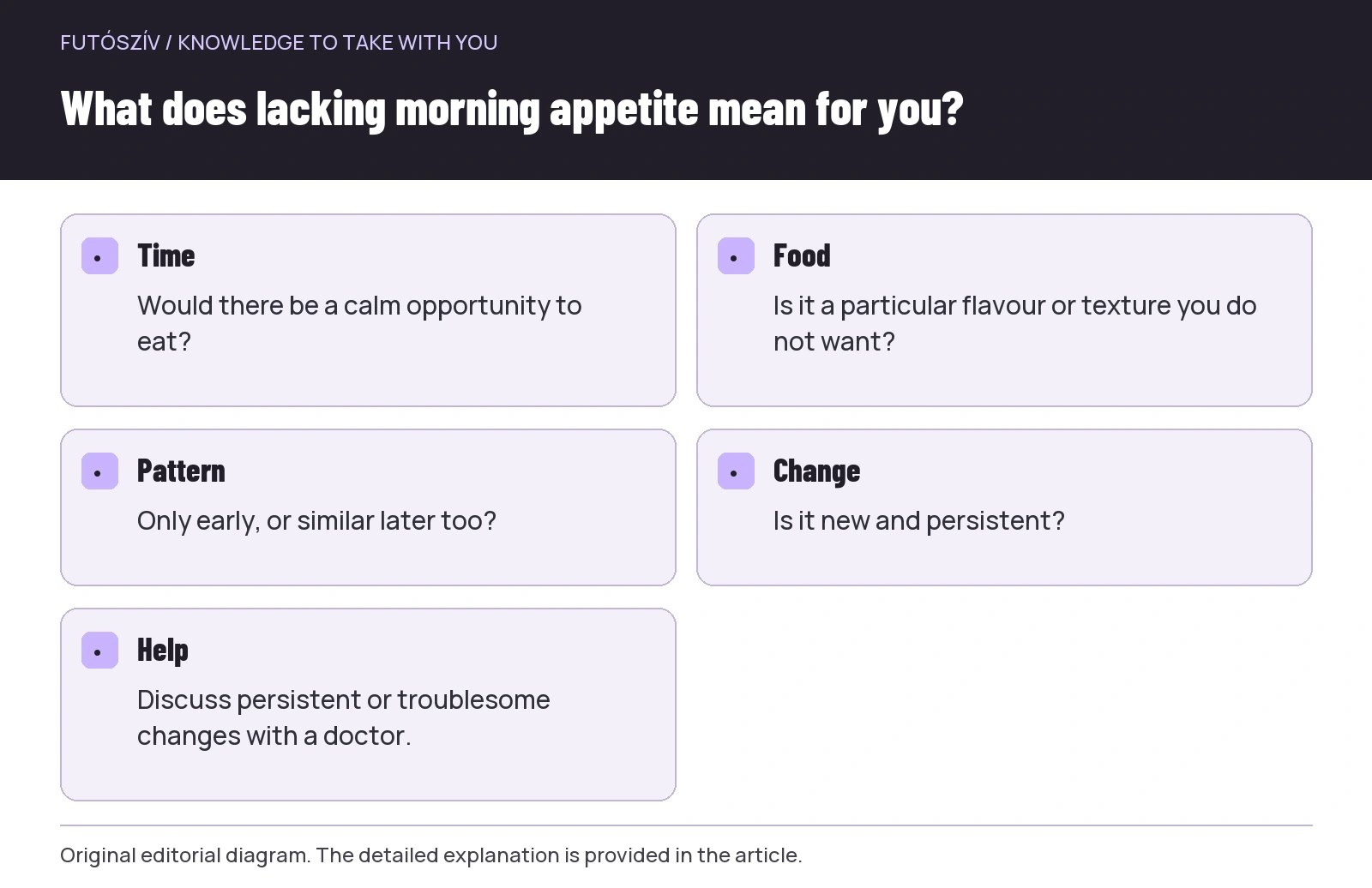 Enlarge diagram
Text version of the diagram
- Time
- Would there be a calm opportunity to eat?
- Food
- Is it a particular flavour or texture you do not want?
- Pattern
- Only early, or similar later too?
- Change
- Is it new and persistent?
- Help
- Discuss persistent or troublesome changes with a doctor.
If lack of time is the main barrier, simplify the process
Prepare in the evening whatever can safely be prepared while retaining a good texture. Setting out a clean bowl, utensils, ingredients not needing refrigeration or a breakfast card also reduces morning decisions. Store food requiring refrigeration appropriately and transport it with cooling suited to the journey. Speed is no reason to skip storage instructions. First identify one bottleneck in your own kitchen.
If breakfast does not fit at home, check whether there is a genuine opportunity later. “I will eat at work” is a plan only if there really is time, an appropriate place and, when needed, a fridge. Prepare a combination you can comfortably eat under those conditions. Do not leave the first meal of the day to a meeting break that regularly fails to happen. Solving access is a specific organisational task.
The complexity of the food may need simplifying. Instead of a bowl with many ingredients that must all be freshly prepared each morning, try an option with a few familiar components. Variety need not mean using the maximum possible number of ingredients at every breakfast. Choosing between two or three suitable, easy-to-use versions is often a smaller task. Continue to adapt eating across the whole day to your individual needs.
If a particular food does not appeal, identify the sensory aspect
It matters whether sweet flavour, excessive heat, dry bread or a large amount of preparation work puts you off. A precise obstacle allows a more targeted idea. For example, if you dislike sweetness at breakfast, a savoury combination using ingredients that fit your diet may be an option. If porridge seems too thick, you can explore preparation method and serving texture. These are kitchen choices, rather than proof of an underlying health cause.
You can add a different suitable topping to familiar bread or serve separately the parts normally mixed in a bowl. Fruit beside yogurt, separately packed cereal or a savoury accompaniment to bread may create a different experience. Check allergens in every version. Do not assume a plant-based or lactose-free alternative is equivalent in every respect to the product replaced. Base the choice on the actual composition and your own prescribed diet.
If you want to try a liquid or softer breakfast, plan that as a complete eating situation as well. What is it made from, where will you store it, when will you consume it and what role does it have in your day? The name “smoothie” does not automatically answer questions about nutrients or the right quantity. A preferred texture can support comfort, but with persistent eating difficulties, chewing or swallowing symptoms, appropriate professional help matters more than a general recipe.
With an early run, put later meals on the page too
When coordinating morning training and breakfast, consider more than the minutes before departure. What happens after the run? Will you stay at home, travel immediately or change at work? A missed meal may actually continue through an organisational gap after running. Mapping the whole morning reveals when the next meal is genuinely accessible.
The NSW Institute of Sport guide to training during meal times emphasises planning ahead and individual circumstances. In your own routine, this may mean eating at a different time or rearranging an appropriately structured schedule. It does not mean everyone needs the same number of meals or the same timing. A sports dietitian can help develop an option suited to your personal load.
Do not treat companions’ habits as a compulsory standard. Someone saying they never eat in the morning does not tell you their overall diet, load or health. Equally, a picture of a large, impressive breakfast is not a personal prescription for you. The goal is your own adequate nutrition and workable routine. A community example can offer a starting idea, but cannot decide instead of your individual needs.
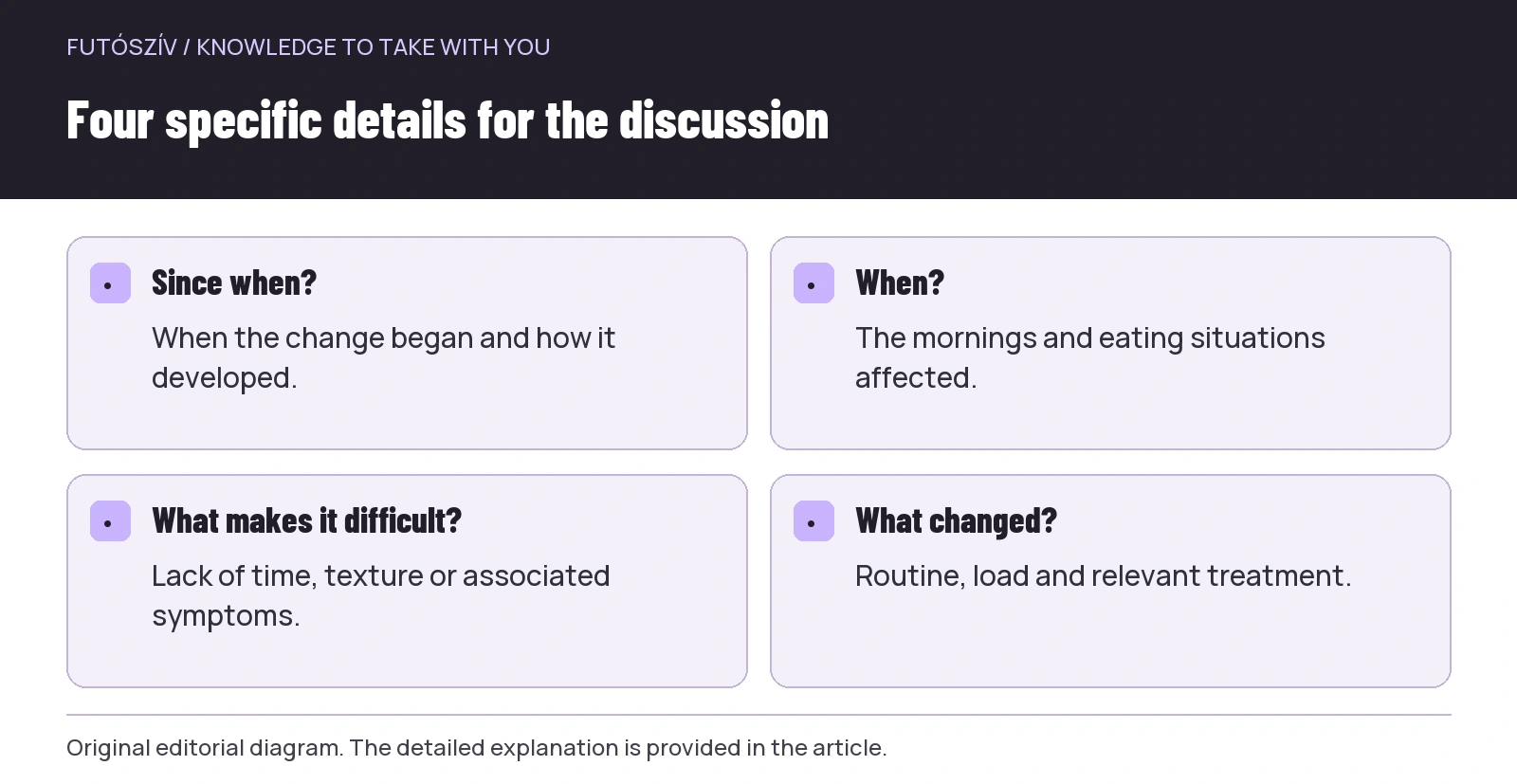 Enlarge diagram
Text version of the diagram
- Since when?
- When the change began and how it developed.
- When?
- The mornings and eating situations affected.
- What makes it difficult?
- Lack of time, texture or associated symptoms.
- What changed?
- Routine, load and relevant treatment.
A short observation sheet about breakfast
| Question | Useful note | Quick conclusion to avoid |
|---|---|---|
| When does it occur? | After waking or throughout the morning | Every morning must have exactly the same cause |
| Is there an opportunity to eat? | Place, time and available food | Lack of time proves low requirements |
| What does not appeal? | A specific flavour, texture or food | An entire food group is at fault |
| What changed? | Routine, load, medicine or how you feel | An association is already a definite diagnosis |
| What helped? | A feasible, precise adjustment | One occasion guarantees success in every situation |
Keep the length of the notes manageable. A date, a short description of the morning situation, the food eaten and an important circumstance are often enough to ask a more specific question. You do not need to count calories or constantly score every bodily signal. If keeping a diary itself causes tension, describe the main difficulty in words instead and discuss it with a professional. Collecting data is a tool, rather than a performance goal in its own right.
When is a medical discussion important?
An unexplained or non-improving reduction in appetite, a situation making regular eating difficult and weakness are reasons worth taking to a doctor. The NHS information on unintentional weight loss highlights the importance of investigating unintended weight loss, particularly with other symptoms. Do not automatically derive a reassuring explanation from running. Healthcare assessment determines which further steps are needed.
Prepare a short opening statement for the consultation: how long the change has existed, when it occurs and how it affects eating or daily function. Mention any weight change you have noticed and other symptoms as well. A new medicine or changed treatment is important information too. You do not have to select a possible illness in advance. An accurate history helps more than the name of an online diagnosis you believe is certain.
You need not hide fear associated with eating, strong anxiety about gaining weight or a compulsion to compensate behind a running plan either. These are problems that can be discussed and for which professional support is available. Breakfast-planning ideas are useful when they do not conceal difficulties needing another kind of help. Sporting performance is no reason to interpret persistently inadequate eating as discipline others should follow.
How can you formulate a good question for a dietitian?
Rather than asking only for a breakfast recipe, show your actual day. When do you wake, run and work, where is a fridge, and which foods can you genuinely manage? Add the flavours or textures you like and what regularly gets missed. A dietitian can then look for an appropriate connection between personal needs and feasibility. A general article can do less: it helps refine the question and recognise organisational obstacles.
A useful question might be: “I have no time to eat during the first part of work after an early run; how can we restructure the day around my needs?” Another is: “This texture does not appeal when I wake; what suitable alternative and timing could we try?” Professionals also need to know about any accompanying health symptoms. The aim of breakfast is not a theoretically perfect bowl eaten at all costs. You are seeking a routine that supports your day appropriately and whose difficulties you can discuss in good time.
Sources and further reading
- Healthdirect: Changes to your appetite
- NHS: Unintentional weight loss
- NSW Institute of Sport: Training during meal times
How Futószív articles are prepared: our editorial guidelines.