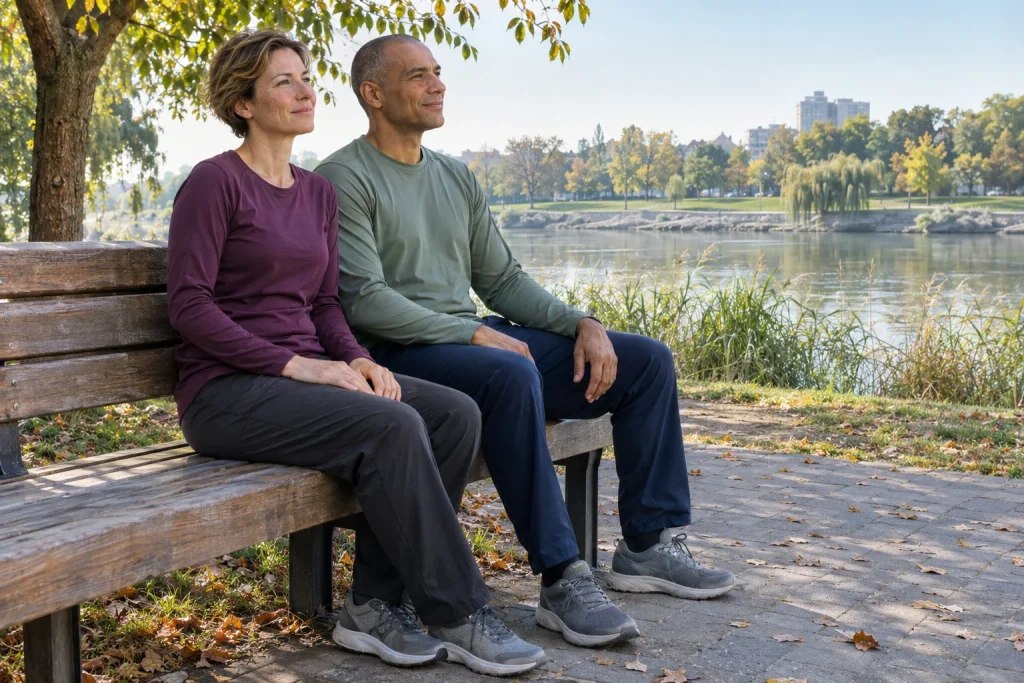
You do not leap into the air at the end of the run, feel invincible or experience a special moment you would later call runner’s high. Yet sitting on the bench feels good now. Everything feels less urgent, the quiet is pleasant and you are content to have come out. This experience can easily disappear beside dramatic runner’s high stories. Calm, feeling uplifted, energy and tiredness nevertheless deserve separate words. One useful question in running psychology is precisely which different feelings we gather into “that felt good”.
Feeling pleasant and being energised are different
Imagine two post-run scenes. In one, you talk animatedly, words come quickly and you would happily stay with the group. In the other, walking home quietly feels good and nothing special seems missing. Both can be pleasant, yet their activation levels differ. Describing an emotional state therefore benefits from two questions: how pleasant or unpleasant is it, and how lively or activated? Pleasantness does not belong exclusively to high energy. Quiet contentment fits here too.
This distinction also appears in research tools. The Physical Activity Affect Scale developed by Lox and colleagues treats positive and negative affect, fatigue and tranquillity as separate components. You need not learn questionnaire scoring to understand the idea. One general mood question does not always reveal which kind of change occurred. Someone can be pleasantly calm without feeling strongly uplifted, and tiredness alone does not reveal whether the whole experience was good or bad.
These questions are not a personality test. They do not divide runners permanently into calm and energetic types. They describe a particular moment more precisely. The start and end of your own run may occupy different places in this conceptual space. Coming home more quietly today does not mean the activity went less well than when you were more talkative afterwards. A richer vocabulary of feelings helps you avoid measuring change against one expected reaction.
Relief can be a separate story
Enjoying what you experienced during an activity differs from relief that something has ended. Both can coexist without being described by one word. For your own example, imagine a programme you were unsure would feel manageable beforehand. Afterwards, your strongest feeling may be that the question is no longer ahead of you. This personal experience is as real as energetic pleasure. It simply says something different about the story.
A 2023 human study separated feelings after brief treadmill exercise into components in physically active and less active people. Although both groups reported a more pleasant state after finishing, in the more active group this was more closely associated with increased positive activated feelings, and in the less active group with decreased negative feelings. Relief also differed between groups. This is a result from a defined research situation, not a classification of everyone. It nevertheless shows that different changes can lie behind “I feel better”.
For your own outings, therefore, ask separately whether moving felt pleasant during the activity or whether you mainly breathed a sigh of relief after completing it. There is no compulsory correct answer. Calling relief alone pleasure can lose what the run itself felt like. Conversely, treating relief as insufficient devalues a real experience. Separating them can help you discuss the next outing more precisely with a coach or companions: what would you like again, and which part was difficult?
 Enlarge image
Runner’s high research measures separate feelings too
Siebers and colleagues’ 2021 human study treated euphoria and reduced anxiety as two important aspects of running pleasure. After the 63 participants’ treadmill runs, both changed relative to walking, and opioid blockade did not prevent this. The methodological point to retain here is that the researchers did not measure one all-encompassing “quantity of happiness”. They asked separately about pleasantly elevated feeling and anxiety. These can connect without being conceptually identical.
Euphoria names an intensely pleasant, elevated state; feeling less tense or calmer is not necessarily equally lively. Research terms therefore should not be freely interchanged. A paper reporting reduced anxiety does not automatically mean every participant experienced exceptional bliss. Similarly, an increase in general pleasantness does not prove the disappearance of every possible negative feeling. Precise naming retains what the study actually asked.
This helps everyday conversation too. Alongside “it felt really good”, say why: thoughts felt lighter, you became livelier, company was enjoyable or your inner pace grew quieter. You do not need a biochemical label for each. Understanding a running experience includes your own wording. A research questionnaire collects comparable data, while your statement can describe that day’s personal meaning.
Why examine calm and activation together?
Niedermeier and colleagues compared three-hour mountain hiking, indoor treadmill walking and a seated control in 42 healthy people, using a random-order crossover study. They used several tools addressing pleasant–unpleasant state, activation and separate mood components. Following the outdoor hike, both tranquillity and elation changed favourably relative to control. This is hiking research, not a promise for every run. Its conceptual lesson is that an activity can accompany several kinds of emotional change worth asking about separately.
Activation is not good or bad in itself either. You may experience pre-start liveliness as anticipation, while using the same everyday word “revved up” for a less pleasant state elsewhere. Precise words help distinguish the two: pleasantly energetic or tense? Calmly content or lacking energy? These examples are not diagnostic categories but options for describing different moments. They aim to prevent every state receiving the same label in conversation.
When sharing an experience with a running companion, you need not seek identical reactions. One of you may want to talk afterwards while the other would sit quietly for a few minutes. This difference alone does not reveal who enjoyed the shared outing more. A simple question can be more precise: “What would suit you now: talking, walking home or staying quiet?” A shared sporting experience does not require arriving with the same expression and energy.
Question wording also influences what we discuss
“The run lifted your spirits, didn’t it?” and “How do you feel now?” are different questions. The first already points towards an expected answer; the second leaves room for several descriptions. A 2025 experiment specifically examined how affective self-ratings during acute exercise depend on positive, negative or neutral question wording. The research directed attention to measurement language. Its everyday lesson is not a secret questioning technique, but that our wording can clarify or narrow a conversation.
It is easy to recall your own experience to fit an expected story too. If you start by seeking when euphoria arrived, becoming calmer or simply enjoying the route may fade into the background. It can help first to describe a few specific impressions freely, then name the overall picture. For example: “The cool air felt good; I did not hurry; by the end I wanted to sit down.” This is not a standardised questionnaire, but a personal description preserving more detail than a label chosen beforehand.
A neutral conversation may also reduce social pressure in the situation without our promising a guaranteed psychological effect. If someone experienced no special pleasure, they should not have to manufacture a successful running-pleasure story as well. They can say it was an ordinary day or that some things felt good and others did not. Sharing an experience is not a contest for the strongest feeling. Research’s different components make this same variety clearer in scientific language.
A simple personal vocabulary for the post-run moment
A few separate headings can help describe experience, but you need not manufacture scores. One can cover the pleasant part: what felt good? Another can describe energy in everyday terms: lively, quiet, tired or something else? A third can cover the situation: were you alone, talking or exploring a new route? Even apparently contradictory pairs such as “content and tired” can remain. You need not close everything with one positive or negative verdict.
| Descriptive statement | Which detail does it preserve? | What does it not establish? |
|---|---|---|
| “I feel calmer sitting here now.” | A quieter, less tense experience. | It does not prove one molecular mechanism. |
| “I feel uplifted and want to talk about it.” | A pleasant, activated state. | It does not mean every run must feel like this. |
| “I am pleased about it, and I am tired.” | Two separate components present together. | It is not a clinical assessment or clearance for exertion. |
A few lines like these need not become compulsory after every run. If you use them, let them help understand the outing rather than create another performance goal. Your description is not a medical or psychological diagnosis, and does not replace professional assessment when you seek help with symptoms. Within these boundaries, it answers an everyday question: how did I experience this activity? That is meaningful in itself without requiring a clinical interpretation.
 Enlarge image
Quiet well-being need not be spectacular
Shared stories easily give centre stage to a memorable peak: a major goal, an exceptional distance or an almost unbelievable sense of freedom. Your own run can still be valuable for a less conspicuous change: enjoying trees on the way home, not rushing yourself or talking calmly. You can name these as personal values without asserting an effect on everyone. A quieter experience is not a failed version of greater pleasure.
The phrase running pleasure is most useful when it does not conceal differences between feelings. It may contain energy, calm, relief and contentment; at other times, none is especially strong. Research’s different questions and measurements help us understand this variety. After your next run, you need not check whether your experience matched a dramatic description. You can say exactly what happened: today you felt more energetic, today calmer, or it simply felt good to spend some time moving.
Sources
- Siebers and colleagues, 2021: Exercise-induced euphoria and anxiolysis
- Niedermeier and colleagues, 2017: Affective responses in mountain hiking
- Lox and colleagues, 2000: Physical Activity Affect Scale
- Unpacking differences in post-exercise affective experiences, 2023
- Zhang, 2025: Question formulations and affective responses
How Futószív articles are prepared: our editorial guidelines.