An aid-station table helps runners when they can quickly understand where to find water, other drinks or food and whom to ask. Volunteers must also track the selection, replenishment and the path of used equipment. A good layout is therefore more than lining up bowls. It separates storage, preparation, handover and collection so tasks remain distinct during busy moments.
This guide is a framework for volunteer orientation and work organisation. It is not a complete event-management, catering or food-safety policy, and does not replace the station leader’s instructions, an appropriate professional plan or regulatory requirements. The responsible organiser determines arrangements for the venue. We do not give runners personal food or fluid amounts. The zones below are an original illustrative model, not a mandatory layout for every race.
Understand the starting situation first
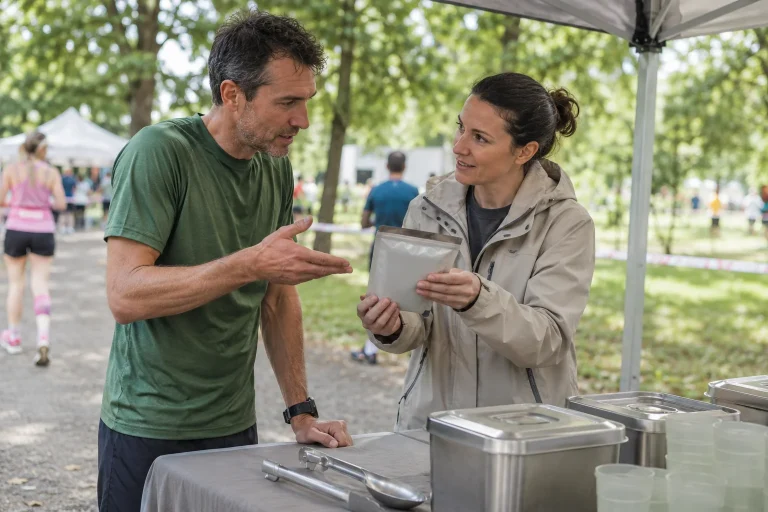
Before the station opens, know who leads it, which supplies arrived, what each item is used for and which preparation tasks a volunteer may carry out. Keep original product labels and the organiser’s recipe or instructions traceable. If contents or handling are unclear from packaging, clarify them with the station leader. A similarly coloured powder or jug does not reliably identify a drink.
The official NN Ultrabalaton team page, for example, describes serving refreshments into participants’ own cups or bottles. Another race may operate differently. Volunteers therefore need to know how their own station actually works: how runners approach, whether they use personal equipment and who performs the handover. Last year’s habits or experience at another event can suggest useful questions but cannot override current organiser procedures.
Consider runners’ movement and replenishment separately
Check where participants approach, where they can stop and how they leave. Replenishing food should not require movement through the same narrow space where runners fill bottles. If the site cannot accommodate this, smaller service units or another organiser-approved layout may be needed. Volunteers should report an actual conflict to the station leader rather than devise a new traffic plan alone.
Keep the runner’s accessible route clear and the necessary assistance area reachable. Piles of boxes, water containers or bins should not automatically consume available space. Arrange the counter’s shape, height and surroundings in accordance with the organiser’s site plan. Fluid provision is usable when a participant can access it with their own equipment, not merely when water theoretically exists on the other side of the table.
The clean preparation area should not collect returns
The prevention guide from Nébih emphasises clean hands, suitable drinking water, clean utensils and protecting prepared food from contamination. At a station, ready-to-use items therefore need a clear place separate from used or potentially contaminated ones. Returned equipment, waste and preparation should not share the same surface. Clean organisation comes from separating tasks, not arranging bowls impressively.
If your work involves waste, a dropped object or another potentially contaminated item, follow local hygiene procedures before returning to clean food. Gloves do not automatically make every subsequent action appropriate or allow unlimited switching between tasks. Necessary handwashing and equipment handling must actually be available. If the conditions are missing, report it to the station leader rather than omitting them because of a rush.
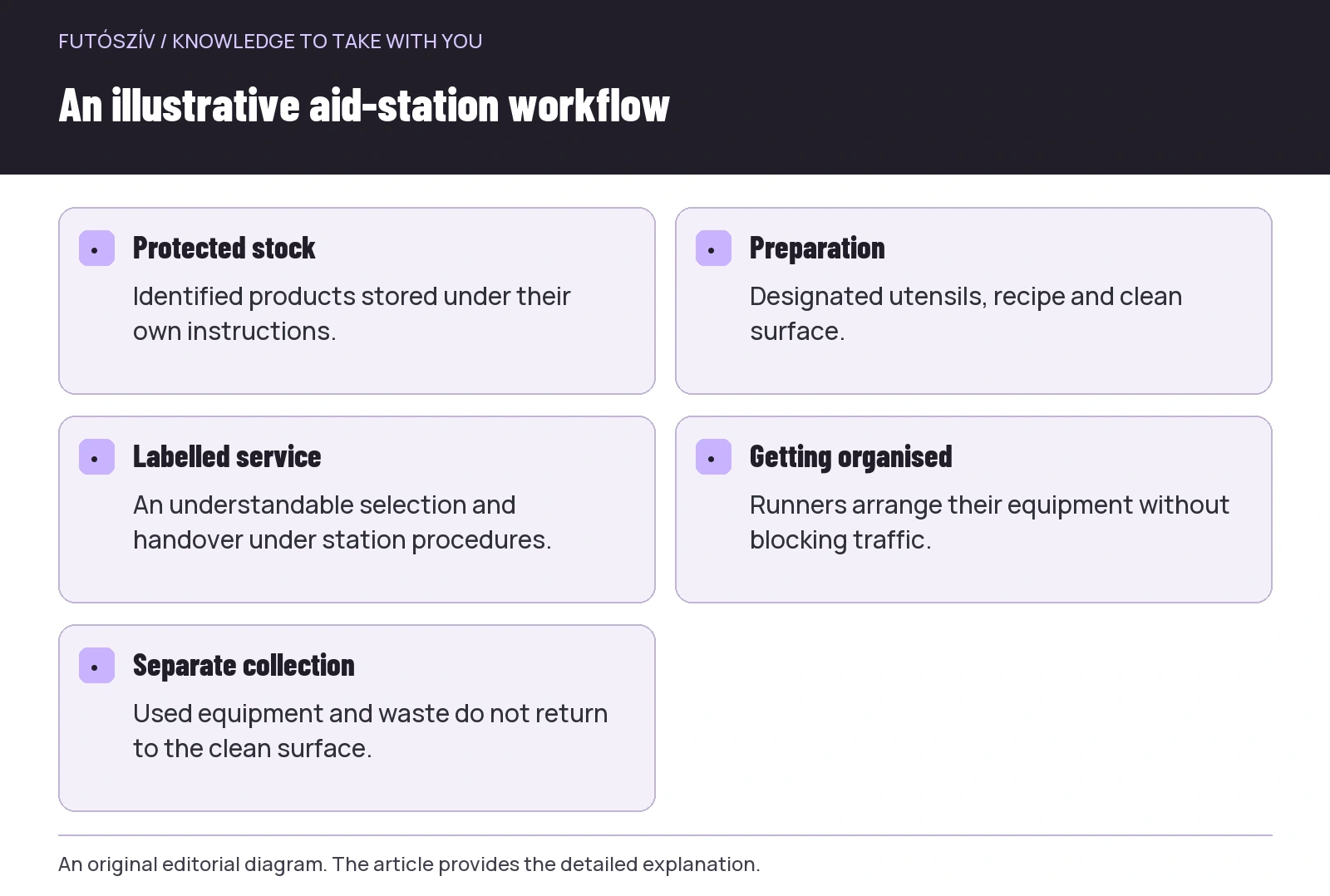 Enlarge diagram
Text version of the diagram
- Protected stock
- Identified products stored under their own instructions.
- Preparation
- Designated utensils, recipe and clean surface.
- Labelled service
- An understandable selection and handover under station procedures.
- Getting organised
- Runners arrange their equipment without blocking traffic.
- Separate collection
- Used equipment and waste do not return to the clean surface.
Label the selection and make it distinguishable
Clearly name water, other drinks and individual foods within the organiser’s system. Supplement colour coding with text. Runners should not need to infer a container’s contents from liquid colour, and volunteers should not rely only on remembering its former position. If a product moves, change the label and inform the team too. Accurate identification also supports quick service.
The Food Standards Agency’s allergen-information best practice presents written information together with supporting conversation. This is UK catering guidance, not cited here as Hungarian event rules. The practical lesson for volunteers is that accurate information should be retrievable and a named person should be able to answer using the actual product or recipe. Guesswork is not appropriate information.
Dispensing water should not contaminate shared supplies
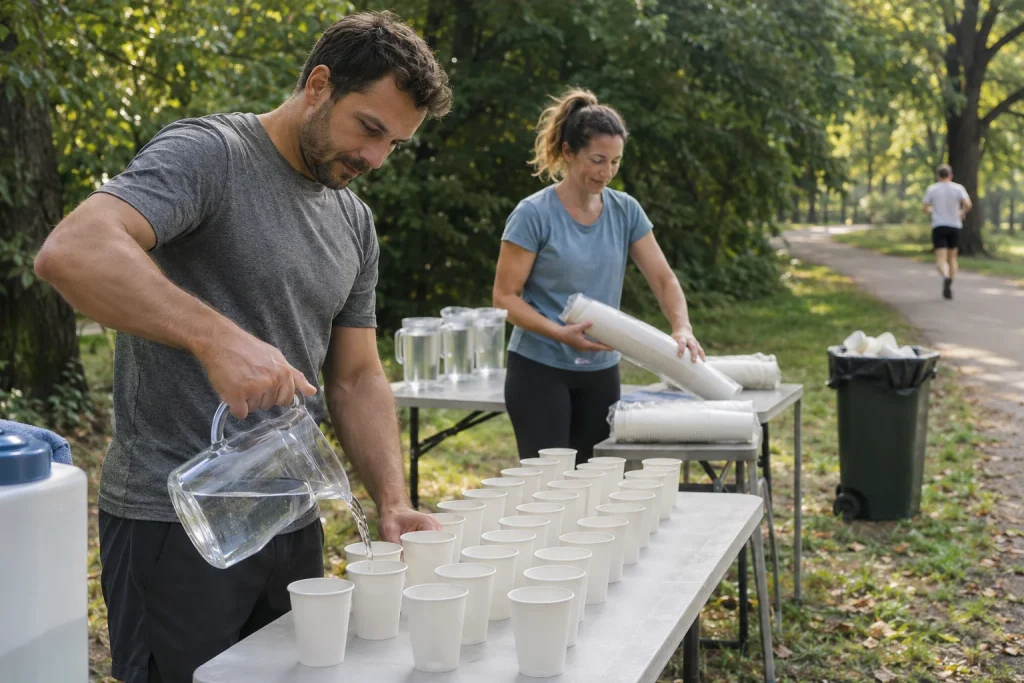
The CDC safe-water-storage information emphasises protecting suitable water from recontamination and dispensing without putting hands or objects into the container. Use the station’s specific tank and dispenser according to organiser instructions. A runner’s used cup or mouthpiece should not be dipped into shared water, and leftovers from a personal bottle should not return to the communal supply.
Allow enough space for the appropriate action when serving. If the tap and runner’s bottle can fit only by touching, or pouring a jug is hard to manage, report the issue. A solution may involve changing equipment or layout under the station leader’s direction. A fast-moving queue must not override proper use. If equipment is contaminated or faulty, remove it from use under local procedures rather than quietly passing it to the next runner.
Mixing drinks should not become an on-site recipe contest
If drinks are made from powder, use the identified product and the organiser’s specified procedure compatible with manufacturer instructions. Arrange the necessary water, measurement, container and labelling. Volunteers should not alter concentration because the previous runner wanted stronger flavour or powder seems likely to run short. Report deviations and shortages to the responsible person. A recipe change is a new task and new information, not an unnoticed economy measure.
Keep the prepared drink identifiable during further storage and service too. Maintain a traceable link between the original package and current supplies. Do not combine jugs of unknown or different contents for tidiness. An apparently empty container is not automatically a clean vessel ready for another use. When handing over preparation and serving roles, clarify each item’s state too.
Food preparation and serving may need their own utensils
Carry out organiser-permitted preparation with appropriate equipment in a clean place. Cutting, opening packaging and plating ready-to-eat food are different actions. Product instructions and on-site procedures determine how each may be performed. Clean serving utensils should not move between foods, and a used or dropped item does not return to the same state through a quick wipe alone.
Do not open all supplies at once merely because the bowls fit on the table. Under the replenishment arrangements agreed with the leader, keep manageable quantities in the service area and the remainder in appropriate required storage. Brief serving and replenishment do not create a new storage duration. The particular product and event’s professional food-handling procedure set limits throughout, not only immediately before opening.
| Illustrative zone | Main task | Keep this separate |
|---|---|---|
| Protected stock | Appropriate storage of identified products | Unknown leftovers and used equipment |
| Preparation | The designated recipe and food-handling operation | Waste collection and personal belongings |
| Labelled service | A selection runners understand and a clean handover | Randomly mixed or unidentified drinks |
| Getting organised | Runners arrange equipment under local procedures | Prolonged obstruction in front of the dispenser |
| Collection | A separate path for used equipment and waste | Clean serving and preparation surfaces |
Match roles to the table layout
Know who prepares, serves, tracks replenishment and receives ingredient or operational questions. One person can perform several tasks if local procedures and hygiene conditions appropriately allow it, but switches should not go unnoticed. If one role continually pulls someone away from another, tell the station leader. Conflicting tasks may be an organisational issue rather than an individual lack of speed.
During a rush, use short, shared phrases about the selection and queue direction. Keep information no longer than a runner can understand at that point, while remaining accurate. Do not supplement an answer you do not know with a confident-sounding assumption. Say you will consult the responsible person or check product details. This particularly matters for ingredients and personal dietary requirements, where well-intentioned improvisation is insufficient.
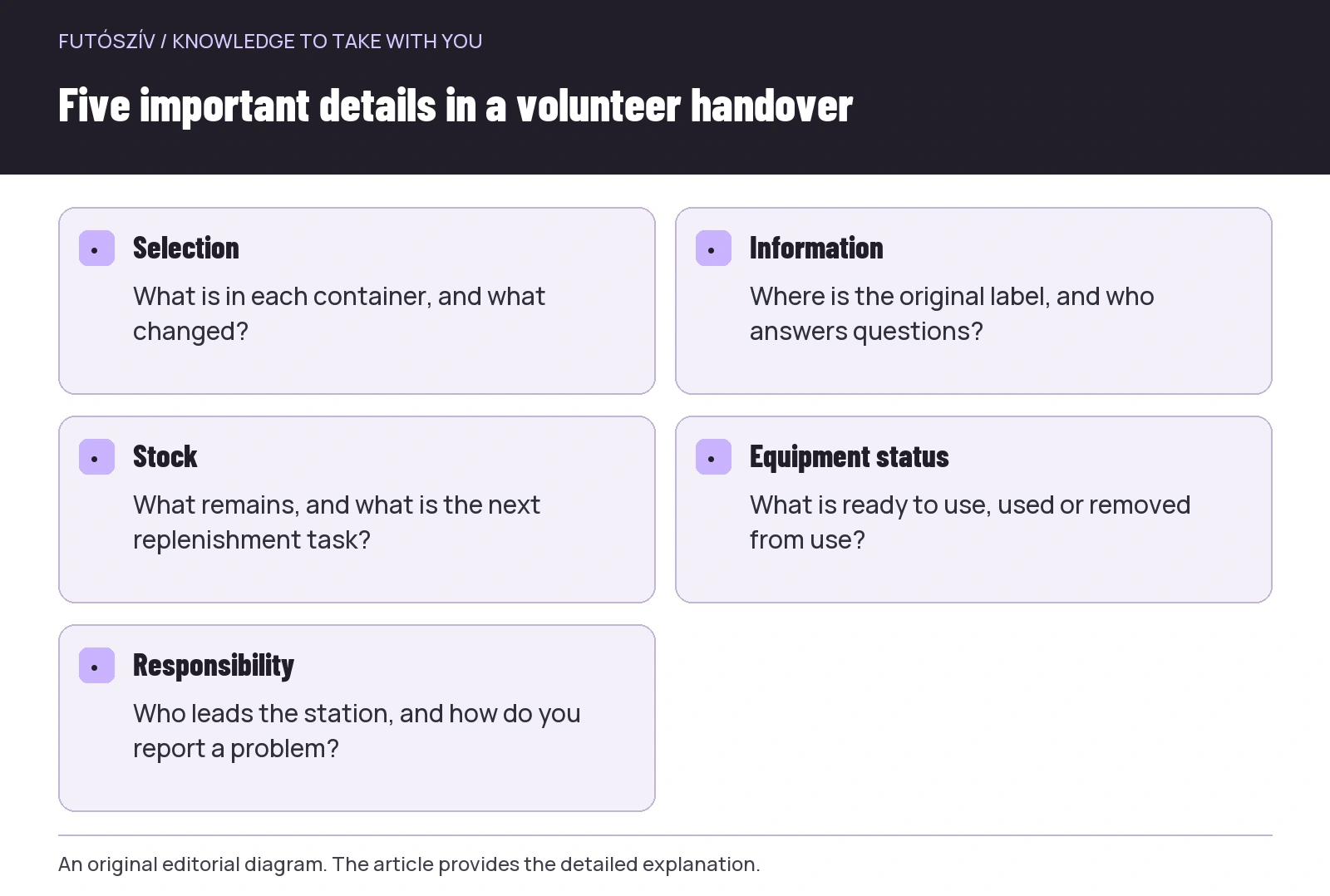 Enlarge diagram
Text version of the diagram
- Selection
- What is in each container, and what changed?
- Information
- Where is the original label, and who answers questions?
- Stock
- What remains, and what is the next replenishment task?
- Equipment status
- What is ready to use, used or removed from use?
- Responsibility
- Who leads the station, and how do you report a problem?
Report shortages before supplies run out
The replenishment lead should know what is in the service area, what remains in suitable storage and when to notify the station leader. A precise report names the product and status rather than merely saying ‘there isn’t much’. If a supply runs out, introduce a new product only with clear identification and under the organiser’s decision. The earlier label, recipe and allergen information cannot automatically transfer to another version.
Remaining prepared food and unopened reserves are different situations. Do not combine them to create one conveniently countable quantity. Handling history and specific instructions matter more than a neat stock figure. The next person taking over should understand the current state. Stock tracking need not mean a complicated spreadsheet: well-labelled containers and a few precise updates may also work within the local system.
An answer should not become personal dietary instructions
Volunteers can explain what the station offers and provide known information from a product or recipe. They should not guess how much a particular runner ought to eat or drink. A personal plan and health condition are separate matters. If someone is unwell or requests help, follow the event’s appropriate medical or organisational procedure. Do not declare a particular food or tablet a certain solution for unknown symptoms.
If runners clarify which drink they want in their bottle, help under designated serving procedures. If they request an individual change the station cannot appropriately provide, say so clearly and consult the responsible person. Friendly communication does not mean automatically saying yes to everything. Runners need real information about what is available to make a sensible decision within their own plans. Concealing uncertainty does not sustainably improve station speed either.
At shift changes, pass on the layout and exceptions too
Show new volunteers the zones, supplies, equipment roles and station leader. Explain changes in drinks, labels or replenishment. Clearly separate equipment removed from use so the new person does not have to guess why a jug is standing aside. A brief handover prevents the next shift from reinterpreting the station from scratch amid an arriving group of runners.
Finish the handover with actual feedback. Does the new responsible person know which container holds water and which another drink, where ingredient information is and what the next replenishment task is? They do not need to repeat every word, but must understand critical distinctions. Shared understanding of the current state maintains orderly operation, not merely somebody physically standing beside the table at all times.
Closing also establishes the condition for subsequent use
When closing, separate appropriately preserved products, prepared or opened supplies, used equipment and waste under organiser instructions. Volunteers should not decide the fate of leftovers without knowing required handling. Name responsibilities for cleaning, return transport and storage. Do not automatically distribute food in uncertain condition merely to leave less on the counter.
In evaluation, record where movements crossed unnecessarily, which labels were hard to read and which questions lacked an accessible answer. These are specific points to improve. A well-arranged aid-station table makes traceable work visible: protected stock leads through appropriate preparation to labelled service and clean handover, while used equipment leaves along a separate path. This helps runners and volunteers during busy race moments.
Sources and further reading
- NN Ultrabalaton: Official team information – refreshments using personal cups
- Nébih: Preventing foodborne illness
- Food Standards Agency: Allergen Information for Non-Prepacked Foods Best Practice
- CDC: Safe Water Storage
How Futószív articles are prepared: our editorial guidelines.