Clothing during a run usually receives more attention than what happens afterwards. Yet a short loop ending at home, a session finishing at a forest car park and a race followed by a long journey are different situations. Sweaty or soaked clothing, waiting and weather together can easily make the finish uncomfortable. A change-of-clothes pack is therefore not a general luxury list, but a plan fitted to finishing and getting home. A good pack keeps necessary pieces accessible and dry, and lets you actually use them at the location.
Map the route after the finish line
Think through the first half-hour and the rest of the journey home. Where can you stop, change, put the bag down, and how far must you walk to transport? At a race, the finish area, baggage collection and exit are not necessarily one point. Read the organiser’s current site plan and procedures. You do not need to schedule every small step, but know the main places and distances. The benefit of spare clothes also depends on when you can reach them, not merely whether you took a dry top somewhere.
Do not prepare arrival only for an ideal, quick scenario. There may be a baggage queue, your companion may be delayed or transport may require waiting. Choose necessary outer layers and dry clothing for that real situation. Do not automatically infer comfort while standing or walking slowly from how warm you feel during running. The relationship between wet clothing and cold surroundings is also discussed in the CDC cold-weather guide . The practical lesson is appropriate dry protection available in advance, rather than the same clothing pack for everyone.
Even a short journey home needs an appropriate ending
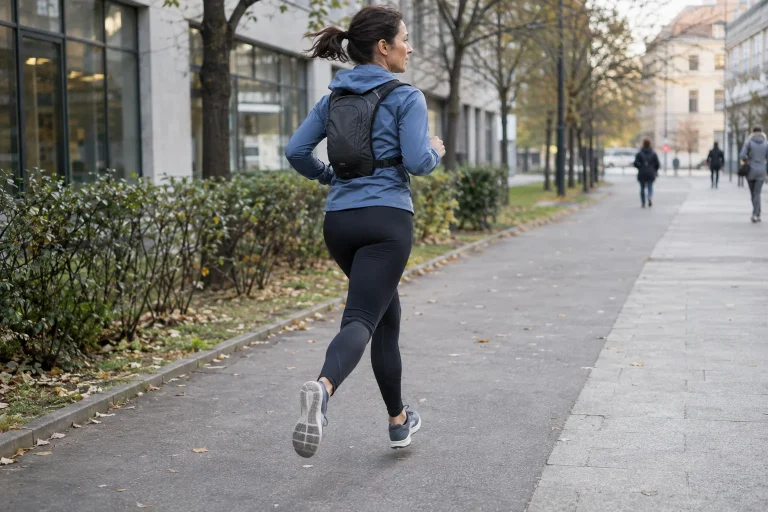
If you will be home within a few minutes, the pack is often simple. Keep keys and necessary belongings accessible, and take damp equipment out of a closed bag at home. If you chat afterwards, visit a shop or wait longer, that differs from going directly home. State this in the plan too. Every short loop does not need a large bag, but your actual programme needs suitable clothing. “I am close to home” does not itself keep you warm if the ending no longer follows the original scenario.
Particularly on social runs, agree beforehand what happens at the end. Does everyone leave immediately, or is there shared waiting and another activity? If the pack stays in a car or other storage, know who can access it and when. Dry clothes are only part of a working plan if you can actually reach them. A shared arrangement is easier to manage than phone calls afterwards while different people hold keys and bags. A good ending is an organisational task too, rather than clothing selection alone. A few details clarified beforehand can prevent unnecessary delay.
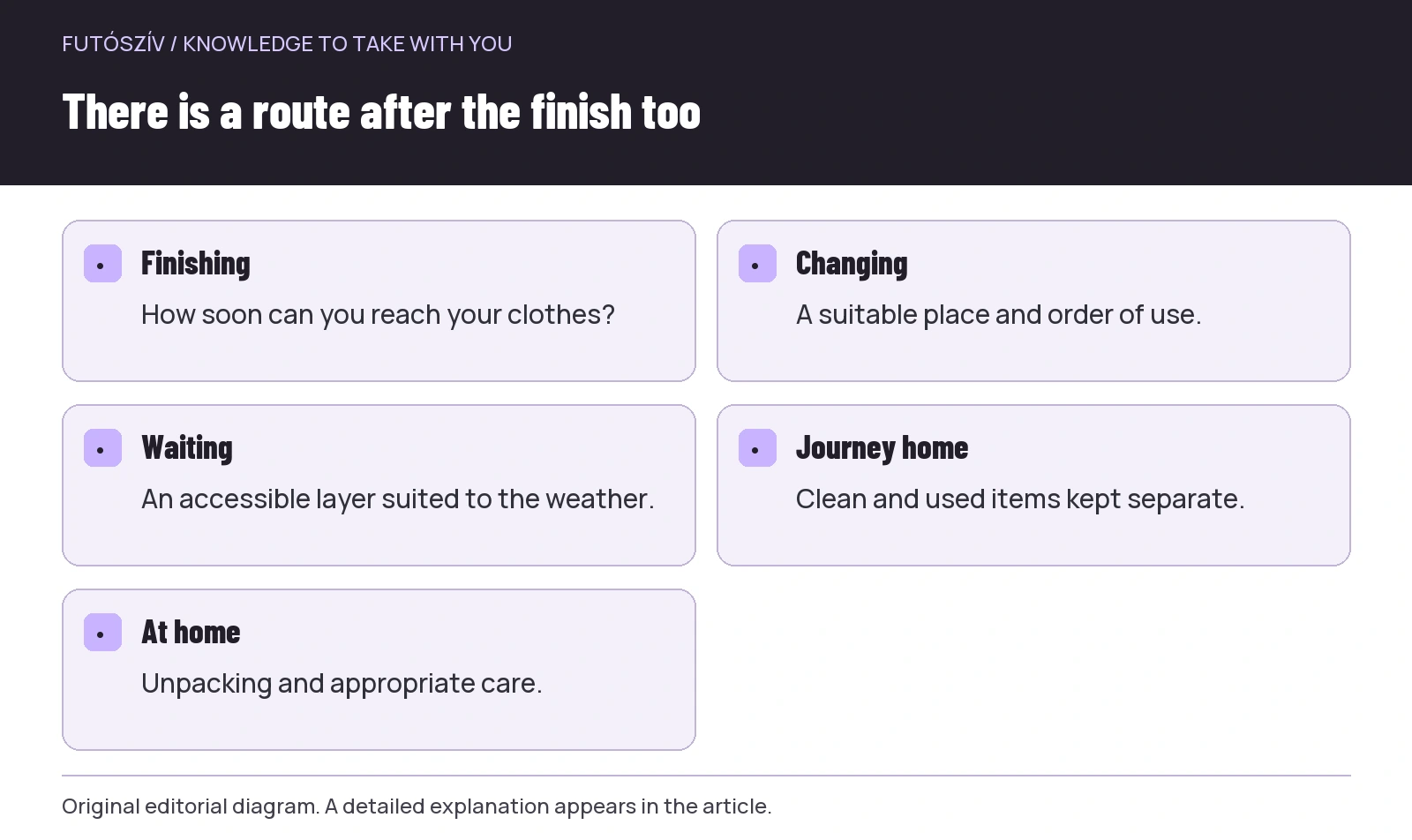 Enlarge diagram
Text version of the diagram
- Finishing
- How soon can you reach your clothes?
- Changing
- A suitable place and order of use.
- Waiting
- An accessible layer suited to the weather.
- Journey home
- Clean and used items kept separate.
- At home
- Unpacking and appropriate care.
Finishing at a car: order matters too
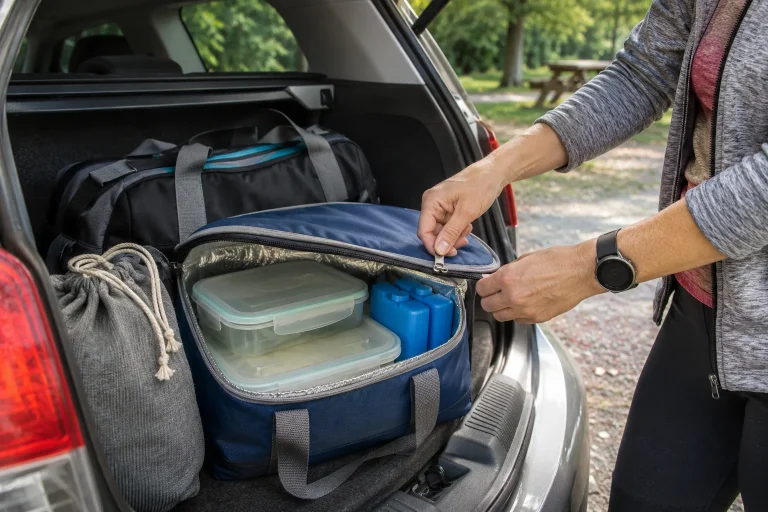
At or near the car park, think beforehand about what you can access first. A dry top, outer layer, socks or other necessary clothing should not be at the bottom of the entire load. Give wet and muddy items a separate place, and do not put clean clothing on the same wet surface. Choose a changing solution that respects site rules, your comfort and privacy. Every car park does not require buying a special device, but anticipating the actual possibilities is useful. Pack in the order of use.
Fitness to drive and travel home remains a separate question. Dry clothing does not solve fatigue or feeling unwell. If you do not feel in a suitable condition after running, adapt the journey-home plan and ask for help if necessary. This article concerns clothing packing, not assessing an individual’s health. In practice, alongside clothing, include who you travel home with, how, and what workable alternative exists. The pack does not itself replace assessing the situation. The aim of finishing is appropriate travel home, not leaving as quickly as possible.
Train or bus: waiting is part of the journey
With public transport, the stages leading to a platform, stop and seat can differ. You may first wait in the cold, then board a warmer vehicle. Layers therefore need to be manageable: you should be able to put on the necessary outer clothing and pack it appropriately later. Separating wet shoes and used clothing helps your own comfort and that of other passengers. Check your bag’s size and carrying ease, since a large, disorganised bag can also be troublesome when tired. Spare clothing is not usable merely because you bring another item for every imaginable situation.
Leave realistic room before departure time. If finishing and baggage collection take time, an overly tight connection can create a rush. Keep necessary personal belongings dry and accessible, so you do not search among wet clothes for a ticket or phone. Always check current local timetables and conditions; experience from a previous event does not guarantee the next. Packing and travel plans need to work together. This often produces a simpler, smaller selection than throwing everything into a bag at the last moment.
Race baggage facilities do not work by assumption
Read which bag the organiser accepts, where to hand it in, how to label it and where it is returned. Advance drop-off, a size restriction or another event-specific arrangement may apply. The 2026 London Marathon event guide , for example, describes detailed finishing and baggage-collection procedures. This is an example from one event, not the rules of another. Use current documentation for your own run. Packing spare clothes can only be finalised well once you know how they can reach the finish.
Label the pack according to organiser instructions and handle important documents and personal items as required. Do not assume every baggage facility offers the same valuables-storage service. If a separate device or chip must be returned after finishing, include that in your route too. For meeting a supporter, choose a clear, permitted and accessible point. “We will meet at the finish” may be insufficient at a crowded location. Access to clothing and meeting arrangements together create a predictable ending. A well-organised plan is more than a larger change bag.
What should go at the top of the bag?
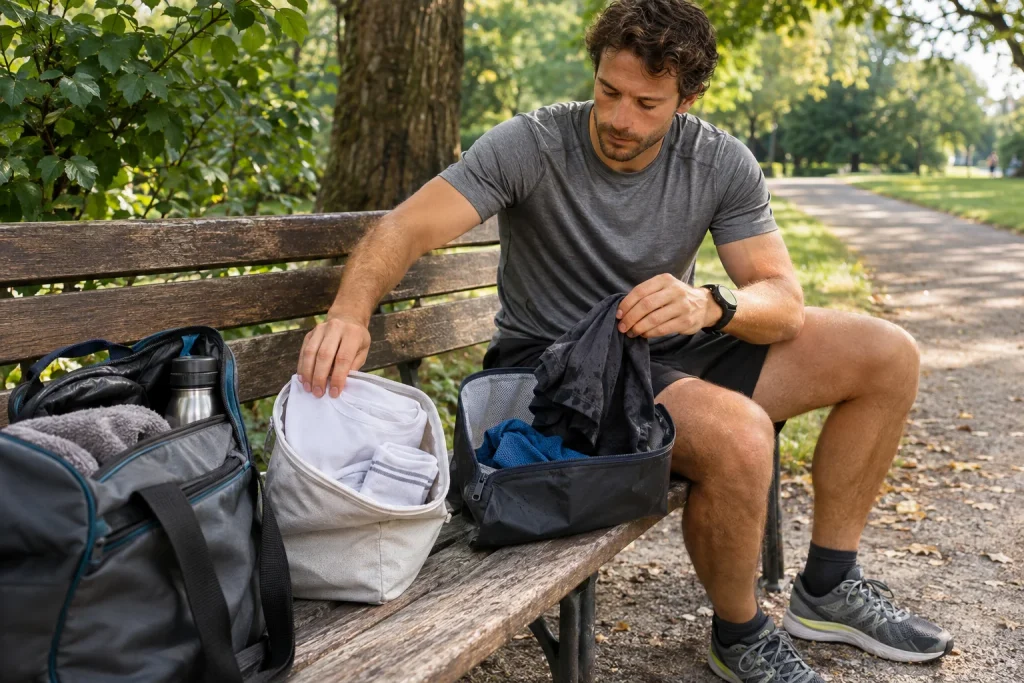
Place the first dry layer you need somewhere easily accessible and suitably protected. Exact contents depend on weather and travel home, but order of use is a generally useful organising principle. First, what you put on immediately; then further changing items; and separately, a place for damp equipment. Give small items a designated compartment. Clean socks should not await you deep inside a shoe, or keys wrapped in a towel, if you need them quickly. On-site manageability, rather than item count, makes contents useful.
Do a brief dry rehearsal at home: in what order do things come out of the closed bag? Where do removed clothes go, and what stays clean? You do not need to stage a complete changing scene; handling the objects and considering the sequence is enough. If a step would require placing everything on the ground, adjust packing. Smaller separate units can help, but you do not need a separate sealed pouch for every piece. The aim is clarity and separation of states. Too much packaging can slow you down as much as a disorganised heap.
| Journey home | The main question | Packing emphasis |
|---|---|---|
| A short walk home | Will you really go straight home? | A layer suited to the actual ending |
| Returning to the car | What can you access first? | Separate dry clothes and wet items |
| Train or bus | How much waiting and walking is involved? | Manageable layers and accessible personal items |
| Race finish | Where and when do you get the pack back? | Preparation according to current organiser procedures |
| Meeting a supporter | Who brings the clothing, and where do you meet? | A workable point agreed beforehand |
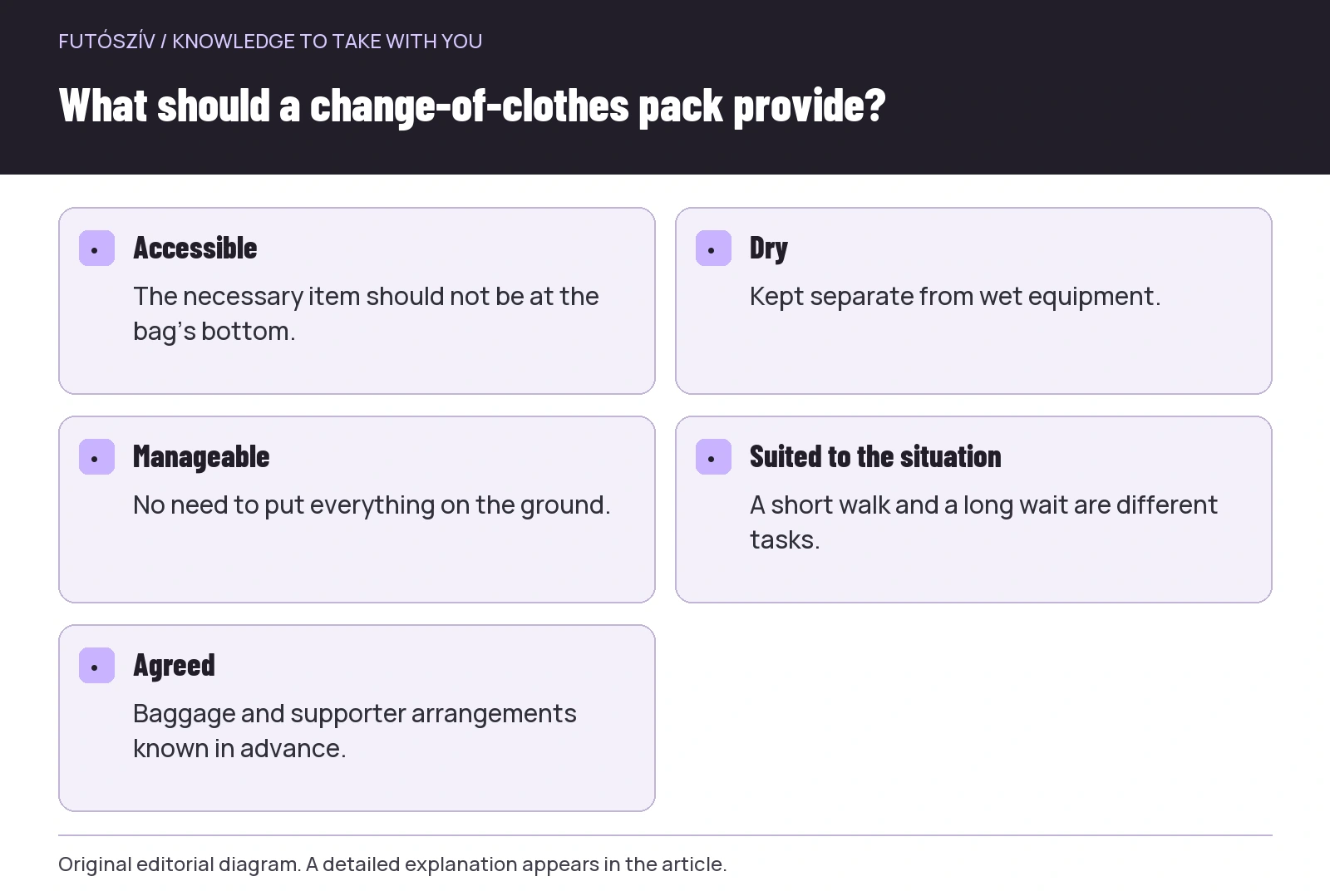 Enlarge diagram
Text version of the diagram
- Accessible
- The necessary item should not be at the bag’s bottom.
- Dry
- Kept separate from wet equipment.
- Manageable
- No need to put everything on the ground.
- Suited to the situation
- A short walk and a long wait are different tasks.
- Agreed
- Baggage and supporter arrangements known in advance.
Clean and used: two separate states
Give damp running clothes a separate place that protects clean items and necessary belongings. At home, however, unpack used items and care for them as instructed, rather than leaving them until the next week. Shoes, bottles and electronics may need different care; do not regard one sealed bag as dealing with everything. Storage is a temporary state, not cleaning. In a well-organised homeward pack, you know what is drying, awaiting washing and usable again. This simplifies preparing the next run too.
If the spare clothes themselves got wet or dirty inside the bag, examine the packing fault. More clothes may not be necessary; better separation or placement may be. Bottle closure and the bag’s water protection can also be questions. A soft jacket on top does not automatically protect everything beneath. Follow your own containers’ and bag’s requirements, and keep delicate personal belongings in a way appropriate to their role. The clothing plan works when you can actually retrieve something dry and usable at the finish.
Uncomfortable cold and illness are not the same task
This guide concerns everyday preparation. If someone is very cold, confused, unusually sleepy or showing other concerning symptoms, do not treat it simply as a clothing-packing question. The NHS information on hypothermia describes it as a medical emergency. Seek immediate appropriate help in such a situation, and at a race also contact the organiser’s medical point. General advice cannot assess symptoms remotely or declare them resolved with a dry T-shirt. The person’s condition takes priority over the journey-home timetable.
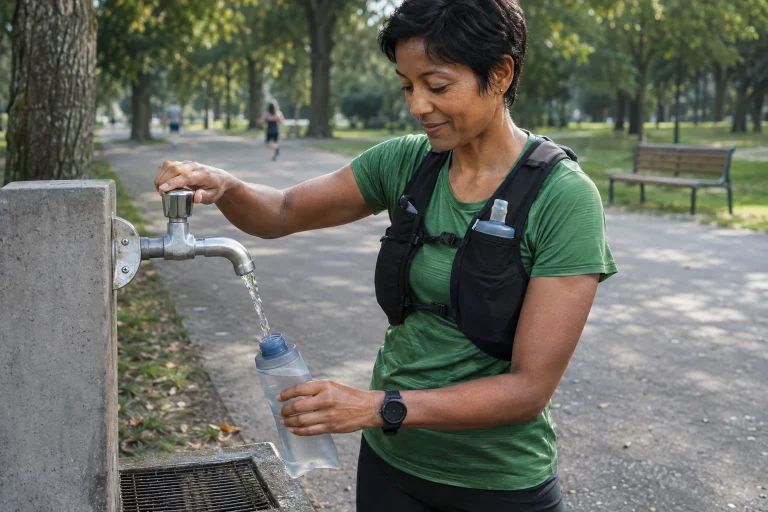
Preparation should therefore include knowing how to reach help as well as clothing. Where is the organiser’s assistance point, whom can you call, and where do you meet your companion? Every short loop does not need a lengthy checklist, but a working plan for your own route is useful. A dry layer serves a preventive comfort and environmental role, not a diagnostic one. Good preparation reduces avoidable uncertainty while clearly distinguishing everyday changing from a condition requiring medical assistance. Do not blur the two.
The next pack improves through previous experience
After getting home, note what you genuinely needed, what remained unnecessary and what was badly placed. “I needed the dry top, not the second pair of shoes, and the key was hard to find” is more precise than “I took too much”. This can produce a more targeted selection next time. Always tie experience to circumstances: a short urban loop, cold car park and long train journey differ. A useful list should not become a rigid compulsory pack for every run. Readjust it to the actual ending.
A good change-of-clothes pack is not necessarily large. It contains suitable pieces protected dry, accessible personal items and organised space for used equipment. You know where and when you open it and the order in which contents come out. The finish line or end of training then does not remain the last forgotten part of preparation. Your run ends with appropriate travel home, and equipment returns to the care process too. A few specific planned steps serve this more reliably than one more T-shirt thrown in at the last moment.
Sources and further reading
- CDC: cold weather and wet clothing
- NHS: hypothermia and seeking help
- London Marathon 2026: finishing and baggage-collection guide, an event example
How Futószív articles are prepared: our editorial guidelines.