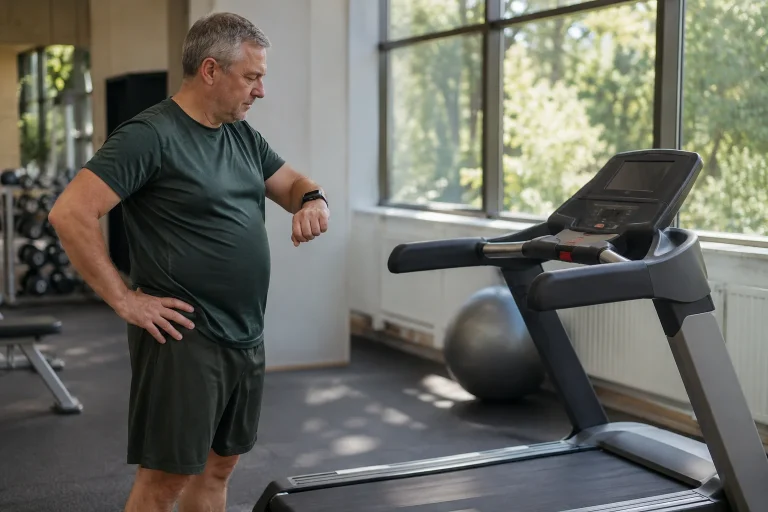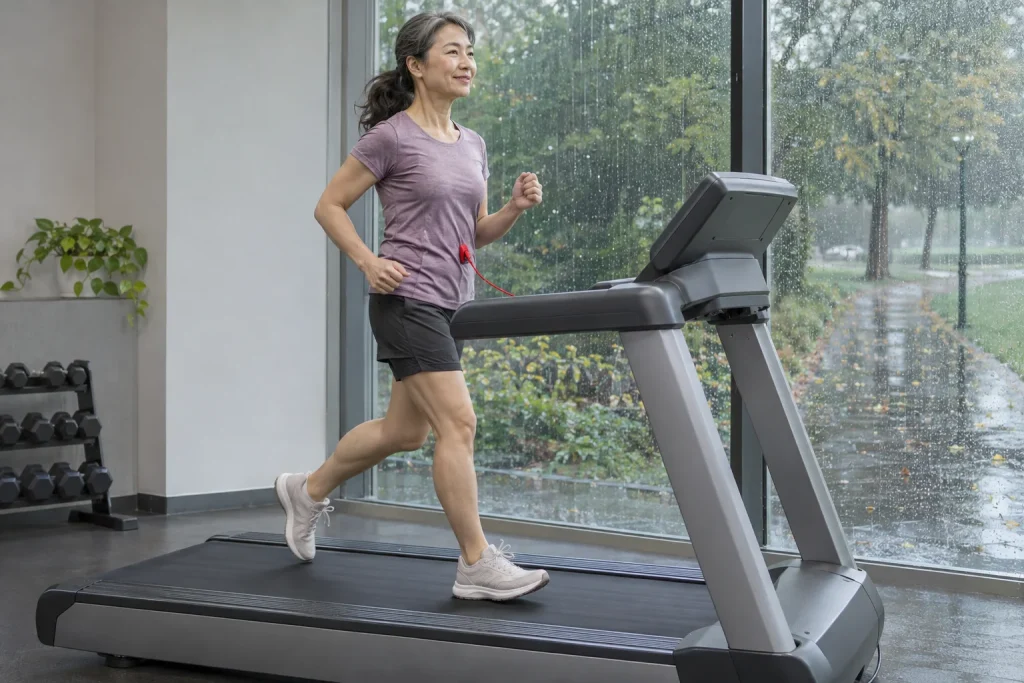
Treadmill training is real running work, but the conditions are not identical to outdoor running in every detail. The moving belt, speed setting, airflow, incline and visual surroundings can all shape the experience. To compare them, first clarify which characteristic you want to treat as equal.
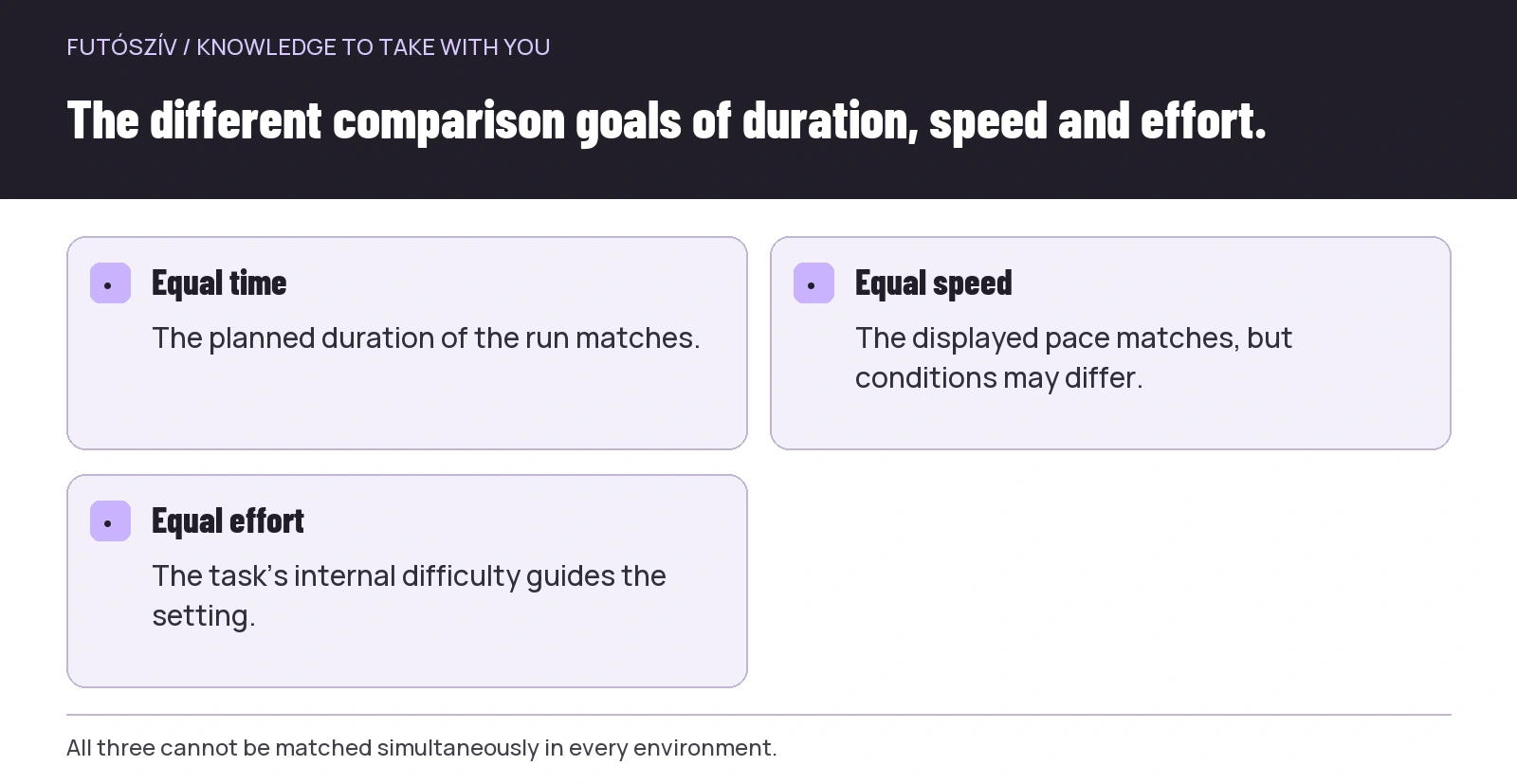
Equal duration, equal displayed pace and equal effort are three separate goals. Sometimes they may come close; at other times they differ. Useful training does not require converting every indoor number into a perfect outdoor equivalent.
What remains running, and what changes?
On a treadmill, you still take steps, produce force and respond to the workload. The motor does not perform the entire task for you. However, your body’s position relative to the room remains roughly constant while the ground surface moves underneath, so the situation is not identical in every sensory and mechanical detail.
A comparative kinematic and kinetic study directly analysed treadmill and overground running. Its very question was which characteristics are similar and which can differ. This does not imply that treadmills are useless or that every value transfers unconditionally.
The practical aim may simply be completing manageable training in bad weather, predictable surroundings or a particular time window. That is a valid reason even when the experience and some metrics differ from running outside.
The machine type matters too
On a motorised treadmill, the controls typically set the speed; on a self-powered machine, your movement drives the belt. The two approaches do not necessarily produce the same workload at an apparently identical displayed speed. A curved self-powered deck can be a particularly different task.
An experiment comparing motorised, non-motorised and outdoor running found different cardiorespiratory demands in the situations tested. The result concerned a particular machine and protocol, not a universal conversion formula for every gym.
Get to know how a new machine works first. Do not automatically treat the speed familiar from one treadmill as a starting setting on another type. A familiar display does not mean familiarity with the movement situation.
Where did the one-per-cent rule come from?
In a classic study nine runners completed short bouts at several speeds and inclines, and researchers compared the results with the energy cost of outdoor running. The one per cent in the study’s title comes from this specific testing situation.
Participants were trained male runners familiar with treadmills, trials were short and speeds lay within a particular range. At the slower speeds tested, zero and one per cent could also be evaluated differently. The finding does not mean one per cent is compulsory for every person on every run.
Increasing incline introduces a new workload variable. If the aim is an easy run, do not make it unnecessarily difficult for the sake of a general rule. Effort suited to the workout’s purpose matters more than literally fulfilling a research title.
 Enlarge diagram
Text version of the illustration
- Equal time
- The planned duration of the run matches.
- Equal speed
- The displayed pace matches, but conditions may differ.
- Equal effort
- The task’s internal difficulty guides the setting.
Why can the same pace feel different?
The room’s air, temperature and airflow differ from outdoors. A constant belt speed can create a different attentional situation, and your relationship with the machine matters too. Some people find the task calmer, others more constrained.
Do not try to trace the experience to one certain cause. If the same number feels harder indoors, examine the conditions, incline and machine too. Your personal experience does not become invalid because the display theoretically shows an easy pace.
Consider duration in comparisons too. A short, familiar indoor run differs from an unusually long session in a warm room. Adjusting to the complete environment is a meaningful training decision.
The displayed speed is not always a perfect reference
The machine’s condition and operation can affect actual belt speed. A measurement study examining different treadmills analysed belt-speed fluctuations and the role of machine type. Mechanical variation can exist behind a constant display number.
This does not call for daily home dismantling or dangerous belt measurements. If you experience abnormal operation, jerking or uncertain movement, inform the operator and do not continue using it at full speed. Maintenance belongs to the appropriate professional.
For your log, using the same machine for comparable tasks may be useful if its operation is reliable. On changing gyms, do not immediately translate a pace difference into a definite fitness change.
Why might the watch and treadmill show different values?
Indoors, a wrist device may estimate distance from different data than on an outdoor GPS run. Arm movement, previous calibration or an additional sensor used may play a role. The device’s official guide is needed to understand its exact operation.
Holding the handrails changes wrist movement too. This may alter both estimated distance and the actual running task. The difference between two displays does not itself establish that one is the faultless standard.
Choose a consistent logging procedure and label the source of the distance. You do not need to keep running after every session until every device shows exactly the same kilometres. Completing the main task and documenting it reliably may matter more.
Acceleration time also affects short intervals
A motorised treadmill does not always reach the selected speed immediately. A substantial part of a short work interval may be spent accelerating. Pressing the button, reaching target speed and starting the planned interval can be separate moments.
Do not therefore automatically transfer a session with very short, abrupt changes onto the machine. Choose a task that the equipment can follow safely and clearly. Operating the controls should not take attention needed for safe movement.
Jumping on and off a moving belt is not a good general shortcut for recovery periods. Follow the machine’s safe operating procedure and deceleration options. If the planned session can be performed only through risky handling, change the session.
Hill training and descending are separate questions too
A positive incline can provide a controllable uphill task, but outdoor movement can differ in several respects at the same number. A study of downhill, level and uphill running directly compared movement and forces measured on the machine and overground.
If the goal is mountain running, a treadmill does not automatically teach handling rocks, roots, turns and changing ground. The endurance task may complement preparation, while terrain skills may also require experience on actual terrain.
Do not assume that extensive uphill work has addressed downhill demands. Up and down are different tasks. Do not judge a race route solely by elevation gain accumulated on a treadmill.
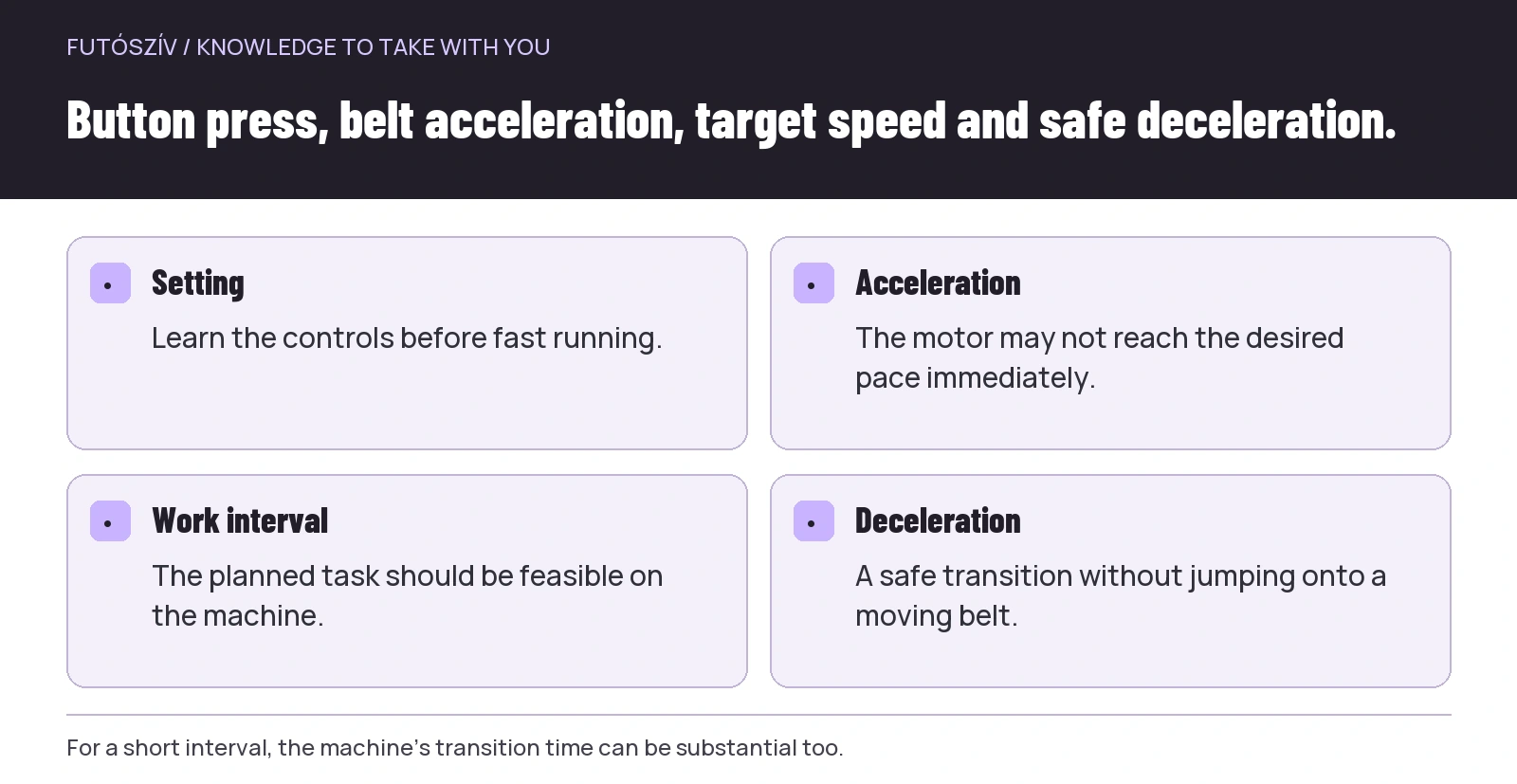 Enlarge diagram
Text version of the illustration
- Setting
- Learn the controls before fast running.
- Acceleration
- The motor may not reach the desired pace immediately.
- Work interval
- The planned task should be feasible on the machine.
- Deceleration
- A safe transition without jumping onto a moving belt.
A comfortable, safe start
Before starting, learn the stop and emergency-stop arrangements and use safety devices according to the manufacturer’s instructions. Keep the belt and surrounding area clear, and prevent laces or clothing catching. Ask the operator for a demonstration on an unfamiliar machine.
Begin at a speed where you can orient yourself and operate the controls safely. You need not select your usual outdoor pace in the first minute. Getting used to the machine is a part of the session in its own right.
Phone calls, complicated menus or other distractions make it easier to lose track of the situation. If a setting needs adjustment, slow down and stop properly where necessary. Administrative tasks on a moving belt are not a compulsory time-saving measure.
Plan the indoor environment too
Provide suitable ventilation and conditions for comfortable running. If the room is warm or stuffy, adapt the session’s intensity and length accordingly. A fan may improve comfort, but does not guarantee the programme is manageable under any heat stress.
Place water and necessary items so you do not have to reach dangerously for them. Keep towels and bottles away from moving parts. Simple everyday arrangements support attentive running.
If you feel unusually unwell, dizzy, in pain or have breathing difficulty, stop the machine safely and seek appropriate help. Being indoors does not remove the need to assess symptoms.
How should you switch between the environments?
If you have mainly used a treadmill for a longer period, adapt the return outdoors to the route and your experience. Turns, descents, unevenness and wind play a greater role again. The same speed per hour is not necessarily the same task.
The reverse applies too: at the start of a new indoor period, smaller, simpler trials can help you learn the machine and surroundings. You need not choose the longest or most complex workout for the first occasion.
Where possible, it is useful later to practise movement situations important to the race in the actual environment too. A treadmill is a tool within the plan, not a complete replacement for every outdoor skill.
What is worth recording?
Machine type or identifier, incline, duration of the main section and perceived effort aid comparison. Mark if distance comes from the watch too. This prevents the log confusing different sources later.
Return to the purpose when evaluating the workout. Did you want a manageable easy run, controlled climbing or a sustained harder section? Success does not necessarily mean perfectly reproducing every displayed number from the outdoor session.
Differences between treadmill and outdoors need not prevent good preparation. They become manageable when you recognise the important variables and use the equipment for the task. Consistent, meaningful training is worth more than a compulsory conversion rule.
Sources
- A kinematics and kinetic comparison of overground and treadmill running.
- A 1% treadmill grade most accurately reflects the energetic cost of outdoor running.
- Non-motorized Treadmill Running Is Associated with Higher Cardiometabolic Demands.
- A new method for measuring treadmill belt velocity fluctuations.
- Joint kinematics and ground reaction forces in overground versus treadmill graded running.
How Futószív articles are prepared: our editorial guidelines.