
Race week can remain full of work, travel and family responsibilities even when your running calendar revolves around the approaching event. It is easy to leave bib collection, packing and getting there until the end of the week, then try to do everything at once. A workable race-week plan distributes these organisational tasks across the time genuinely available.
This guide concerns logistics; it does not prescribe final-week training volume, a dietary regime or a health decision. Follow your own training programme and needs. The calendar’s purpose is to prevent administration and travel appearing as unexpected tasks on the final evening. Always take precise race-day details from your own event’s current information.
First enter the week’s genuinely fixed commitments
Working hours, business trips, family events and official race deadlines all belong in the calendar. Alongside the start, the collection window and, where needed, a team meeting can be fixed commitments too. The number of apparently free evenings is not enough on its own: getting places and daily responsibilities take time.
If working the day before the race, do not automatically leave clothing and documents for that evening. First look for a preparation slot when you can work calmly. Many tasks can be completed earlier: checking registration status, confirming accommodation, preparing your own information sheet or attending to the necessary clothing.
With a variable work schedule, mark how far ahead the roster is confirmed. Do not treat unknown time as guaranteed free time. If bib collection could clash with work, clarify this early using the official options. Collection by somebody else may have its own requirements; check these before asking for the favour.
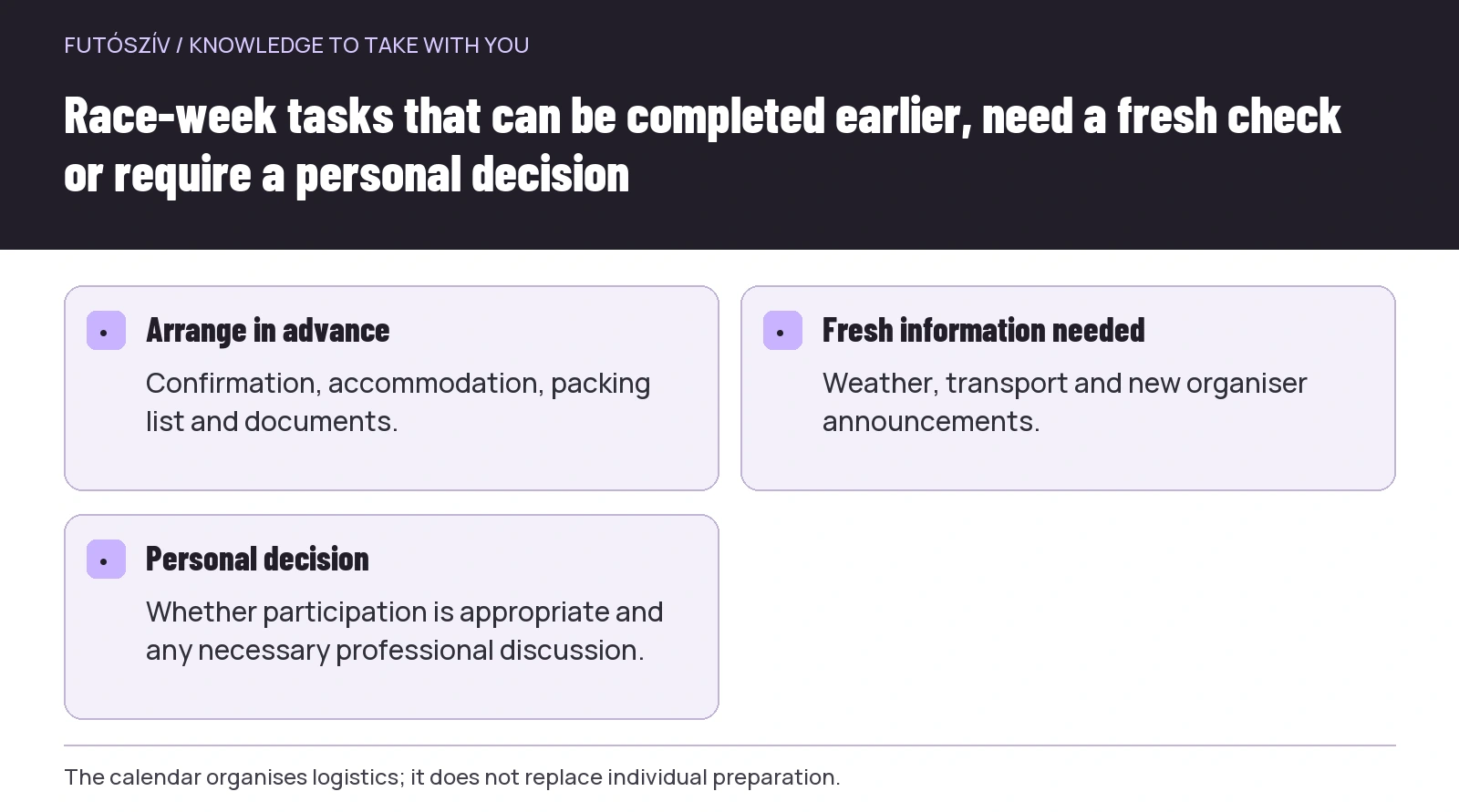
Divide race-week tasks into three groups
Can be completed earlier. This might include finding the confirmation, checking details, preparing a basic travel option and making a packing list. These do not necessarily need to wait until the final day. Completing a task reduces the open questions that must be resolved simultaneously later.
Requires fresh information. Weather, transport changes, final venue announcements or the organiser’s last briefing may belong here. You can plan for them earlier, but must check them again with current information. Mark the check time in your calendar rather than filling a missing field with invented certainty.
Depends on personal circumstances. Whether taking part is appropriate and whether your own programme needs adjustment are not simple administrative fields. Symptoms or uncertainty may require suitable professional discussion. Registration being in order and a train ticket being purchased do not by themselves decide whether you can participate in the planned form.
| Task group | Example | Planning approach |
|---|---|---|
| Can be arranged in advance | Finding the confirmation and required document | Can be completed in a specific earlier slot |
| Needs a fresh check | Timetable or transport change | Assign a designated checkpoint |
| Requires an individual decision | Change arising from health circumstances | Clarify separately with appropriate help |
 Enlarge diagram
Text version of the illustration
- Arrange in advance
- Confirmation, accommodation, packing list and documents.
- Fresh information needed
- Weather, transport and new organiser announcements.
- Personal decision
- Whether participation is appropriate and any necessary professional discussion.
An early-week check can resolve many uncertainties
Open your registration confirmation and the official page for your own race category. Do the name, distance, team or selected participation format match? Is any payment or information still outstanding? Use the official administrative channel if you find a discrepancy. There may be more opportunity to clarify it early in the week than in the queue before the start.
Read identification requirements separately. The official 2026 Boston Marathon rules set out detailed bib-collection and identification requirements, for example. This is an example from a specified event edition; your own race’s current document is what matters for you. The important lesson is to find collection prerequisites in advance.
Make a short list of open questions, then close those that have received answers. Do not repeatedly collect different informal opinions about the same detail if the official answer is clear. Name any contradiction, however. Different years or two different locations, for example, may require a clarifying question.
Have a complete door-to-door travel option
Whether travelling by train, bus or car, examine the final walk too. The station, car park and bib-collection entrance may be separate points. Race-day closures can change access. The event’s central address does not necessarily lead to the gate suitable for you.
The BSI question-and-answer page for first-time racers also uses event information and route maps to help people learn about on-site services. Your own plan needs time to reach them too. You can review the relative locations of bib collection, changing facilities and the starting area during the week.
If travelling to accommodation, clarify check-in, access when departing and post-race luggage arrangements separately. Having a room the previous night does not automatically solve washing and changing after running. Checkout time and service conditions are separate information. Ask the actual accommodation provider rather than assuming general practice.
Do not leave too many pending tasks for the end of a working day
If travelling after work on Friday, prepare the important parts of your luggage earlier. Keep work items separate from race items. Arriving directly from a business trip may create further storage questions for a laptop, work clothes and running equipment. Do not automatically expect the race bag drop to solve these.
Enter commitments associated with finishing work realistically too. If a task may definitely run late, avoid building the journey around one tight connection where a suitable alternative exists. A race-week plan cannot eliminate every unexpected situation. It helps make recognisable clashes visible earlier.
Agree when you will be available for shared responsibilities again. Race-related travel may take more time than the running programme. If travelling with others, the meeting and packing arrangements are shared questions too. A precise time frame simplifies everyone’s own schedule.
Make equipment checking a separate session
Lay out your selected race clothing alongside mandatory and personally necessary items. This lets you spot gaps in good time. Check that clothes are clean and dry according to their own care instructions. “It is somewhere” is not the same as accessible in your bag and ready to use.
Prepare bib attachment and the timing-device wearing method according to the organiser’s guidance. If you receive the device later, mark the associated task separately. Check the operation and charging of your phone, light or other electronics according to their own requirements. Give this space in the calendar too.
You can select familiar items for different weather options beforehand. Adapt the final decision to current conditions. Using equipment bought at the last minute and not yet tried is a separate question; it is not an automatic answer to every uncertainty. If a mandatory item is missing, resolve it in good time with precise knowledge of the requirement.
 Enlarge diagram
Text version of the illustration
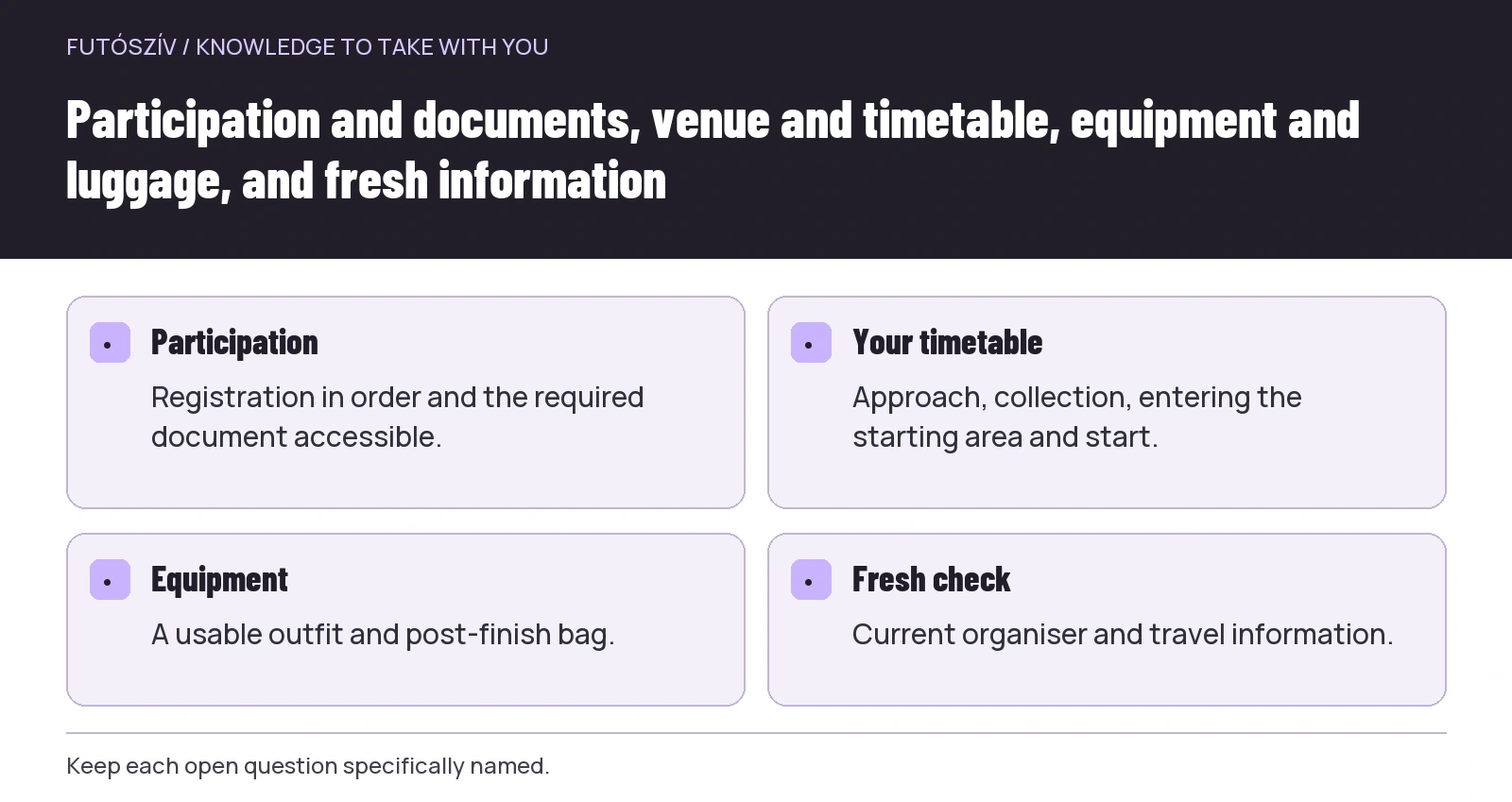
- Participation
- Registration in order and the required document accessible.
- Your timetable
- Approach, collection, entering the starting area and start.
- Equipment
- A usable outfit and post-finish bag.
- Fresh check
- Current organiser and travel information.
Two separate bags may also simplify things
One bag contains what you will have with you while running. The other holds items needed after the finish or for travel. Bag-drop and luggage-handling conditions determine how you can deposit or store them. Not every event offers safekeeping of valuables, and size limits or opening hours may vary.
Make it clear when each bag is needed. Do not lock travel documents somewhere you cannot access before the return journey. Do not put post-finish clothing in a car staying at another relay point unless transport there is arranged. Check the movement of items alongside your own programme’s timetable.
If a supporter helps, explain precisely what you expect and where you will meet. Looking after luggage, cheering and getting home are separate tasks. Do not assume another person has automatically agreed. In the completed plan, their availability and own time limits are real information too.
An illustrative week alongside work
Early in the week, a runner checks registration, collection and accommodation, then closes out clarifying questions. On an earlier free evening, they prepare the packing list and examine the equipment. Next time, they read through the site plan and plan the final walking part of the journey. Mainly fresh checks remain towards the end of the week.
On the day of travelling after work, they take the bag prepared earlier and check transport changes before departure. At the accommodation, they clarify returning there and leaving the following day. On the evening before the start, they check their own sheet and look for new organiser announcements. They do not try to squeeze every task that could have been completed earlier into that one evening.
The example is not a compulsory seven-day schedule. Your work roster and event arrangements may require a different distribution. The organisational principle is to give tasks that can be closed earlier an earlier slot, while checking fresh information at the right time. This can make the last check shorter and more focused.
If something changes during the week
First identify which part is affected. Delayed work may alter travel, transport changes may alter access, and a personal problem may change the whole participation plan. You do not necessarily need to redesign every field, but must trace the affected dependencies. If arriving later, check the collection window too.
Find your own event’s amendment or withdrawal deadline. Not every problem can be solved by changing distance or transferring an entry. Clarify official options in good time and inform the companions affected. Paying for travel or registration does not automatically make a decision unchangeable.
If working with a coach, report the programme actually completed and changes in circumstances accurately. This article does not recommend making up missed sessions in the final week. Organisation and training preparation are different tasks that need coordinating around the real situation. Honest calendar information is useful for this.
Four lines for the final check
Is participation in order and is the required document accessible? Are your location and timetable clear? Do you have suitable equipment and a post-finish bag? Have you checked the latest organiser and travel information? If any answer is uncertain, treat it as a specific open question.
This will not make race week uneventful. It does give the many small matters their own time, source and next step. Alongside work and travel, this can provide a calmer framework for reaching the start: rather than a heap of unresolved tasks at the end of the week, you have your own programme prepared earlier and checked against fresh information.
How Futószív articles are prepared: our editorial guidelines.