A good running promo video can show within seconds why an event might be exciting: costumes, lights, an unusual location or people moving together. But a video does not perform the same task as current race information. It is easy to infer distance, date or participation conditions unnoticed from atmosphere, although these require separate checks.
The aim is not to enjoy the film less. Rather, after watching an inspiring piece, prepare for the programme actually available now. A few simple checks are enough: who published it, which event and year it shows, what the next official edition is and what is genuinely known about it already. The following method is our own source-reading aid.
Look for three separate dates
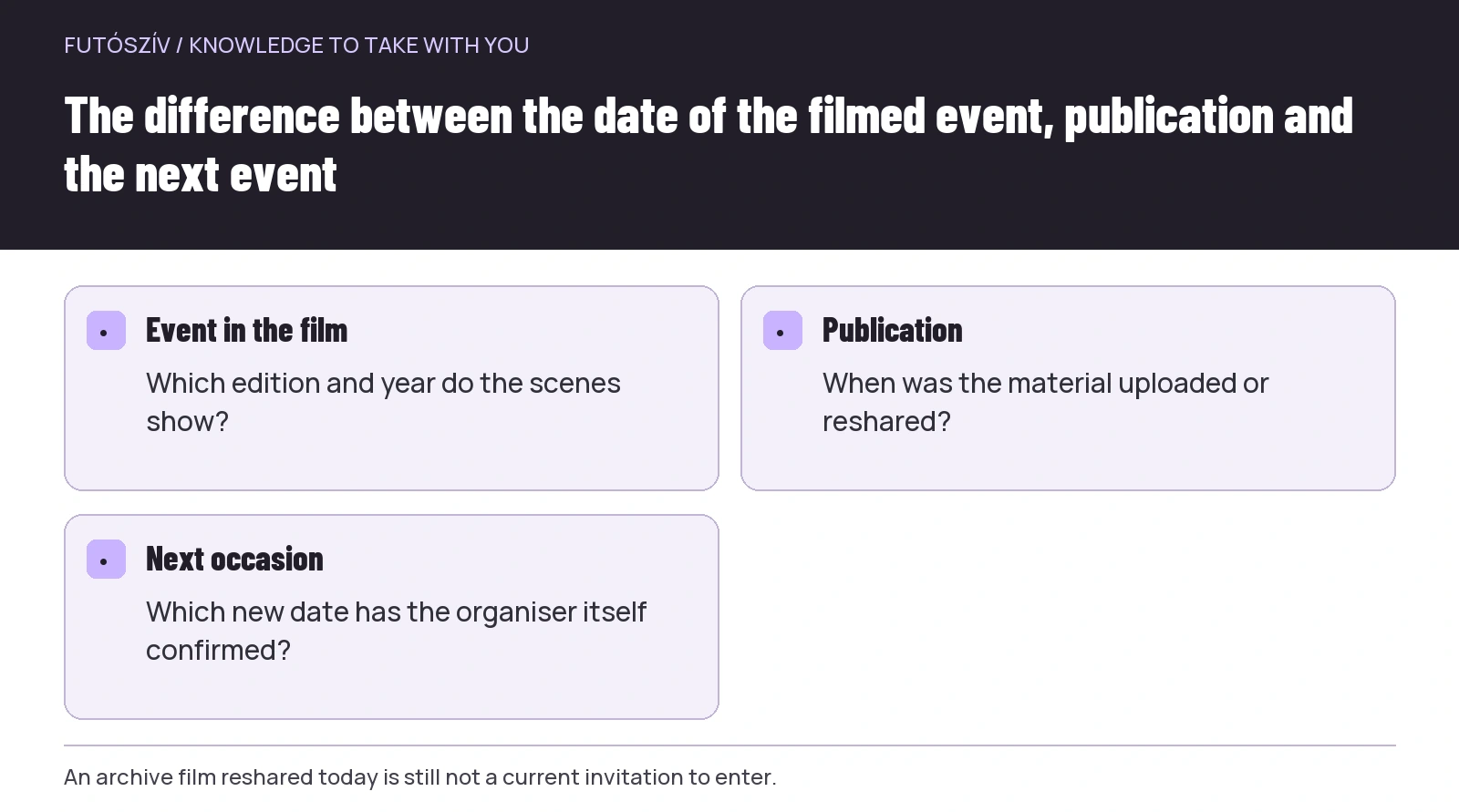
The date of the event shown, the video’s publication date and the next event date are separate facts. A film uploaded in November may show an October run and be shared again years later. The timestamp of a social post appearing now does not turn older material inside it into a new event.
If the title has a year, start there and find the same edition in the description and linked organiser page. Without a year, organiser results, archived news or a media library may offer clues. A number on clothing, a start arch or poster can be useful, but alone does not always establish identification reliably.
Open the next event’s date separately afterwards. Do not add a year to the old event or assume the weekend always falls on the same day. An estimated calendar entry is not yet an organiser announcement. Keep an uncertain date uncertain in your own plan until appropriate primary confirmation exists.
Check where the film comes from
Ideally, reach the recording first through the organiser’s official website or media library. A video-platform channel name may resemble the organiser’s, so verify the connection through the official website where possible too. Another participant’s film can be a valuable account, but does not establish the same things as an organiser’s announcement.
The official Sportoló Nemzet video gallery , for example, lists material by year and event, including the LED’s Run film from 27 March 2026. Earlier light runs appear in the gallery too. This illustrates why the particular entry and year matter, rather than simply a shared event name or striking stadium image.
Separate enthusiastic wording attached to a reshare from original information as well. A friend’s comment that “we should go here in spring” does not mean the next date of the filmed event has been published. The invitation can later be tied to current official event information. Until then, the video is a shared idea rather than a completed entry plan.
 Enlarge diagram
Text version of the diagram
- Event in the film
- Which edition and year do the scenes show?
- Publication
- When was the material uploaded or reshared?
- Next occasion
- Which new date has the organiser itself confirmed?
Four archival examples labelled correctly
The following examples are promotional material for earlier events, checked on 18 November 2026. They are neither a list of currently open entries nor next year’s programme. They share the possibility of showing atmosphere clearly by naming their own year.
| Archived material | Its year | What can you search for next? |
|---|---|---|
| BSI: short film of the 8th PENNY Santa Run | 2023 | Official information for the current Budapest Santa event |
| Sportoló Nemzet: LED’s Run summary | 2026 | The next separately announced light-run edition |
| Nagy Sportágválasztó: Halloween Run video | 2018 | The Halloween event’s current organiser information |
| Nagy Sportágválasztó: Sötét Zsaruk in the cellar system | 2019 | Current conditions for the underground programme |
The 2023 Santa Run short film is archived material from BSI’s official channel. The organiser’s article for the Halloween video carries a 2018 date, while the announcement associated with Sötét Zsaruk carries a 2019 date. Stating the earlier year does not diminish enjoyment of the film; it prevents mistaking it for a current invitation.
Identify the race shown in the video
A summary may edit together scenes from several distances, starts and age groups. Pictures of a short children’s race may be followed by an underground section of a longer distance and then central celebrations. This does not mean every entrant experiences every part. Look in the particular race information for what your own route includes.
The same applies to costumes and supplied items. A distinctive outfit in the film does not prove it was included in entry or permitted at the current event. A finisher medal, shirt, refreshment or gift pictured is not a current service list either. Learn these from the chosen edition’s entry conditions.
If one scene caught your group’s attention, turn it into a specific question. Do you want to know which race passes through that place, what theme comes with it or whether a shared family part exists? Interest then becomes verifiable decision-making information. “We expect exactly this” does not, by itself, identify the event version you are choosing.
The camera is not an on-site light or distance meter
A recording can show a luminous atmosphere but cannot replace a description of course lighting. Editing, the camera and published image size may portray surroundings differently from participants’ perceptions. Do not decide personal-light requirements from the video’s brightness. Find the current organiser requirement.
The sense of distance and time can change in a film too. A seemingly short tunnel part may be selected scenes from a longer section, and a crowd shot does not show the whole wait. Read course length, surface, elevation and lap structure from the map and event information. An atmospheric piece is not tasked with documenting all of this continuously.
Runners’ smiles or fast movement are not personal suitability recommendations either. They do not tell you the participant’s experience or chosen race. Your own situation and event conditions matter for your participation. A video can inspire, but does not prescribe distance, pace or a health decision.
An archive and new announcement can make sense together
An older film can legitimately accompany a new event announcement to illustrate atmosphere. Read two separate statements: old material shows what an earlier occasion was like, while the new announcement tells you what has been announced for the next one. Do not automatically add every detail from one to the other.
For example, an organiser may announce a new date and venue while distances, fees and start times follow later. Those facts do not become known merely because an earlier film sits alongside the announcement. Your calendar can then contain an event idea or confirmed date, but a detailed entry plan needs the necessary conditions to appear first.
Check years throughout the organiser’s page too. If the heading already refers to next year but the fee table or deadline is still old, do not build a mixed information sheet. Ask for clarification or mark what is missing. Missing precise details do not authorise treating the last edition as continuing unchanged.
 Enlarge diagram
Text version of the diagram
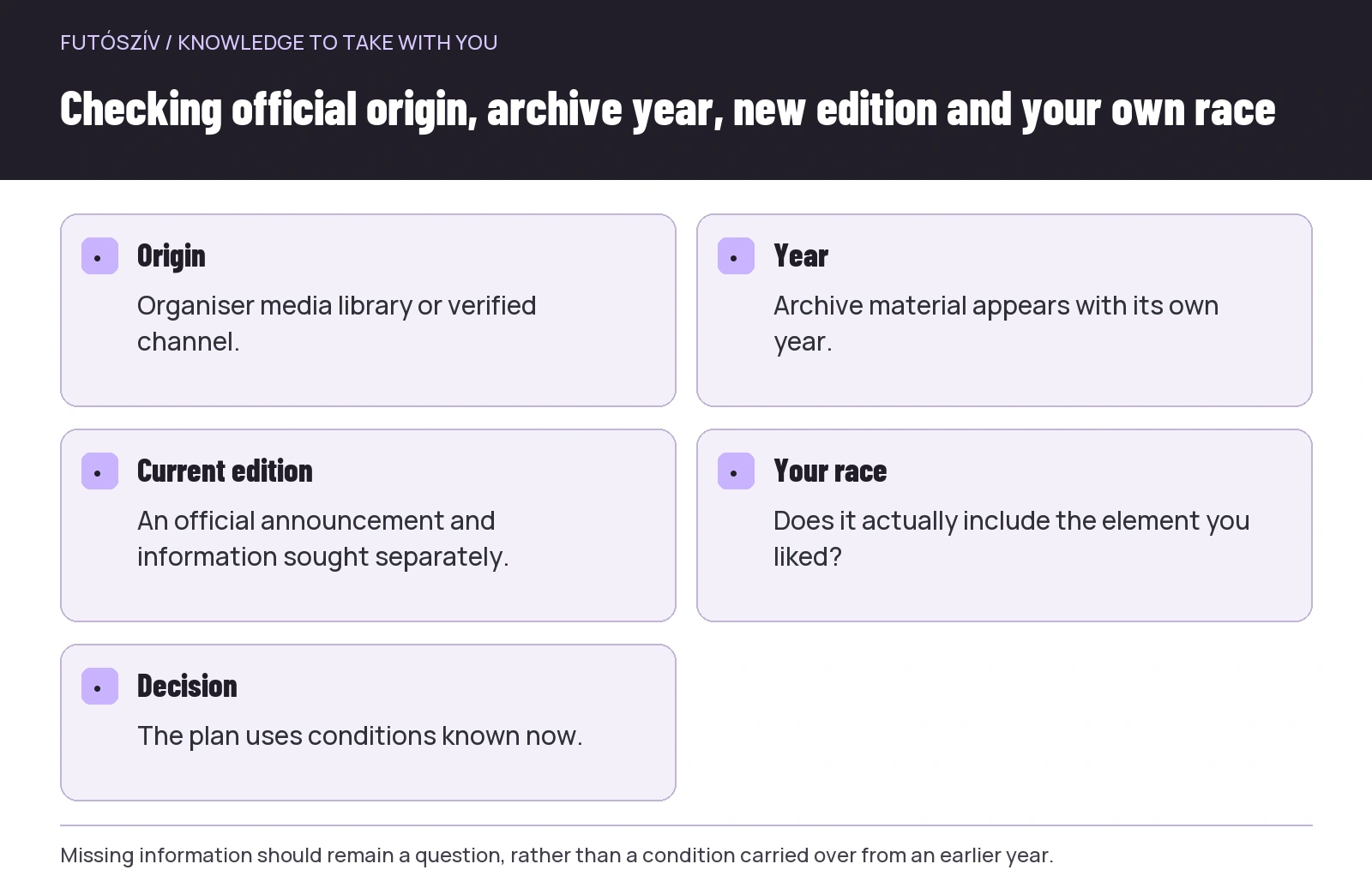
- Origin
- Organiser media library or verified channel.
- Year
- Archive material appears with its own year.
- Current edition
- An official announcement and information sought separately.
- Your race
- Does it actually include the element you liked?
- Decision
- The plan uses conditions known now.
Your own checklist for a video you liked
The following short sheet helps turn a film-inspired idea into a real event plan. You do not need a long research note for every viewing. Before deciding to participate, however, have the official source and year you are actually relying on.
| Field | Question for your own notes |
|---|---|
| Origin | Did you find it on an official organiser page or verified channel? |
| Recording year | Which event edition does it show? |
| Publication | When was it uploaded or reshared? |
| Part you liked | Costume, route, light, community or another element? |
| Next edition | Is there already a primary organiser announcement? |
| Your race | Which participation format includes the element you want? |
| Missing information | What remains to learn from event information or the organiser? |
| Checking date | When did you review the current source? |
If the sheet shows only that the programme is interesting but no new date exists yet, that is still useful. Every promotional film need not immediately become an entry. Save the organiser’s official page and look there later for current information. Do not conceal a missing next edition with an invented date.
An imagined situation: a forwarded light run
A spectacular evening-running video enters a friends’ group with “we should go here next spring”. One member checks the original source and discovers it shows a stadium programme from an earlier year. A detailed page for the next edition is not yet available. Names and circumstances here are fictional rather than specific entry advice.
The group then records two things separately: they like a luminous shared outing, but the specific event cannot yet be chosen with a reliable date. They look for officially announced options fitting their time frame or leave the decision until later. Nobody books travel for a weekend inferred from an old video. The idea remains, and uncertainty remains visible too.
In another version, new information exists already, but the chosen distance does not include the part they liked in the video. The group can then decide whether to choose another race within their capabilities or seek another programme. That does not make the film itself misleading; viewers need to connect different parts of a summary with their specific entry format.
Keep the precise label when recommending it to others
When forwarding, a short sentence of your own is enough: which year’s archive film it is, what you liked and where current official information can be found. Do not add a fresh date or price you have not checked. If the new edition has only been announced, say so. Friends then need not infer entry status from the intention behind the share.
Do not gather current administrative rules from comments beneath an archive video. A question may have concerned an old fee, another venue or a discontinued process. Always use organiser information for the edition currently chosen when deciding. Comments can offer experience but do not override current conditions.
If you want to display the film on your own platform, check the rights holder’s official sharing or embedding options and their conditions. A publicly playable video is not general permission to download, recut or use frames as your own material. This is not a media-licensing guide; a link to the original source is usually a simpler starting point.
Make your own plan the next step, rather than another playback
If the event appeals, find answers to your own participation questions in current information: distance, timetable, course type, costume, equipment, cost and travel. Discuss with the group which part draws you and how the shared day would work. One scene does not necessarily mean the same agreed programme to everyone.
Meanwhile, the video can remain what it does particularly well: awaken personal interest and convey the atmosphere of an earlier event. Clear handling of years and sources does not diminish that experience. It helps inspiration become a running outing whose current conditions you understand and which you genuinely want to choose in your own circumstances.
How Futószív articles are prepared: our editorial guidelines.