A relay team works well when leg allocation fits members’ real commitments and race rules. Different speeds are not an exceptional problem: most groups of friends bring different backgrounds and aims. The important question is how to share running, travel, waiting and responsibility so everyone understands their next task.
Dividing total distance by team size is only an initial number. It does not describe terrain, leg shapes, exchange points or how much each person can appropriately undertake. A good plan therefore gathers data and constraints first, then assigns names to legs. Speed is only one field on the shared sheet.
State the shared team aim first
Do you want to complete within the rules with good cooperation? Are you pursuing a specific result? Is this a workplace social day with plenty of conversation alongside running? These aims can produce different decisions. If everyone expects something else, even the prettiest leg spreadsheet cannot resolve the basic difference.
Attach a commitment for the whole day to the aim too. When must you arrive, how long does the event last, who travels together and is anyone available only during a particular period? Besides distance run, total participation time matters. Someone taking a short leg may still be unable to remain all day.
Write a short shared sentence to return to later. For example: “Today’s aim is a compliant team completion manageable for everyone; we agree legs beforehand and communicate changes promptly.” This is an illustrative sample, not compulsory wording. An explicit common principle guiding details is what matters.
Race rules define the available choices
Read conditions on team size, permitted order, exchanges and legs. Not every relay permits changing anywhere. A fixed two- or three-leg event differs from a longer team race with many points. Category, age limits and entry details may matter too, so check your own current edition.
The Budapest Half Marathon trio page , for example, provides separate legs and exchange information. Read these for the appropriate season; sections are not necessarily equal. Adopt the organiser’s official breakdown rather than assuming thirds of the total distance.
A longer event may offer another planning tool. The NN Ultrabalaton team information , for example, explains the organiser system for team details and leg planning too. Check current platform rules and deadlines separately. Do not automatically transfer procedures familiar from another event.
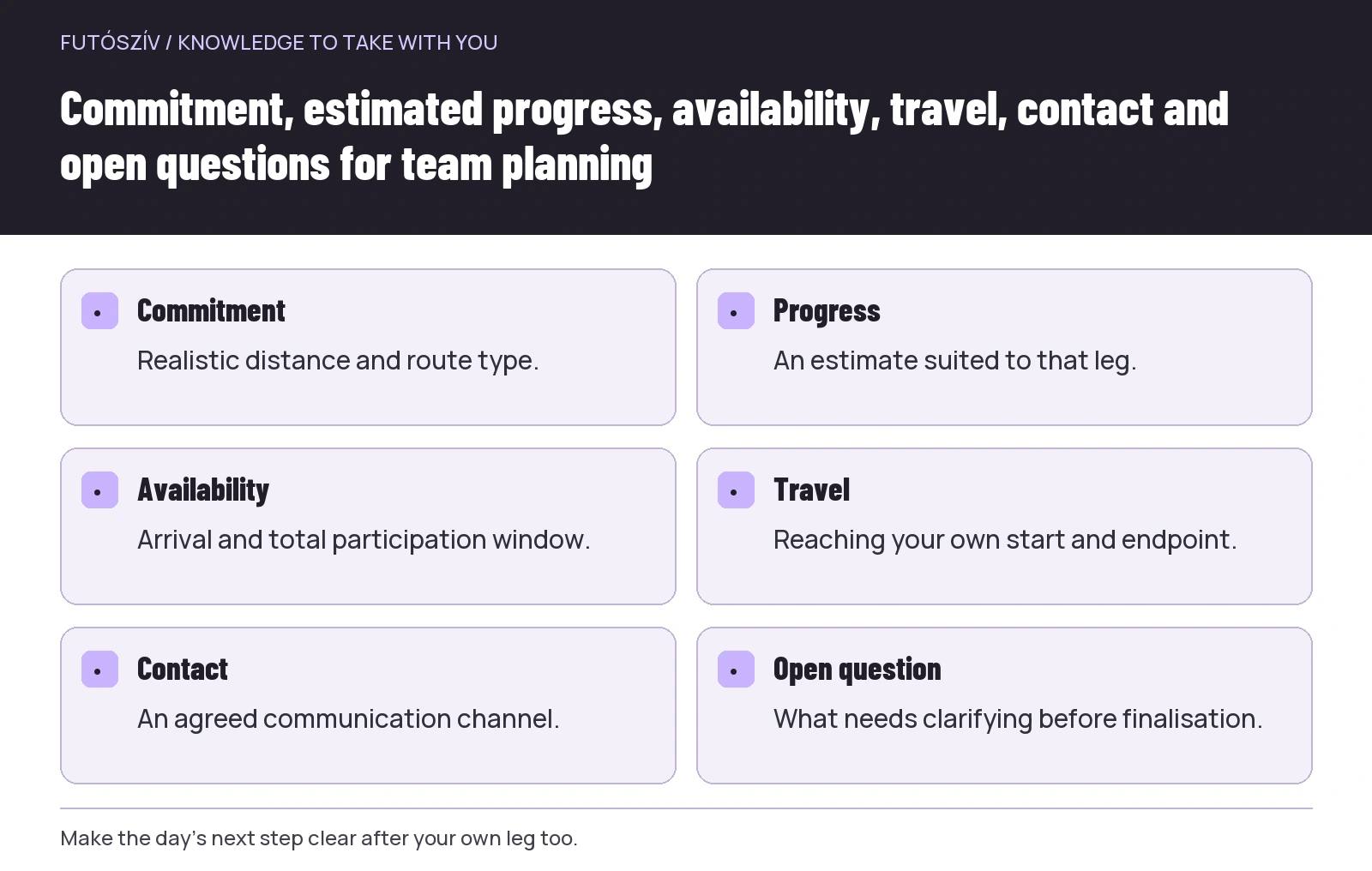 Enlarge diagram
Text version of the diagram
- Commitment
- Realistic distance and route type.
- Progress
- An estimate suited to that leg.
- Availability
- Arrival and total participation window.
- Travel
- Reaching your own start and endpoint.
- Contact
- An agreed communication channel.
- Open question
- What needs clarifying before finalisation.
Ask every member for the same information
Ask what distance and route type they can realistically undertake, their previous experience and availability. If uncertain about preparedness, they need to clarify it with appropriate professional help. A captain’s organisational role does not include deciding medical fitness.
Interpret expected pace for the particular leg. On different terrain or distance, the fastest short result is not a suitable sole estimate. Do not ask everyone for conspicuously optimistic numbers to beautify total team time. Realistic data support useful exchange timings and travel plans.
Do not treat an individual limit as an opening bid. If someone prefers a shorter leg of a familiar kind, that is planning information. Extra distance accepted under friendly pressure can make things harder for the whole team later. A precise commitment is more valuable than an enthusiastic but unconsidered yes.
| Member information | What should you ask? |
|---|---|
| Task undertaken | Which leg type and distance fit the individual situation? |
| Estimated progress | What realistic time can be planned for that part? |
| Availability | When can they arrive, and until when can they stay? |
| Travel | How will they reach their own start and endpoint? |
| Contact | Through which agreed channel can they be reached? |
| Open question | What still needs clarification before entry or allocation? |
Describe legs beyond kilometres
Add terrain, elevation, time of day and access to the exchange point beside each part. Equal-length legs can differ when one is easily reached and urban while another is a trail section after dark. Allocation needs to reflect required experience and equipment too.
For fixed legs, match members to suitable sections. Where the race allows more flexibility, examine permitted points and travel first. If transport cannot happen in time, an ideal running allocation on paper is unusable. Running routes and driving or public-transport routes are different planning layers.
Some points may have limited access or particular opening times. Organiser guidance is fundamental here too. Your spreadsheet does not replace on-site staff instructions. Plan approaches without relying on obstructing others or local traffic.
Create a first allocation, then request confirmation
A captain or designated organiser can draft a version from the information received. It is a proposal members must read back. Include name, leg, expected arrival and travel task together. Make confirmation specific so everyone knows what they accept.
Do not ask only “is everyone happy?”. In a long group message, overlooking one’s own row is easy. Request separate confirmation of the leg and travel. Mark uncertain fields open. Silence does not mean a considered commitment in every situation.
Give the version a date or simple version label. If changing it, do not resend an old file without explanation. One shared, clearly identified current plan reduces the chance of someone waiting at another point. Notify affected people separately too, particularly near the event.
Estimate arrivals while keeping uncertainty visible
An arrival plan needs starting time and estimated leg durations. In a simple example, six kilometres averaging 7:00 min/km take 42 minutes. This is arithmetic, not pace advice. Do not fit the next member’s preparation and travel exactly to the final minute.
The Ultrabalaton Trail leg-calculator description presents arrival planning based on start time, members, pace and leg allocation. Such a tool calculates from entered estimates. If an estimate or actual progress changes, update the plan too. Its output is not a guaranteed forecast.
Distinguish planned from actual time in communication. “We expect them then according to plan” and “they have now started the leg” are different data. Reporting an actual start can help the next member. Naming a time’s source reduces guessing.
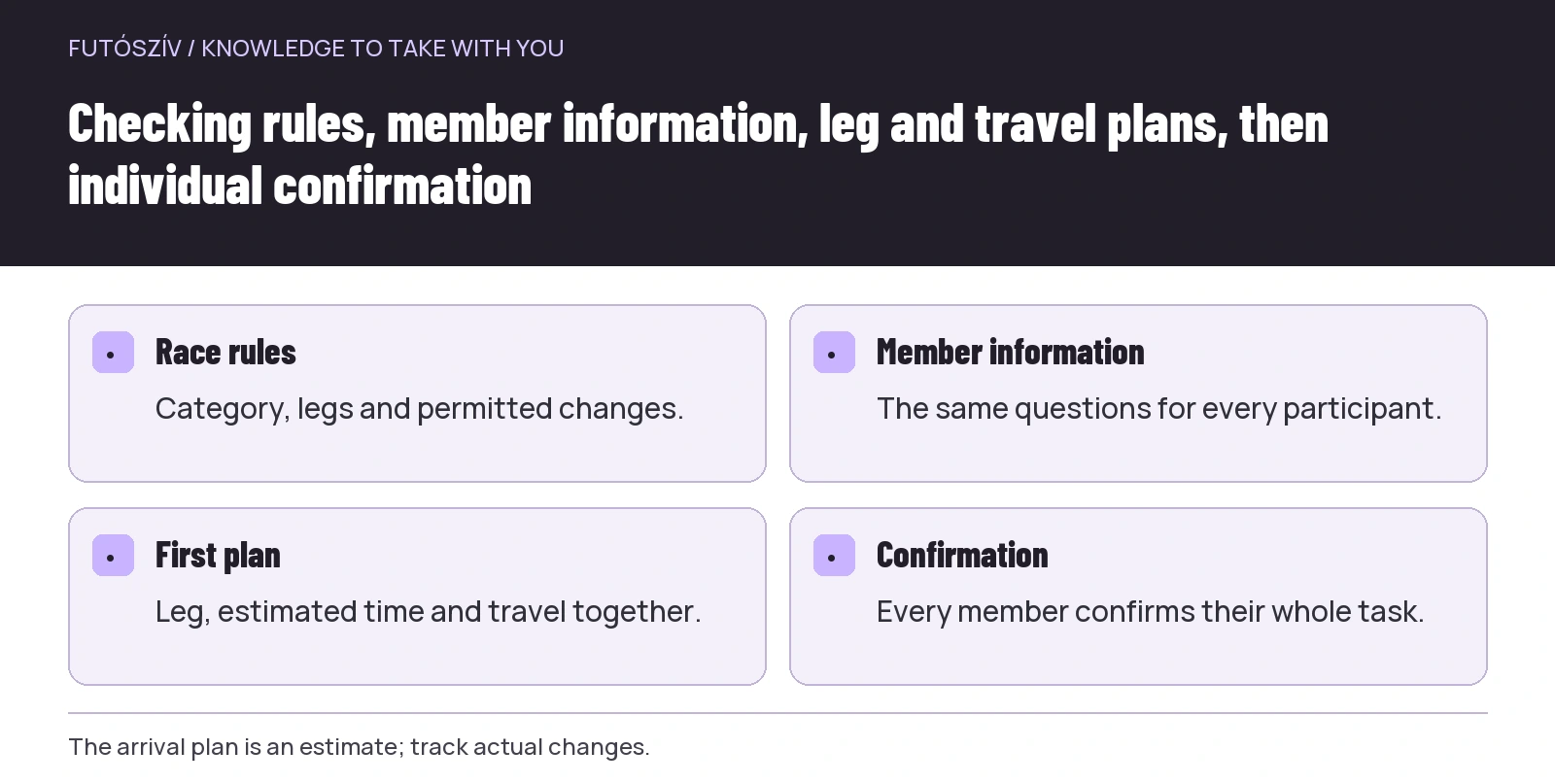 Enlarge diagram
Text version of the diagram
- Race rules
- Category, legs and permitted changes.
- Member information
- The same questions for every participant.
- First plan
- Leg, estimated time and travel together.
- Confirmation
- Every member confirms their whole task.
Different speeds can mean different logistics too
A faster runner may reach the next point sooner than the transport team can comfortably get there. Check travel particularly carefully for short legs. Faster running does not mean road travel can be hurried too. If the connection is too tight, change allocation or transport arrangements.
Slower progress may mean the next runner waits longer. Suitable clothing, supplies and time are needed according to individual requirements. Do not leave someone waiting without information when a significant change occurs. A brief factual update can resolve uncertainty without requiring the runner to keep phoning.
Clarify the next task of the member finishing a leg too. Where do they receive clothes, how do they travel onwards and when do they meet the team? The exchange ends part of their programme, not the whole day. Allocation is complete when nobody remains in an unresolved situation afterwards.
Do not make one person do everything
Captain, information coordinator, travel organiser and baggage handler may be different people. In a small team, one naturally has several tasks, but name them anyway. If every detail is on one phone and in one head, that person becoming unreachable can stall the whole system.
Coordinate running and driving roles responsibly across the day. Personal fitness to drive and current circumstances matter to travel; a name in a spreadsheet does not automatically make someone suitable for every task. Longer events need particular advance planning here. Team results never justify rushing traffic.
Share necessary contact details within the circle agreed by participants. The shared sheet need not be public. Make it available to those who need it for their tasks. Organisational clarity and justified data sharing can coexist.
Have a change procedure within race rules
If someone cannot undertake their planned part, check official modification options first. Member replacement, order changes and leg changes can have different conditions. Friendly agreement alone does not settle entry records. Deadlines and organiser administration may be needed.
For changes on course, use simple communication too: who decides, whom do they tell and where is the next definite meeting? Not every problem can be solved beforehand, but information flow can be named. The runner’s actual situation and staff instructions may take priority over original allocation.
If no compliant and appropriate continuation exists, the team must also be able to decide to stop. This is not merely one person’s “perseverance”. Report under the event procedure and organise onward travel. The shared aim may include every member closing the day in a clear, organised way.
A brief team rehearsal can reveal more than another spreadsheet
Before the event, talk through one exchange’s whole story. Who waits where, what do they carry, which object does the arriving runner hand over and how do they travel onwards? Review exact chip or bib use alongside organiser instructions. Seek missing information in the rehearsal rather than the fastest action.
By the end, every member should be able to explain their leg, travel, communication and next step after exchange. If anything is uncertain, there is still time to clarify. A team of different speeds can then arrive with a shared, understandable programme. An allocation’s value is coordinating participants’ real commitments and race conditions into one working day.
How Futószív articles are prepared: our editorial guidelines.