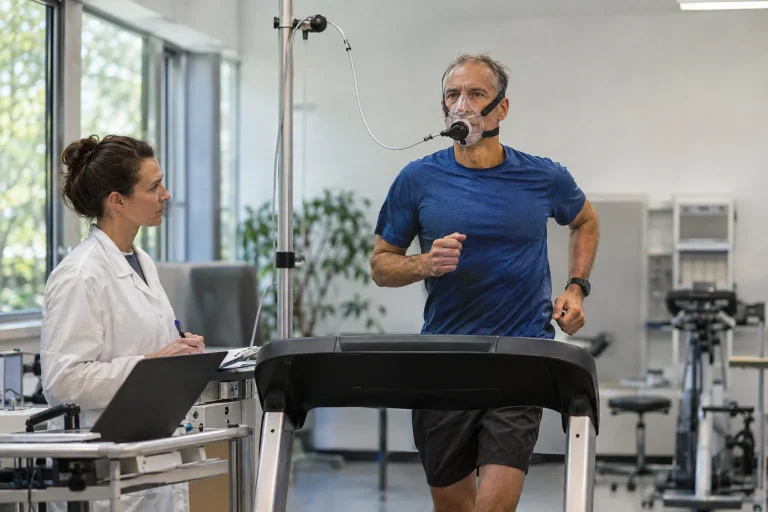
The name tempo run is both familiar and uncertain. One coach means sustained, controlled hard running; another means marathon pace; a watch manufacturer may mean a range within its own zone system. Before trying to execute a session labelled “tempo” precisely, find out what effort you want to sustain and for how long.
Properly understood, a tempo run is not a midweek test race. It is a task with planned difficulty, duration and place in the week. Useful execution often requires restraining the urge to prove yourself at the start and retaining choices at the end.
Look for the session’s sentence behind the label
“I am doing tempo today” provides little information. More useful is: after warming up, a set period of continuous, even, controlled hard running follows, then an easy ending. This supports choosing a route, intensity references and evaluation.
Clarify whether the main set is one continuous section or blocks interrupted by short easy parts. The structures differ even when work time totals are equal. Dividing into blocks changes loading continuity, rather than merely making the watch easier to read.
It also matters whether the aim is practising current race pace or approaching intensity estimated from a measurement. The two may relate but are not automatically identical. A pace calculated from a future dream time does not prove you chose an appropriate speed for today.
What does controlled hard effort mean?
You are doing noticeable work and breathing more firmly than during an easy run, but speed does not force immediate struggle. At the main set’s start, the aim is not to find the hardest tolerable feeling immediately. Loading develops over time, so a calmer beginning is not wasted time.
Perceived effort is useful but needs learning. The same number can differ on two people’s scales, and a difficult workday may alter the session’s experience. A brief sentence about breathing and control often preserves experience more accurately than an isolated value.
Losing comfortable conversation can suggest leaving the easy range, but a talk test cannot reveal an exact upper lactate threshold. A field impression provides direction; do not claim laboratory precision for it.
Threshold is not one magical pace
Lactate threshold and its associated running speed are not interchangeable concepts. A study involving seventy-five female and male competitive runners analysed relationships between several physiological factors and speed assigned to the threshold. The findings also remind us that a single percentage does not fully explain running pace.
“Threshold” is also used under different measurement and calculation methods. If receiving test results, ask which boundary was estimated, using what protocol and how it translates into practice. Even a colourful zone chart needs an understandable definition behind it.
You do not need to measure threshold before every tempo session. A conservative starting point, clear task and retrospective evaluation may matter more. The physiological concept can support thinking but does not replace daily regulation of loading.
 Enlarge diagram
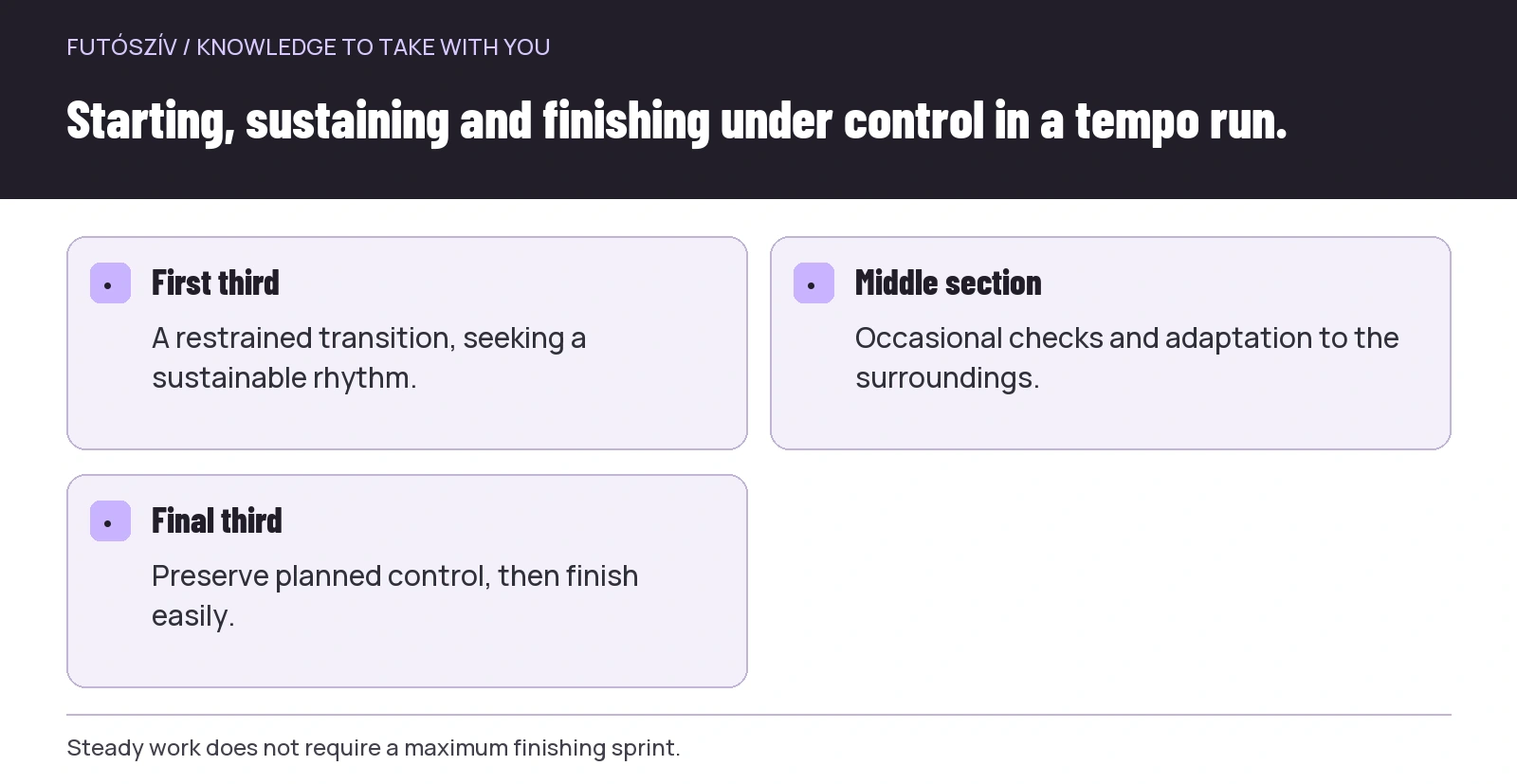
Text version of the diagram
- First third
- A restrained transition, seeking a sustainable rhythm.
- Middle section
- Occasional checks and adaptation to the surroundings.
- Final third
- Preserve planned control, then finish easily.
Why not start blindly from a race distance?
Ten-kilometre or half-marathon race pace represents different load durations for different runners. A half marathon is close to an hour for one person and several hours for another. The same race name cannot therefore be assigned the same exercise-physiology range for everyone.
The result’s date and conditions matter too. An old personal best, or one run downhill or in cool weather, may not be a useful benchmark for a hot session today. Current preparedness and daily surroundings may override an apparently logical target pace on paper.
If using a race-derived training reference, treat it as an initial estimate. During the main set, observe whether the assigned pace actually produces the intended effort. A good session does not have to validate a chart in every condition.
Continuous running or blocks?
In the continuous version, observe how breathing, attention and pace develop without interruption. Starting matters particularly because no short recovery resets the task. Main-set duration is therefore one of the most important planning variables.
Blocks provide more opportunities to check control and adjust. However, easy gaps can tempt you to run every work section harder than planned. A pause does not automatically authorise acceleration.
Moving between forms is not simple addition. Previously completing a total time in short blocks does not establish that the same time continuously is an appropriate starting point. Changing structure is a loading modification in its own right.
The first third is for starting appropriately
At the main set’s beginning, find a rhythm you can imagine retaining for the whole planned duration. Instead of an immediate charge, allow a short transition from easy running into the target effort. Do not confuse initial freshness with unlimited reserve.
If in the first minutes you are already counting what remains and thinking only about enduring it, review the pace. The speed may be too hard, the plan too long or the day unsuitable for this task. Correction generally costs less early than after complete exhaustion.
In a session planned to be even, you do not need to react to another runner passing or a brief watch fluctuation. Your task lasts longer than an encounter on a path. You do not need to renegotiate a good rhythm in response to every external cue.
Pay attention in the middle without analysing every step
Occasionally check that breathing and movement still match the aim. A brief internal check may be enough. You do not need to spend the whole sustained section constantly checking posture and counting.
Pace may naturally change on small climbs or in wind. Even effort does not always draw a straight pace line. Forcing your average back on every hill can easily turn the session into repeated bursts of strain.
Let the watch provide feedback rather than continuous judgement. Delayed heart-rate increases or inaccurate instantaneous GPS pace do not justify speeding up and slowing every few seconds. Evaluate data over a broader context alongside your own sensations.
You do not need an exam at the end
If you planned sustained, steady work, retaining control at the finish is a good result. A maximum finish adds a new task. That may deliberately belong to another session, but should not become a compulsory ending to every tempo run.
The last third can help evaluate the start. If you slowed markedly or movement fell apart, you gained useful information for next time. There is no need to rename a poorly chosen pace afterwards as willpower training.
Allow time for an easy ending too. A session contains more than fast-section kilometres. Getting home, eating and the next day’s load also affect how sustainable the whole programme is.
 Enlarge diagram
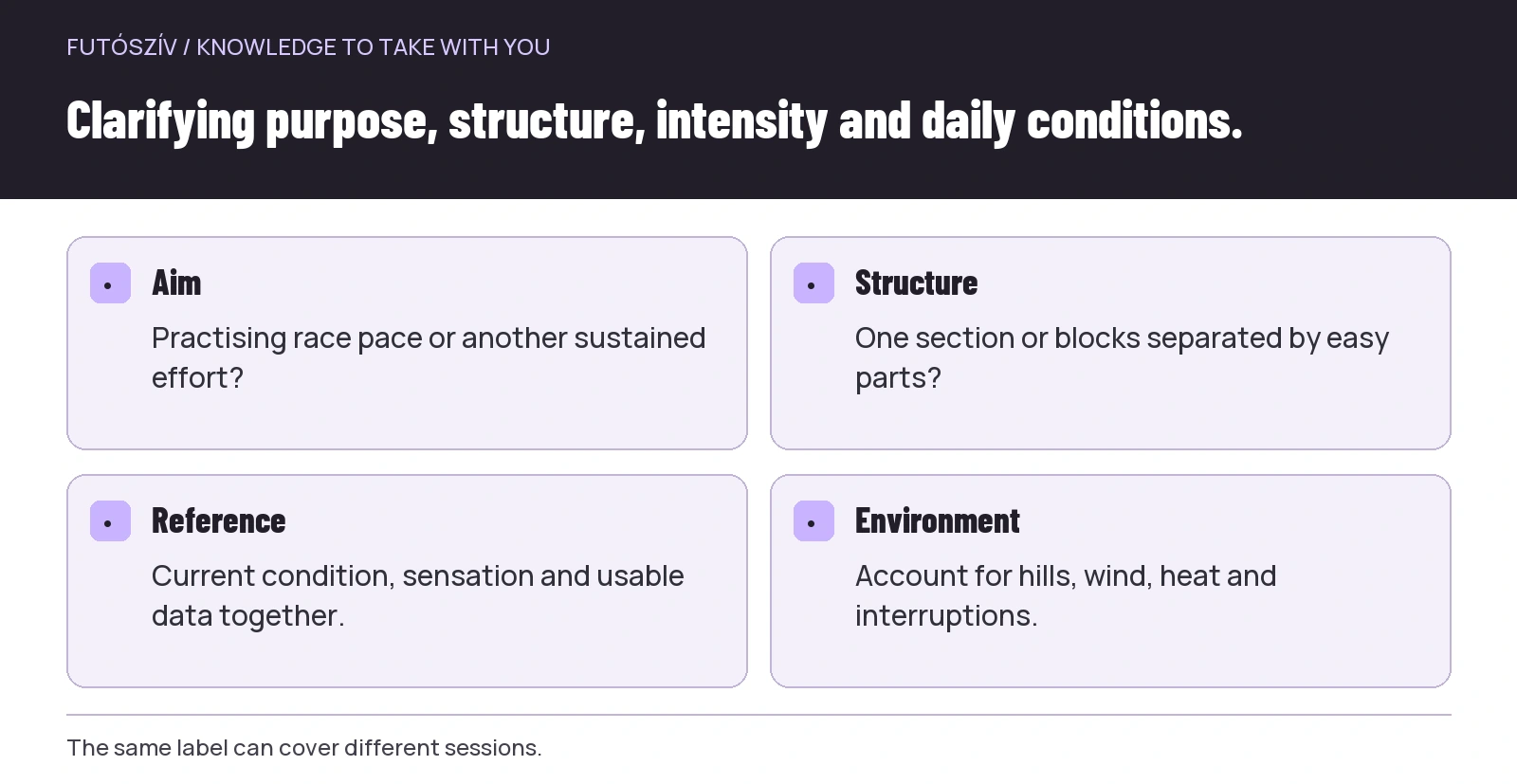
Text version of the diagram
- Aim
- Practising race pace or another sustained effort?
- Structure
- One section or blocks separated by easy parts?
- Reference
- Current condition, sensation and usable data together.
- Environment
- Account for hills, wind, heat and interruptions.
Why should every run not be moderately hard?
An early experiment examining intensity distribution compared different proportions of easy and moderately hard work in trained runners. The whole programme’s structure mattered; the finding did not concern whether one tempo run was necessary or unnecessary.
In a study with thirty recreational runners , both groups with different intensity distributions improved over ten kilometres, while the difference in improvement between groups was not significant in the primary comparison. This is more nuanced than one label winning for everyone.
The everyday conclusion is that tempo running is one tool within a programme. If every easy day also drifts unnoticed into this effort, differences between days can disappear. Do not try to prove a plan’s seriousness by maximising hard sections.
Ask about the outcome measure too
A randomised study comparing different running sessions also measured maximal oxygen uptake; on this measure, high-intensity interval groups showed more favourable changes than the continuous versions studied. This does not make every other session worthless.
Running performance, capacity to tolerate loading and a laboratory measure are different concepts. If a method changes one measure more, that does not imply building all preparation around that method alone. Different sessions can have different tasks.
When reading a research title or social post, ask what was measured, in whom and against what comparison. This separates an interesting result from an exaggerated personal promise. Interpret tempo running’s usefulness in the same way.
Route and surroundings: conditions for maintaining pace
For continuous work, a route with few interruptions and clear visibility is useful. A pedestrian crossing, busy junction or crowded park is not a place to insist on uninterrupted running. Stop when necessary; safety is not a flaw in training data.
A circuit may simplify navigation, but monotony or frequent bends can distract. On a straight route, the turning point and wind direction matter. Do not evaluate location solely by length on a map.
In heat, the same external pace can create different internal loading. Restraining effort, shortening the main set or moving it to another day may be appropriate. A kilometre pace chosen in cool weather is not a compulsory commitment in every season.
What feedback should you give your coach or yourself?
Instead of “done” or “could not do it”, describe where the task changed. Was the start easy but the finish uncontrollable? Did breathing remain manageable while legs tired? Did the surroundings interrupt running? These can justify different next decisions.
Do not hide health symptoms within a session rating. Recurring pain or unusual illness is a separate signal that may require individual investigation or loading discussion. Severe chest symptoms, fainting or breathing difficulty may require immediate help.
A good log does not demand constant self-justification. It can include shortening the main set because of that day’s condition, thereby keeping the session composed. This is decision-making experience that can improve the following week’s plan.
Sources
- Factors Influencing Running Velocity at Lactate Threshold.
- Impact of training intensity distribution on performance in endurance athletes.
- Does polarized training improve performance in recreational runners?
- Aerobic high-intensity intervals improve VO2max more than moderate training.
This article explains concepts and decisions in execution. The research concerns particular groups and protocols; it does not provide a pace or weekly dose applicable to everyone.
How Futószív articles are prepared: our editorial guidelines.