In a shared household, time for running can connect to several people’s days even if only one runs. Someone shops, stays with a child, receives a delivery or simply wants their own programme in the same slot. A workable agreement therefore says more than when the runner leaves: it also identifies tasks remaining and each person’s own time.
This can concern couples, families and other shared households. Everyone need not exercise, and personal time need not involve the same activity. The following method helps organise specific time windows, handovers and arrangements. The aim is a week where others’ commitments are visible alongside running.
Discuss the entire absence rather than departure alone
“I will run for half an hour” often means only recorded moving time. Preparation and travel may come before it, followed by returning, washing and changing. If others expect you to take over a task after half an hour, misunderstanding can arise. State the entire programme’s time window and mark separately when you will genuinely be available again.
Make the window realistic. Outings always extended by a few minutes can become unpredictable waiting for the other person. If more time is often needed, include it in the next arrangement. A more accurate window leaves less room for argument than an optimistic promise followed by an explanation.
The role of social surroundings in organising activity is also discussed on the CDC page on overcoming barriers . In your household, a specific request for help might mean agreeing on a time beforehand. Saying which task needs covering on Tuesday and until when is clearer than a general “support my running”.
Put fixed tasks on the table first
Review work, travel, agreed meetings and household tasks tied to a particular time. With children, this may include drop-offs, pickups and arranging necessary supervision. Elsewhere, care or shared-transport tasks may matter. These reveal when someone definitely needs to be available.
List more than visible execution. A programme can include preparation and organisation too: booking, packing, finding necessary items and coordinating by phone. These tasks do not necessarily disappear when someone leaves to run. Name organisational work too when reviewing the full load.
You do not need to score every everyday action. The aim is to make specific tasks affecting that window visible. If conflict always appears at the same point, write it separately. Instead of “you always leave at the wrong time”, “the handover before dinner is unresolved” becomes a solvable question.
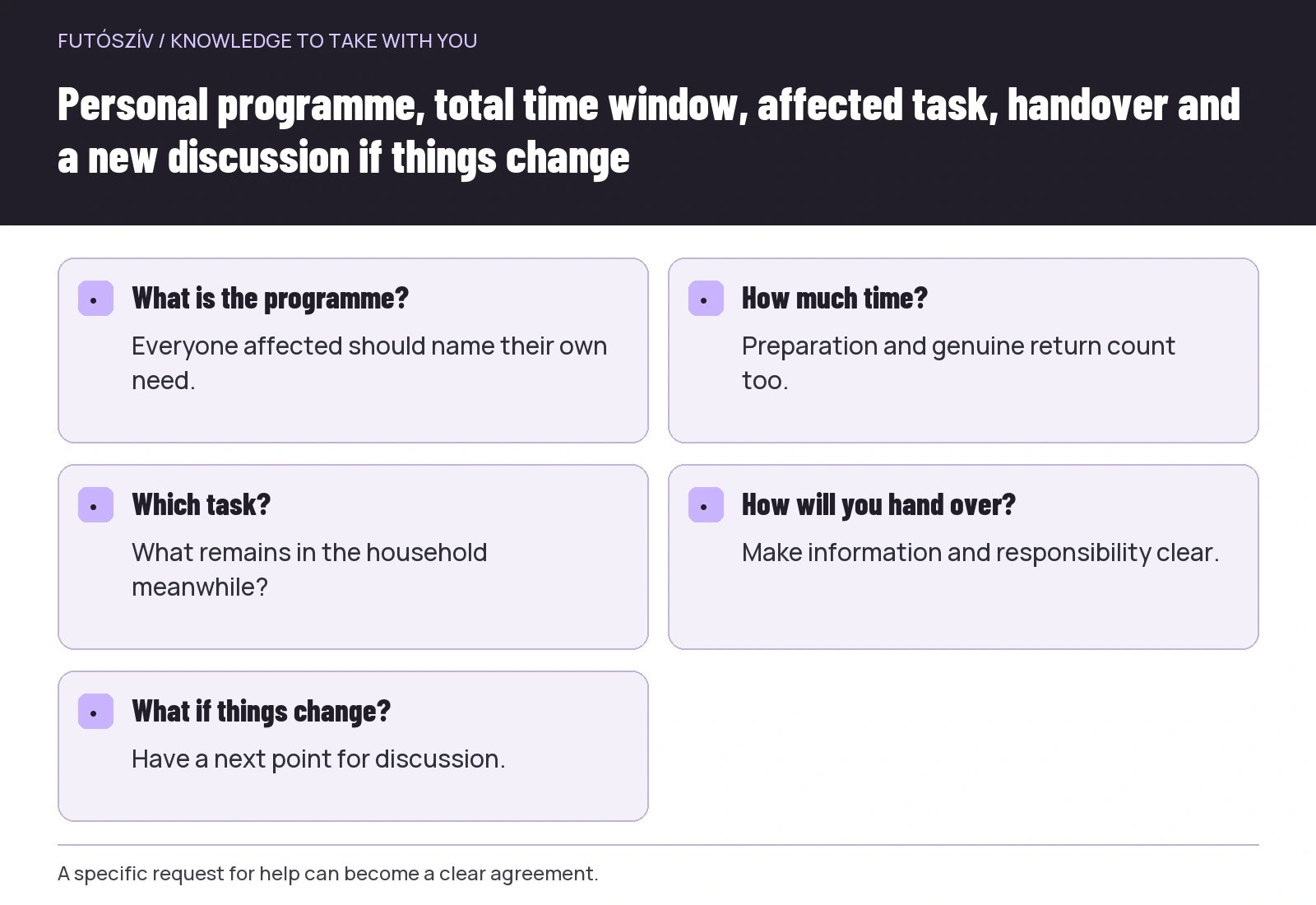 Enlarge diagram
Text version of the diagram
- What is the programme?
- Everyone affected should name their own need.
- How much time?
- Preparation and genuine return count too.
- Which task?
- What remains in the household meanwhile?
- How will you hand over?
- Make information and responsibility clear.
- What if things change?
- Have a next point for discussion.
Ask everyone affected about personal time
One person’s run should not automatically be more important because it relates to a race entry or visible training plan. Another person’s reading, meeting, creative work or chosen programme can be a real need too. The calendar concerns the time window and required handover, not how impressive an activity looks.
Even if both of you run, you may want different things. One may seek company and the other independent time. A shared run replaces two personal outings only if both genuinely choose that. You do not have to turn every individual need into a joint activity to simplify organisation.
Ask specifically: which next outing matters, how much total time does it need and what is flexible? You can coordinate from the answers. An unnamed need can easily be sidelined, but the other person should not have to guess it. A precise request can be paired with a precise commitment.
Distinguish four kinds of time
| Type | What does it mean? | How should you handle it? |
|---|---|---|
| Fixed shared task | It must happen at a particular time | Identify responsibility and necessary handover beforehand |
| Agreed personal time | Someone follows their own programme | Record the entire time window |
| A jointly chosen activity | Everyone concerned prepares for the same outing | Clarify the purpose and ending together |
| Backup | An examined option for disruption | Do not let it become an unnoticed new obligation |
Categories help recognise when two different roles become mixed. A family walk can be a shared experience without necessarily being the same as one person’s chosen run. A trip combined with shopping may be practical but does not always replace personal time. Those involved can clarify the meaning together.
A handover needs an ending and taking back
If someone takes over a task at departure, explain what it needs and when you will resume it. Instead of “I will be right back”, a specific window and next task help more. For example, who starts dinner, whom you still need to call or when the next family activity starts. A handover works when the other person is not searching for missing information.
For childcare, an agreed, appropriate supervision arrangement is a basic requirement. Do not bridge an organisational gap by assuming nothing will go wrong for a short time. Adapt the specific situation to the child’s needs and responsible agreement among the adults involved. The running window does not override these conditions.
The NIDDK practical guide also names childcare as a barrier that can arise in organising movement and mentions seeking reliable help. In your situation, this can be used as an option agreed beforehand. Another person’s availability must not be assumed simply because they helped before.
Make resuming responsibility clear on returning too. If you still need time to get ready, include it in the original window. Your companion should not have to ask again when they can begin their own activity. More accurate planning of the entire outing’s end often simplifies the whole evening rhythm.
An illustrative example with two separate departures
In one household, both adults want their own exercise time. On a weekend morning, one leaves first while the other stays with the shared task, then they swap after a realistic handover point. Between the two programmes, there is time to return and complete necessary preparation. They do not hand each other every open question at the gate while dressed to run.
They discuss the difference between the shorter and longer outing beforehand. They do not necessarily choose equal minutes, but both needs are visible across the whole week. If the longer programme involves travel, its complete time appears too. The system compares actual changes in availability at home rather than running-watch data.
This is a scheduling example, not a template suitable for every household. Another family situation may need help, another day or an entirely different format. The lesson is the complete window and handover named beforehand. Without them, even a well-intended swap can become waiting for each other.
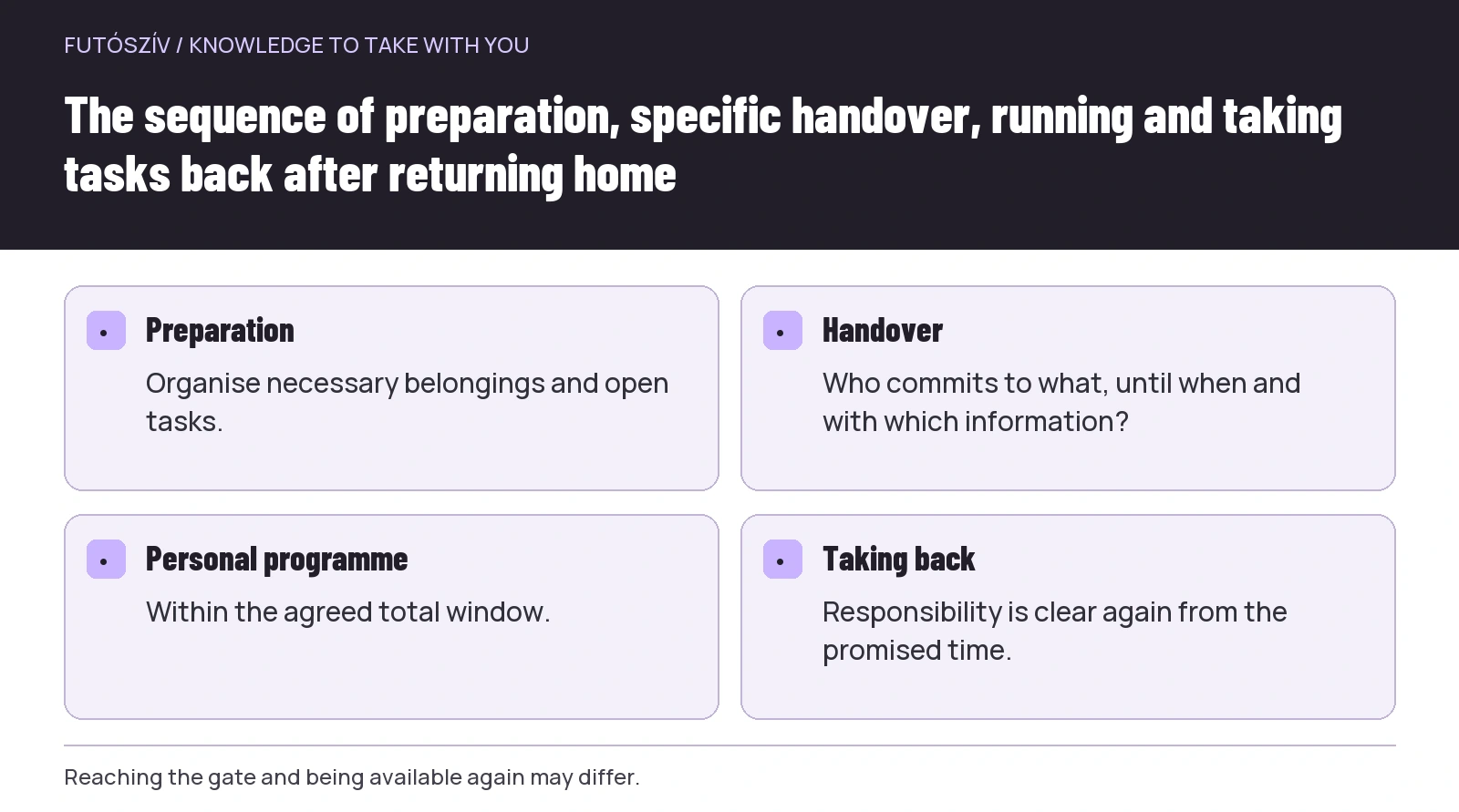 Enlarge diagram
Text version of the diagram
- Preparation
- Organise necessary belongings and open tasks.
- Handover
- Who commits to what, until when and with which information?
- Personal programme
- Within the agreed total window.
- Taking back
- Responsibility is clear again from the promised time.
If only one of you runs
Support from the other person does not mean they must learn to love running too. Working specific agreements and visible personal time for them may be enough. Share as much running detail as the common calendar needs. Different interest in kilometres does not prevent precise coordination.
During race preparation, communicate temporarily longer programmes in good time. One important event can involve many separate occasions: training, travel, race-pack collection and the race itself. Together they affect the family schedule. Entering does not itself mean every related window is automatically agreed.
Ask separately about accompanying you too. Someone may enjoy travelling with you to a race; another may have other plans. Cheering, looking after bags and driving home are separate tasks, not compulsory extras. A specific request for help gives the other person a genuine choice and makes your own logistics more precise.
When the day changes unexpectedly
First resolve the fixed task and a safe solution. Illness, late work or another unexpected circumstance may require reviewing the earlier calendar. Do not pretend the original conditions remain unchanged. You can discuss modification factually with attention to the next step.
Keep missed personal time in mind, but do not turn it into punitive point scoring. Look together for the next usable opportunity. If the same person’s programme repeatedly falls through, review that separately. A lasting pattern is a different question from one exceptional evening.
A useful sentence might be: “Today’s plan no longer works. When shall we look at the next real opportunity?” This acknowledges the missed outing and creates a place for another discussion. It does not promise a replacement without an available time. A specific next conversation reduces unresolved expectations.
Consider balance from several perspectives
Equal minutes do not necessarily give everyone equally usable time. A calm, predictable window can differ from several small opportunities interruptible at any moment. Discuss predictability and related tasks as well as length. Those affected can explain what works for them.
Longer-term sporting goals are also worth planning together if they significantly affect shared time. Every week need not look the same. A period around a race can differ if commitments are clear and you discuss the later period too. An explicit, manageable agreement matters more than an apparently perfect template nobody chose.
Travel, preparation and equipment care can use shared resources alongside running. Ignoring them completely may give one person a different sense of the programme’s real cost. Naming tasks is not an argument against sport; it is a condition for more accurate organisation.
A short weekly discussion with five questions
What next personal programme do you particularly want to organise? What is its complete time window? Which shared task does it affect? What is the exact handover method? When will we review it if something changes? A few specific answers may be more useful than a general argument about who has how much free time.
After discussion, the calendar should show departure, genuine return and responsibility for the affected task. Mark anything still uncertain too. Shared uncertainty is easier to manage than contradictory plans each privately assumed to be certain. Everyone can then start from the same information for the next outing.
Workable running time is ultimately more than an entry about running in a calendar. It is an agreement in which time, tasks and others’ own needs are recognisable. It needs adjustment occasionally, but not necessarily renegotiation from scratch every week. A few well-chosen questions can create a repeatable, clear shared arrangement.
How Futószív articles are prepared: our editorial guidelines.