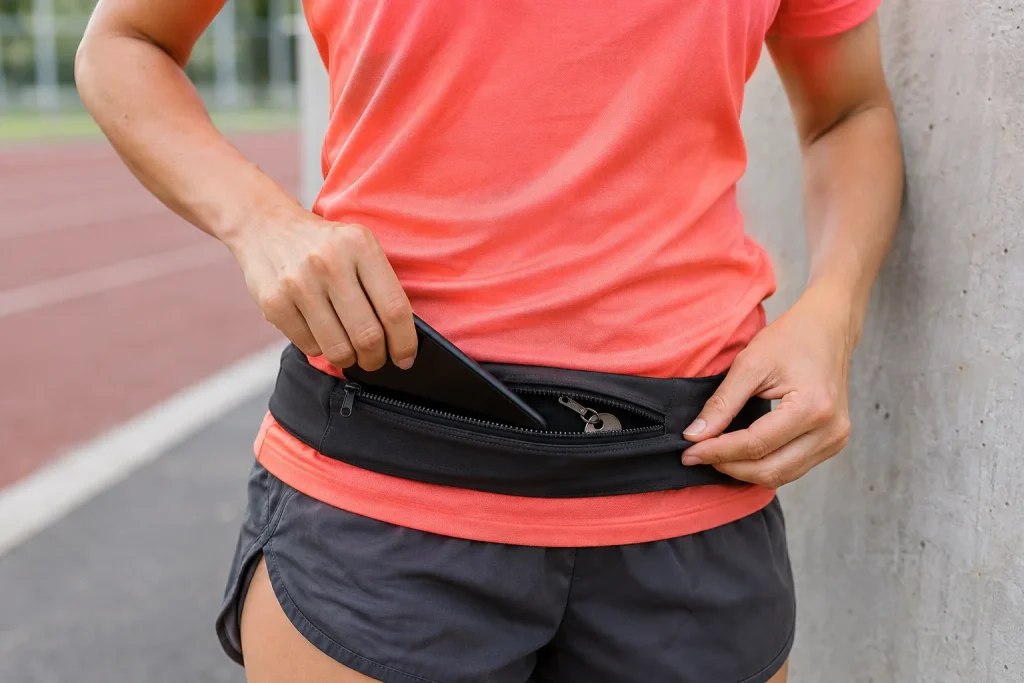
Putting away a phone and keys seems minor but can spoil a whole run. A bouncing phone makes you adjust shorts, while gripping it in a hand continually demands attention. A running belt can offer a simple answer if it suits your proportions, clothes and objects. An empty comfortable strap does not establish loaded performance. A good trial examines the whole arrangement: what you carry, where, how you retrieve it and how it stays put when you want to stop thinking about it.
Two basic forms, several adjustments
Belts include buckle-and-adjuster designs and continuous elastic versions chosen by size. Construction determines dressing, fine adjustment and pocket positions. The SPIbelt FAQs provide manufacturer information on sizing and loaded use, among other things; the FlipBelt size chart illustrates another sizing system. These are not independent rankings. They show differing selection and usage conditions behind the same “running belt” name.
For adjustable straps, inspect adjustment range, buckle location and loose ends. For elastic belts, inspect size and how to put them on. Do not assume your trouser size translates automatically. Measure where instructed and try at the actual wearing height. Waist and hip areas differ in shape and circumference. The belt must work where you use it, not an average position implied by a general label.
Your phone and its case are one object
Before buying, examine the device with its actual case and attached accessories. A thick case edge or camera bump can sit differently even in a theoretically large pocket. Fitting inside differs from stable carrying and easy retrieval. Check fabric tension, closure operation and corners pressing your body. The FlipBelt manufacturer Q&A offers device-carrying information too, without replacing your own trial.
Do not place a phone solely where it is least visible. Front placement may ease access, rear placement feel different and side placement meet an arm. These are trial questions, not universal rules. Pocket design and intended use determine supported positions too. Do not randomly reverse or alter a product described for specific use. Seek stable, comfortable, safely manageable carrying with your route and clothes.
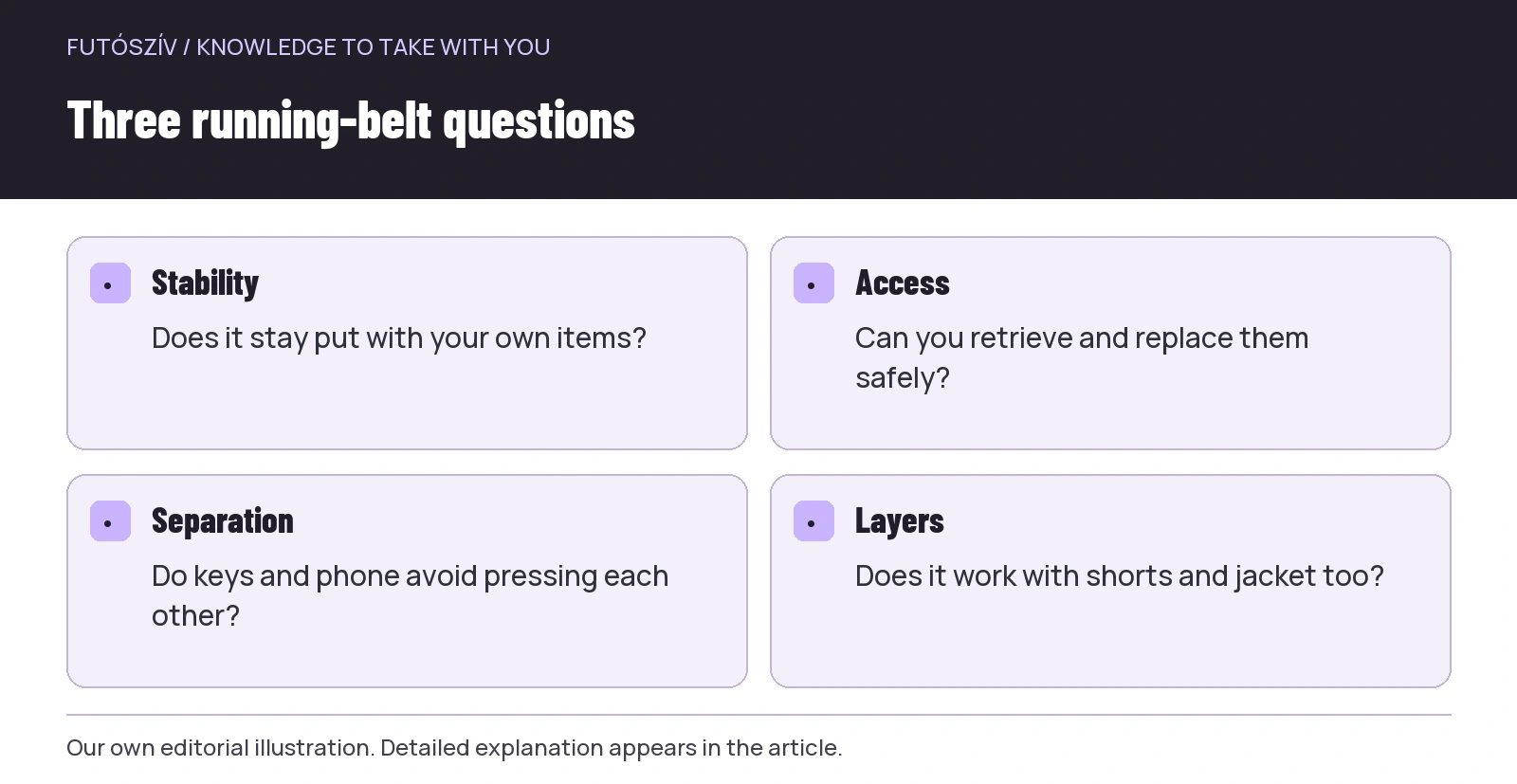 Enlarge diagram
Text version of the illustration
- Stability
- Does it stay put with your own items?
- Access
- Can you retrieve and replace them safely?
- Separation
- Do keys and phone avoid pressing each other?
- Layers
- Does it work with shorts and jacket too?
Think about keys separately
Keys dropped beside a phone can make noise and press the device or belt fabric. Use separate compartments or purpose-designed attachment as instructed. Edges can rotate differently while running than standing. Give small objects defined places. Do not hurriedly dismantle a keyring inside the belt just before departure; organise necessary, safely separable items beforehand. The goal is predictable access on returning home too.
Separate frequently needed personal items from rarely used ones. Do not automatically put a card in an open compartment where removing the phone could shift it. Opening direction and closure are real functions. An orderly belt means knowing what happens to other contents during each action. Cramming everything together seems quick initially but later brings searching and loss. Precise arrangement simplifies use rather than complicating it.
Why bouncing is not always a size problem
Tension, position, object mass and distance from the body affect bounce. A large belt may be too loose; a poorly loaded pocket may need more than adjustment. Start with familiar intended settings and change individually. Phone placement, neighbouring items and strap position can be examined separately. Moving everything obscures what solved the problem. A useful trial seeks understandable relationships rather than accidental success.
Tightening is not an unlimited answer. A belt should hold with normal breathing and natural movement. If it presses, twists clothes or needs constant adjustment, reconsider size and design. Another shape or carrying method may fit better. Belts are not compulsory. Well-designed shorts pockets or a suitable vest may handle the load better. The aim is not forcing a belt to work at any cost.
Belt and shorts move together
One belt may behave differently on high and low waistbands, smooth and rough fabric or tucked and untucked tops. Try actual clothes. Check buckles over drawcord knots, belt edges bunching tops and pockets pulling the setup down. The problem may be where garments meet. Observe arrangements before buying another belt. Components should not work against each other.
Jackets and race numbers affect access too. If you may need the phone, know how many layers cover it. Follow number rules without hiding readability for belt convenience. You do not want to repack all pockets whenever adding or removing a layer. Rehearse calmly at home. Access arranged beforehand is especially useful when tired, wet-handed or wearing gloves.
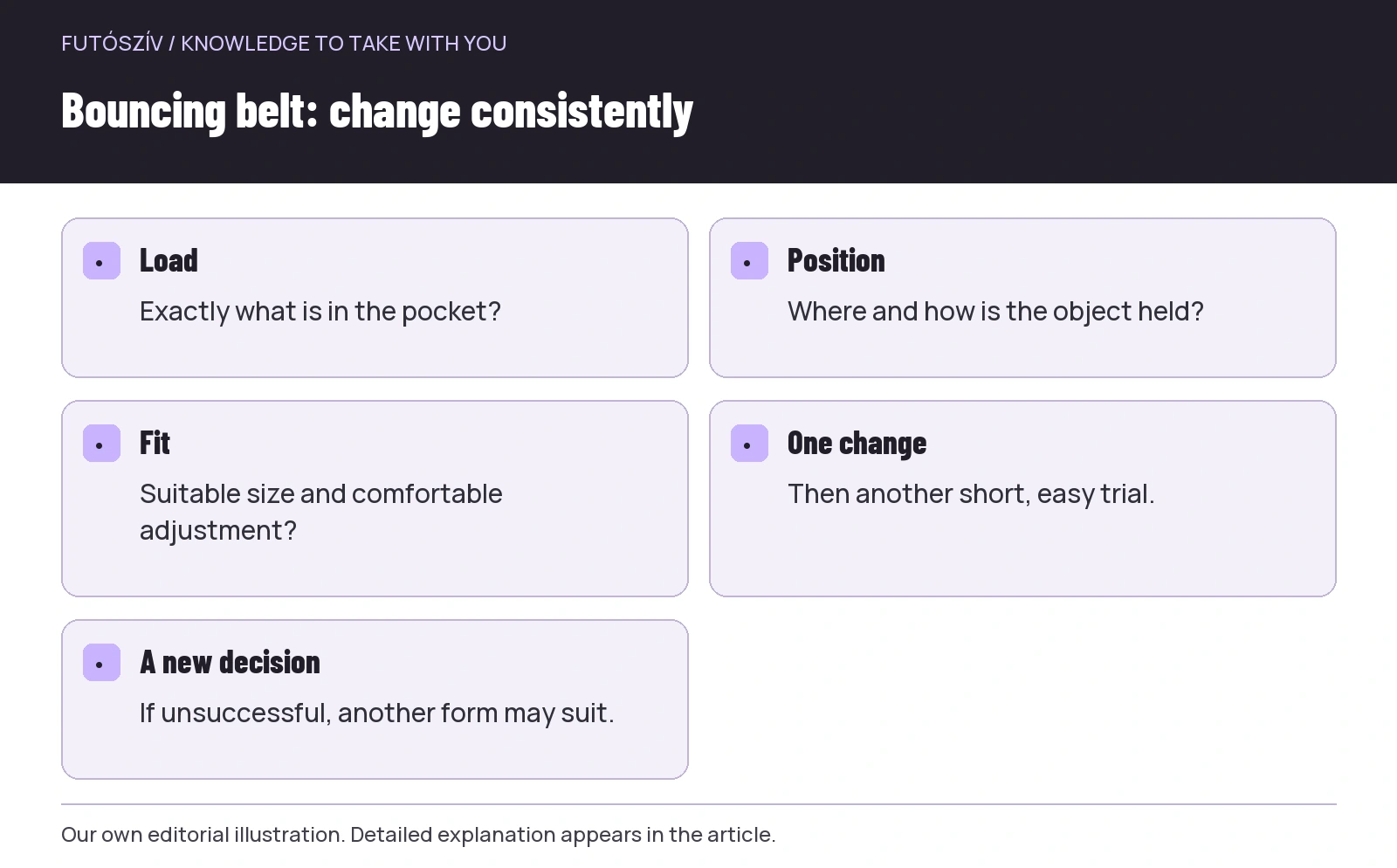 Enlarge diagram
Text version of the illustration
- Load
- Exactly what is in the pocket?
- Position
- Where and how is the object held?
- Fit
- Suitable size and comfortable adjustment?
- One change
- Then another short, easy trial.
- A new decision
- If unsuccessful, another form may suit.
Four real usage situations
A short city loop usually needs a simpler load. With only phone and keys, do not fill remaining compartments with unnecessary reserves. Try the actual phone size with keys separated. Aim to jog without attending to the belt and retrieve the device at a safe stop. Running while watching a screen is unnecessary. Carrying usability is not measured by how quickly you read messages on the move.
Longer running may add food or other items. Check intended use and comfortable load limits. Consuming supplies changes arrangement: give empty packaging a place and secure bottles through supported methods. If all necessities do not fit stably, do not omit important equipment for the belt’s sake. Another carrier or revised route may be better. Choose capacity for the task rather than adapt the task to a pocket at hand.
After-work runs include changing and getting home alongside keys, access cards and phone. Avoid carrying what can stay more safely in appropriate storage, while ensuring needed access in advance. Travelling or unfamiliar places still require attention to personal-item security; a familiar belt does not solve it alone. Closure, awareness and circumstances matter. A light running pocket is not automatically secure storage or anti-theft protection.
At races, the belt works with numbers, fuel and mandatory kit. Start from current event rules. Rehearse the actual load and assess partly empty conditions resembling the finish. Organiser-provided drinks do not necessarily remove your own planning. A belt handles carrying; individual fuelling quantities are separate. Coordinate them before race day.
| If this happens | Check first | Next trial |
|---|---|---|
| Phone bounces | Pocket position, tension and arrangement | One change, then easy jogging |
| Belt twists | Load and clothing interaction | Another arrangement or more suitable size |
| Buckle presses | Exact location and knot beneath | A manufacturer-supported position |
| Phone is hard to retrieve | Opening, case and outer layers | Safe stationary access trial |
| Always too many contents | Real needs and capacity | Another carrier for the task |
Do not infer waterproofing from the pocket name
Technical fabric does not automatically make a belt waterproof. Sweat, rain, zips and openings shape protection together. Read the exact manufacturer claim and limitations. Interpret the phone’s own water protection only through its current manufacturer information too. With separate protective packaging, retest the pocket because size and access change. Packaging must work in the hand as well as against water. Seek a checked system rather than an assumed secure pocket.
Test access at home without endangering valuable electronics. You need not pour water on your phone to check case and belt handling. If protection is not claimed, do not create your own certification from a brief home experiment. Carrying and water protection can be separate functions. Accept that and assemble accordingly. The point is realistic expectations, not one belt serving every possible task.
Care, condition and a reliable arrangement
After running, empty even damp packaging and small objects, then clean and dry by instructions. Inspect closure, strap, buckle and seams. Stretch or damage can change former security. A phone falling out or uncertain zip is not merely cosmetic. Reassess function. A repair should retain hold and comfortable contact rather than only hide a hole.
Keep the reliable arrangement easy to recreate. Know phone, keys and rarely needed items’ positions and settings for usual clothes. Recheck with other loads or thicker layers. A good belt is not the most pocketed or tightest; it works comfortably and stably with your contents. Assess body position, arrangement and access together. This creates a carrying solution that usually stays unnoticed during running.
Sources and further reading
- SPIbelt: manufacturer questions on size and use
- FlipBelt: official size chart
- FlipBelt: product and device-carrying information
How Futószív articles are prepared: our editorial guidelines.