Replacing a worn watch strap is a good opportunity to keep using a working running watch. The choice does not end with colour and width, however. Attachment system, exact watch model, wrist-appropriate length and clasp operation all matter. Similar-looking straps are not necessarily interchangeable, and a part positioned in place may not be securely attached. This guide proceeds from gathering information before purchase to a calm post-replacement trial, without brand rankings or a universal fitting recipe.
When is replacing the strap worth considering?
Distinguish cleanable dirt, uncomfortable adjustment and actual damage. A dusty strap does not automatically need replacing, while a cracked component or unreliable closure is more than a cosmetic issue. Check around holes, clasp attachment, keepers, the textile fastening surface and the connection to the watch. If the fault is in the case or its attachment point, a new strap alone may not resolve it. Clarify continued use and repairability with the manufacturer or service centre in that situation.
A strap change may also reflect a simple change in needs: a different length, finer adjustment or another material. Put this into a precise sentence. During running, one of two adjacent holes being too loose and the other too tight is a concrete problem; “I want a sportier strap” is less useful for choosing. If you have skin symptoms, do not determine their cause or treatment solely from strap material. Material selection and device care are technical questions; evaluating a health problem is a different task.
Identify the exact model, not the brand family
Write down the watch’s full name and case variant if necessary. Different sizes or generations within a product family may require different straps. Device system information, back markings and purchase documents may help identification. Then find the strap section of the correct manufacturer manual. If a retailer gives a short compatibility list cramming many models into one line, compare it with your watch’s documentation. A similar name does not replace this check.
Extract three things separately from the model’s instructions: attachment-system name, required size and the role of any adapter or tool. Do not assume every solution called quick release is identical. Everyday language uses the same term for many attachments. Precise manufacturer terminology helps both searches and support enquiries. A pre-purchase information sheet takes a few minutes but can prevent returning a wrongly chosen accessory and guessing during fitting.
Width and attachment system are two pieces of information
The Garmin comparison of QuickFit and Quick Release expressly treats these as separate systems and states they are not interchangeable. This illustrates why matching a strap’s nominal millimetre width is insufficient. Connection geometry and operation are also part of compatibility. Choose using your exact watch’s manual and check size together with the system name.
A different construction appears in the Polar Pacer strap-changing instructions, which give the size and release steps for that model’s spring-bar attachment. This does not imply every Polar accepts the same strap. Manufacturer examples here help identify differences. Your own product’s full name, size and current manual provide the decision basis, even if you have changed a strap on another watch before.
| Information | What does it mean? | Why check separately? |
|---|---|---|
| Watch model | Identifying the specific case and version. | Differences can exist within a product family. |
| Attachment system | How the strap and case connect. | Equal width does not guarantee interchangeability. |
| Strap width | The appropriate manufacturer size designation. | It is not the strap’s total length. |
| Length and adjustment | The usable range for the wrist. | A strap that physically fits can still be uncomfortable. |
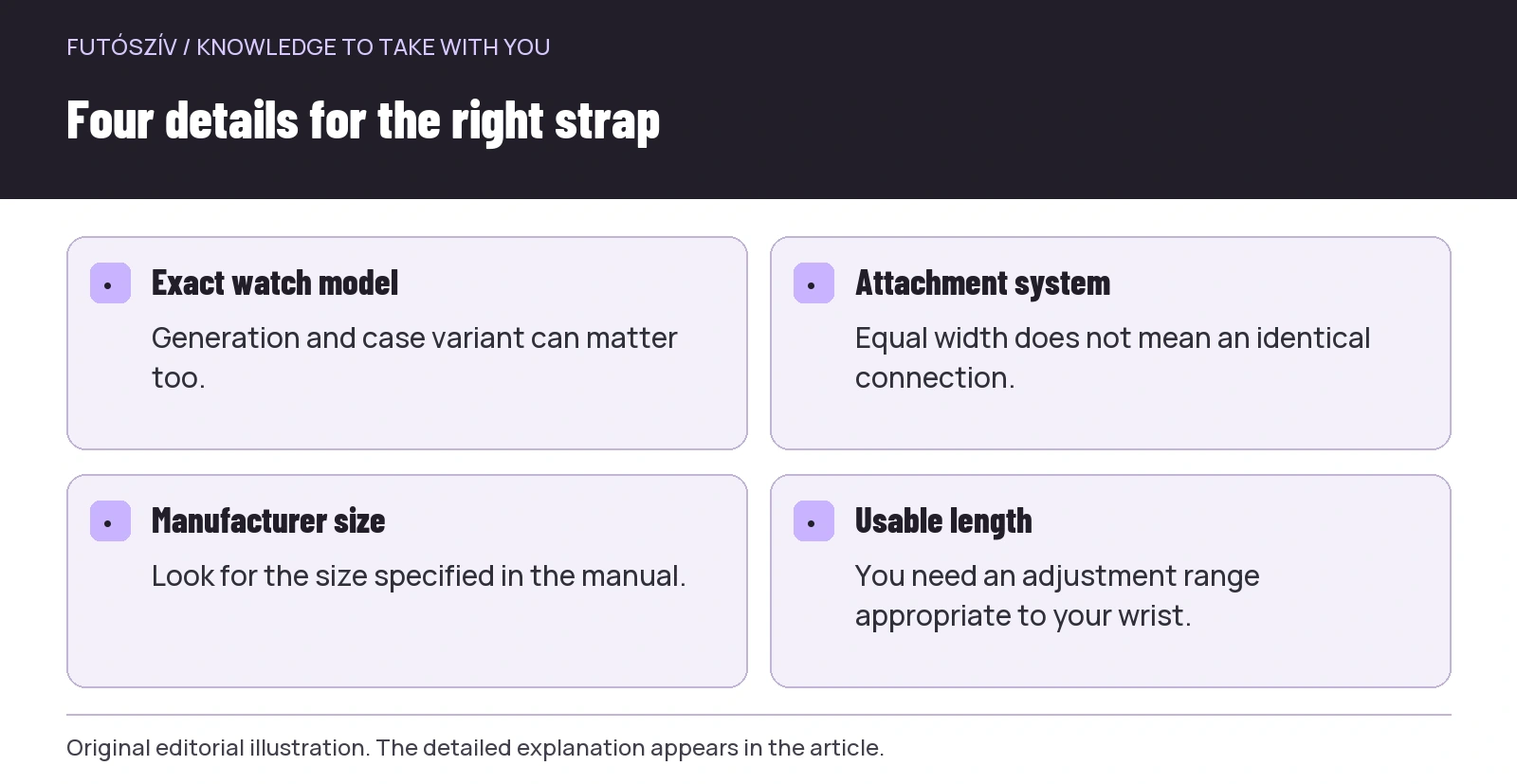 Enlarge diagram
Text version of the illustration
- Exact watch model
- Generation and case variant can matter too.
- Attachment system
- Equal width does not mean an identical connection.
- Manufacturer size
- Look for the size specified in the manual.
- Usable length
- You need an adjustment range appropriate to your wrist.
Judge length by usable adjustment
A compatible connection does not make an excessively long or short strap a suitable replacement. Check the manufacturer’s wrist-size range and how length is specified. Total strap length is not necessarily the usable circumference because the case, overlap and closure form part of the assembly. Follow retailer or manufacturer guidance when measuring your wrist rather than measuring only the old strap’s free end. The aim is adjustment within an appropriate range, not relying exclusively on the last hole or end position.
For a perforated strap, inspect hole spacing; for textile fastening, the usable attachment-surface length; for another closure, its own rules. You need not name one material as best for every runner. Daily wear, running, cleaning after sweating and drying all belong to the choice. Describe comfort needs in a concrete situation: is suitable adjustment available, can the free end be secured, and does the clasp or keeper catch on clothing? These questions are more observable than a general promise of premium quality.
Material and care: read before changing
Cleaning and drying can differ between strap materials. Textile, silicone and leather accessories may not tolerate the same treatment. Find the chosen replacement’s care instructions before use and review the watch’s cleaning rules too. A case designed for a particular environment can still carry an accessory with different limitations. This especially matters if you wear the watch for activities beyond running. Do not infer every new strap’s suitability from the case’s general marking.
A more sustainable choice here is more than a material name. It matters whether you buy the right item, can clean it and can replace a worn part separately. An unnecessary multipack is not necessarily better than one well-identified replacement. If the clasp or keeper is sold separately, ask about that too, while still clarifying compatibility. Retaining working old parts helps only if you do not confuse them with components unsuitable for the new system.
Prepare an orderly fitting area
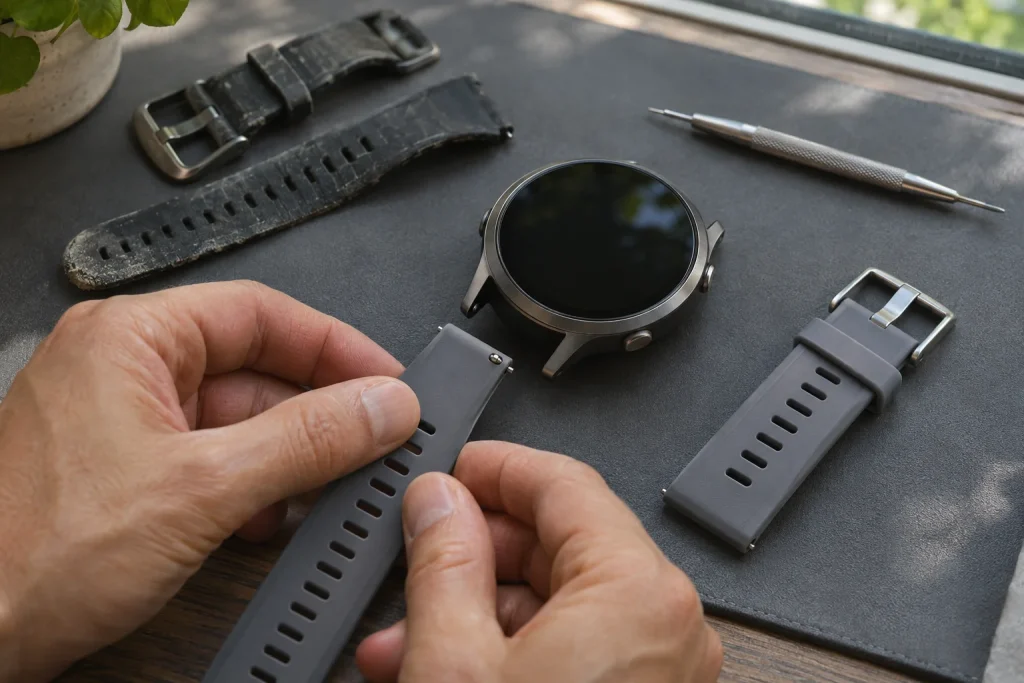
Choose a clean, bright work surface with a soft, lint-free mat to avoid scratching the watch. Provide a separate small place for removed components, away from a sink drain or the floor edge. Open the correct manual at the relevant step rather than starting your search with a half-detached strap in hand. If a tool is needed, use the specified type. A kitchen knife or random screwdriver does not become appropriate because it fits into a gap.
Check watch and strap orientation, especially if the two sides differ. A photograph beforehand may help, but cannot replace the new strap’s fitting sequence. If you see case damage, abnormal looseness or an unidentified fastener during replacement, stop and clarify. Not every strap change must be a home job. Stopping is justified when the specific construction is unclear or faulty, not because an accessory designed for simple replacement is necessarily complicated in general.
Match the movement to the system
A strap sliding sideways into a rail, a spring bar and a latched connector operate through different movements. Do not automatically transfer the pulling direction that worked for one to another. The Apple strap-changing guide , for example, describes its own sideways system with a release button and specifically warns against force. It also addresses checking secure attachment. In every example, understanding the particular system is the point: a stiff part does not necessarily need more force; it may indicate the wrong direction, incomplete release or a different component.
For spring-bar attachment, observe the endpoints and release element specified in the manual; for a latch, the locking sequence. Do not modify the case attachment point to fit an almost-compatible strap. The strap edge should not cover an area the manufacturer leaves clear either. An adapter requires its own exact compatibility and fitting instructions. More intermediate components mean more connections to inspect; checking one strap end is insufficient if another loose connection can exist elsewhere in the system.
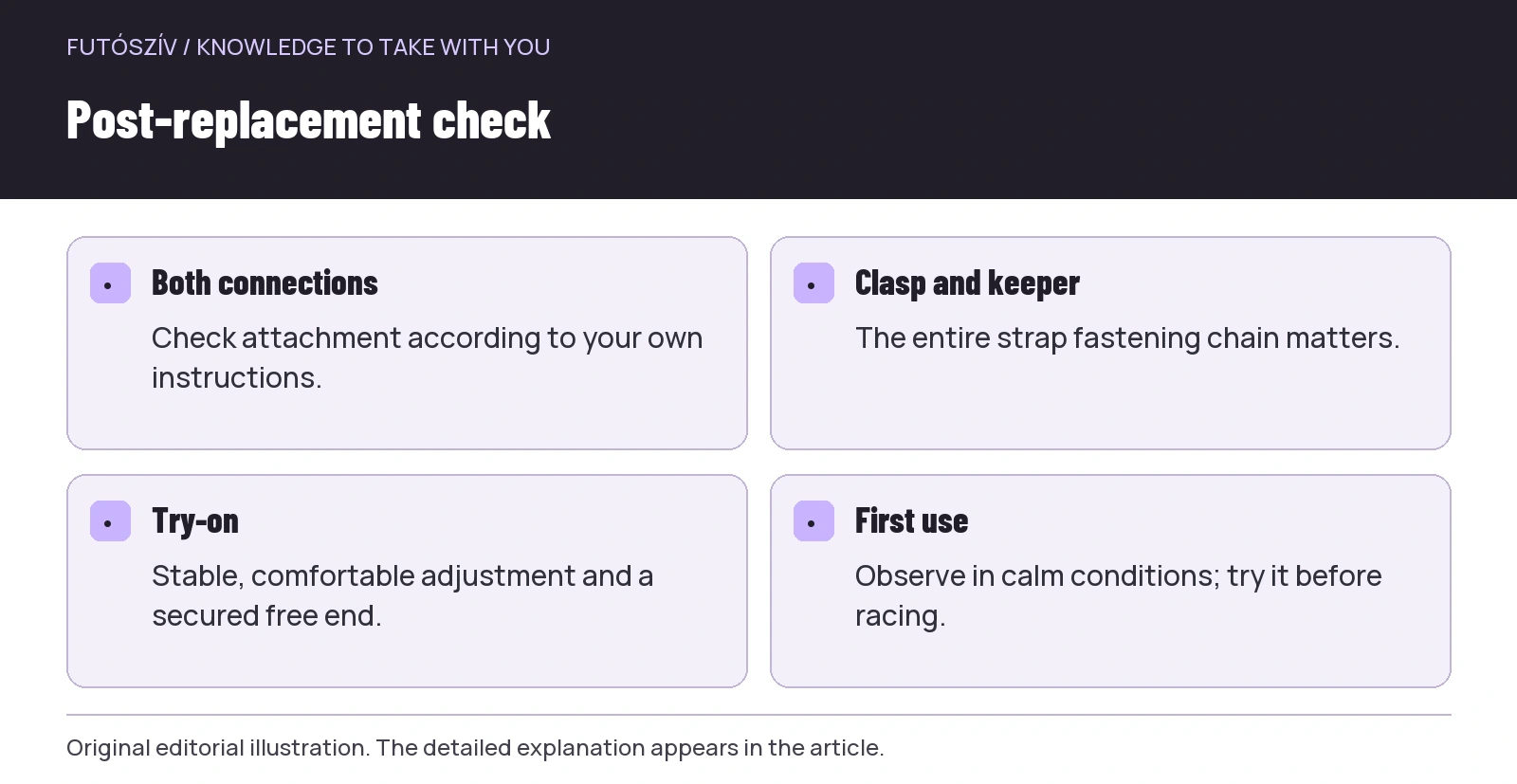 Enlarge diagram
Text version of the illustration
- Both connections
- Check attachment according to your own instructions.
- Clasp and keeper
- The entire strap fastening chain matters.
- Try-on
- Stable, comfortable adjustment and a secured free end.
- First use
- Observe in calm conditions; try it before racing.
Securing is not the same as positioning in place
After replacement, examine both sides closely. Check as described in the manual that the attachment is actually locked, the strap cannot move freely and no obvious asymmetry or gap remains. Keep the trial gentle; it is not a component strength test. A click alone is not exclusive proof in every system, so follow your own instructions’ checkpoints. If the strap does not attach securely, do not keep wearing it on the assumption your wrist will hold it. An uncertain connection can also lead to losing the device.
After checking the watch-side connection, inspect the clasp, keeper or other closure too. Every point in the chain matters: a strap fitting the case well cannot be used appropriately with an incomplete closure. After checking in your hands, put it on and adjust to a comfortable, stable position in calm surroundings according to manufacturer guidance. Move your wrist through its usual range, put on a running top and check the free end. This models everyday use; it does not validate measurement accuracy.
Interpret data with the new strap appropriately too
If the watch uses optical heart-rate measurement, follow manufacturer wearing instructions with the new strap too. Attachment compatibility does not prove better or worse measurement accuracy. Do not immediately call a noticeable post-change data difference a physiological change, or promise others certain measurement improvement from changing material alone. First check wearing position, adjustment and conditions against the device’s instructions. Interpreting running data is a separate task from fitting an accessory.
Make first use an everyday situation that is easy to interrupt, where you can observe clasp and adjustment comfort. An important race start need not be the first trial of a new strap. Remember which adjustment worked and clean it after use as the manufacturer directs. If its surface or connection changes unusually during use, inspect and document it. Completing replacement does not mean the component never needs another check: the strap remains an accessory that wears with daily use.
A pre-purchase question and a post-use note
If compatibility is unclear, send support the full watch model, selected strap’s part number and a specific question. Alongside “will it fit?”, explain that you want to confirm attachment system, size and any required intermediate part. They should not have to guess your version from a photograph. Keeping the answer and purchase information can help with later replacements too. A part number and manufacturer document provide a more precise reference than a product image.
After the replacement, a short personal note is enough: which strap is fitted, how it attaches, where the instructions are and what matters for cleaning. You need no complicated register, but retain accessory identification after discarding the box. The next change then becomes maintenance of a known system. A good decision ends with a securely attached watch, a comfortably adjustable strap and a replacement guided by checkable information rather than guesswork.
Sources and further reading
- Garmin: QuickFit and Quick Release Watch Band Difference
- Polar Pacer User Manual: Changeable wristbands
- Apple: Change your Apple Watch strap
How Futószív articles are prepared: our editorial guidelines.