Choosing running shoes can easily become a contest of incomparable figures: foam height, weight, heel drop, sole width and new invented names every year. These may matter, but no figure alone tells you whether a shoe accommodates your foot, stays secure through a turn or still feels comfortable after an hour. A clear purpose and consistent trial underpin a good purchase. This guide offers observations to support choosing from your own feedback rather than fitting your foot into a popular model.
First, name the intended use
Write one sentence describing the next pair’s job: for example, three easy weekly runs on roads and in parks, or rocky, muddy trails. An everyday trainer, closer-fitting racing shoe and deeply lugged trail shoe have different tasks. If most runs are on pavements, an occasional woodland excursion does not necessarily justify sacrificing everyday comfort. Conversely, a sole that feels soft and pleasant in town has not thereby demonstrated grip on wet roots. Keep the intended task in mind during the trial.
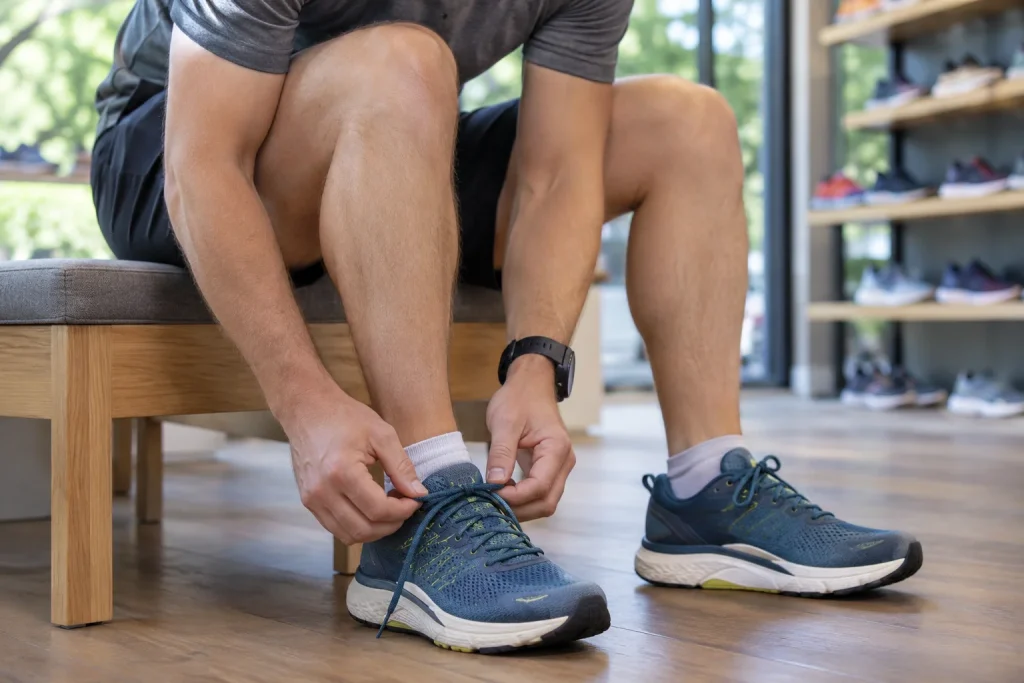
Bring running socks and any professionally recommended insoles you regularly use. Do not decide on a thicker winter setup wearing thin everyday socks. The AAOS athletic-shoe guidance also recommends trying shoes with the socks worn for sport and checking both feet. The principle is simple: the system assessed in the shop should resemble the one you will actually run in. A reliable old pair can show the assistant your familiar shape, but do not request a diagnosis from wear patterns alone.
The number on the box is only a starting point
A size label is not a complete foot description. Two models with the same number may differ in toe shape, midfoot volume, heel width and flex point. Have foot length and width measured while standing, then start with the larger foot’s needs. Treat a previously successful size as a useful reference rather than a rule. Try a new model version again: the same name in another year may conceal a different upper or last. Allow enough time to put on both shoes, rather than arriving so rushed that you try only one.
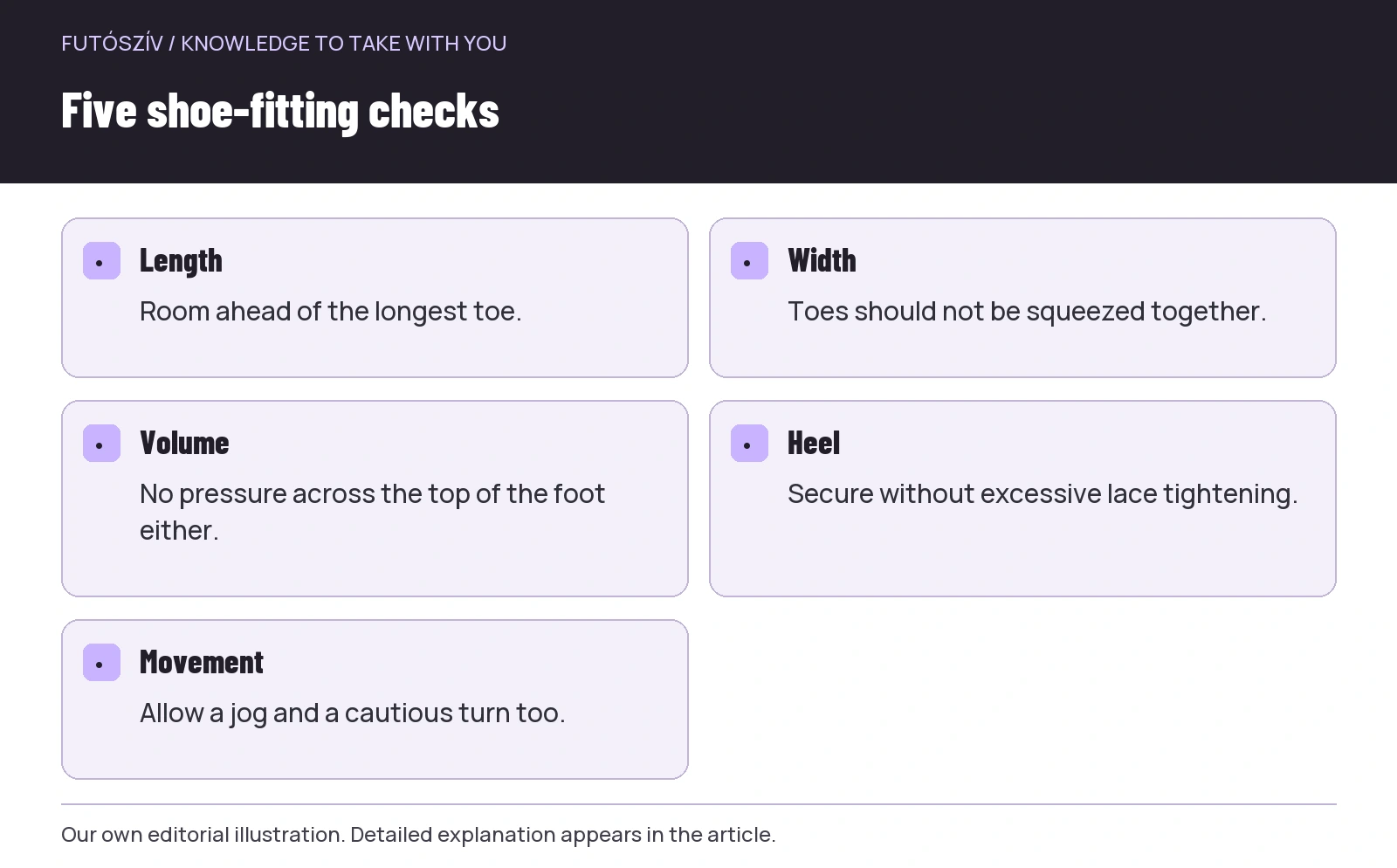
Toes need room ahead, but the aim is not the largest possible empty space. AAOS mentions roughly half an inch before the longest toe; treat that as an approximate fitting consideration, not a millimetre-exact rule for everyone. Overall fit determines suitable size. If you slide backwards and forwards, a larger number does not help; if the toe-box side squeezes your toes, added length may not provide width where needed. Free toe space and secure fit elsewhere matter together.
 Enlarge diagram
Text version of the illustration
- Length
- Room ahead of the longest toe.
- Width
- Toes should not be squeezed together.
- Volume
- No pressure across the top of the foot either.
- Heel
- Secure without excessive lace tightening.
- Movement
- Allow a jog and a cautious turn too.
Width and volume: two separate questions
Width describes sideways room, while volume also includes space above the foot. Your toes may be comfortable while the tongue presses or lacing spreads over a high instep. The opposite is common too: the upper wrinkles while the heel still moves. Another tightening may not be needed; another shape may be. For wide feet, a wider version often makes more sense than progressively longer versions of the same narrow shoe. Ask specifically for options rather than trying only the standard version on the shelf.
The Johns Hopkins Medicine fitting guidance also warns that feet can slide in oversized shoes. A useful shop distinction is “it squeezes” versus “it does not hold”. The first may indicate insufficient space, the second a securing or shape issue. They need different answers. Specify where: little toe, base of the big toe, instep or heel. A precise location helps more than saying something feels odd. Distinguish mild unfamiliarity from clear pressure too.
Let the heel hold without the laces squeezing
Slight heel movement differs from a heel slipping up and down. Walk, then jog a few steps if the shop permits, noticing whether you grip with your toes. A shoe need not feel tight everywhere to feel secure. If securing the heel requires painfully tight laces over the foot, a tighter knot is unlikely to solve it. Heel shape, collar padding and upper work together; another last may be worth trying. One unfamiliar shoe does not mean your foot is “wrong”.
Lacing fine-tunes fit; it is not magic. Loosen the full length first, straighten the tongue, then tighten rows gradually. If a shop specialist demonstrates alternative lacing, test it while moving and check for a new pressure point. A heel-lock loop helps in some shoes and feels uncomfortable in others. It is not compulsory. Aim to move naturally for several minutes rather than making the shoe an immovable object around your foot. Numbness and burning pressure are not acceptable fitting goals.
A ten-minute shop trial in a useful order
Start standing: load both feet, move your toes and take a few natural steps. Follow with a brief easy jog, cautious turn and stop as the shop allows. This is not a performance test; you are checking comfort and hold. A treadmill is useful, but its smooth surface does not simulate every outdoor situation, especially trail-shoe grip. Ask for time and, if possible, try a second model with a different shape for comparison.
| Observation | What to check | A sensible next trial |
|---|---|---|
| The toe box presses sideways | Is width lacking, or are you sliding forwards? | Another last or wide version |
| The heel moves up and down | Are length and lacing appropriate? | Fine-tune hold or try another heel shape |
| The top of the foot feels compressed | Is upper volume sufficient? | Looser lacing or a higher-volume model |
| Turning feels uncertain | Is the foot sliding, or does the sole feel unfamiliar? | Another size, shape or sole construction |
What softness tells you, and what it does not
A soft first impression may be pleasant, but is not the same as long-term comfort. Assess standing, slow movement and your usual easy pace. A high-stack model may change ground feel and turning, while a stiffer one changes the rolling sensation. Neither automatically implies benefit or disadvantage. Does the construction suit you and the task? Note if the shoe involuntarily changes your steps. Do not perform conspicuously “correct” running for an in-store video.
Heel drop, a carbon plate or a stability element is not a standalone prescription. You need not reject every technology or buy every one. With a very different construction, explore it first on shorter, easy outings rather than an important race. A fitting does not replace assessment: recurring pain or altered sensation should not be addressed solely through shopping. Tell a professional the circumstances of symptoms, not only the shoe type.
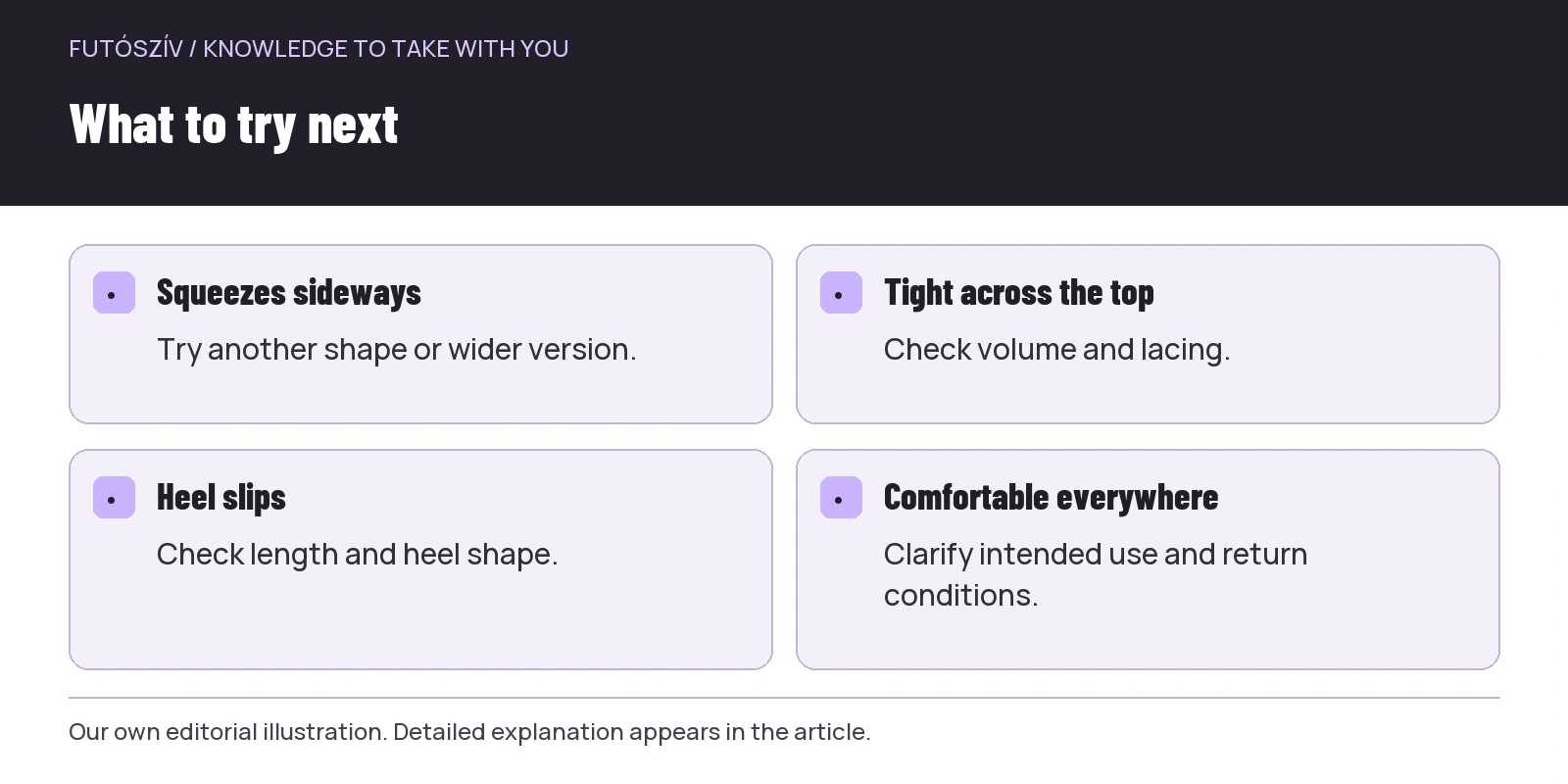 Enlarge diagram
Text version of the illustration
- Squeezes sideways
- Try another shape or wider version.
- Tight across the top
- Check volume and lacing.
- Heel slips
- Check length and heel shape.
- Comfortable everywhere
- Clarify intended use and return conditions.
An in-store video is not a full movement assessment
A short recording can show how you move at that moment and help compare models. A few treadmill seconds do not describe training load, earlier injuries or how movement changes with fatigue. Seeing an ankle move inwards alone is insufficient to explain complex symptoms. Ask which observation supports the recommendation and which other shoe you could try. Good help offers understandable considerations rather than fear about your movement.
With individual orthopaedic needs, substantial deformity, reduced sensation or medical instructions, adapt the usual shop trial. A category label alone does not make a shoe suitable. The FootCareMD athletic-shoe information adds fitting considerations, but specific advice from your treating professional takes priority with your own treatment or insoles. A comfort guide cannot take over that individual decision.
Home trials and return policies
Before buying, read the condition and deadline requirements for exchanges or returns. Options vary by retailer and purchasing method; do not assume a muddy outdoor run leaves you free to choose again. At home, try both shoes on a clean surface with the same socks. Take a brief break and put them on again; this often makes an irritation easier to name. Do not cut off tags or alter shoes before clarifying return conditions.
Make the first outdoor run in the chosen pair easy to shorten. Use a familiar, easy route and observe pressure points. This does not mean painfully fitting shoes must be “broken in”. The Johns Hopkins guidance specifically rejects the assumption that initially ill-fitting sports shoes will certainly become comfortable. Slight upper adaptation does not fix insufficient length or the wrong shape. If rubbing or pressure occurs, stop, check socks and lacing and learn from it.
Your fitting notes: five sentences that help later
You need not chart every model’s technical specifications. Answer five questions: what would I use it for; where was it comfortable; where was it uncertain; which socks did I wear; what would I change in the next trial? This avoids starting over in the next shop. Instead of “nice and soft”, useful information might be: “comfortable at an easy jog, but my heel moves when turning; toe room is good”. The decision becomes more precise even if the final model is cheaper and less fashionable.
Successful shoe choice is not measured by learning every technical term, but by moving naturally and comfortably for your chosen task. Size, shape, hold and purpose together create fit. If two pairs feel much alike, ease of use, construction suggesting durability, price and return terms are legitimate considerations too. A simple, considered choice may prove more valuable over time than the winner of a ranking built around other people’s feet.
Sources and further reading
- AAOS: Athletic Shoes
- Johns Hopkins Medicine: Athletic Shoes, Lace Them to Fit
- FootCareMD: How to Select Athletic Shoes
How Futószív articles are prepared: our editorial guidelines.