A running wardrobe often contains usable items whose size, cut or purpose no longer fits the owner. A community swap can give them continued use. A good event needs more than everyone placing a bag on a table, however. Cleanliness, condition descriptions, size identification and try-on arrangements determine whether clothing genuinely reaches another wearer. This guide offers an editorial model for a small running community, adaptable to its circumstances without exaggerated environmental promises or pressure to acquire things.
Make renewed use the goal
A swap achieves its practical purpose when someone takes clothing they will genuinely use in the right size and role. A full bag carried home is not an outcome in itself. The European Environment Agency overview of textiles discusses longer use, reuse and repair as elements of a more circular system. This does not mean each individual exchange automatically creates precisely calculable environmental savings. Your event can help connect usable condition with actual need.
If your chosen rules allow, explain in the invitation that nobody must bring or take something. Someone seeking one suitable top should not feel compelled to collect unnecessary clothing. Someone offering a good item should know how to prepare it. A shared framework prevents the swap becoming a temporarily tidy clothes dump. A running community also lets people describe concrete uses: layering, cut and pocket access rather than general brand prestige.
Define accepted items beforehand
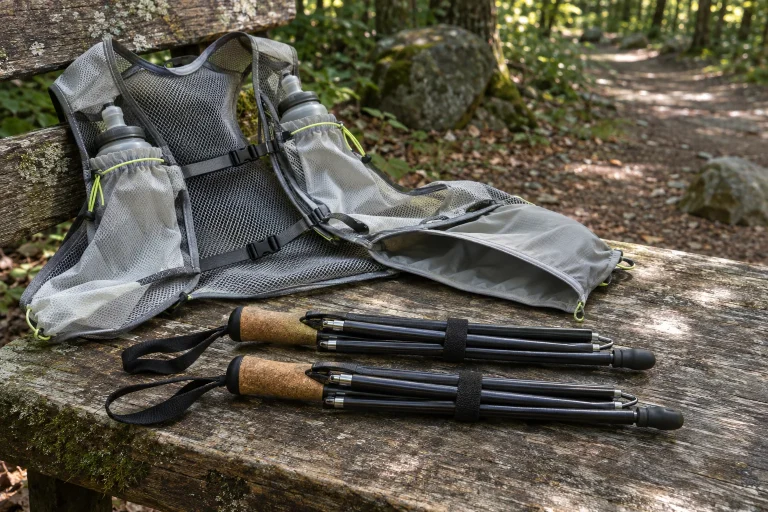
List accepted categories and excluded or separately handled items in the invitation. A small event can limit selection to simple tops, shorts, running trousers and lightweight outer layers. Accept other equipment only if you can appropriately handle its condition and transfer. Shoes, electronics, hydration systems and personal-wear accessories may present different checks; everything need not automatically fall under one clothing-swap rulebook. Clear limits simplify organisers’ and participants’ work.
Require clothing to be cleaned according to its own label, completely dry and inspected. Disclose missing labels, known stains, repairs and wear. Do not mix still-damp or inadequately prepared garments with ready items. If accepting textiles awaiting repair, give them a separate, precisely labelled place and a real next destination. “Repairable” should not be mere hope, and the swap should not promise expert certification unavailable on site.
The contributor’s inspection at home
Lay clothing out in good light and inspect front, back, inside and seams. Empty pockets and remove race-number fasteners or other small items not belonging to it. Check zips and closures normally; record known changes in stretch areas. Remaining surface discolouration, a fraying seam and a stretched waistband are different phenomena. A fair description names location and condition instead of one broad “good quality” adjective.
Wash and dry according to the specific label. The GINETEX care-symbol explanation can help interpret unfamiliar symbols, but follow additional garment-maker instructions too. Preparing for a swap does not justify treating every item at the same high temperature or soaking it in an unknown product. Pleasant fragrance is not a condition assessment and does not replace cleaning, dryness or inspection. Give clothing its permitted care and put known limitations in the description.
 Enlarge diagram
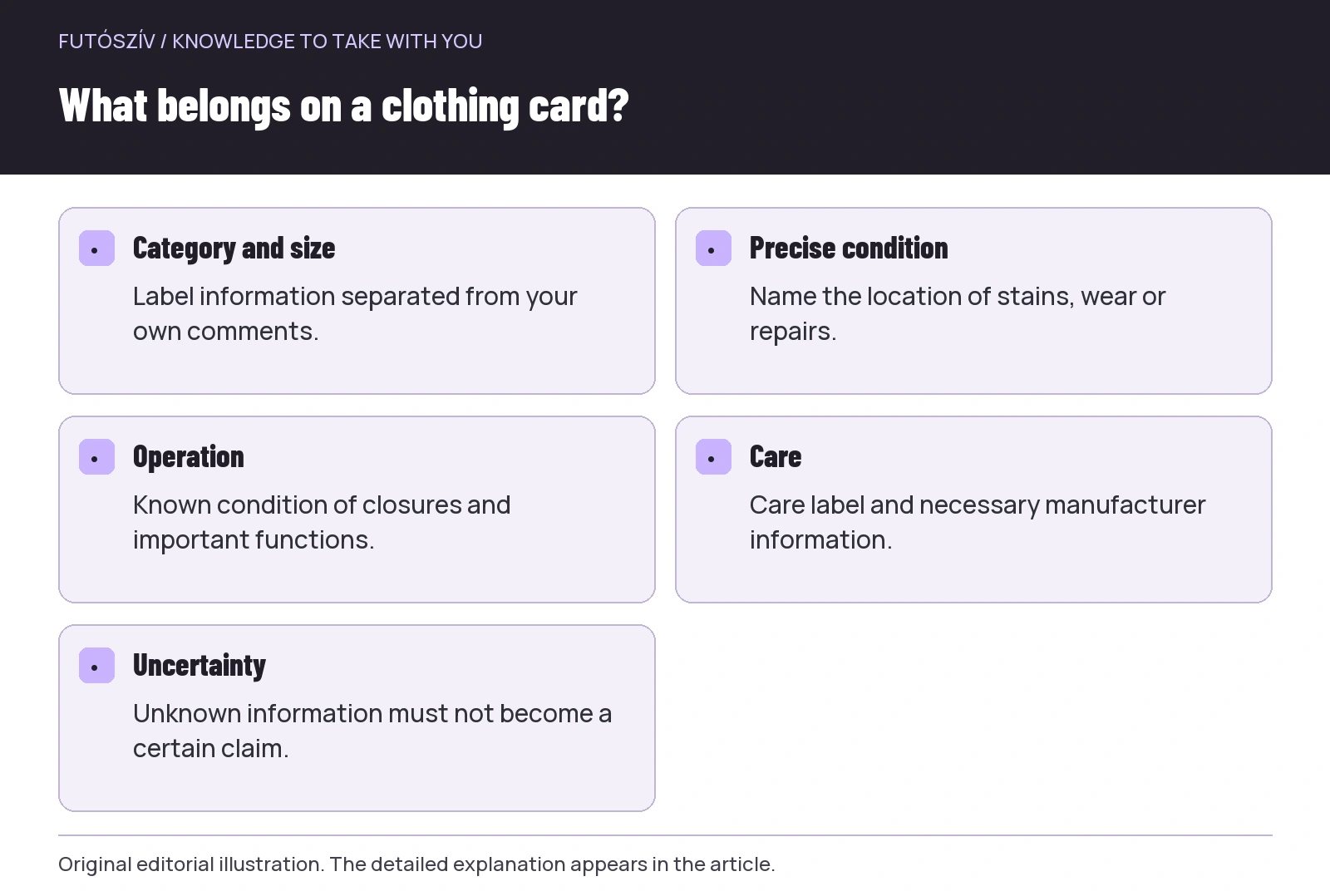
Text version of the illustration
- Category and size
- Label information separated from your own comments.
- Precise condition
- Name the location of stains, wear or repairs.
- Operation
- Known condition of closures and important functions.
- Care
- Care label and necessary manufacturer information.
- Uncertainty
- Unknown information must not become a certain claim.
A short condition card for each item
A small card can state category, labelled size, exact model if known and important condition notes. Do not estimate another size letter merely because the garment seems smaller. Add personal experience of the cut separately from the manufacturer marking. If measurements help, describe the method clearly, such as width measured flat without stretching. Numbers measured differently cannot be compared cleanly, making method at least as important as value.
Keep condition descriptions brief but concrete: faint front stain, one repaired inner seam, zip works normally. State anything you cannot assess too. Do not claim waterproofness solely from an old product name or call an unchecked function faultless. The card is not a laboratory report; it helps the next wearer know what to inspect. Provide personal contact information only as needed and agreed for your system, rather than automatically publishing every participant’s details.
| Card field | Useful content | Less helpful version |
|---|---|---|
| Size | Labelled M, with cut described separately. | I think it fits everyone. |
| Condition | A repaired seam is visible at the right pocket. | Absolutely perfect, without details. |
| Function | I checked the zip; the remaining condition is visible. | Guaranteed for every circumstance. |
| Care | Care label present; photograph or instructions available. | Wash it however you like. |
| Uncertainty | Exact model unknown. | An assumed model presented as certain. |
Make suitable items easy to find at the venue
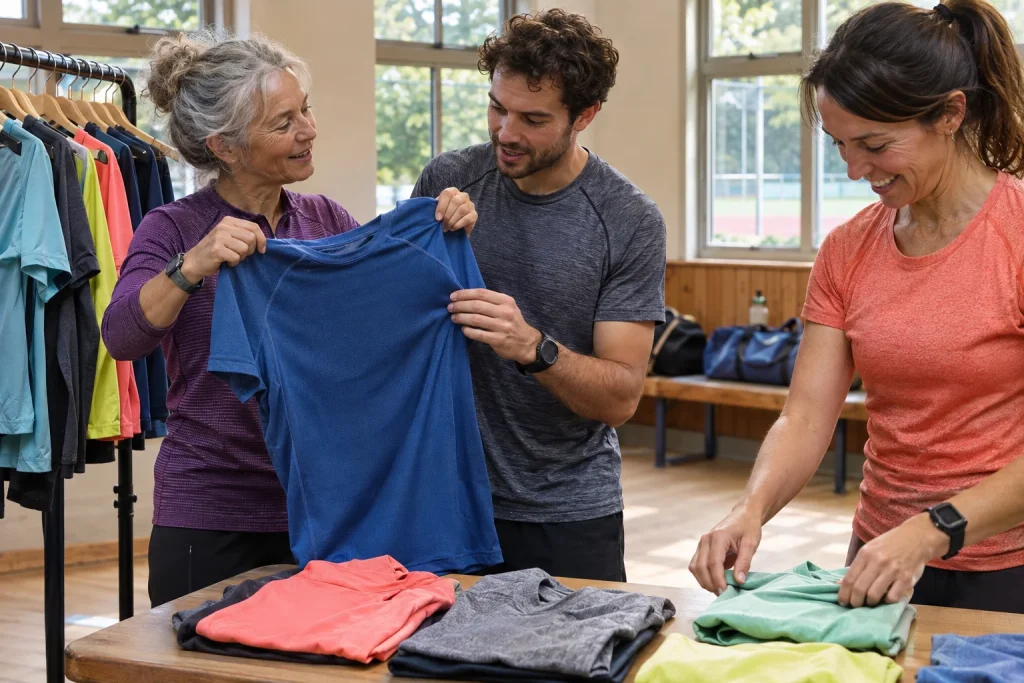
Even small events benefit from sorting by category and size. Tops on hangers are easier to inspect; trouser waists and labels should be accessible. The Tower Hamlets council clothes-swap guide offers practical organisation ideas too, including arranging hangers beforehand. Use a simple layout suited to your running community’s selection. You need not build a shop, but one large mixed pile makes fair condition checks and size searches harder.
Do not let clothing with special care or unresolved condition disappear among other items. Provide somewhere to ask questions and return tried but unsuitable pieces to their places. Clear category signs and accessible shelves help more than everyone sorting on one table simultaneously. Consider access, movement space and seating when choosing the venue too. Speed or loudness should not determine who finds usable equipment.
Keep exchange rules easy to explain
Options include direct exchanges between two people, choosing from a shared collection or a preset item-count system. None is automatically best for every community. Write the chosen rule beforehand rather than changing it for popular brands during the event. If points or another exchange unit are used, categories should not become valuations without expertise. A small club often works more easily with a few clear rules than a complicated system accounting for original prices and every year of use.
Participants should know what happens if their item is not taken, when selection begins and what to do if a condition-description discrepancy appears later. Clarify the organiser’s role and limits of individual arrangements too. The community need not guarantee every product’s technical condition to provide a fair framework, but must explain inspection limits clearly. Rules support clothing information; they cannot replace a missing label or concealed damage.
Trying on aims to understand fit
Provide comfortable, respectful try-on arrangements suited to the venue. Within announced limits, participants decide for themselves what and how to try. An outer layer can be checked over a familiar running top; another item may need a separate space. Judge cut beyond a standing mirror view: observe arm movement, waist position and pocket access through normal, gentle movements. The swap venue is not a place for a full workout or material stress test.
Discuss fit concretely without judging bodies. “It pulls at the shoulders” or “I struggle to reach that pocket” is useful; a general comment on someone’s body is not. Size markings are references, not personal evaluations. If an item is unsuitable, leave it for someone else. Enjoying a swap need not require taking something home. The good choice is a top or trousers comfortable in your actual use and of known condition, not merely carrying an exciting brand.
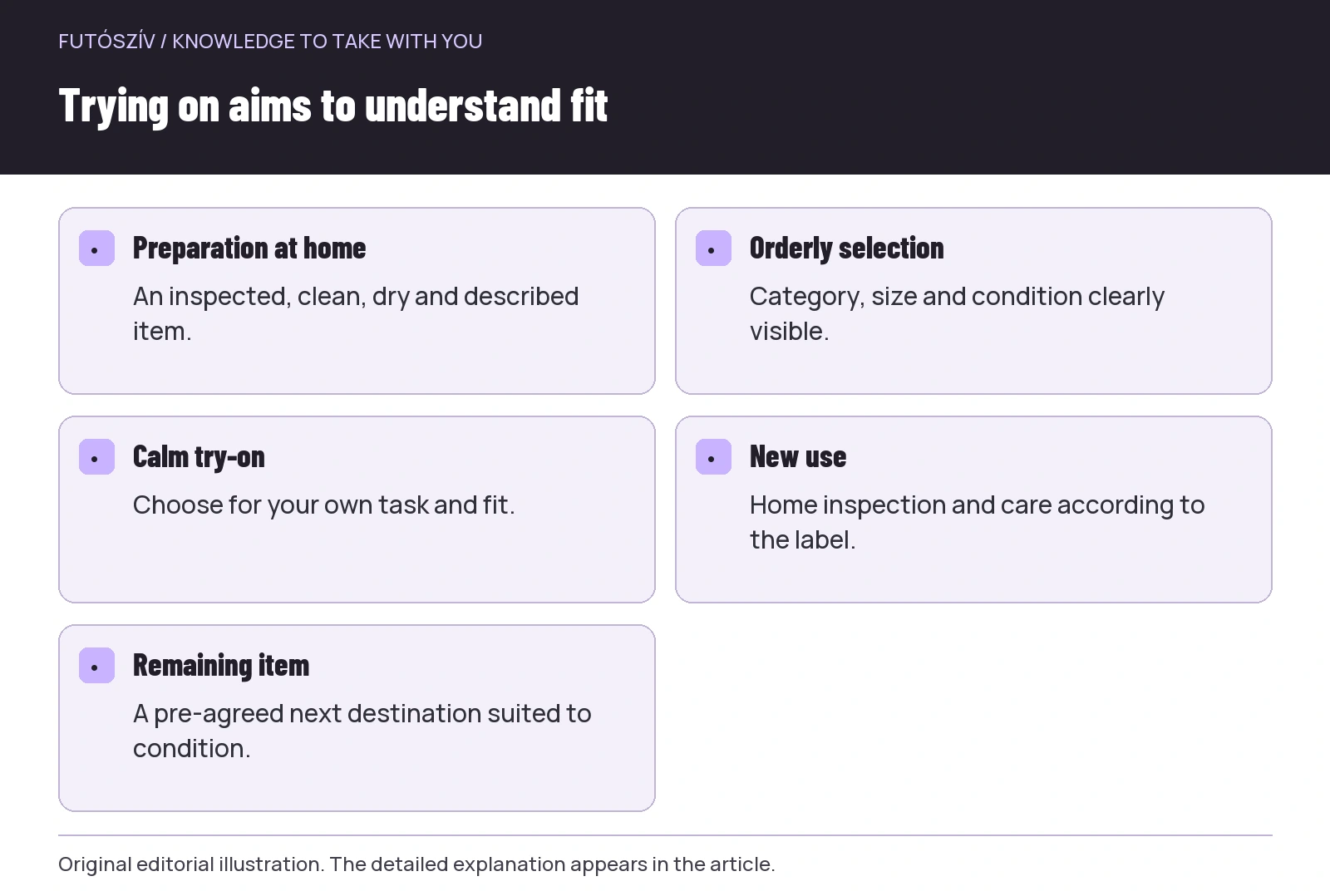 Enlarge diagram
Text version of the illustration
- Preparation at home
- An inspected, clean, dry and described item.
- Orderly selection
- Category, size and condition clearly visible.
- Calm try-on
- Choose for your own task and fit.
- New use
- Home inspection and care according to the label.
- Remaining item
- A pre-agreed next destination suited to condition.
Ask about function for running clothes too
Pocket size, zip operation, stretch-waistband condition and layering are practical questions. Trousers comfortable while standing may behave differently with your phone or intended contents; examine this within trial opportunities and with the owner’s agreement. Previous care and repairs matter for membrane or specially coated tops. Label and product identification help find further instructions. A clothing swap cannot replace technical assessment of a specialist function, so do not count an uncertain capability as confirmed.
If the item would serve as compulsory race equipment, check that event’s current requirements separately. A general clothing label at the swap is not race certification. Likewise, a previous owner’s experience does not guarantee your comfort. Asking how they used it and why they are passing it on can help if they wish to explain. Such information complements condition description without replacing your own trial and checks. Known history and your own needs together provide a meaningful decision basis.
Do not leave the fate of remaining clothing until the end
Agree beforehand whether contributors reclaim unselected items or an arranged onward destination exists. Plan donation only with an organisation that actually accepts those garments under its conditions. Unusable textile does not automatically become an appropriate donation because it remains on a swap table. Check local collection and acceptance rules separately. Condition may lead to different routes: reuse, appropriate repair or handling through the relevant system.
An orderly finish includes tidying racks and venue and completing clearly accepted follow-up tasks. A simple note may count items finding new wearers and those remaining, if actually counted. Do not turn that into precise environmental savings without a suitable method. Later use shows practical results: are people wearing the clothing, did size and condition labels work and which organisational step supported good choices? These can guide targeted improvements next time.
With the new owner: care, trial and a genuine wardrobe place
Inspect received clothing at home and prepare it according to its label. Clarify missing important information through the appropriate manufacturer source. Before the first run, check necessary closures, layering and access for planned conditions. Used clothing is not worse merely because it had another owner, but condition and suitability remain concrete questions. It gains a meaningful place with you when you will use it and know how to care for it.
A community running-clothes swap gains value from accurate information and calm choices. Clear acceptance rules, clean dry clothing, precise sizing, known faults and orderly try-ons help existing gear find real purposes. Organisers need not become experts on every product. Create a framework where people understand what they give and take, and remaining clothing’s future is as organised as the event’s beginning.
Sources and further reading
- EEA: Textiles, Circularity Metrics Lab
- GINETEX: Care symbols
- Tower Hamlets: Organise your own clothes swap event
How Futószív articles are prepared: our editorial guidelines.