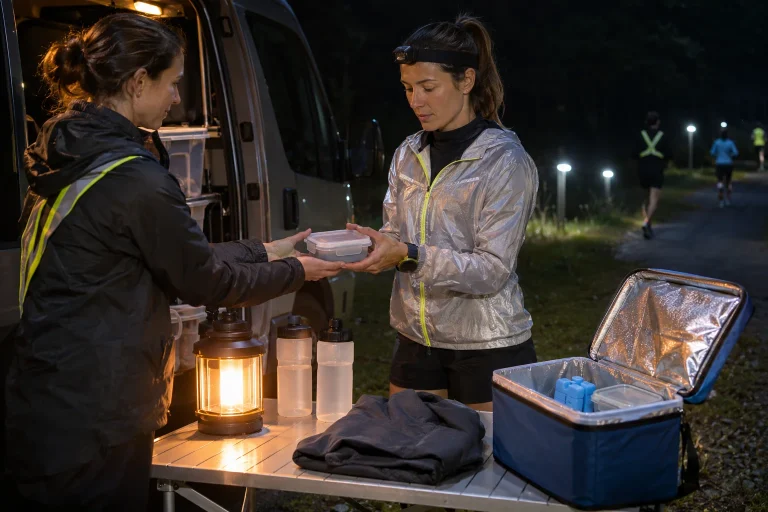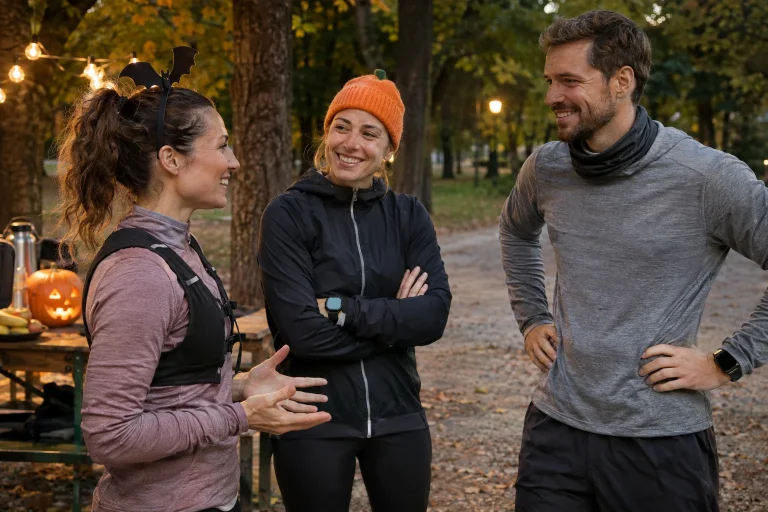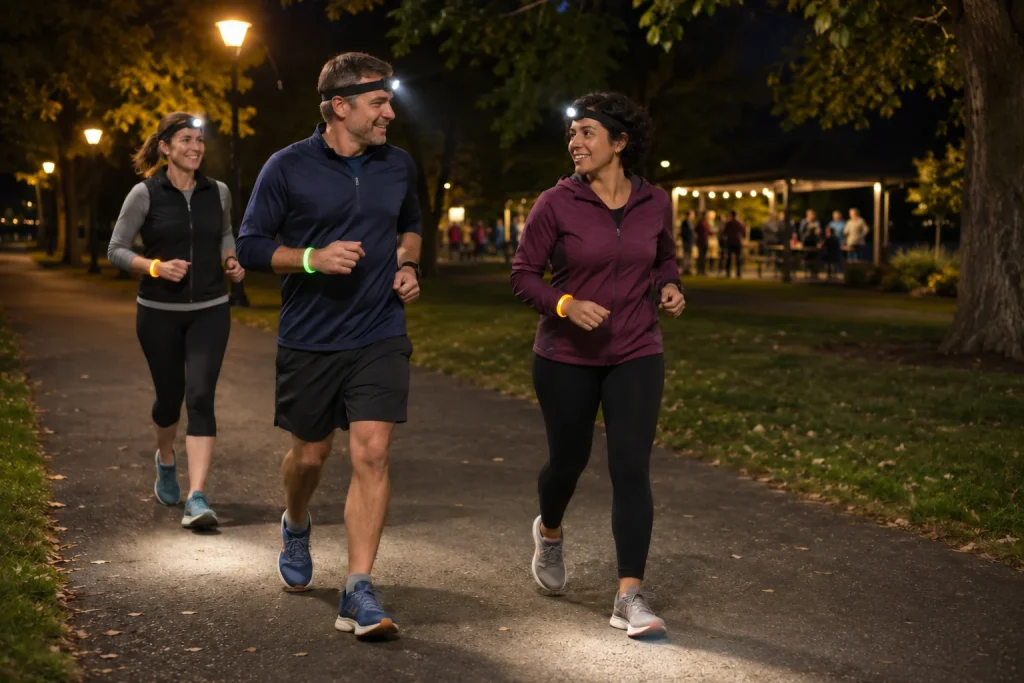
A promotional film for a night run can inspire you in seconds. Illuminated courses, glowing wristbands, costumes, music and places where running is not normally possible all appeal. The experience can be special, but a “fun run” is not a uniform difficulty category. A short stadium loop, winter mountain route and themed cellar system demand very different preparation. Choose by considering atmosphere and specific conditions together.
This guide provides practical considerations for organising an evening event and testing equipment. It does not replace race information. Mandatory equipment, age limits, course use and schedules relate to the particular event. Something seen in a video does not establish that it will be permitted or sufficient next time.
First, decide what kind of darkness to prepare for
At a lit urban event, crowds, narrow entrances and changing lights are often the main planning issues. On trails, your own light, the ground and route-finding are central too. An underground themed run can involve enclosed space, echoes and visual effects. Colourful videos of all three do not make them interchangeable.
The Sportoló Nemzet video gallery offers, for example, a glimpse of an earlier LED’s Run. Such an archival film is useful inspiration, but make a fresh entry decision from the current course and programme. Check the film’s year too. Steps, distances and equipment requirements at an earlier venue may differ from the new race information.
Read about the environment alongside the distance
Five kilometres can mean flat, wide asphalt or a technical path with substantial climbing. Even familiar ground may require fresh attention after dark. Look for surfaces, elevation gain, markings and time limits in the race information. Clarify when the dark section begins: do you start with lights already on, or does sunset arrive along the route? A forest light at departure will not stay that way throughout.
The Tajga Trail race information is a good example of a night experience carrying specific mandatory equipment and distance requirements. Look for the same detail for your own event. Clarify uncertainty before leaving rather than deducing what is needed from the person beside you at the start.
| Event type | What to check separately | What not to assume automatically |
|---|---|---|
| A stadium light run | Steps, narrow sections and starting waves | That lighting will remain even throughout |
| An urban night run | Closures, crossings and companion rules | That the entire route is closed to public traffic |
| A night trail | Personal lighting, markings and mandatory kit | That the next runner will always show the way |
| A Halloween event | Sound effects, costumes and children’s conditions | That the theme feels the same for every age group |
| An underground run | Entry, surfaces, light and organiser rules | That the location can be visited independently at other times |
Decorative light is different from useful illumination
A glowing wristband may make you more recognisable, but does not help you see the ground. Light strings, LED shirts and similar accessories are mainly visual features. They do not replace a personal light required by the event. Use a light whose attachment and operation you have tested while running. Impressive performance figures on packaging alone do not tell you whether wearing it will be comfortable.
Test the beam direction too. Set too high, it lights far ahead but shows less nearby ground and may disturb others. Pointed too steeply down, it leaves only a short visible section. Find the setting for your movement and situation. While talking, turn the light aside or down, because moving your head can easily direct it into another person’s eyes.
 Enlarge diagram
Text version of the illustration
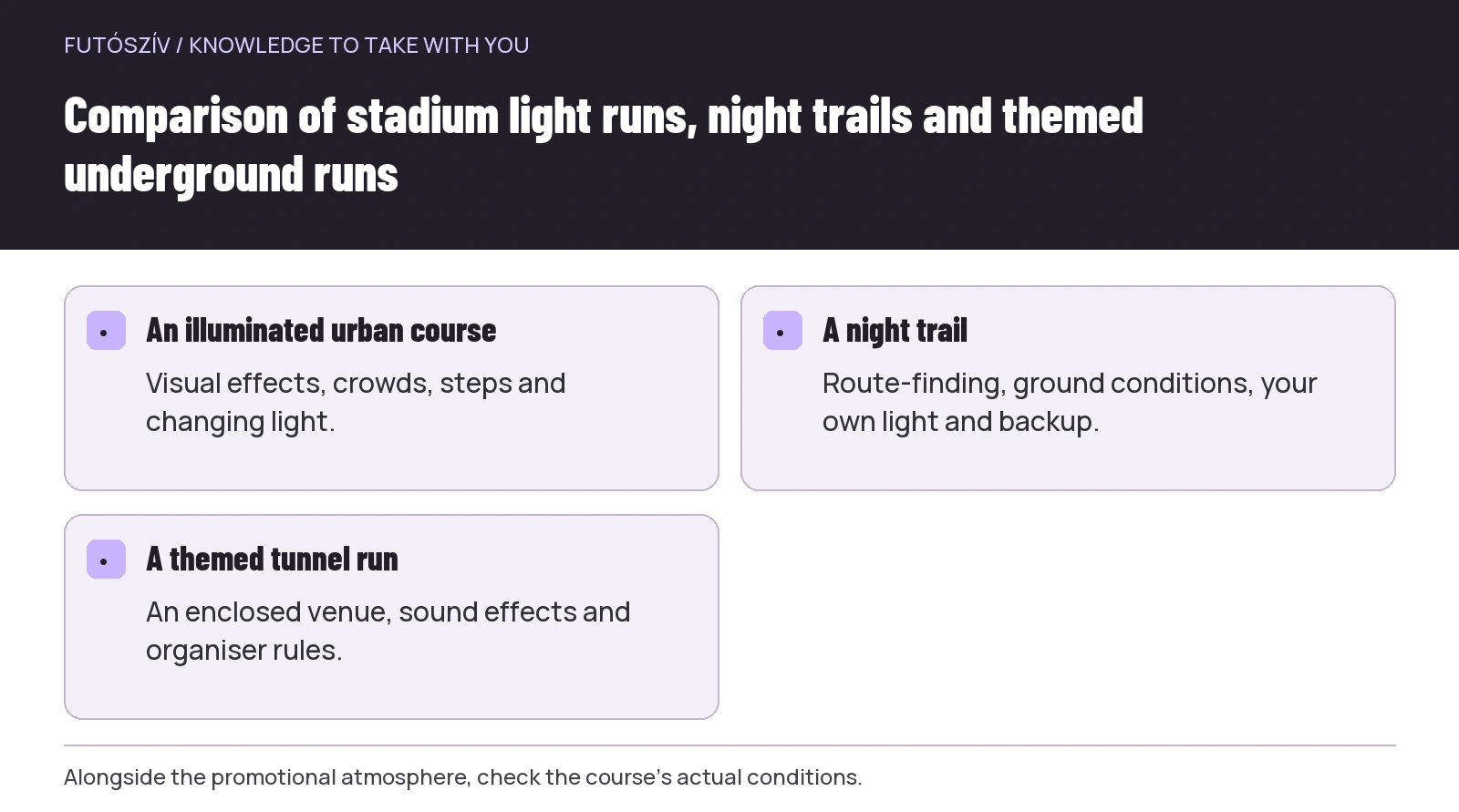
- An illuminated urban course
- Visual effects, crowds, steps and changing light.
- A night trail
- Route-finding, ground conditions, your own light and backup.
- A themed tunnel run
- An enclosed venue, sound effects and organiser rules.
Do not end the light test in your hallway
Before the event, run with it on a familiar, safe section. Does it bounce? Does the strap slip? Can you switch it on with cold hands or gloves? If it has several settings, can you find the right mode without inspecting the entire menu? Small adjustments in darkness are much more awkward when the group has already moved on.
Plan power for the full period of use, not just expected running time. Waiting before the start, possible slowdowns and leaving after finishing may need light too. Cold and the selected brightness can affect actual usability; read the manufacturer’s information. Adapt backup arrangements to event rules and surroundings, and know what to do if the main light fails.
Test the costume while moving too
A costume comfortable for a quick photo may twist, ride up or catch on something while running. During the trial, turn your head, look down, bend and run a few corners. Is your field of view clear? Can you reach your laces and belt? Do decorations extend into other people’s space? A good costume works with running rather than needing constant adjustment.
Check race-number placement separately. A covered chip or number can interfere with timing and identification; organisers provide specific wearing rules. Choose clothing underneath for the weather, not appearance alone. Something warm while standing before the start may be excessive while moving, and wet fabric can feel uncomfortable again at the finish. Decide beforehand what happens to layers.
A special venue has special rules
The official BBU Halloween Run page describes above-ground and underground sections, races and participation conditions. Apply the same approach to other themed events: the unusual experience comes with organisational rules. Do not treat visual features as climbing scenery or stop to film where the field is moving continuously.
Overtaking may be more limited in tunnels or narrow corridors. If someone slows ahead, allow time and distance rather than loudly pressuring them to move faster. Do not leave the marked route because another passage looks interesting. An area opened for an event does not mean the whole venue is freely available.
Sound effects, darkness and crowds feel different to different people
A horror theme may feel playful to you but unpleasant or too intense to someone else. Discuss this particularly when attending with family or a group new to such events. Watch earlier footage, read the organiser’s description and ask about flashing lights, sounds or frightening characters if these affect the decision.
Do not persuade someone to start by saying they will get used to it. A shared outing need not involve everyone choosing the same race. Someone may prefer a shorter, brighter or walking version, while another attends only as a companion. Age limits and accompaniment rules remain compulsory regardless; check them alongside the family decision.
 Enlarge diagram
Text version of the illustration
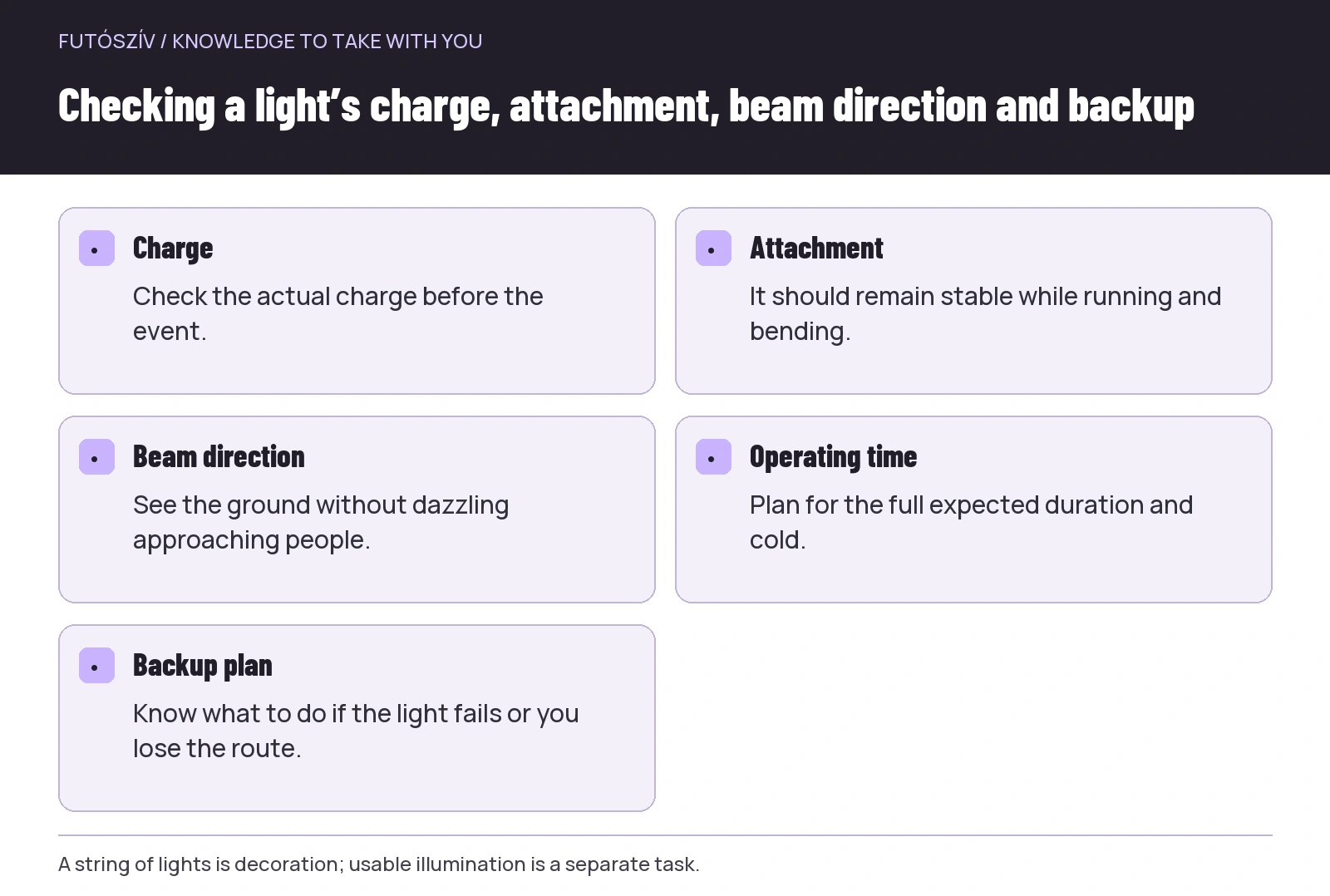
- Charge
- Check the actual charge before the event.
- Attachment
- It should remain stable while running and bending.
- Beam direction
- See the ground without dazzling approaching people.
- Operating time
- Plan for the full expected duration and cold.
- Backup plan
- Know what to do if the light fails or you lose the route.
Finding the route is a separate task after dark
Following the crowd is convenient but not always reliable. A runner ahead can miss a marker or be entered in a different distance. Know the marking type and distance junctions beforehand, and whether a downloaded route is required. If using navigation, do more than download the file: open it and test that your device genuinely displays it.
Slow at an uncertain point and inspect the markings. Do not try to solve an unclear direction by moving ever faster. At a race, follow the organiser’s procedure for losing the route and officials’ instructions. Agree in advance when a group will regroup. Accessible phones and lights matter more here than every item looking perfect in a start photo.
Do not discover how to get home only at the finish
At an evening event, usual transport can end before you change and reach the stop. Plan the return from your own expected finish, not the event’s first start. Allow for bag collection, meeting friends and possible walking from the finish. If a companion waits, agree a precise point and wider time window rather than only “call when you are done”.
Prepare post-finish clothing separately. Waiting in light running kit can feel different from moving in it. Check bag-storage hours, parking access and lighting too. When travelling together, clarify who leaves when and whom they wait for. A shared outing is more likely to stay a happy memory if searching for car keys does not begin only when everyone is tired.
Two practice outings that catch many surprises
Equipment trial. Use the light, belt, phone and important costume parts together on a familiar route that is easy to leave. Do not aim to reproduce the full distance. Check actions: can you drink, open the pocket, adjust the beam and bend to your shoes? Anything awkward here still has time for another solution.
Time-of-day trial. On another occasion, observe how an evening departure fits your day. When do you eat, how do you get there and how does moving after dusk feel? A familiar morning rhythm does not automatically produce a good evening routine. You need not recreate a whole race day; try a few important elements in real circumstances.
A final check before the start
- I read the current race information rather than only watching an old video.
- I know the chosen distance’s surface, elevation, time limit and markings.
- Mandatory equipment is actually with me, working and accessible.
- I tested my own lighting while running and distinguish it from decorative features.
- The costume does not obstruct vision, the race number or safe movement.
- The group agreed on differing paces, stops and meeting arrangements.
- My return journey fits my own expected finish.
- I know where and how to ask organisers for help if a problem arises.
The best part of an evening fun run is familiar movement gaining a new setting. Preparation does not remove its playfulness; it makes room for it. Once light, costume, route and the journey home are settled, you can attend more easily to what brought you out: lights moving together, an unusual space and your own enjoyable running experience.
How Futószív articles are prepared: our editorial guidelines.