When rest is difficult rather than running
The day is over and you finally want to sit down or sleep, but an uncomfortable sensation and urge to move appear in your legs. You stand, move, feel temporarily better, then symptoms return at rest. As a runner, it is easy to call this muscle fatigue, inadequate stretching or a need for magnesium. Such symptoms may need a different assessment too.
Restless legs syndrome, or RLS, does not simply mean moving your legs a lot. It is a neurological condition with a characteristic pattern that can disturb sleep and daytime life. Symptoms need individual assessment because similar sensations can have other causes. This article offers pointers for seeking help, not a home diagnosis or treatment recipe.
What pattern is characteristic?
The US NINDS information highlights a strong urge to move the legs, often with unpleasant sensations. Symptoms can begin or worsen at rest, improve temporarily with movement and often be worse in the evening or at night. Both falling asleep and staying asleep can become difficult.
These features matter together. Picking out one is insufficient: legs can hurt after training, become numb while sitting for other reasons and many people move around before sleep. Review the characteristic pattern and other explanations with a professional.
Descriptions can be personal. You do not need precisely the same words as an information page. Your own experience is more useful in a medical discussion: where you feel it, when it appears, which movements change it and how much it interferes with rest.
It is not the same as cramps or muscle soreness
The NHS RLS page also notes that muscle cramps or peripheral nerve problems, for example, can cause similar symptoms. Post-training pain, injury-related symptoms confined to one part of the leg and an evening urge to move are not interchangeable terms.
Treating every sensation with the same stretching or massage programme is not a good solution. Occasional relief from a method does not, by itself, establish the cause. The symptom timeline and everyday consequences can help frame appropriate questions.
New significant weakness, loss of sensation, severe pain after injury or another unusual symptom needs separate assessment. Do not automatically regard everything as RLS because evening leg restlessness has occurred before. Seek appropriate emergency assistance in an urgent dangerous situation.
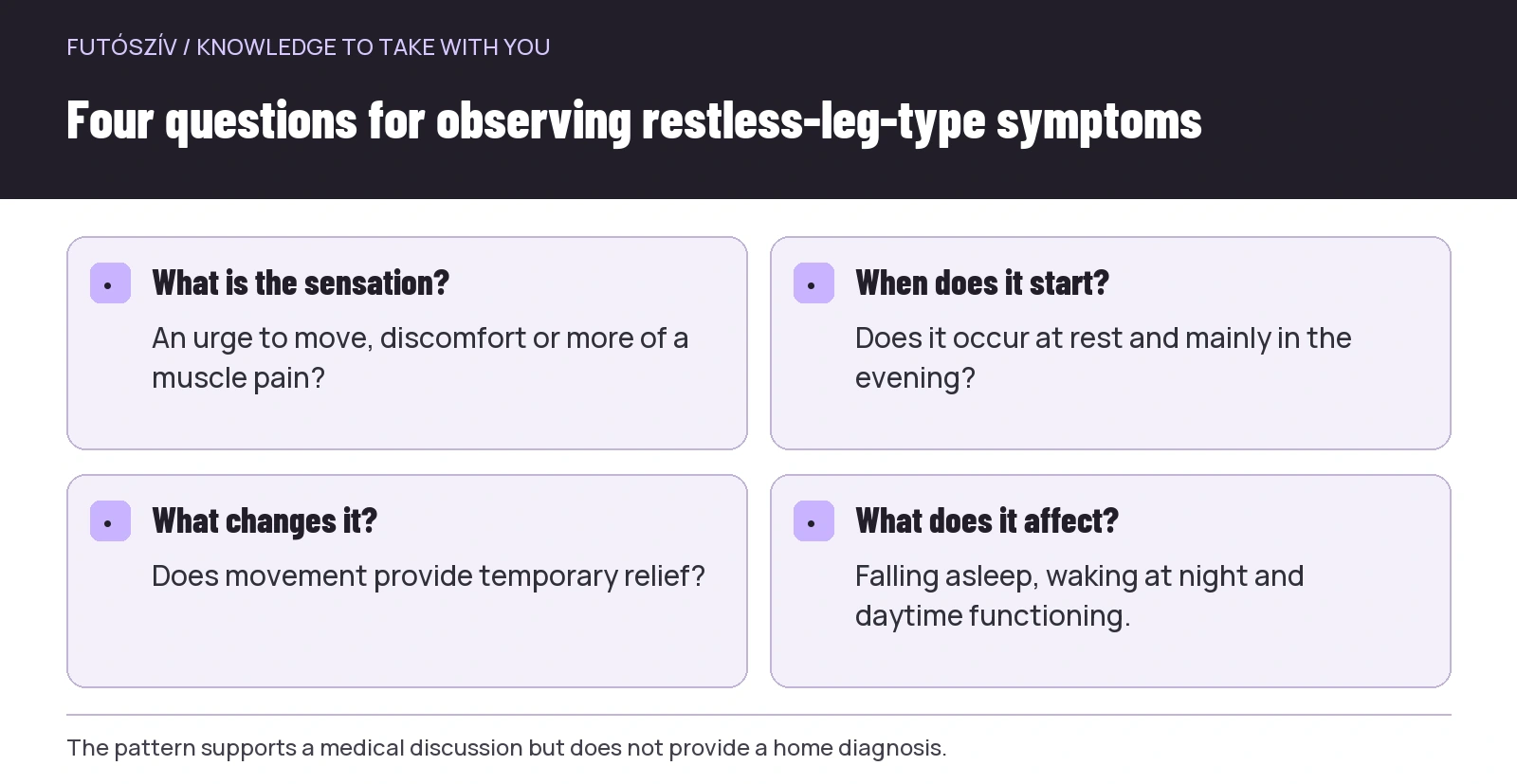 Enlarge diagram
Text version of the diagram
- What is the sensation?
- An urge to move, discomfort or more of a muscle pain?
- When does it start?
- Does it occur at rest and mainly in the evening?
- What changes it?
- Does movement provide temporary relief?
- What does it affect?
- Falling asleep, waking at night and daytime functioning.
When should you seek help?
If symptoms recur, make falling asleep difficult, interrupt sleep or interfere with daytime functioning, talk to a doctor. You do not need to wait until training results deteriorate too. Work, attention, mood and social life matter just as much as running pace.
A good race result does not prove a night-time symptom is insignificant. Many people keep functioning for a long time while sleeping poorly. ‘I can still cope’ is not the same as having the condition appropriately addressed. Seeking help with symptoms does not make an athlete less committed.
A brief summary may be enough for the first appointment. How long has it lasted, how often does it happen, when is it strongest and what happens after movement? Bring results from any earlier investigation or treatment too. You do not need to decide beforehand which test should be ordered.
A simple record may help more than many scores
Record a few representative evenings: when you sat or lay down, when symptoms appeared, what helped briefly and how much sleep was disturbed. Daytime activity and usual evening circumstances can also be mentioned. The aim is not to make a spreadsheet for every symptom.
A running watch’s estimate of night-time movement does not equal an RLS diagnosis. A device may detect movement but cannot independently determine the preceding urge or sensation or other possible causes. Your own account is therefore not an unnecessary addition to the data.
If watching sleep data creates tension, simplify tracking. A few sentences are often enough to make the discussion more precise. Taking symptoms seriously does not require a premium device or perfect diary.
Iron status matters, but this is not a call for self-treatment
The 2025 AASM treatment guideline considers appropriate iron-status testing and interpretation important for clinically significant RLS. This involves more than looking at one blood-count result or selecting a ferritin target from an athlete forum. Test results and the whole condition influence decisions together.
Do not independently start iron supplementation simply because you run and your legs feel restless in the evening. Dose, form, need and monitoring are professional questions. ‘Athletes need it anyway’ is not an appropriate basis. A laboratory reference range and a treatment decision for a particular condition do not always address the same question.
If you have an earlier report, ask whether updated testing is needed and which values should be considered together. The aim is not to achieve the highest possible number. Iron supplementation is not a general performance-enhancement project and does not replace assessment of the symptoms’ background.
Why does the complete medication list matter?
The AASM guideline also emphasises reviewing factors that worsen symptoms, including certain medicines and other sleep conditions. Tell the doctor or pharmacist about regular and occasional medicines, non-prescription products and supplements too. Do not mention only the ‘serious’ medicines.
A suspected connection is not a reason to stop independently. Abruptly stopping some medicines can itself create problems, and the underlying condition being treated matters too. Discuss whether there could be a connection, whether changes are possible and how they could be made safely.
If several professionals are involved, help them see the same current list. A clear coordinated plan is needed rather than personal medication experiments timed around running. Coaches are not responsible for recommending or stopping medicines.
Old treatment advice may no longer be current
The full text of the 2025 AASM guideline places significant emphasis on the risk of augmentation associated with dopaminergic treatment, meaning treatment-related worsening of symptoms. As a result, it assesses the routine use of several previously common dopaminergic medicines differently. This does not mean a reader taking such medication should immediately stop it.
If symptoms start earlier, intensify or appear differently while RLS is already being treated, tell the treating doctor. The change may matter, but do not determine its cause from an article. Any modification needs to be an individual, monitored process.
An old forum post, a friend’s successful treatment or an advertisement does not replace current professional judgement. The question is not which medicine is ‘strongest’, but which approach suits the individual, with what risks and follow-up.
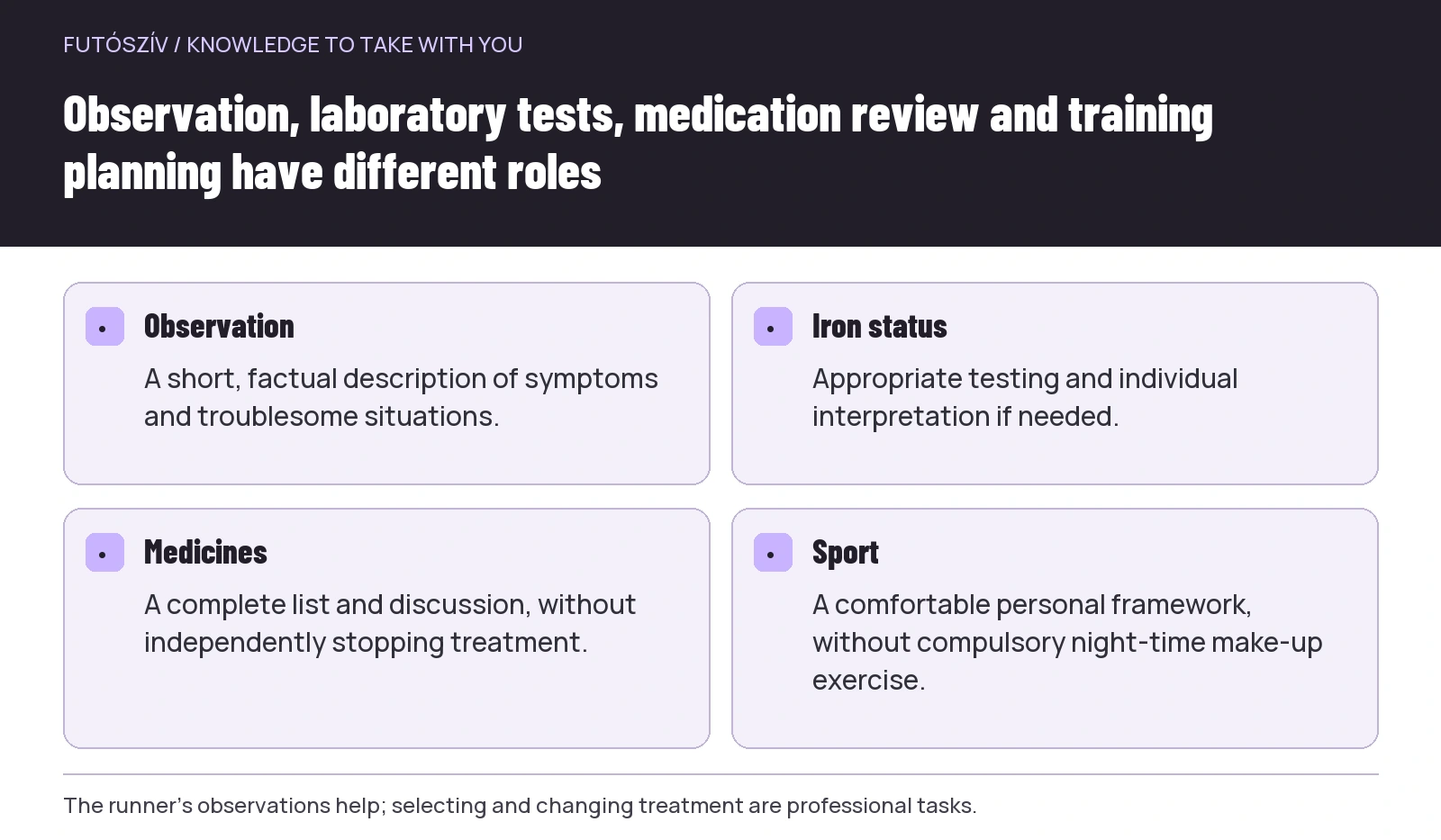 Enlarge diagram
Text version of the diagram
- Observation
- A short, factual description of symptoms and troublesome situations.
- Iron status
- Appropriate testing and individual interpretation if needed.
- Medicines
- A complete list and discussion, without independently stopping treatment.
- Sport
- A comfortable personal framework, without compulsory night-time make-up exercise.
Where can movement fit?
The NHS also mentions regular daytime activity among everyday options. This does not mean responding to symptoms with an even longer run or treating walking around at night as training to complete. Temporary relief with movement is not the same as resolving the condition.
If you run, observe personal connections: is resting different after a late, demanding session compared with a familiar easier one? That can provide experience to discuss, but do not turn one evening into a rule for every day. Other circumstances may have changed too.
Adapt sport to the daytime effects of poor sleep as well. If you are very sleepy, travel, technical routes or other attention-demanding tasks are not merely questions of motivation. You do not need to complete the plan at any cost or make up for missing it later with punitive exercise.
Simplifying the evening environment
The aim can be to avoid unnecessary organisational rushing around rest. Prepare the next day’s equipment beforehand, briefly write down important tasks and create an evening framework that feels calmer to you. This does not promise to treat RLS; it makes tasks surrounding sleep easier.
Review caffeine and alcohol alongside symptoms and the clinician’s advice. You do not need to try many dietary changes or supplements simultaneously. When everything changes, understanding each effect becomes harder and costs can increase unnecessarily.
General sleep-hygiene ideas do not remove the need for assessment. If the urge to move still regularly prevents sleep, a new mattress or even stricter evening routine may not be what is needed. Explain that symptoms persist.
Longer journeys and race weekends
Discomfort related to sitting makes it worth considering long travel in advance. What opportunities exist to stop or change position more comfortably, and how will usual care fit? Adapt the specific solution to the travel method and personal needs.
Do not try a new medicine or supplement the day before a race to guarantee sleep. If already receiving treatment, discuss travel questions in time. Ask accommodation about quieter conditions beforehand too, without sharing sensitive details publicly.
Prepare for travelling home as well. After a poor night, sleepiness and attention issues do not disappear when the race ends. If driving is unsafe, find another solution. Making the whole weekend work matters more than keeping a schedule at any cost.
How can a running partner help?
Do not call the symptoms whining or promise a certain solution from one product. Listen to what makes the evening or following day difficult and support seeking appropriate help. Someone else’s treatment is not a community vote.
Shared training can be arranged more flexibly if the person requests it. They do not need to report after every bad night or share their diagnosis with the entire group. A simple option to cancel or modify can mean a great deal.
A useful aim is a more restful, functional life and appropriate care. Running can have a place in that, but must not become a task through which someone has to prove they are trying hard enough to overcome symptoms.
Sources
- NINDS: symptom patterns and assessment.
- NHS: restless legs syndrome.
- AASM 2025: clinical practice guideline for restless legs syndrome and periodic limb movement disorder.
- Full text of the AASM guideline.
How Futószív articles are prepared: our editorial guidelines.